
Listen to this Post
Introduction:
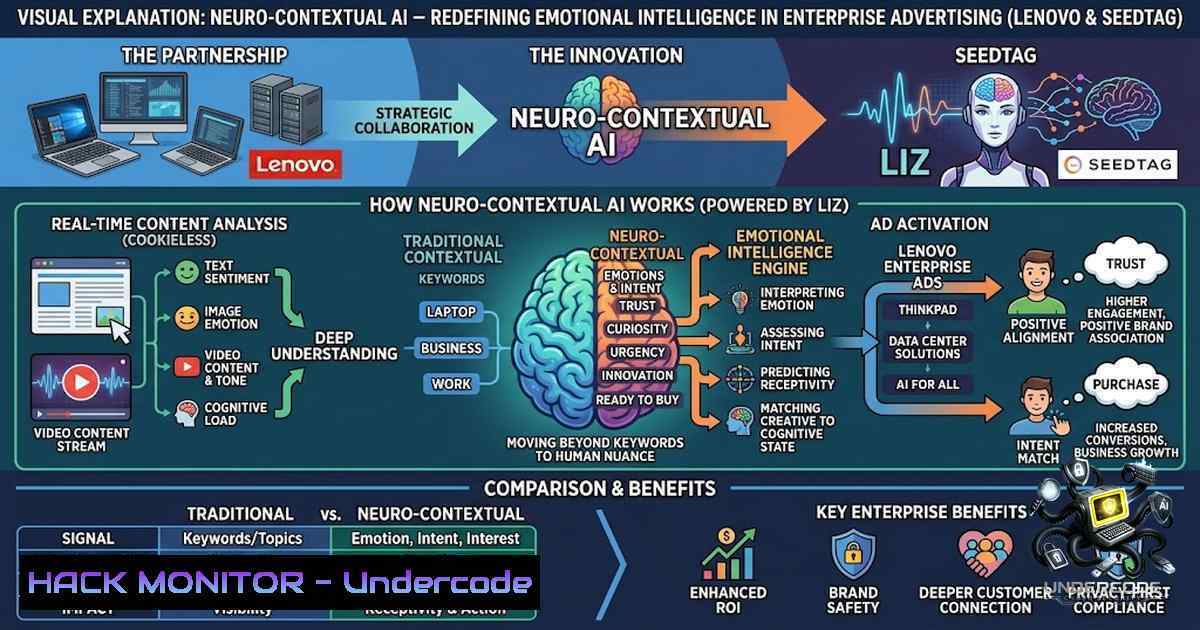
The intersection of neuroscience, artificial intelligence, and contextual advertising has given rise to a new paradigm: neuro-contextual targeting. Unlike traditional keyword-based or demographic approaches, neuro-contextual AI leverages real-time emotional state detection—analyzing interest, intent, and emotion through advanced pattern recognition. Lenovo’s recent FIFA World Cup 2026 campaign, powered by Seedtag’s proprietary Liz AI, achieved a 94% lift in brand awareness by aligning messaging with moments of Excitement, Desire, and Optimism. This case study demonstrates how privacy-first AI can decode human cognitive responses at scale, offering a blueprint for enterprises seeking to combine emotional intelligence with technical precision.
Learning Objectives & Secrets:
- Objective 1: Understand how neuro-contextual AI models (Liz) decode real-time interest, emotion, and intent using a suite of 30+ in-house AI models, moving beyond keywords to achieve “real human understanding”.
- Objective 2 Secret Tip: Leverage emotional alignment—not just content matching—to drive engagement. Seedtag’s neuroscience study showed that emotionally-matched ads drive 3.5x higher neural engagement than non-contextual ads.
- Objective 3 Secret Tip: Integrate multi-layered measurement frameworks (Brand Lift with Kantar + attention analysis with Lumen) to validate emotional targeting. Lenovo’s campaign used a 500-person sample of IT decision-makers and C-suite executives to correlate emotional states with brand metrics.
You Should Know:
1. Deconstructing Seedtag’s Neuro-Contextual AI Architecture
Seedtag’s Liz AI operates on a multi-agent system that combines neuroscience principles with agentic AI. Rather than relying on cookies or PII, Liz analyzes contextual signals—page content, viewing patterns, and semantic relationships—to detect emotional states as they happen. This is achieved through:
– 30+ proprietary AI models that decode interest, emotion, and intent in real time.
– Neuro-Contextual intelligence engine that processes content at scale, trained on over a decade of content understanding.
– Privacy-first architecture that never stores user emails, names, or identifiers.
Step‑by‑step guide to understanding the data flow:
- Content Ingestion: The system crawls and indexes web content, extracting semantic features and contextual signals.
- Emotion Mapping: AI models analyze text, images, and user interaction patterns to assign emotional scores (Excitement, Desire, Optimism, etc.).
- Intent Prediction: Real-time intent models differentiate between casual browsing and high-transactional readiness.
- Ad Allocation: The system matches advertiser messages to environments where the target emotion is detected, optimizing for engagement.
- Measurement: Post-campaign analysis uses Brand Lift studies and attention metrics (APM scores) to validate performance.
Linux command to simulate content analysis (using `curl` and `jq` to fetch and parse contextual data):
 Fetch a webpage and extract semantic features (conceptual example)
curl -s https://example.com/article | \
pup 'p text{}' | \
head -1 100 > content.txt

Simulate emotion scoring using a lightweight NLP model (requires python3)
python3 -c "
import json
from transformers import pipeline
classifier = pipeline('text-classification', model='distilbert-base-uncased-finetuned-sst-2-english')
with open('content.txt', 'r') as f:
text = f.read()
result = classifier(text[:512])
print(json.dumps(result, indent=2))
"
Windows PowerShell equivalent for API-based emotion detection:
 Invoke a hypothetical emotion detection API
$headers = @{ "Authorization" = "Bearer YOUR_API_KEY" }
$body = @{ "text" = (Get-Content -Path .\content.txt -Raw) } | ConvertTo-Json
Invoke-RestMethod -Uri "https://api.seedtag.com/v1/emotion" -Method Post -Headers $headers -Body $body -ContentType "application/json"
2. Privacy-First Advertising: Technical Implementation and Compliance
Neuro-contextual advertising is inherently privacy-first because it does not rely on personal data collection. Seedtag’s approach aligns with global privacy regulations (GDPR, CCPA) by:
– Processing only publicly available contextual signals.
– Avoiding cross-site tracking and fingerprinting.
– Using client-side embeddings so user queries never leave the device.
Step‑by‑step guide to implementing a privacy-first contextual ad SDK:
- Initialize the SDK with a publisher ID and model selection (e.g.,
openai/gpt-5.2). - Enable client-side embeddings to ensure queries are processed locally.
- Set privacy flags to disable any data collection (e.g.,
privacy: true). - Serve ads based on contextual analysis of the current page, without storing user identifiers.
Example JavaScript code for a privacy-first contextual ad SDK:
// NotPixel-style SDK initialization (privacy-first)
const ads = new Ads({
publisherId: "pub_10565",
model: "openai/gpt-5.2",
privacy: {
clientSideEmbeddings: true,
noPII: true
}
});

// Request an ad based on current page context
ads.getAd({
url: window.location.href,
content: document.body.innerText.slice(0, 1000)
}).then(ad => {
document.getElementById('ad-container').innerHTML = ad.html;
});
API security best practices for contextual ad exchanges:
- Use HMAC authentication for all API requests to prevent man-in-the-middle attacks.
- Implement rate limiting (e.g., 100 requests/minute per publisher) to mitigate abuse.
- Validate all incoming payloads against a strict JSON schema to prevent injection attacks.
3. Emotional Targeting Measurement: Kantar + Lumen Integration
Lenovo’s campaign employed a dual-measurement framework: Brand Lift (Kantar) and attention analysis (Lumen). The results were striking:
– Excitement: +94% Top of Mind Awareness, +27% Unaided Awareness, +74% Message Association.
– Desire: +8% Brand Favourability, +6% Brand Consideration (71% overall).
– Attention: APM score of 1,940″ vs. Lumen benchmark of 1,109″.
– Optimism: Unlocked 16 million incremental impressions.
Step‑by‑step guide to setting up a Brand Lift study:
- Define control and test groups (e.g., exposed vs. unexposed to the campaign).
- Deploy survey pixels to measure unaided and top-of-mind awareness.
- Collect responses from a statistically significant sample (e.g., 500 IT decision-makers).
- Calculate lift using the formula:
(Test Group Metric - Control Group Metric) / Control Group Metric 100. - Correlate with attention data (APM, view rate) to identify which emotional contexts drove the highest engagement.
Python script to analyze Brand Lift data:
import pandas as pd
import numpy as np

Load campaign data
df = pd.read_csv('campaign_data.csv')

Calculate lift for each emotional segment
for emotion in ['Excitement', 'Desire', 'Optimism']:
test_mean = df[df['emotion'] == emotion]['awareness'].mean()
control_mean = df[df['emotion'] == 'control']['awareness'].mean()
lift = (test_mean - control_mean) / control_mean  100
print(f"{emotion}: {lift:.1f}% lift")
Linux command to monitor real-time attention metrics (APM) using `tcpdump` and tshark:
 Capture network traffic to analyze ad impression timings
sudo tcpdump -i eth0 -w ad_traffic.pcap port 443

Extract APM-related metrics (conceptual example)
tshark -r ad_traffic.pcap -Y "http.request.uri contains '/impression'" -T fields -e frame.time -e ip.src
- Agentic AI for Media Planning: Liz Agent Technical Overview
Seedtag recently launched Liz Agent, an agentic AI platform that streamlines media planning and campaign activation through a conversational interface. Liz Agent integrates directly with Seedtag’s proprietary Neuro-Contextual data, optimizing variables like targeting, creativity, and approach.
Step‑by‑step guide to using Liz Agent for campaign optimization:
- Input campaign goals (e.g., “Increase brand awareness among IT decision-makers”).
- Liz Agent analyzes historical Neuro-Contextual data to identify high-performing emotional segments.
- Generate audience personas based on real-time interest, emotion, and intent signals.
- Recommend creative variations tailored to each emotional context.
- Automate bid adjustments based on predicted engagement scores.
Example API call to Liz Agent (conceptual):
curl -X POST https://api.seedtag.com/v1/liz-agent \
-H "Authorization: Bearer YOUR_API_KEY" \
-H "Content-Type: application/json" \
-d '{
"campaign_goal": "brand_awareness",
"target_audience": "IT_decision_makers",
"emotional_targets": ["Excitement", "Optimism"],
"budget": 500000,
"channels": ["display", "ctv"]
}'
5. Cloud Hardening for Neuro-Contextual AI Workloads
Deploying neuro-contextual AI at scale requires robust cloud infrastructure. Seedtag’s architecture likely includes:
– Auto-scaling Kubernetes clusters to handle real-time inference loads.
– Encrypted data pipelines (AES-256-GCM) to protect content during processing.
– Zero-trust network policies to segment AI models from external APIs.
Step‑by‑step guide to hardening a cloud-based AI inference pipeline:
- Enable VPC peering to keep internal traffic private.
- Deploy AI models in isolated namespaces with resource limits.
3. Use mTLS for all service-to-service communication.
- Implement WAF rules to filter malicious requests (e.g., SQL injection, XSS).
- Audit all API calls using centralized logging (e.g., ELK stack).
Kubernetes security manifest example:
apiVersion: networking.k8s.io/v1
kind: NetworkPolicy
metadata:
name: ai-model-isolation
spec:
podSelector:
matchLabels:
app: neuro-contextual-ai
policyTypes:
- Ingress
- Egress
ingress:
- from:
- podSelector:
matchLabels:
app: api-gateway
egress:
- to:
- namespaceSelector:
matchLabels:
name: kube-system
Linux command to monitor pod security:
kubectl exec -it pod/neuro-ai -- /bin/bash -c "apt-get update && apt-get install -y lynis && lynis audit system"
- Vulnerability Exploitation and Mitigation in Contextual AI Systems
Contextual AI systems face unique security threats, including data poisoning attacks on contextual bandits and cryptographic context injection. To mitigate:
– Validate training data for anomalies before model updates.
– Implement input sanitization to prevent prompt injection.
– Use differential privacy to limit the impact of poisoned samples.
Python code to detect data poisoning in contextual bandits:
import numpy as np
from scipy.stats import zscore

Simulated reward data
rewards = np.array([0.8, 0.9, 0.7, 0.1, 0.85, 0.95, 0.2, 0.88])

Detect outliers (potential poisoning)
z_scores = zscore(rewards)
threshold = 2.5
poisoned_indices = np.where(np.abs(z_scores) > threshold)[bash]
print(f"Potential poisoned samples at indices: {poisoned_indices}")
Linux command to scan for injection vulnerabilities in API endpoints:
 Use OWASP ZAP to scan a target API
zap-cli quick-scan --spider -r -t https://api.seedtag.com/v1/emotion
What Undercode Say:
- Key Takeaway 1: Neuro-contextual AI represents a fundamental shift from reactive to predictive advertising—decoding not just what people see, but how they feel about it. Lenovo’s 94% awareness lift proves that emotional alignment outperforms traditional contextual methods.
- Key Takeaway 2: Privacy-first is not a constraint but an enabler. By eliminating reliance on PII, neuro-contextual targeting sidesteps regulatory hurdles while delivering superior engagement.
Analysis: The Lenovo-Seedtag campaign validates the commercial viability of neuroscience-informed AI. However, the technology also raises ethical questions about emotional manipulation and the threshold at which profiling violates personal identity. As agentic AI platforms like Liz Agent become more autonomous, enterprises must implement governance frameworks to ensure emotional targeting remains transparent and consensual. The 16 million incremental impressions unlocked through Optimism suggest that positive emotional states are underutilized in B2B advertising—a finding with implications for IT and cybersecurity vendors targeting decision-makers.
Prediction:
- +1 Neuro-contextual AI will become the standard for enterprise advertising within 24 months, driven by privacy regulations and the demise of third-party cookies.
- +1 Agentic AI platforms like Liz Agent will automate 70% of media planning tasks, reducing campaign setup time from weeks to hours.
- -1 The commoditization of emotional data may lead to regulatory scrutiny, similar to GDPR for cookies, requiring new consent frameworks for emotional targeting.
- +1 Integration of neuro-contextual AI with CTV and programmatic exchanges (e.g., NeuroX) will unlock new inventory and measurement capabilities.
- -1 Adversarial attacks on contextual bandits could become a vector for brand sabotage, necessitating robust anomaly detection in AI pipelines.
▶️ Related Video (82% Match):
🎯Let’s Practice For Free:
🎓 Live Courses & Certifications:
Join Undercode Academy for Verified Certifications
🚀 Request a Custom Project:
Secure, high-velocity infrastructure and disruptive technological engineering. Contact our engineering team for high-tier development and proprietary systems:
[email protected]
💎 Smart Architecture | 🛡️ Secure by Design | ⭐ Trusted by Thousands
IT/Security Reporter URL:
Reported By: https://lnkd.in/p/eSkFrcsr – Hackers Feeds
Extra Hub: Undercode MoN
Basic Verification: Pass ✅


