
Listen to this Post
Introduction:
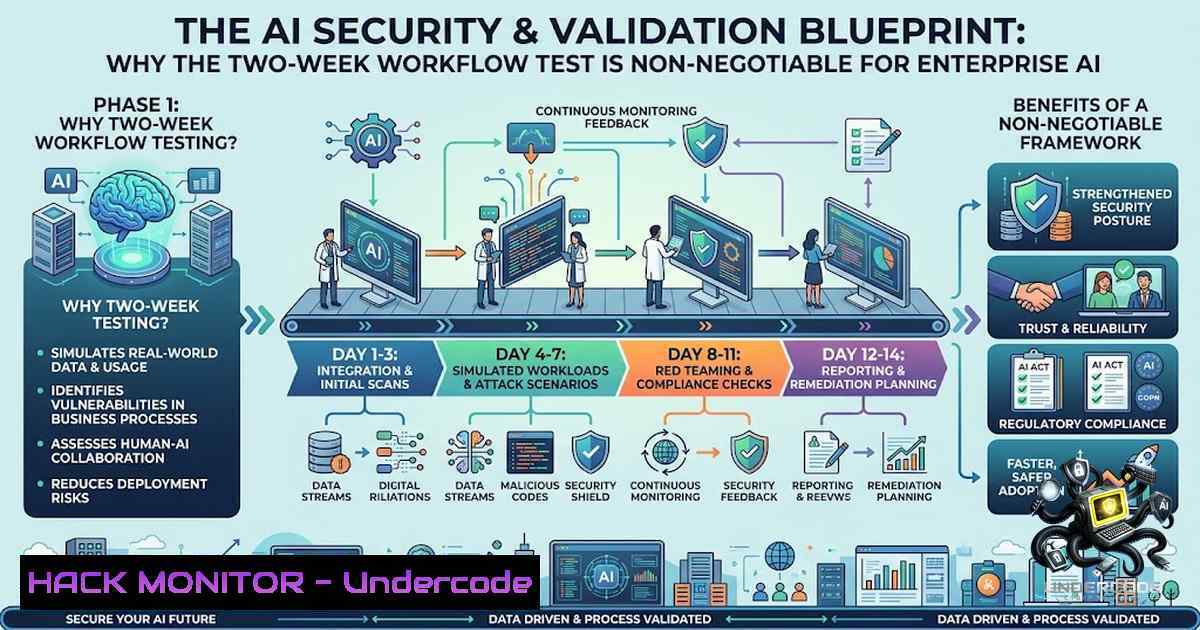
The rapid integration of Large Language Models (LLMs) and AI agents into enterprise workflows presents a critical security paradox: automation increases efficiency but exponentially amplifies the blast radius of a single failure. Priya Vrat Misra’s recent discourse on the “Two-Week Workflow Test” highlights a fundamental shift in MLOps and AI security—moving from a “move fast and break things” mentality to a “validate small and secure what scales” paradigm. This approach is not merely a project management tactic; it is a risk management framework designed to contain hallucinations, data leakage, and prompt injection vulnerabilities before they become systemic organizational threats.
Learning Objectives & Secrets:
- Objective 1: Establish a Human-in-the-Loop (HITL) Baseline – Learn to configure week-one validation protocols that treat AI output as “untrusted input” until verified against deterministic business logic.
- Objective 2 secret tips: Implement “Shadow Mode” Logging – Do not simply spot-check. Integrate real-time semantic drift detection to compare AI outputs against a golden dataset, automatically flagging deviations for manual review without disrupting the user experience.
- Objective 3 secret tips: Automate the “Kill Switch” Criteria – Define clear, code-based thresholds (e.g., accuracy drop > 15%) that trigger an automatic rollback to a legacy system, ensuring the pilot cannot inadvertently cause production downtime.
You Should Know:
1. Operationalizing the Two-Week Audit: Tooling and Monitoring
The core of the validation phase involves running the AI workflow in parallel with existing systems. To effectively execute this, you must instrument your AI pipeline to capture every input, output, and intermediate step. The goal is to create an immutable audit trail.
Step‑by‑Step Guide:
- Week 1 (Full Review): Route all AI-generated decisions to a queue. A human reviewer uses a web interface to approve or reject the output. The system must log the “Human Correction” value (the delta between the AI output and the final approved output).
- Week 2 (Spot-Check & Logging): Reduce manual review to 20% of traffic, but activate verbose logging for the remaining 80%. Use a vector database to store embeddings of all AI outputs for later semantic similarity analysis against accepted outputs.
- Command (Linux/Mac): Use `jq` to parse JSON logs from your AI inference API and extract latency and token usage for cost/performance analysis.
Extract token usage and response time from raw logs
cat ai_workflow.log | jq -r '.usage.total_tokens, .metrics.latency_ms' | paste -d ',' - - > token_latency.csv
- Command (Windows/PowerShell): Use `Select-String` and `ConvertFrom-Json` to filter logs for errors or specific user interactions during the pilot.
Find all errors in the validation log
Get-Content .\ai_pilot.log | Select-String "ERROR" | ForEach-Object { $_ -replace '^.?{', '{' | ConvertFrom-Json | Select-Object timestamp, error_code }
2. Hardening the Prompt Pipeline Against Injection
During the two-week pilot, security teams must actively test for prompt injection and data extraction attempts. The pilot environment must be firewalled from the production knowledge bases.
Step‑by‑Step Guide:
- Use a proxy or gateway (e.g., Cloudflare AI Gateway or a custom NGINX config) to intercept and sanitize inputs. Implement a “Deny List” for prompt phrases like “Ignore previous instructions” or “Exfiltrate data”.
- Deploy a Web Application Firewall (WAF) rule specifically for the AI endpoint to block SQLi and XSS attempts, as these can sometimes be used to break the LLM context window.
- Command (Linux): Use `iptables` to restrict access to the AI model’s serving port (e.g., 8000) to only the review team’s IPs during the pilot, preventing untrusted internal scans.
Allow only the review team's subnet
sudo iptables -A INPUT -p tcp --dport 8000 -s 192.168.10.0/24 -j ACCEPT
sudo iptables -A INPUT -p tcp --dport 8000 -j DROP
3. The “Golden Dataset” Strategy for Accuracy Benchmarking
Priya Vrat Misra emphasized “Track accuracy against your existing benchmark, not a vibe.” This requires a static, high-quality dataset of edge cases (e.g., 100-500 queries) that the AI must pass before scaling.
Step‑by‑Step Guide:
- Create a `golden.json` file with input prompts and the “Correct” output (as defined by subject matter experts).
- Write a Python script that runs the pilot AI on these prompts daily. Compare the output using ROUGE or BLEU scores, and log the drift.
- Code Snippet (Python):
import json
from nltk.translate.bleu_score import sentence_bleu</li>
</ul>

def validate_ai_output(golden_file, ai_endpoint):
with open(golden_file, 'r') as f:
data = json.load(f)
for entry in data:
response = call_ai_api(entry['input'])  Pseudo-function
score = sentence_bleu([entry['correct_output'].split()], response.split())
if score < 0.6:  Alert if BLEU score is low
send_alert(f"Workflow underperforming on: {entry['input']}")
4. Cloud and API Security Hardening
Since most AI workflows rely on external APIs (OpenAI, Anthropic, or private cloud endpoints), the two-week test is the ideal time to harden key management.
Step‑by‑Step Guide:
- Rotate API keys specifically for the pilot. Use a secrets management tool (e.g., HashiCorp Vault) to inject environment variables.
- Implement a “Scoped Key” policy: The pilot API key should only have access to the specific vector database collection or the specific fine-tuned model version, limiting blast radius if the key is compromised.
- Configure Network Policies in Kubernetes (if applicable) to restrict egress traffic from the AI pod to only the necessary DNS/IPs.
NetworkPolicy.yaml
apiVersion: networking.k8s.io/v1
kind: NetworkPolicy
metadata:
name: ai-egress-restrict
spec:
podSelector:
matchLabels:
app: ai-pilot
policyTypes:</li>
<li>Egress
egress:</li>
<li>to:</li>
<li>ipBlock:
cidr: 10.0.0.0/24  Internal DB
ports:</li>
<li>protocol: TCP
port: 443
5. Data Leakage Prevention (DLP) in Pilot Outputs
A common failure in pilots is the AI inadvertently reproducing Personally Identifiable Information (PII) from the training data. The review team must actively look for this.
Step‑by‑Step Guide:
- Integrate a DLP scanner (e.g., using the `presidio` library) into the logging pipeline to redact or alert on regex patterns like SSNs, Credit Card numbers, or emails.
- Command (Linux): Use `grep` to scan log files for common email patterns to ensure no internal employee emails are being hallucinated or leaked.
Scan AI output logs for potential emails
grep -E -o "\b[A-Za-z0-9._%+-]+@[A-Za-z0-9.-]+.[A-Z|a-z]{2,}\b" ai_outputs.log | sort | uniq -c | sort -1r
6. Rollback and Disaster Recovery Procedures
If the pilot fails the “kill” criteria at the end of week two, you must have a script to revert to the legacy system instantly without manual intervention.
Step‑by‑Step Guide:
- Write a CI/CD pipeline step (GitLab CI or GitHub Actions) that checks the accuracy threshold from the golden dataset. If the pass rate is below 80%, the pipeline halts deployment and sends a Slack alert.
- Ensure there is a feature flag controlling the AI workflow. If the flag is toggled to “OFF”, the application routes traffic to the deterministic algorithm (the old system).
- Script (Bash – Toggle Feature Flag):
!/bin/bash
If pilot fails, turn off feature flag
if [ "$ACCURACY_SCORE" -lt 80 ]; then
curl -X PATCH https://your-api-gateway.com/flags/ai_workflow \
-H "Authorization: Bearer $API_KEY" \
-d '{"enabled": false}'
echo "Rollback initiated. Traffic routed to legacy system."
fi
What Undercode Say:
- Key Takeaway 1: The “two-week test” is not a bureaucratic hurdle but a necessary stress test for AI systems. It forces security and data science teams to define what “correct” looks like and to enforce it programmatically.
- Key Takeaway 2: The human reviewer is the ultimate “security control.” Their corrections during week one should be used to fine-tune the reward model or to augment the prompt engineer’s instructions for week two.
- Analysis: Many organizations underestimate the cognitive load on reviewers. To succeed, implement “reviewer fatigue” metrics and ensure the validation workload is distributed. Furthermore, the pilot must actively test for “jailbreaks” that attempt to circumvent the workflow’s objective. This pilot is essentially a red-team-in-a-box; if the AI cannot handle the edge cases during a controlled rollout, it will undoubtedly fail in the chaos of production, leading to reputational damage and financial loss.
Prediction:
- -1: As AI agents are granted greater system autonomy, the lack of rigorous “Two-Week Pilots” will lead to a significant class-action lawsuit against an enterprise for negligent data handling due to an unvetted AI hallucination, forcing regulatory bodies to mandate third-party AI validation requirements.
- +1: Organizations that adopt this “Prove it Small” strategy will experience a 50% reduction in AI-related incident response costs over the next two years, as they will have built robust logging and rollback procedures that allow for faster patching and recovery.
- +1: The demand for “AI Validation Engineers” will skyrocket, transforming the role of the traditional QA team into a hybrid discipline that combines prompt engineering, cybersecurity, and software testing—a shift that will elevate the security posture of the entire software development lifecycle (SDLC).
▶️ Related Video (76% Match):
🎯Let’s Practice For Free:
🎓 Live Courses & Certifications:
Join Undercode Academy for Verified Certifications
🚀 Request a Custom Project:
Secure, high-velocity infrastructure and disruptive technological engineering. Contact our engineering team for high-tier development and proprietary systems:
[email protected]
💎 Smart Architecture | 🛡️ Secure by Design | ⭐ Trusted by ThousandsIT/Security Reporter URL:
Reported By: https://lnkd.in/p/ew-vXeBA – Hackers Feeds
Extra Hub: Undercode MoN
Basic Verification: Pass ✅🔐JOIN OUR CYBER WORLD [ CVE News • HackMonitor • UndercodeNews ]
📢 Follow UndercodeTesting & Stay Tuned:


