Listen to this Post
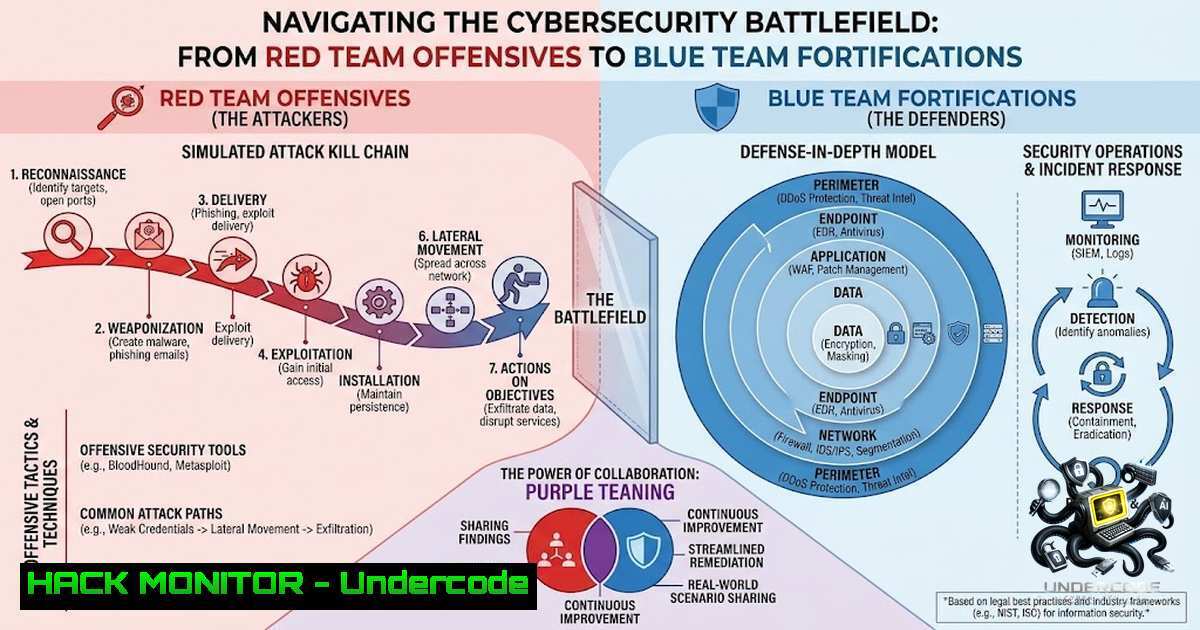
Introduction:
The modern cybersecurity landscape is a high-stakes arena where offensive and defensive forces continually clash. Understanding the distinct yet interdependent roles of Red Teams, Blue Teams, and Security Operations Centers (SOCs) is the first step for any aspiring professional. This article provides a comprehensive guide to the core disciplines of cybersecurity, offering practical insights, essential commands, and a step-by-step roadmap for building a robust career in this dynamic field.
Learning Objectives & Secrets:
- Objective 1: Master the Offensive (Red Team) Mindset. Learn to think like an attacker by understanding the tools, techniques, and procedures (TTPs) used in penetration testing and vulnerability exploitation.
- Objective 2 Secret Tip: Defensive (Blue Team) Fortification. Gain proficiency in defensive strategies, from SIEM monitoring to proactive threat hunting, to effectively protect organizational assets.
- Objective 3 Secret Tip: The Power of Certification. Discover how certifications like CompTIA Security+, BTL1, and CISSP can validate your skills and accelerate your career progression.
You Should Know:
1. Red Team: Simulating the Adversary
Red Teams are the ethical hackers of the cybersecurity world. Their primary mission is to simulate real-world attacks to identify security gaps before malicious actors can exploit them. This involves a structured methodology that includes reconnaissance, vulnerability scanning, exploitation, and post-exploitation activities.
Step-by-Step Guide to a Basic Red Team Reconnaissance:
- Reconnaissance: Gather information about the target. This can be passive (OSINT) or active.
– Command (Linux): `theHarvester -d example.com -l 500 -b google` – This command uses theHarvester to gather emails and subdomains associated with a domain.
2. Scanning: Identify live hosts and open ports.
- Command (Linux): `nmap -sV -p- 192.168.1.1` – Performs a version scan on all ports of a target IP.
- Enumeration: Dig deeper into services found. For example, enumerating SMB shares.
– Command (Linux): `enum4linux -a 192.168.1.10` – Enumerates Windows and Samba systems.
4. Exploitation: Attempt to gain access using a known vulnerability.
– Command (Linux): `msfconsole` – Launches the Metasploit Framework, a powerful tool for developing and executing exploit code.
5. Post-Exploitation: Once access is gained, the goal is to maintain persistence and extract valuable data. Tools like Mimikatz are used for credential dumping.
– Command (Windows – Admin): `mimikatz.exe “privilege::debug” “sekurlsa::logonpasswords”` – This attempts to extract plaintext passwords and hashes from memory.
2. Blue Team & SOC: The Defenders’ Arsenal
The Blue Team is responsible for defending an organization’s digital assets. This is often centralized within a Security Operations Center (SOC), where analysts monitor, detect, and respond to threats.
Step-by-Step Guide to SOC Alert Triage:
- Monitor SIEM: A Security Information and Event Management (SIEM) tool aggregates logs from across the network.
– Example (SIEM Query – Splunk): `index=main sourcetype=WinEventLog:Security EventCode=4625` – This searches for failed login attempts.
2. Triage the Alert: Analyze the alert to determine if it’s a true positive, a false positive, or requires deeper investigation.
3. Investigate: If suspicious, correlate the alert with other data sources like EDR (Endpoint Detection and Response).
– Command (Windows – EDR): `Get-MpThreatDetection` – In Microsoft Defender, this command lists detected threats.
4. Escalate: If a confirmed incident is found, escalate it to the Incident Response (IR) team.
5. Tune Rules: To reduce alert fatigue, refine SIEM rules to suppress noisy but harmless alerts.
3. Incident Response: The Cybersecurity “SWAT Team”
When a breach is confirmed, the Incident Responders are called in. Their goal is to contain the threat, eradicate it, and recover systems.
Step-by-Step Guide to Incident Containment:
- Detection & Analysis: Identify and isolate affected systems. Preserve evidence immediately; do not power down systems as it may destroy volatile memory evidence.
2. Short-Term Containment: Stop the bleeding.
- Command (Linux): `sudo iptables -A INPUT -s 10.0.0.5 -j DROP` – Blocks all traffic from a suspected malicious IP.
- Command (Windows – PowerShell): `New-1etFirewallRule -DisplayName “Block_IP” -Direction Inbound -RemoteAddress 10.0.0.5 -Action Block` – Creates a firewall rule to block an IP.
- Forensic Analysis: Create a forensic backup (bit-by-bit copy) of the affected systems for analysis.
– Command (Linux): `sudo dd if=/dev/sda of=/mnt/evidence/disk_image.dd bs=4096` – Creates a disk image for forensic analysis.
4. Eradication & Recovery: Remove the threat from the environment and restore systems from a clean backup.
5. Post-Incident Review: Analyze the incident to improve future defenses.
4. Threat Hunting: Proactive Pursuit
Threat Hunters proactively search for advanced threats that evade automated security tools. They use a combination of data analysis and hypothesis-driven investigation.
Step-by-Step Guide to a Basic Threat Hunt:
- Form a Hypothesis: Start with a question. “Are there any signs of lateral movement using PsExec in my environment?”
- Gather Data: Query your EDR or SIEM for relevant telemetry.
– KQL Query (Microsoft Sentinel/Defender): `DeviceProcessEvents | where FileName == “psexec.exe”` – This searches for instances of PsExec execution.
3. Analyze Results: Look for anomalies. Is PsExec being run from an unauthorized or unusual system?
4. Investigate & Respond: If a threat is found, escalate it to the Incident Response team.
5. Building Your Cybersecurity Career Path
The field offers diverse paths, from offensive security to defensive operations. Certifications are key to validating your skills and advancing your career.
- Entry-Level (Blue Team): CompTIA Security+ is a great starting point for SOC Analysts.
- Intermediate (Blue Team): BTL1 (Security Blue Team Level 1) offers a hands-on approach to defensive analysis, covering SIEM, threat hunting, and incident response.
- Advanced (Leadership): CISSP is a gold-standard certification for experienced professionals moving into architecture and leadership roles.
What Undercode Say:
- Key Takeaway 1: Cybersecurity is not monolithic. It is a multifaceted field with specialized roles, from the offensive tactics of the Red Team to the defensive vigilance of the Blue Team and SOC.
- Key Takeaway 2: Practical, hands-on skills are paramount. While certifications open doors, the ability to use tools like Nmap, Mimikatz, and SIEM platforms is what defines a true professional.
The journey into cybersecurity is a continuous learning process. Understanding these core concepts and mastering the associated tools is the foundation for a successful and impactful career. The landscape is constantly evolving, and those who adapt and learn will be the ones who protect our digital future.
Prediction:
- +1 The demand for skilled SOC Analysts and Incident Responders will continue to outpace supply, creating significant job security and high earning potential for qualified professionals.
- -1 The increasing sophistication of AI-driven attacks will place immense pressure on defensive teams, requiring them to continuously upskill and adopt AI-powered defensive tools to keep pace.
- +1 The convergence of Red and Blue Team skills (Purple Teaming) will become a highly sought-after competency, as organizations look for professionals who can both attack and defend.
- -1 The cybersecurity skills gap will persist, leaving many organizations vulnerable to attacks due to a lack of qualified personnel to fill critical roles.
- +1 Practical, performance-based certifications like BTL1 will gain more prestige over traditional multiple-choice exams, as they better demonstrate real-world capabilities.
- -1 The rapid adoption of cloud and hybrid environments will introduce new, complex attack surfaces, requiring defenders to master new tools and techniques for cloud security.
▶️ Related Video (84% Match):
🎯Let’s Practice For Free:
🎓 Live Courses & Certifications:
Join Undercode Academy for Verified Certifications
🚀 Request a Custom Project:
Secure, high-velocity infrastructure and disruptive technological engineering. Contact our engineering team for high-tier development and proprietary systems:
[email protected]
💎 Smart Architecture | 🛡️ Secure by Design | ⭐ Trusted by Thousands
IT/Security Reporter URL:
Reported By: https://lnkd.in/p/eixifG_w – Hackers Feeds
Extra Hub: Undercode MoN
Basic Verification: Pass ✅


