Listen to this Post
Introduction:
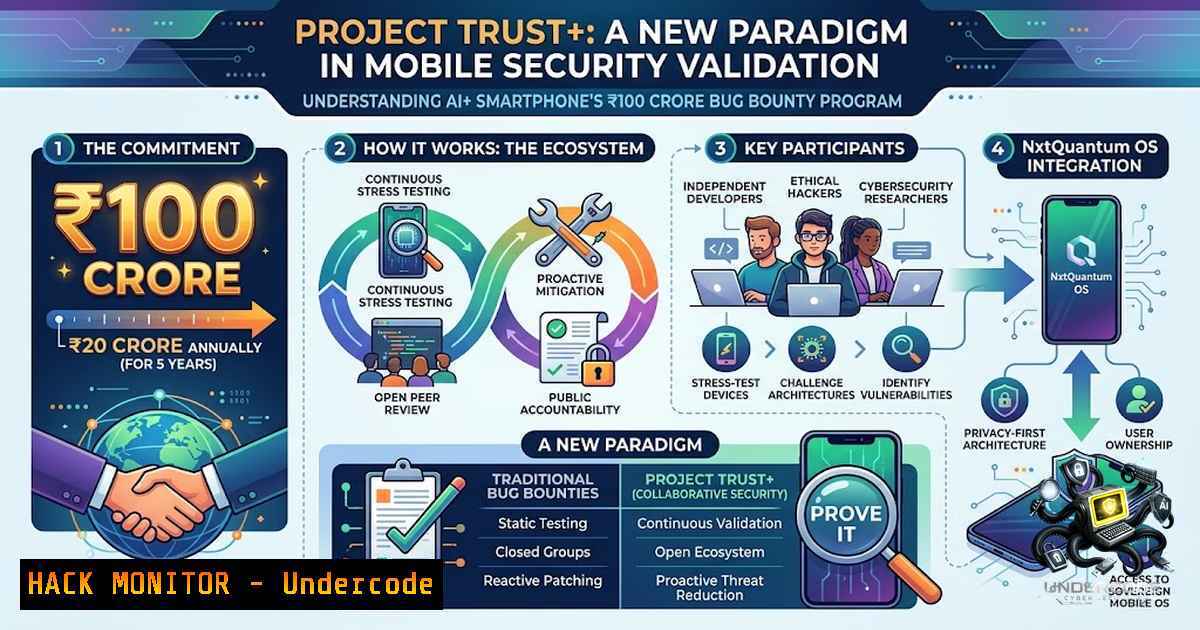
In an unprecedented move for the consumer electronics sector, Indian smartphone manufacturer Ai+ has announced a staggering ₹100 crore ($12 million USD) bug bounty program, signaling a major shift in how device manufacturers approach security. This initiative, named “Project Trust+,” represents a five-year commitment that elevates the traditional one-off vulnerability disclosure policy into a continuous, collaborative security research partnership. The program arrives at a critical juncture where mobile operating systems are increasingly targeted by sophisticated zero-day exploits and state-sponsored actors, making the need for proactive, incentivized security research more pressing than ever.
Learning Objectives & Secrets:
- Objective 1: Master Mobile Vulnerability Discovery. Learn to identify and report critical vulnerabilities in Android-based operating systems, including kernel-level exploits, privilege escalation bugs, and memory corruption flaws.
- Secret Tip 2: Optimize Fuzzing Frameworks. Deploy advanced fuzzing techniques to uncover zero-day vulnerabilities by focusing on proprietary system components unique to Ai+ devices.
- Secret Tip 3: Build Effective Proof-of-Concept (PoC) Exploits. Structure your vulnerability reports with working PoC code to maximize bounty payouts and facilitate rapid patching by the engineering team.
You Should Know:
1. Reconnaissance and Device Preparation for Bounty Hunting
A successful bug bounty campaign begins long before the first exploit is written. The first step for independent security researchers targeting Ai+ devices is establishing a controlled testing environment to avoid legal repercussions and ensure reproducible results. This involves setting up a dedicated device (smartphone/tablet) or using an emulator with the stock Ai+ operating system image (when available). To comply with the program’s rules, researchers must begin by navigating to Ai+’s official security page and completing their “Project Trust+” registration to receive a legitimate authorization token that validates their testing activities. This process white-lists your IP and device IDs, ensuring that your subsequent network traffic is recognized as authorized penetration testing.
 Android Debug Bridge (ADB) Commands for Initial Enumeration

<ol>
<li>List connected devices
adb devices</p></li>
<li><p>Install a custom CA certificate for MiTM attacks during testing
adb root
adb remount
adb push custom_ca.crt /system/etc/security/cacerts/
adb shell chmod 644 /system/etc/security/cacerts/custom_ca.crt</p></li>
<li><p>Check SELinux status (important for exploitation attempts)
adb shell getenforce</p></li>
<li><p>Pull kernel configuration for vulnerability analysis
adb shell zcat /proc/config.gz > kernel_config.txt
- Fuzzing the Ai+ User Interface and Input Validation
One of the primary attack surfaces in modern smartphones is the user interface, specifically the input parsing logic used by system applications. A crucial method to uncover vulnerabilities involves sending malformed data to system intents, such as file paths, serialized objects, or URL schemes. By fuzzing these inputs, researchers can identify crashes that may lead to remote code execution (RCE) or denial of service (DoS). For instance, using the Android tool “IntentFuzz,” testers can dynamically generate and send intents to broadcast receivers, observing the system’s logging output for segmentation faults. This technique is particularly effective against Ai+’s custom “NxtQuantum” UI layer, which processes complex intent data structures unique to the brand.
 Python Script Example for Intent Fuzzing using ADB
import subprocess
import random
import string

def random_string(length=100):
return ''.join(random.choices(string.ascii_letters + string.digits + string.punctuation, k=length))

base_intent = "am broadcast -a android.intent.action.VIEW -d "
while True:
malformed_data = random_string(5000)  Excessively long payload
command = base_intent + "'http://" + malformed_data + ".com'"
try:
subprocess.check_output(["adb", "shell", command], stderr=subprocess.STDOUT, timeout=2)
except subprocess.CalledProcessError as e:
print(f"Potential Crash Detected: {e.output}")
 Log the crash for further investigation
- Exploiting Insecure APIs in the Ai+ Cloud Infrastructure
The scope of “Project Trust+” likely extends beyond the physical device to include the cloud services powering the Ai+ ecosystem, such as over-the-air (OTA) updates, user account management, and backup services. Many modern vulnerabilities arise from insecure direct object references (IDOR) or broken access control in cloud APIs. To test this, researchers should utilize traffic interception tools like Burp Suite or OWASP ZAP to analyze the data exchange between the smartphone and its backend servers. A practical test involves creating two user accounts, capturing the authentication tokens, and attempting to access resources belonging to Account A using Account B’s token. If successful, this indicates a severe horizontal privilege escalation flaw that could compromise user data globally.
 Linux/Windows Commands for API Interception and Token Testing

<ol>
<li>Using curl to test an API endpoint for IDOR (Linux/WSL)
curl -X GET "https://api.aiplus.com/v1/user/profile" \
-H "Authorization: Bearer eyJhbGciOiJIUzI1NiIs..." \
-H "Content-Type: application/json"</p></li>
<li><p>Modifying user_id in the request to target another user (Check for IDOR)
curl -X GET "https://api.aiplus.com/v1/user/profile?user_id=123456" \
-H "Authorization: Bearer eyJhbGciOiJIUzI1NiIs..." \
-H "Content-Type: application/json"</p></li>
<li><p>Windows Equivalent (using PowerShell)
Invoke-RestMethod -Uri "https://api.aiplus.com/v1/user/profile" -Headers @{Authorization="Bearer eyJhbGciOiJIUzI1NiIs..."}
4. Cloud and Server-Side Request Forgery (SSRF) Exploitation
Ai+’s aggressive expansion and revenue targets (aiming for over ₹7,500 crore) imply rapid cloud infrastructure scaling, which often introduces misconfigurations. A dangerous class of vulnerabilities involves Server-Side Request Forgery (SSRF), where an attacker can coerce the server to make requests to internal services. For a bounty hunter, this might involve finding an endpoint in the Ai+ app that fetches an external image, and then manipulating that URL to point to internal metadata endpoints (like AWS IMDS or GCP metadata). A successful exploitation can lead to the exposure of sensitive cloud access keys.
 Nmap for internal network discovery if SSRF is suspected
nmap -sV -p 80,443,8080 10.0.0.0/24

Burp Suite Intruder payloads for SSRF testing:
 http://169.254.169.254/latest/meta-data/
 http://metadata.google.internal/computeMetadata/v1/
 file:///etc/passwd (Protocol handler check)
5. Securing the Build Process and Binary Hardening
From the defender’s perspective, Ai+ must implement rigorous secure coding practices to reduce the attack surface. This involves using compiler-level protections during the OS build. For the security researcher analyzing the firmware, identifying whether these protections are enabled is crucial. If the stack canary or NX (No-Execute) bits are disabled, buffer overflow exploits become significantly more viable. Additionally, analyzing the bootloader for vulnerabilities is critical; an unlocked bootloader vulnerability can allow persistent malware to be installed, bypassing all operating-level security controls.
 Linux Commands to Analyze Binary Hardening

Check compiled binary for security features
checksec --file /system/bin/system_server

Output example:
 RELRO STACK CANARY NX PIE RPATH RUNPATH
 Partial RELRO Canary found NX enabled PIE enabled No RPATH No RUNPATH

Analyzing kernel security settings from the device
adb shell cat /proc/sys/kernel/randomize_va_space
 0 = No ASLR, 1 = Partial ASLR, 2 = Full ASLR (Recommended)
6. Mitigation and Patch Verification Strategies
Beyond just finding vulnerabilities, “Project Trust+” emphasizes ongoing collaboration. Therefore, after a vulnerability is reported and patched, researchers must verify the patch’s effectiveness. This involves downloading the latest OTA update and re-running the exploit code to ensure it no longer works. For system-level patches, this might require downgrading the device to reproduce the issue and then upgrading to test the fix. This cycle of “find, fix, and verify” is the cornerstone of a mature secure development lifecycle (SDLC). It also validates the ₹20 crore annual investment by ensuring that the engineering team isn’t just shipping code but is effectively hardening the platform against regression bugs.
 ADB Command to check build fingerprint (Updated after patch)
adb shell getprop ro.build.fingerprint

Command to verify OTA update status
adb shell getprop ro.build.version.security_patch

If patched, the vulnerability should be unreachable.
 Example: Attempting the older IntentFuzz crash should now return an error or be handled gracefully.
What Undercode Say:
- Key Takeaway 1: Ai+ is leveraging “Project Trust+” as a trust-building mechanism to differentiate itself in a crowded and competitive Indian smartphone market dominated by global giants.
- Key Takeaway 2: The five-year, ₹100 crore budget ensures the program’s sustainability, creating a reliable revenue stream for full-time security researchers and significantly boosting India’s cybersecurity talent ecosystem.
Analysis:
The ambition shown by Ai+ in committing ₹100 crore to a bug bounty program demonstrates a sophisticated understanding of modern cybersecurity threats. Unlike typical “one-off” bug bounties that often attract casual researchers, a five-year initiative will likely attract seasoned professionals capable of uncovering complex, chained exploits. The CEO’s statement that security is “not a finished destination” echoes a proactive DevSecOps philosophy, shifting liability from the consumer to the manufacturer. For India, this move is strategically vital; it not only challenges the perception that secure devices originate from Silicon Valley or China but also establishes India as a hub for high-value security research, potentially retaining talent that often migrates abroad. Furthermore, pairing financial resources with open collaboration reduces the likelihood of vulnerabilities being discovered and sold on the gray market, ultimately protecting the end-user’s data.
Prediction:
- +1: Ai+ will likely see a surge in consumer confidence and brand loyalty, directly translating into market share growth, given that privacy and security are now major purchasing factors for tech-savvy consumers.
- +1: The program will accelerate the development of an indigenous cybersecurity talent pool in India, leading to a booming sector of specialized mobile security consultancies and “white-hat” teams.
- -1: The first year of “Project Trust+” may expose a high volume of critical vulnerabilities, potentially leading to reputational damage if the initial patch turn-around times are not exceptionally fast.
- -1: If the program fails to attract top-tier international talent due to complex legal or payment processing hurdles, the quality of research may not match the scale of the investment, lowering the return on investment.
- +1: Successful implementation will force competitors—both Indian and international—to increase their own bounty payouts, raising the industry standard for security transparency globally.
- -1: Misconfiguration in the bounty platform or handling of disclosure agreements could lead to legal friction between the researchers and Ai+, stifling the collaborative spirit.
- +1: Long-term, the initiative will likely lead to the open-sourcing of security tools and fuzzers specifically designed for Ai+ devices, contributing to the broader security community.
- +1: The project sets a precedent for “Make in India” that goes beyond manufacturing, proving that Indian brands can lead in high-stakes technological domains like digital security.
- -1: The aggressive revenue target of ₹7,500 crore might prioritize feature development over security hardening during the initial phase, creating a backlog of technical debt.
- +1: Regulatory bodies in India may use this as a benchmark to mandate structured bug bounty programs for all consumer IoT and smartphone manufacturers, improving national cyber hygiene.
▶️ Related Video (76% Match):
🎯Let’s Practice For Free:
🎓 Live Courses & Certifications:
Join Undercode Academy for Verified Certifications
🚀 Request a Custom Project:
Secure, high-velocity infrastructure and disruptive technological engineering. Contact our engineering team for high-tier development and proprietary systems:
[email protected]
💎 Smart Architecture | 🛡️ Secure by Design | ⭐ Trusted by Thousands
IT/Security Reporter URL:
Reported By: https://lnkd.in/p/eu4wBzPq – Hackers Feeds
Extra Hub: Undercode MoN
Basic Verification: Pass ✅


