Listen to this Post
Introduction:
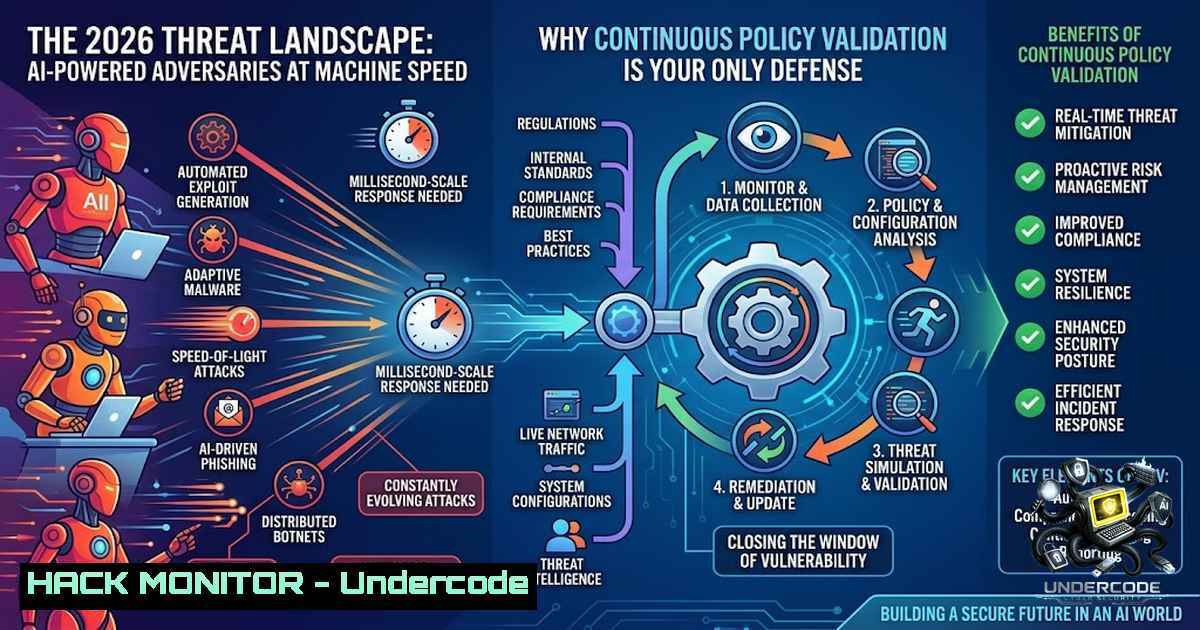
Artificial intelligence has fundamentally rewritten the rules of cyber warfare. What was once a force multiplier for attackers has now crossed into autonomous operation—AI no longer merely assists; it executes live intrusions, builds deployment-ready malware, and compresses attack timelines from days to hours. According to CrowdStrike’s 2026 Threat Hunting Report, 88% of vulnerabilities with public proof-of-concept exploit code are now exploited within 48 hours, with some threat groups launching attacks within just 24 hours of disclosure. In this environment, traditional perimeter-based security and periodic compliance audits are obsolete. The only viable defense is a strategy built on continuous policy validation, Zero Trust architecture, and network security automation—precisely the triad that FireMon’s latest integrations with Illumio, VMware NSX, and Zscaler are designed to deliver.
Learning Objectives:
- Understand how AI is transforming both offensive and defensive cyber operations in 2026, including the compression of attack windows and the rise of autonomous attack tooling.
- Master the implementation of continuous policy validation across hybrid environments, integrating firewall, cloud, and microsegmentation policies into a unified governance model.
- Learn to operationalize Zero Trust at enterprise scale through automated policy management, real-time visibility, and compliance assurance across multi-vendor infrastructure.
You Should Know:
- The AI Attack Surface: Understanding the New Threat Paradigm
The 2026 threat landscape is defined by what Check Point Research calls AI’s transition “from assistant to operator”. Attackers are now using large language models to discover zero-day vulnerabilities, with one documented case involving AI-assisted collaboration to identify a flaw in a content collaboration platform. More alarming, AI is now building deployment-ready malware and attack suites—one developer used an AI environment to produce VoidLink, an 88,000-line command-and-control framework, in under a week.
The attack surface has expanded dramatically. CrowdStrike documented a 171% increase in cloud-focused eCrime activity, including credential theft, cryptomining, and attacks on enterprise LLMs. Attackers are targeting AI infrastructure directly, with one incident seeing privilege escalation within a cloud provider’s foundation model service followed by nearly 200,000 API requests to AI models in just two minutes. Meanwhile, indirect prompt injection detections have risen roughly fivefold between March and May 2026, approaching 1% of all observed prompts.
For defenders, the message is clear: maintaining the status quo is not enough. Security teams must move at the same pace as their adversaries or risk falling further behind. This means adopting AI-powered defense strategies that can process telemetry, automate policy decisions, and dynamically adjust security postures in real time.
- Continuous Policy Validation: The Cornerstone of Modern Defense
Traditional security approaches rely on periodic audits and manual policy reviews—a model that simply cannot keep pace with machine-speed adversaries. Continuous policy validation addresses this gap by automatically verifying that security configurations align with internal policies and industry frameworks such as NIST, PCI DSS, and CIS at all times.
FireMon’s approach to continuous validation operates across multiple enforcement layers. By normalizing, analyzing, and continuously validating segmentation intent across network, virtual, and host enforcement points, the platform helps security teams operationalize Zero Trust at enterprise scale. This means that every policy change, every configuration update, and every access request is validated against the organization’s security intent in real time, not just during quarterly audits.
The practical impact is substantial. Organizations using FireMon report up to a 90% reduction in compliance reporting time through consolidated policy data and faster validation and change reviews. Automated rule recertification and audit-ready reporting eliminate the manual effort that traditionally consumes security teams’ time. Perhaps most critically, continuous validation detects policy drift and divergence before they can be exploited—a capability that is essential when attackers are exploiting vulnerabilities within hours of disclosure.
Step-by-Step Guide: Implementing Continuous Policy Validation
- Inventory All Security Enforcement Points: Begin by identifying every firewall, cloud security group, SDN policy, and microsegmentation control across your hybrid environment. FireMon’s unified topology ingests and normalizes policies from Cisco, Palo Alto, AWS, Azure, Illumio, VMware NSX, and Zscaler.
-
Define Security Intent: Establish your organization’s security policies and compliance frameworks as a single “policy playbook.” This includes defining segmentation intent, access controls, and least-privilege rules.
-
Automate Policy Validation: Deploy automation tools to continuously validate firewall rules and access controls against your defined intent. FireMon’s integration with Illumio, for example, models Virtual Enforcement Nodes (VENs), policies, and telemetry inside a centralized view, allowing teams to detect inconsistencies between endpoint and network policy enforcement.
-
Implement Real-Time Compliance Monitoring: Configure automated alerts, remediation, and change validation to maintain continuous compliance across on-premises firewalls, routers, switches, SASE, and cloud networks.
-
Generate Audit-Ready Reports: Leverage automated reporting to eliminate manual audit preparation. FireMon’s compliance dashboards and rule recertification workflows provide a single source of truth for auditors.
Linux Command Example: Auditing Firewall Rules for Compliance
 Extract and analyze iptables rules for compliance checking
iptables -L -1 -v | grep -E "ACCEPT|DROP|REJECT" | awk '{print $1, $2, $3, $4, $5, $6, $7, $8, $9, $10, $11, $12, $13}' > /var/log/firewall_audit_$(date +%Y%m%d).log

Check for overly permissive rules (0.0.0.0/0)
grep "0.0.0.0/0" /var/log/firewall_audit_.log | wc -l

Validate that specific high-risk ports are blocked
for port in 22 3389 445 1433 3306; do
iptables -L -1 | grep "dpt:$port" || echo "WARNING: Port $port may be open"
done
Windows PowerShell Example: Auditing Windows Firewall Rules
 Export all firewall rules for analysis
New-1etFirewallRule -DisplayName "Audit_Export" | Export-Csv -Path "C:\FirewallAudit\all_rules_$(Get-Date -Format 'yyyyMMdd').csv"

Find overly permissive inbound rules
Get-1etFirewallRule -Direction Inbound -Action Allow | Where-Object {$_.RemoteAddress -eq "Any"} | Select-Object DisplayName, RemoteAddress, LocalPort

Generate compliance report against NIST guidelines
Get-1etFirewallRule | Group-Object -Property Direction, Action | Format-Table -AutoSize
3. Zero Trust Microsegmentation: Operationalizing Least Privilege
Zero Trust has moved from concept to mainstream adoption, but many organizations still struggle to operationalize segmentation due to siloed policies and governance blind spots. According to FireMon Insights, 60% of enterprise firewalls fail high-severity compliance checks on first evaluation, with 34% failing at critical levels. These failures point to process and ownership issues, not just isolated misconfigurations.
Microsegmentation addresses this challenge by enforcing least-privilege access at the workload level, stopping lateral movement and containing breaches. FireMon’s expanded support for Zero Trust microsegmentation—including deeper integration with Illumio and continued coverage for VMware NSX and Zscaler—enables organizations to unify segmentation and firewall governance under one model.
The integration works by bringing Illumio’s host-based segmentation data into FireMon’s real-time compliance, risk, and recertification workflows. This provides unified visibility across network, endpoint, and container-based segmentation, delivering unprecedented insight into access and policy enforcement. Security teams can simulate network and endpoint paths to validate connectivity, detect lateral movement, and identify risk—all from a single dashboard.
Step-by-Step Guide: Deploying Zero Trust Microsegmentation
- Classify Assets and Workloads: Identify all workloads, applications, and data flows across your hybrid environment. Label resources by Role, Application, Environment, and Location—the same labels that Illumio uses for its segmentation policies.
-
Define Segmentation Policies: Create microsegmentation policies that enforce least-privilege access between workloads. Start with high-value assets and gradually expand coverage.
-
Integrate with Existing Firewall Policies: Use FireMon to unify Illumio label-based policies with traditional firewall rules, detecting and resolving conflicts automatically.
-
Validate Segmentation Intent: Continuously validate that segmentation policies remain consistent across all enforcement points. FireMon’s integration detects mismatched or overly permissive policies across both enforcement layers.
-
Monitor and Optimize: Leverage hit-count telemetry to inform policy cleanup and optimization, eliminating unnecessary rules and reducing the attack surface.
-
Network Security Automation: Scaling Defense at Machine Speed
With attackers leveraging AI to automate tasks previously performed manually—including generating scripts, payloads, and commands during cyberattacks—defenders must similarly automate their security operations. Network security automation is no longer optional; it is essential for keeping pace with machine-speed adversaries.
FireMon’s Network Security Policy Management (NSPM) capabilities provide the automation layer that organizations need. By unifying policy governance across firewalls, cloud controls, and microsegmentation platforms, FireMon enables automated policy management, real-time network visibility, and continuous compliance monitoring across multi-vendor environments. This automation eliminates manual review and cleanup, cuts operational costs, and keeps firewalls lean, efficient, and responsive—even at enterprise scale.
The practical benefits are measurable. A major U.S. federal agency using FireMon reduced manual effort for compliance and change management by 60% while managing over 500 devices across Cisco, Palo Alto, AWS, and Azure environments. Compliance reporting that once took days now completes in minutes. Automated change workflows and audit documentation ensure that every policy change is validated against security intent before deployment.
Step-by-Step Guide: Automating Network Security Operations
- Centralize Policy Management: Deploy a centralized platform that integrates policy planning, risk analysis, and asset management across your entire hybrid network.
-
Automate Change Workflows: Implement automated change validation that enforces intent and compliance at every step. Non-compliant changes should be automatically denied.
-
Enable Real-Time Visibility: Ensure 100% real-time visibility into all security policies and network assets across cloud and on-prem environments.
-
Deploy Automated Remediation: Configure automated alerts and remediation actions for policy violations, reducing mean time to resolution.
-
Generate Continuous Compliance Reports: Leverage automated reporting to eliminate manual audit preparation and maintain continuous compliance posture.
-
The Integration Advantage: Unifying Security Across Hybrid Environments
The complexity of modern hybrid environments—spanning on-premises data centers, multiple cloud providers, and countless enforcement points—creates security gaps that attackers are eager to exploit. FireMon’s integration ecosystem addresses this challenge by unifying disparate security controls into a cohesive governance framework.
The FireMon and Illumio integration is particularly significant. By combining network and endpoint intelligence, the integration delivers continuous validation, unified compliance visibility, and optimized policy management across modern segmentation platforms. This eliminates policy sprawl and automates threat containment. Teams can detect and resolve conflicts automatically, accelerating Zero Trust deployments from months to weeks.
The integration also extends to VMware NSX and Zscaler, ensuring consistent policy enforcement across virtual and cloud environments. For organizations with existing investments in these platforms, FireMon provides the essential governance layer that makes Zero Trust practical at scale—without ripping or replacing existing infrastructure.
Cisco IOS Command Example: Validating Segmentation Policies
! Display current access lists for review
show access-lists

! Check for overly permissive rules
show running-config | include permit any any

! Validate that specific networks are properly segmented
show access-list SEGMENTATION_POLICY

! Generate audit log of recent configuration changes
show logging | include %SEC-6-IPACCESSLOG
AWS CLI Command Example: Auditing Security Groups
 List all security groups in a VPC
aws ec2 describe-security-groups --filters Name=vpc-id,Values=vpc-12345678

Find security groups with overly permissive rules (0.0.0.0/0)
aws ec2 describe-security-groups --filters Name=ip-permission.cidr,Values=0.0.0.0/0

Generate compliance report for all security groups
aws ec2 describe-security-groups --query 'SecurityGroups[].[GroupName, GroupId, IpPermissions]' --output json > security_group_audit.json

Check for unused security groups
aws ec2 describe-security-groups --filters Name=group-1ame,Values= --query 'SecurityGroups[?length(Attachments)==<code>0</code>]'
What Undercode Say:
- Key Takeaway 1: The 2026 threat landscape is defined by AI-driven attacks that operate at machine speed, compressing attack timelines from days to hours and automating every phase of the kill chain. Defenders must adopt AI-powered, automated security operations or risk being overwhelmed.
-
Key Takeaway 2: Continuous policy validation across firewalls, cloud controls, and microsegmentation platforms is the only way to maintain security posture in an environment where 88% of vulnerabilities are exploited within 48 hours of disclosure. Periodic audits are no longer sufficient.
Analysis:
The convergence of AI-driven attacks, expanding attack surfaces, and compressed response windows demands a fundamental shift in security strategy. Traditional perimeter-based security and manual policy management are no longer viable. The organizations that will survive the 2026 threat landscape are those that embrace continuous policy validation, Zero Trust architecture, and network security automation as core operational principles rather than aspirational goals. FireMon’s integration with Illumio, VMware NSX, and Zscaler demonstrates how unified policy governance across hybrid environments can operationalize Zero Trust at enterprise scale. The reported 90% reduction in compliance reporting time and elimination of blind spots between enforcement layers are not just efficiency gains—they are survival imperatives in an era where attackers can compromise AI infrastructure and exfiltrate data in minutes. The security community must articulate what it needs from AI and demand that vendors deliver automated, intelligent defense capabilities that match the speed and sophistication of their adversaries.
Prediction:
- -1: Organizations that fail to adopt continuous policy validation and Zero Trust architecture will experience a significant increase in successful breaches over the next 12-18 months. The combination of AI-driven attack automation and compressed vulnerability windows will overwhelm traditional security operations centers, leading to higher incident response costs, regulatory fines, and reputational damage. The 60% of enterprise firewalls already failing high-severity compliance checks represent a ticking time bomb.
-
-1: The AI attack surface will continue to expand as organizations deploy more LLMs and AI agents without commensurate security controls. Indirect prompt injection, data leakage through GenAI, and compromise of AI infrastructure will become mainstream attack vectors. Organizations that do not implement governance over their AI deployments will see sensitive data exfiltrated through seemingly benign AI interactions.
-
+1: Organizations that embrace continuous policy validation and automated security operations will achieve a decisive defensive advantage. The integration of AI into security operations—including AI agent-generated detection leads that are already increasing 2.5 times faster than human-initiated ones—will enable defenders to match the speed of their adversaries. Early adopters of unified policy governance across hybrid environments will reduce breach containment times, lower compliance costs, and build lasting cyber resilience.
-
+1: The maturation of Zero Trust microsegmentation platforms, combined with centralized policy governance, will enable organizations to operationalize Zero Trust at scale without disruptive infrastructure replacements. This will democratize advanced security capabilities, making enterprise-grade protection accessible to organizations that previously lacked the resources for complex security transformations.
-
-1: The criminal AI tooling market will continue to mature, with phishing-as-a-service kits embedding language models with built-in jailbreaks and conversational AI voice-agent services running vishing and one-time-passcode theft at scale. This will lower the barrier to entry for cybercriminals, increasing the volume and sophistication of attacks against organizations of all sizes. Virtual identity will no longer be a reliable trust anchor as voice, face, documents, and live video become cheap to forge convincingly.
▶️ Related Video (72% Match):
https://www.youtube.com/watch?v=2J2UkGPQ9mk
🎯Let’s Practice For Free:
🎓 Live Courses & Certifications:
Join Undercode Academy for Verified Certifications
🚀 Request a Custom Project:
Secure, high-velocity infrastructure and disruptive technological engineering. Contact our engineering team for high-tier development and proprietary systems:
[email protected]
💎 Smart Architecture | 🛡️ Secure by Design | ⭐ Trusted by Thousands
IT/Security Reporter URL:
Reported By: Sillari Cybersecurity – Hackers Feeds
Extra Hub: Undercode MoN
Basic Verification: Pass ✅


