Listen to this Post
Introduction:
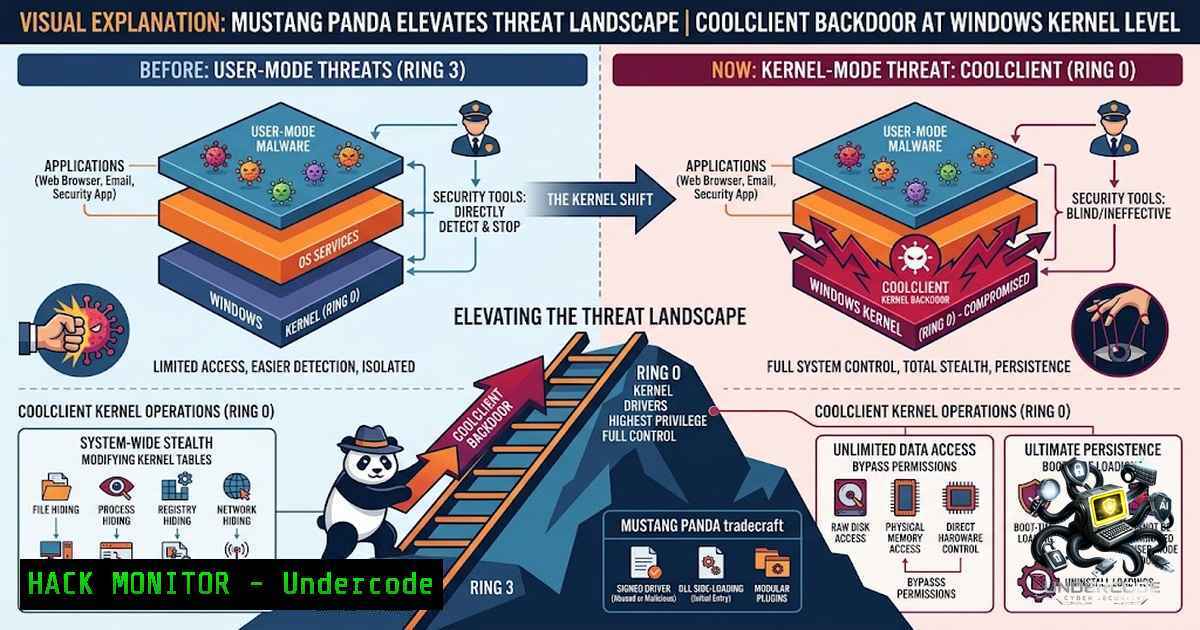
The Advanced Persistent Threat (APT) group known as HoneyMyte, more widely recognized as Mustang Panda, has once again raised the bar for cyber-espionage tradecraft. In a significant escalation observed throughout 2025 and into 2026, the group has integrated a signed Windows kernel-mode rootkit driver into its notorious CoolClient backdoor. This evolution marks a departure from traditional user-mode malware, allowing the backdoor to operate with near-invisible stealth by hiding processes, files, registry keys, and command-and-control (C2) communications directly from the operating system and security products. The implications for targeted organizations, which include government entities across Myanmar, Mongolia, Pakistan, and Russia, are profound as this development signifies a new era of sophisticated, difficult-to-detect espionage malware.
Learning Objectives:
- Understand the multi-stage infection chain and the role of DLL sideloading in deploying the CoolClient backdoor.
- Analyze the technical mechanisms of the signed Windows kernel-mode rootkit driver and its IOCTL-based communication with user-mode components.
- Identify key indicators of compromise (IoCs) and defensive strategies to detect and mitigate kernel-level rootkit threats.
- Learn practical commands and methodologies for forensic investigation and system hardening against such advanced persistent threats.
You Should Know:
- The Multi-Stage Attack Chain: From PlugX to Kernel Persistence
The deployment of the updated CoolClient variant follows a meticulously crafted, multi-stage execution chain that leverages living-off-the-land techniques and DLL sideloading to evade detection. In observed campaigns, particularly against targets in Myanmar, the attackers first used the PlugX backdoor as an initial post-compromise implant. Before deploying the main CoolClient components, the adversary takes a critical preparatory step: adding exclusions to Microsoft Defender to ensure their malicious files remain undisturbed. This is achieved using the Windows Management Instrumentation Command-line (WMIC) utility:
wmic /Node:localhost /Namespace:\Root\Microsoft\Windows\Defender Path MSFT_MpPreference call Add ExclusionPath="%programfiles%\Microsoft\Windows Defender"
wmic /Node:localhost /Namespace:\Root\Microsoft\Windows\Defender Path MSFT_MpPreference call Add ExclusionPath="%programfiles%\Microsoft\Windows Defender\defender.exe"
These commands create a safe haven for the malware by instructing Defender to ignore the fake Windows Defender directory and its renamed executable. The actor then creates the directory and copies the CoolClient components into it. A legitimate Sangfor executable, typically named Sang.exe, is renamed to `defender.exe` and placed in the same folder to serve as a DLL sideloader. Persistence is established through a scheduled task that executes `defender.exe` with SYSTEM privileges at system startup:
schtasks /create /sc onstart /tn "\Microsoft\Windows\Windows Defender Advanced Threat Protection Service" /tr "\"%programfiles%\Microsoft\Windows Defender\defender.exe\"" /ru "system" /F
When executed, `defender.exe` sideloads a malicious library, libngs.dll, from its own directory—a classic DLL sideloading technique that abuses the application’s search order. This first-stage loader decrypts and executes the second-stage component, `loadcert.ini` (which, despite its `.ini` extension, contains executable code), which is responsible for persistence via the `goopdate` registry run key and the installation of a Windows service named media_updaten. It also performs UAC bypass, process injection, and ultimately deploys the final-stage `cert.ini` component, which handles C2 communications and the core backdoor functionality.
- The Kernel-Mode Rootkit Driver: Stealth Through the Core
The crown jewel of this new CoolClient variant is its signed kernel-mode driver, typically written to disk as msagent.sys. The driver is signed with a valid certificate issued to Nanjing Ranyi Technology Co., Ltd., a certificate that has been observed on other malicious drivers dating back to 2013. Crucially, the driver is only installed if CoolClient has full access to the Service Control Manager (SCM) and possesses the sensitive `SeTcbPrivilege` privilege. This privilege, also known as “Act as part of the operating system,” is a highly sensitive system right that allows a process to operate with the highest level of trust within Windows. If these conditions are not met, the malware gracefully skips driver installation and proceeds with the user-mode backdoor alone, ensuring operational continuity.
Once loaded, the driver receives its configuration from the user-mode CoolClient component via Input/Output Control (IOCTL) requests. The analyzed sample uses three primary IOCTL codes:
– 0x222120: Registers the current CoolClient process as a trusted entity with the driver, preventing it from being hidden or terminated.
– 0x2221E0: Passes the configured C2 IPv4 address to the driver, allowing it to filter and hide this address from Windows network information.
– 0x2220F0: Registers filesystem and registry paths that should be protected from inspection or modification by other programs.
To achieve its stealth, the driver hooks the `Nsiproxy` driver to filter out C2 addresses from network information queries made by system tools or security software. It also employs mechanisms to hide processes, protect files and registry keys, and prevent their deletion or modification, effectively making the backdoor invisible to conventional security scans.
3. Forensic Detection and Manual Removal Techniques
Detecting and removing a rootkit operating at the kernel level requires a combination of specialized tools and manual forensic techniques. Standard antivirus scans are often ineffective against such threats. Security teams should employ a multi-pronged approach:
- Kernel Memory Dump Analysis: Capturing a complete kernel memory dump is crucial for forensic analysis. On a compromised system, this can be performed using the following command in an elevated command prompt:
rundll32.exe C:\Windows\System32\comsvcs.dll, MiniDump (Get-Process -1ame lsass).Id C:\temp\lsass.dmp full
Note: This command dumps the LSASS process memory, but for full kernel analysis, a system crash dump or a live kernel memory acquisition tool like `WinDbg` is required.
- Driver Enumeration: Use the `DriverQuery` command to list all installed drivers and look for suspicious or unsigned entries, particularly those with unusual names or paths:
driverquery /v /fo csv > drivers.csv
- Process and Network Anomaly Detection: Use `Tasklist` to identify hidden processes and `Netstat` to spot unusual network connections, particularly on ports associated with known C2 infrastructure:
netstat -ano | findstr ESTABLISHED
tasklist /v /fo table
- Registry and File Integrity Checks: Use `Regedit` or PowerShell to examine run keys and service entries for anomalies. The `Sysinternals` tools, particularly `Autoruns` and
Process Explorer, are invaluable for identifying suspicious startup entries and loaded drivers. Tools like `GMER` and `Kaspersky TDSSKiller` are specialized anti-rootkit utilities that can detect and remove kernel-level threats.
4. System Hardening and Mitigation Strategies
Preventing the initial compromise and limiting the impact of such advanced threats requires a robust defense-in-depth strategy:
- Enforce Strict Code Signing: Enable Secure Boot and enforce strict driver signing requirements to prevent the loading of unsigned or improperly signed kernel drivers.
- Restrict Administrative Privileges: Implement the principle of least privilege. Limit the number of users with administrative rights and use tools like Microsoft’s Local Administrator Password Solution (LAPS) to manage local admin passwords. The requirement for `SeTcbPrivilege` by the CoolClient driver highlights the critical nature of this control.
- Enable Credential Guard and Virtualization-Based Security (VBS): These features can help protect against kernel-level threats by isolating critical system processes and credentials in a secure environment.
- Monitor for Defense Evasion: Actively monitor for attempts to add exclusions to Windows Defender or other security products. Use Event Logs and SIEM solutions to alert on suspicious `wmic` and `schtasks` commands.
- Deploy Endpoint Detection and Response (EDR): EDR solutions with behavioral analysis and memory scanning capabilities are better equipped to detect and respond to rootkit-like behavior compared to traditional antivirus.
5. The Role of Threat Intelligence
Given the sophistication of Mustang Panda and its focus on government and diplomatic entities, proactive threat hunting is essential. Organizations should integrate threat intelligence feeds to stay informed about the latest tactics, techniques, and procedures (TTPs) used by APT groups. The Indicators of Compromise (IoCs) published by Kaspersky, including file hashes, paths, and C2 domains, should be ingested into security monitoring tools. This proactive approach enables security teams to hunt for signs of compromise before a full-blown breach occurs.
What Undercode Say:
- Key Takeaway 1: The evolution of CoolClient to include a signed kernel-mode rootkit demonstrates a clear trend among advanced threat actors: they are increasingly willing to invest in sophisticated, low-level techniques to achieve long-term, undetected persistence. The use of a valid certificate, even an expired one from 2014, highlights the challenge of relying on signature-based trust alone.
- Key Takeaway 2: The attack chain’s reliance on living-off-the-land techniques—such as DLL sideloading with legitimate binaries, WMIC for Defender exclusions, and `schtasks` for persistence—makes detection difficult. Defenders must shift focus from file-based signatures to behavioral analysis and anomaly detection to catch these attacks in their early stages.
Analysis: The Mustang Panda campaign is a stark reminder that cyber-espionage is not just evolving; it is fundamentally changing its operational paradigm. By moving malicious functionality into the Windows kernel, the attackers have effectively bypassed many of the security controls that operate at the user level. This forces a re-evaluation of traditional defense strategies. The use of a signed driver, even with an outdated certificate, shows that attackers are adept at exploiting the trust mechanisms built into the operating system. For security professionals, this means that relying on static analysis or simple hash-based detection is no longer sufficient. The future of defense lies in robust behavioral monitoring, comprehensive endpoint visibility, and the ability to detect and respond to anomalous activities at the kernel level. The fact that the driver is only deployed under specific privilege conditions also underscores the critical importance of privilege management as a foundational security control.
Prediction:
- -1: The sophistication of the CoolClient rootkit will likely lead to a surge in similar kernel-level threats from other APT groups, as the technique proves effective and the required tools and knowledge become more widely disseminated.
- -1: The use of legitimate but expired certificates will continue to pose a significant challenge for security vendors and defenders, as traditional trust models are repeatedly subverted.
- -1: The focus on government and diplomatic targets in Asia and Russia indicates that geopolitical tensions will continue to be a primary driver for such advanced cyber-espionage campaigns, with no sign of abating.
- +1: This public disclosure by Kaspersky will force Microsoft and other security vendors to invest more heavily in kernel-level security enhancements, potentially leading to more robust operating system protections against such rootkits in future Windows versions.
- +1: The detailed technical analysis provided will empower the global cybersecurity community to develop better detection rules, hone their hunting skills, and build more resilient defenses against these advanced threats.
▶️ Related Video (76% Match):
🎯Let’s Practice For Free:
🎓 Live Courses & Certifications:
Join Undercode Academy for Verified Certifications
🚀 Request a Custom Project:
Secure, high-velocity infrastructure and disruptive technological engineering. Contact our engineering team for high-tier development and proprietary systems:
[email protected]
💎 Smart Architecture | 🛡️ Secure by Design | ⭐ Trusted by Thousands
IT/Security Reporter URL:
Reported By: https://lnkd.in/p/eFpDy5J5 – Hackers Feeds
Extra Hub: Undercode MoN
Basic Verification: Pass ✅


