Listen to this Post
Introduction:
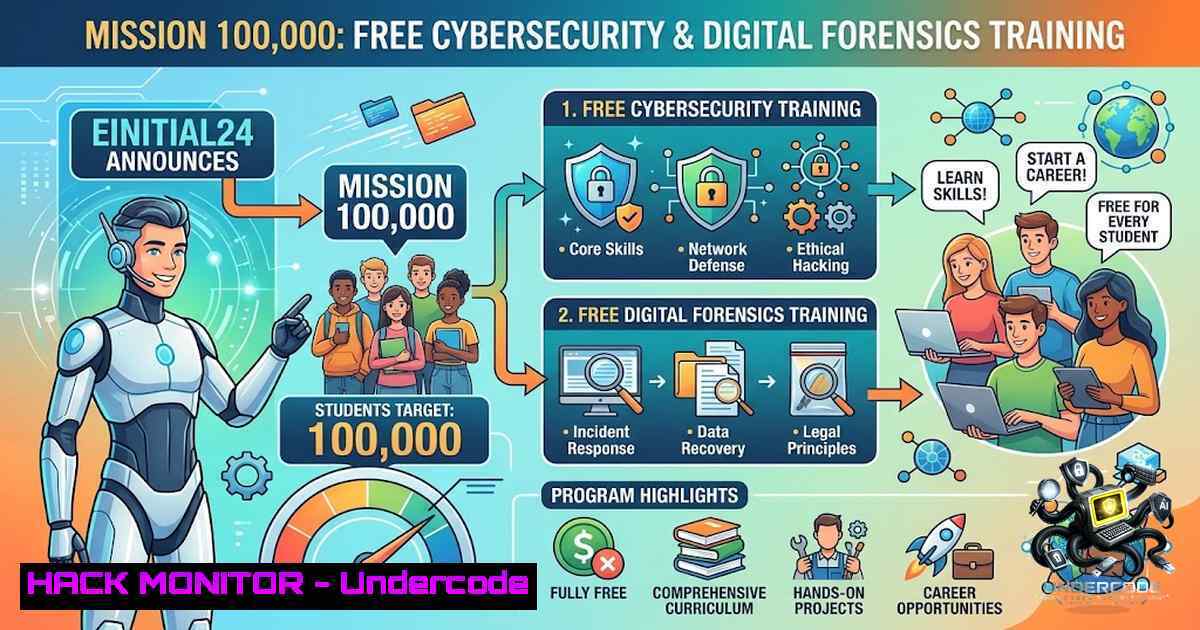
The cybersecurity industry faces a critical talent shortage, yet the cost of quality education remains a significant barrier for many aspiring professionals. EINITIAL24 has launched “Mission 100,000,” a large-scale initiative designed to provide free cybersecurity, digital forensics, and AI skills training to over 100,000 students across India. This community-driven approach aims to democratize access to technical education through a structured learning ecosystem that includes YouTube tutorials, daily updates, and peer support networks.
Learning Objectives:
- Understand the core principles of ethical hacking and penetration testing using Kali Linux.
- Acquire foundational skills in Digital Forensics and Incident Response (DFIR).
- Learn to configure and secure systems against common cyber threats.
You Should Know:
- Setting Up Your Kali Linux Lab for Ethical Hacking
Kali Linux is the industry-standard platform for penetration testing and security auditing. For beginners, the first step is to set up a safe, isolated environment to practice techniques without legal repercussions. You can run Kali Linux as a virtual machine using VirtualBox or VMware on Windows, or install it as a primary operating system. The EINITIAL24 YouTube channel provides step-by-step visual guides for this process.
Step-by-step guide:
- Install VirtualBox: Download and install VirtualBox from the official website.
- Download Kali Linux: Get the ISO file from the official Kali website.
- Create a Virtual Machine: Allocate at least 2GB of RAM and 20GB of storage for the VM.
- Install Kali: Boot from the ISO and follow the installation prompts.
- Update the System: Open a terminal and run the following commands to ensure your tools are up-to-date:
sudo apt update
sudo apt full-upgrade -y
- Install Essential Tools: If not pre-installed, you can add tools like `nmap` for network scanning and `metasploit-framework` for exploitation:
sudo apt install nmap metasploit-framework -y
2. Mastering Network Scanning with Nmap
Reconnaissance is the first phase of any ethical hack. Nmap (Network Mapper) is a powerful utility used to discover hosts and services on a computer network, thus building a map of the network.
Step-by-step guide:
- Basic Scan: To scan a target IP address (e.g., 192.168.1.1) for open ports, use:
nmap 192.168.1.1
- Service Version Detection: To identify the software versions running on open ports, add the `-sV` flag:
nmap -sV 192.168.1.1
- Operating System Detection: Use the `-O` flag to guess the target’s operating system:
nmap -O 192.168.1.1
- Aggressive Scan: The `-A` flag enables OS detection, version detection, script scanning, and traceroute:
nmap -A 192.168.1.1
Caution: Always ensure you have explicit written permission before scanning any network or system that you do not own.
- Introduction to Digital Forensics and Incident Response (DFIR)
DFIR is a specialized field focused on identifying, investigating, and remediating cyberattacks. A core skill is analyzing disk images to uncover evidence. Tools like Autopsy and The Sleuth Kit are commonly used for this purpose.
Step-by-step guide (using Autopsy on Windows/Linux):
- Download Autopsy: Get the latest version from the official Autopsy website.
- Create a New Case: Open Autopsy and create a new case, providing a case name and directory.
- Add Data Source: Add a disk image (e.g., a `.dd` or `.E01` file) for analysis.
- Run Ingest Modules: Select modules to run, such as “File Type Identification,” “Email Parser,” and “Web Artifacts.”
- Review Results: Analyze the extracted data, including deleted files, browser history, and registry entries, to build a timeline of events.
- Generate Report: Use the built-in reporting feature to document your findings. This is a crucial step for presenting evidence in a professional context.
4. Cloud Security Hardening: Basic Principles
As organizations migrate to the cloud, securing these environments is paramount. Basic hardening involves identity and access management (IAM), network security, and data protection. While specific commands vary by provider (AWS, Azure, GCP), the principles remain consistent.
Step-by-step guide (Conceptual):
- Enable Multi-Factor Authentication (MFA): This is the single most effective control to prevent account compromise.
- Implement the Principle of Least Privilege: Grant users only the permissions they absolutely need to perform their jobs.
- Configure Network Security Groups (NSGs) / Security Lists: Restrict inbound and outbound traffic to only necessary ports and IP addresses. For example, on a Linux server, you can use `iptables` to set rules:
Allow SSH from a specific IP
sudo iptables -A INPUT -p tcp -s 192.168.1.100 --dport 22 -j ACCEPT
Drop all other SSH attempts
sudo iptables -A INPUT -p tcp --dport 22 -j DROP
- Enable Logging and Monitoring: Ensure that logs for all critical services are enabled and sent to a centralized SIEM (Security Information and Event Management) system for analysis.
5. Leveraging AI for Cybersecurity
Artificial Intelligence is rapidly transforming the cybersecurity landscape, both for attackers and defenders. AI can be used to automate threat detection, analyze large datasets for anomalies, and even generate phishing emails. For defenders, understanding AI is crucial.
Step-by-step guide (Using Python for a simple anomaly detection concept):
– Set up Python: Ensure Python is installed on your system.
– Install Libraries: Use `pip` to install necessary libraries:
pip install scikit-learn pandas numpy
– Load a Dataset: Load a dataset of network traffic (e.g., KDD Cup 1999 dataset) using Pandas.
– Apply an Algorithm: Use a simple algorithm like Isolation Forest from `scikit-learn` to detect outliers or anomalies in the data.
– Interpret Results: The algorithm will flag data points that deviate significantly from the norm, which could indicate malicious activity.
What Undercode Say:
- Key Takeaway 1: EINITIAL24’s initiative is a significant step towards bridging the cybersecurity skills gap in India by removing financial barriers to entry.
- Key Takeaway 2: The shift from paid courses to a free, community-driven model, as championed by this mission, will likely foster a more diverse and inclusive cybersecurity workforce.
Analysis: The mission addresses a critical point—talent is universally distributed, but opportunity is not. By providing free access to industry-relevant tools and knowledge, EINITIAL24 is not just teaching skills but is actively building a community of practitioners. This approach is more sustainable and impactful than isolated paid courses, as it creates a network of learners who support and grow with each other. The integration of practical skills (Kali Linux, DFIR) with career development (resume tips, placement updates) ensures that students are job-ready. The use of multiple platforms (YouTube for learning, WhatsApp for community and updates) creates a comprehensive ecosystem that caters to different learning and engagement styles.
Prediction:
- +1 Initiatives like “Mission 100,000” will accelerate the development of a new generation of cybersecurity professionals in India, potentially making the country a major hub for global security talent.
- +1 The community-driven learning model is likely to become a benchmark for other educational initiatives, proving that collaborative, free resources can be more effective than expensive, isolated courses.
- +1 As more students gain access to practical training, the overall security posture of Indian enterprises and government institutions is expected to improve, as the local talent pool becomes more skilled and readily available.
- +1 The focus on both offensive (ethical hacking) and defensive (DFIR) skills will produce well-rounded professionals capable of handling complex security challenges.
- -1 The rapid influx of new learners, while positive, may temporarily saturate the entry-level job market, requiring organizations to adapt their hiring processes to identify and nurture raw talent effectively.
▶️ Related Video (82% Match):
🎯Let’s Practice For Free:
🎓 Live Courses & Certifications:
Join Undercode Academy for Verified Certifications
🚀 Request a Custom Project:
Secure, high-velocity infrastructure and disruptive technological engineering. Contact our engineering team for high-tier development and proprietary systems:
[email protected]
💎 Smart Architecture | 🛡️ Secure by Design | ⭐ Trusted by Thousands
IT/Security Reporter URL:
Reported By: https://lnkd.in/p/eBUAa9bB – Hackers Feeds
Extra Hub: Undercode MoN
Basic Verification: Pass ✅


