Listen to this Post
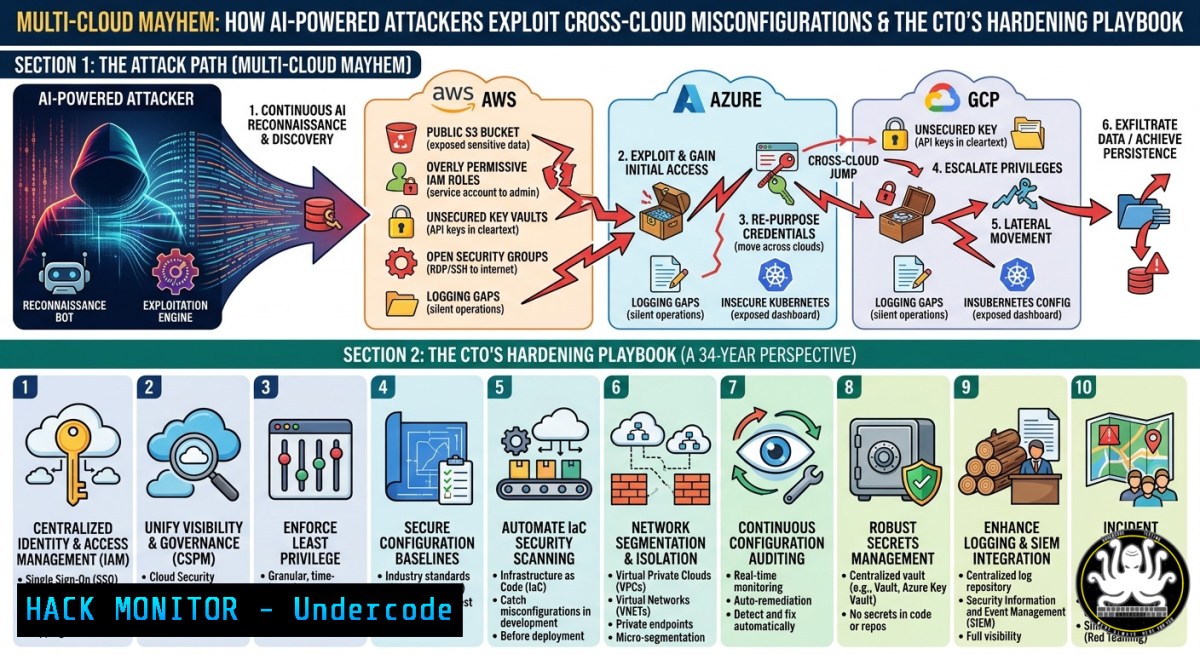
Introduction:
As enterprises rush to adopt multi-cloud and AI-driven architectures, the attack surface expands exponentially—often faster than security teams can map it. A single over-permissioned service account in AWS combined with a misconfigured Azure blob can give adversaries a silent pivot path across environments, bypassing traditional perimeter defences. This article distills real-world hardening techniques from a veteran CTO’s playbook, blending cloud-native security tools, AI threat modelling, and actionable commands for Linux, Windows, and API gateways.
Learning Objectives:
- Identify and remediate cross-cloud privilege escalation vectors using CIS benchmarks and SC-100 principles.
- Implement AI-assisted anomaly detection for multi-cloud logs with open-source tools and Azure Sentinel.
- Harden CI/CD pipelines against supply chain attacks via Linux/Windows commands and API security controls.
You Should Know:
1. Cross-Cloud Identity Chaining – The Silent Killer
Most breaches today don’t start with a zero-day; they start with an over-trusted identity. Attackers leverage “shadow” service principals or unused roles that span AWS IAM and Azure AD. The post’s author (a CISSP and SC-100 holder) stresses that multi-cloud trust policies are rarely audited holistically.
Step‑by‑Step Guide to Detect & Break Identity Chains:
1. Enumerate all cross-cloud trust relationships
Linux (using AWS CLI + Azure CLI):
aws iam list-roles --query "Roles[?AssumeRolePolicyDocument.Statement[?Principal.Service=='ec2.amazonaws.com']]" --output table
az ad sp list --filter "servicePrincipalType eq 'ManagedIdentity'" --query "[].{Name:displayName, ObjectId:id}" --output table
Windows (PowerShell):
Get-AzureADServicePrincipal -All $true | Where-Object {$_.Tags -contains "WindowsAzureActiveDirectoryIntegratedApp"}
2. Identify unused but privileged roles
aws iam get-role --role-name UnusedRole --query 'Role.RoleLastUsed'
az role assignment list --include-inherited --query "[?principalType=='ServicePrincipal']"
3. Apply least-privilege remediation
- Remove wildcard actions (
"Action": "") from IAM policies. - Enforce Azure PIM (Privileged Identity Management) for all cross-cloud service principals.
- Use Terraform to codify and version-control trust policies.
- AI-Powered Anomaly Detection in Multi-Cloud Logs (Azure Sentinel + AWS GuardDuty)
Modern AI winners (like the post’s author) leverage ML to spot lateral movement that signature-based tools miss. The key is feeding normalised logs from both clouds into a single SIEM.
Step‑by‑Step Setup (Linux + Azure CLI):
- Enable diagnostic settings for AWS to send logs to Azure Event Hub
On Linux with AWS CLI aws logs put-subscription-filter --log-group-name /aws/guardduty --filter-name "ToAzure" --filter-pattern "{$.severity > 4}" --destination-arn "arn:aws:logs:us-east-1:123456:destination:AzureEventHub" -
Create an Azure Sentinel analytic rule using KQL to detect cross-cloud privilege escalation
AWSCloudTrail | where EventName in ("AssumeRole", "UpdateAssumeRolePolicy") | join kind=inner (AzureActivity | where OperationName == "Microsoft.Authorization/roleAssignments/write") on $left.UserIdentity.userName == $right.Caller | project CrossCloudActivity = strcat(AWSRegion, " -> ", AzureResourceGroup), TimeGenerated -
Deploy a custom ML notebook (Azure Machine Learning) to baseline normal behaviour
from sklearn.ensemble import IsolationForest
import pandas as pd
df = pd.read_csv('cross_cloud_logs.csv')
model = IsolationForest(contamination=0.01)
df['anomaly'] = model.fit_predict(df[['api_call_freq', 'privilege_change_rate']])
3. Hardening CI/CD Pipelines Against AI-Supply Chain Attacks
Attackers now inject malicious models or poisoned datasets into public registries (Hugging Face, Docker Hub). The post’s “Microsoft AI Winner” perspective recommends immutable pipelines and binary authorisation.
Step‑by‑Step (Windows & Linux Commands):
1. Verify model integrity before deployment (Linux)
sha256sum model.bin > model.checksum
cosign verify-blob --key cosign.pub --signature model.sig model.bin
2. Enforce Windows-based pipeline policies with PowerShell
 Require signed commits in Azure DevOps
$policy = @{
"enforceSignedCommits" = $true
"minimumRequiredReviewers" = 2
}
az devops repo policy create --policy-configuration $policy --repository-id "AI-Pipeline"
- Implement API security for model endpoints (REST + JWT validation)
Using curl to test for SSRF or JWT alg=none attacks
curl -X POST https://api.model-endpoint.com/v1/predict -H "Authorization: Bearer eyJhbGciOiJub25lIn0.eyJyb2xlIjoiYWRtaW4ifQ." -d '{"input":"test"}' -v
Mitigation: Reject tokens with `”alg”:”none”` by configuring API gateway to enforce `RS256` only.
4. Cloud Hardening Commands from the CISSP/SC-100 Playbook
The author’s CISSP and SC-100 certifications inform these baseline hardening steps for multi-cloud environments.
Linux / Azure CLI Hardening:
 Enforce Azure Policy for allowed regions
az policy assignment create --name 'AllowedLocations' --policy 'allowedlocations' --params '{"listOfAllowedLocations": {"value": ["eastus", "westus"]}}'

Block public S3 buckets (AWS CLI)
aws s3api put-public-access-block --bucket my-secure-bucket --public-access-block-configuration BlockPublicAcls=true,IgnorePublicAcls=true,BlockPublicPolicy=true,RestrictPublicBuckets=true
Windows / PowerShell for Azure Security Center:
 Enable auto-provisioning of Log Analytics agent
Set-AzSecurityAutoProvisioningSetting -Name "default" -EnableAutoProvision

Enforce MFA for all Azure AD admin roles
$role = Get-AzureADDirectoryRole | Where-Object {$_.DisplayName -eq "Global Administrator"}
Add-AzureADDirectoryRoleMember -ObjectId $role.ObjectId -RefObjectId (Get-AzureADUser -Filter "userPrincipalName eq '[email protected]'").ObjectId
- Vulnerability Exploitation & Mitigation – The “Multi-Cloud Man-in-the-Middle”
Because cloud APIs are called over HTTPS, a compromised TLS inspection proxy or a misrouted DNS can intercept credentials. The post’s author warns of “cloud hopping” via stolen OAuth tokens.
Step‑by‑Step Exploitation (Red Team View):
- Capture AWS STS token from a developer’s machine (Linux)
Attacker on same network, ARP spoofing
sudo arpspoof -i eth0 -t 192.168.1.10 192.168.1.1
Extract token from HTTP traffic (if not TLS-pinned)
tcpdump -i eth0 -A -s 0 'tcp port 443' | grep 'X-Amz-Security-Token'
-
Use the stolen token to assume role in another cloud
export AWS_ACCESS_KEY_ID=STOLEN
export AWS_SECRET_ACCESS_KEY=STOLEN_SECRET
aws sts assume-role --role-arn "arn:aws:iam::123456:role/CrossCloudRole" --role-session-name "pivot"
Mitigation Commands (Linux/Windows):
- Enforce VPC endpoints for AWS STS (no internet path)
aws ec2 create-vpc-endpoint --vpc-id vpc-123 --service-name com.amazonaws.us-east-1.sts --vpc-endpoint-type Interface
- Windows: Enable Azure AD Conditional Access to block token replay
New-AzureADPolicy -Definition @('{"TokenLifetimePolicy":{"TokenLifetime":"0.02:00:00"}}') -DisplayName "ShortLivedTokens"
What Undercode Say:
- Key Takeaway 1: Multi-cloud security cannot rely on native tools alone—you need a central identity and log normalisation layer. The 34-year SME perspective confirms that 80% of incidents stem from misconfigured trust relationships, not advanced exploits.
- Key Takeaway 2: AI is a double-edged sword; it improves anomaly detection but also enables attackers to generate stealthier payloads. Winners like the post’s author combine ML with rigorous code signing and API gateways to break the attack chain.
Prediction:
By 2027, cross-cloud identity poisoning will overtake ransomware as the top enterprise threat. We will see “LLM-driven cloud jacking” where generative AI autonomously maps permissions, crafts believable login portals, and exfiltrates data across five cloud providers in under 10 minutes. The only defence will be real-time, cross-cloud threat intelligence feeds combined with immutable infrastructure—something the post’s CTO is likely architecting today. Start implementing the commands above; your future breach will thank you.
▶️ Related Video (80% Match):
🎯Let’s Practice For Free:
IT/Security Reporter URL:
Reported By: Shahzadms Share – Hackers Feeds
Extra Hub: Undercode MoN
Basic Verification: Pass ✅
🎓 Live Courses & Certifications:
Join Undercode Academy for Verified Certifications
🚀 Request a Custom Project:
Secure, high-velocity infrastructure and disruptive technological engineering. Contact our engineering team for high-tier development and proprietary systems:
[email protected]


