Listen to this Post
Introduction:
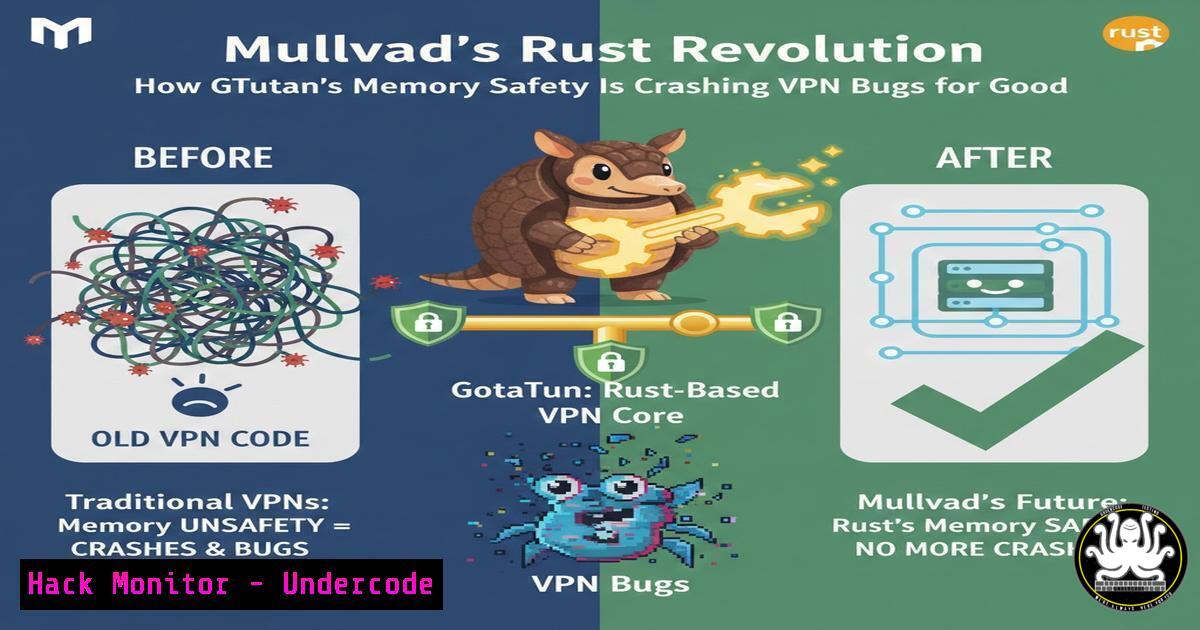
Mullvad VPN has executed a critical infrastructure overhaul, replacing its crash-prone WireGuard implementation with GotaTun, a new stack written in Rust. This strategic shift from Go to Rust directly targeted and eliminated 85% of Android application crashes, showcasing how programming language choice is a foundational cybersecurity and reliability concern. The move underscores a growing industry trend where memory-safe languages are becoming essential for building resilient and secure network infrastructure.
Learning Objectives:
- Understand the specific security and stability vulnerabilities inherent in VPN implementations written in non-memory-safe languages like Go and C.
- Learn the core principles of the Rust programming language that mitigate entire classes of common software exploits, such as buffer overflows and race conditions.
- Gain practical knowledge for auditing, testing, and configuring VPN clients, with a focus on stability and leak prevention across different operating systems.
You Should Know:
1. The Inherent Risks in Legacy VPN Stacks
The legacy `wireguard-go` implementation, while functional, operated in user space and was susceptible to complex memory management bugs and concurrency issues. These vulnerabilities often manifested as sudden crashes or connection drops, which not only degrade user experience but can also cause IP address leaks—a critical privacy failure for a VPN. The opaque nature of these crashes in Go made root-cause analysis difficult for developers, leaving latent stability holes.
Step‑by‑step guide explaining what this does and how to use it.
Problem Identification: To diagnose similar instability in a network service, system logs are the first source of truth.
Linux/Mac Command: Use `journalctl` or `dmesg` to look for panic messages or kill signals related to your VPN process.
journalctl -u wg-quick@wg0 --since "1 hour ago" | grep -i "panic|fatal|error"
dmesg -T | tail -50
Windows Command: Use PowerShell to query the System event logs for application crashes.
Get-WinEvent -FilterHashtable @{LogName='System'; Level=2; ProviderName='Application Error'} | Select-Object -First 5 | Format-List
Analysis: Frequent `SIGSEGV` (segmentation fault) errors indicate memory access violations, a classic sign of unsafe memory handling that Rust’s ownership model is designed to prevent.
2. Rust’s Borrow Checker: Your Built-In Security Auditor
GotaTun’s foundation in Rust introduces the “borrow checker,” a compile-time enforcer of memory safety rules. It guarantees that data cannot be simultaneously mutated and accessed from multiple places without explicit, safe synchronization. This eliminates data races—a common source of heisenbugs in concurrent network programming—and null pointer dereferencing, which are leading causes of crashes and security exploits in other languages. There is no runtime performance penalty for these guarantees.
Step‑by‑step guide explaining what this does and how to use it.
Concept in Code: In Rust, you either have one mutable reference or multiple immutable references to data, enforced at compile time.
fn main() {
let mut data = vec![1, 2, 3];
let ref1 = &data; // First immutable borrow
// let ref_mut = &mut data; // This line would cause a COMPILE-TIME error
println!("{:?}", ref1);
} // ref1 goes out of scope here
let ref_mut = &mut data; // Now a mutable borrow is allowed
Actionable Insight: When auditing a codebase, look for the absence of `unsafe` blocks in the core data path. In GotaTun, critical networking operations can be performed without relying on unsafe, dramatically reducing the attack surface.
3. Benchmarking VPN Stability and Leak Prevention
A stable VPN connection must be resilient to network changes and must never leak traffic outside its encrypted tunnel. The 99.99% perceived crash stability achieved by GotaTun sets a new benchmark. Professionals must actively test for leaks—DNS, IPv6, and WebRTC—to validate any client’s claims.
Step‑by‑step guide explaining what this does and how to use it.
Testing Tool Setup: Use dedicated leak-testing websites or command-line tools. For automated testing, a script can be useful.
Linux/Mac Script Example: Create a bash script (vpn_leak_test.sh) to test DNS servers.
!/bin/bash
echo "Testing DNS servers with VPN active..."
VPN_DNS=$(dig +short myip.opendns.com @resolver1.opendns.com)
SYSTEM_DNS=$(scutil --dns | grep "nameserver[0]" | awk '{print $3}')
echo "VPN tunnel DNS resolves to: $VPN_DNS"
echo "System DNS config shows: $SYSTEM_DNS"
if [[ "$VPN_DNS" != "$YOUR_VPN_SERVER_IP" ]]; then
echo "WARNING: Potential DNS leak detected!"
fi
Windows Test: Use `nslookup` manually or with PowerShell to see which DNS server resolves your query.
nslookup myip.opendns.com resolver1.opendns.com
Network Stress Test: Simulate poor networks with tools like `tc` (Traffic Control) on Linux to drop packets and see if the VPN reconnects gracefully, a key stability metric.
sudo tc qdisc add dev eth0 root netem loss 10%
4. Configuring Advanced Privacy Features: DAITA and Multihop
GotaTun enables advanced privacy features like DAITA (Defensive Asymmetric IP Traffic Analysis resistance) and Multihop by design. DAITA helps obfuscate traffic patterns to resist fingerprinting, while Multihop routes traffic through multiple servers, drastically increasing adversary effort for surveillance. Proper configuration is essential for their efficacy.
Step‑by‑step guide explaining what this does and how to use it.
Understanding Multihop: Instead of Endpoint = Server_A, your config chains connections: Your Device -> Server_A (Entry) -> Server_B (Exit) -> Internet.
Sample WireGuard Config Snippet (Conceptual): While implementation-specific, a multihop-aware client config would define peers for both entry and exit nodes.
[bash]
PrivateKey = [bash]
DNS = 10.64.0.1
[bash]  Entry Node - Server A
PublicKey = [bash]
AllowedIPs = 10.10.0.2/32
Endpoint = entry-server.mullvad.com:51820
[bash]  Exit Node - Server B (Traffic ONLY routed via Server A)
PublicKey = [bash]
AllowedIPs = 0.0.0.0/0, ::/0
AllowedIPs = !10.10.0.2/32  Except the entry node IP
Endpoint = exit-server.mullvad.com:51820
Verification: After connection, trace your route to ensure it passes through multiple hops.
traceroute 8.8.8.8
5. The Road to Cross-Platform Security Hardening
Mullvad’s roadmap to deploy GotaTun on iOS and desktop represents a crucial security hardening initiative. A unified, memory-safe codebase across all platforms eliminates platform-specific vulnerabilities and streamlines security patches. For IT administrators, this means a consistent security posture can be enforced across an entire fleet of diverse devices.
Step‑by‑step guide explaining what this does and how to use it.
Audit Preparation: When a third-party audit (as planned by Mullvad for 2026) is published, security teams should map its findings to their own risk registers.
Action Plan:
- Review: Obtain the public audit report. Focus on the “Critical” and “High” severity findings and their remediation.
- Map: Correlate findings with your asset inventory. Does the vulnerable component exist in your deployment?
- Patch & Policy: Update clients immediately. Create an IT policy mandating the minimum app version containing the fixes.
Example Policy Rule (Group Policy or MDM): Enforce a minimum version of the VPN client that includes the audited GotaTun stack.
What Undercode Say:
- Memory Safety is Non-Negotiable for Critical Infrastructure: Mullvad’s data-driven decision—linking 85% of crashes to the old stack—proves that adopting memory-safe languages like Rust is no longer a niche preference but a operational requirement for reliability and security. It’s a tangible ROI on security-by-design.
- The Future of Defense is in the Compiler: This shift moves the burden of preventing entire vulnerability classes from the security reviewer’s tired eyes to the compiler’s unwavering logic. It represents the most effective form of proactive defense, reducing the human-error factor in secure coding.
Analysis (approx. 10 lines):
Mullvad’s transition is a microcosm of a larger industry pivot, championed by entities like CISA, towards memory-safe languages. The staggering reduction in crashes isn’t just a quality-of-life improvement; it directly correlates to fewer exploitable instability windows and a more reliable privacy guarantee for the user. For cybersecurity professionals, this case study is a powerful argument to advocate for rewriting or replacing security-critical legacy components, especially those handling network traffic or cryptography. The planned independent audit will further set a standard for transparency, providing a verifiable trust model that other security tool vendors should be pressured to follow. This isn’t just a VPN update; it’s a blueprint for modern secure systems development.
Prediction:
The successful deployment of GotaTun will catalyze a domino effect across the cybersecurity and networking software industry within the next 2-3 years. We will see mainstream firewall vendors, SD-WAN controllers, and critical internet daemons (like DNS resolvers and DHCP servers) initiate similar rewrites in Rust or other memory-safe languages. This will significantly reduce the volume of CVEs related to memory corruption in network-edge software, forcing red teams and threat actors to shift their focus more heavily to social engineering, configuration exploitation, and logic flaws in application layers. The “crash rate” metric will become a standard KPI in security procurement checklists for any networking tool.
▶️ Related Video (82% Match):
🎯Let’s Practice For Free:
IT/Security Reporter URL:
Reported By: Laurent Minne – Hackers Feeds
Extra Hub: Undercode MoN
Basic Verification: Pass ✅


