Listen to this Post
Introduction:
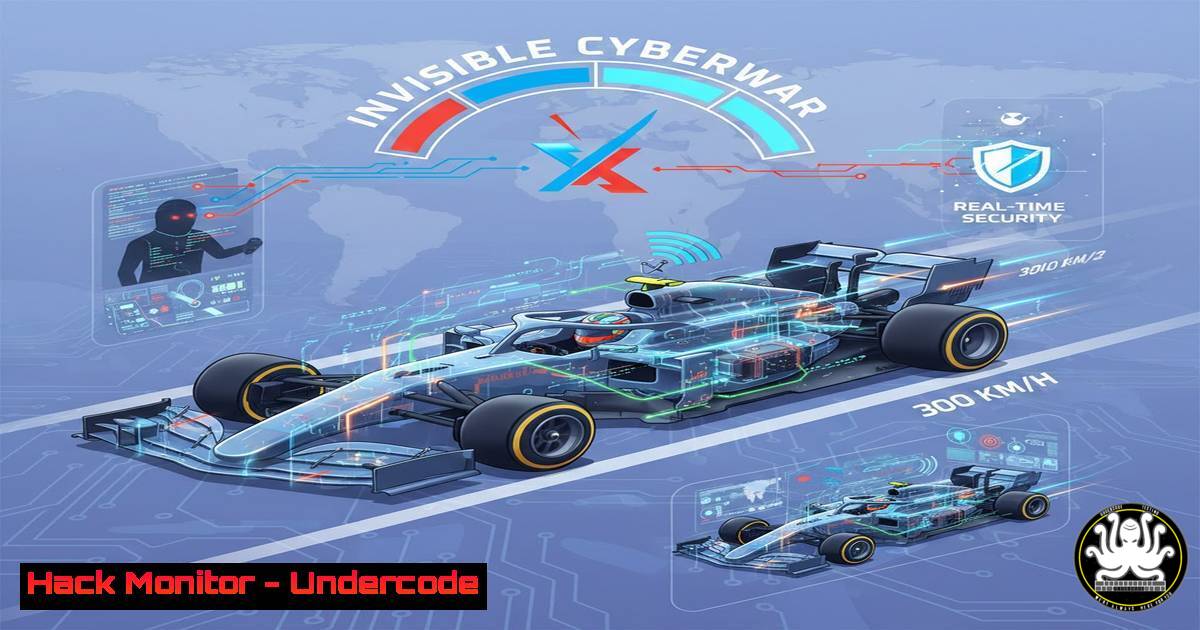
While millions watch drivers battle for milliseconds on the track, a far more clandestine conflict unfolds in the digital realm. Formula 1 cars are rolling data centers, generating over 3 terabytes of sensitive telemetry and strategic data per race weekend, making them prime targets for espionage and sabotage. This high-stakes environment offers a masterclass in real-time, zero-trust cybersecurity for critical infrastructure, where a single compromised packet can mean the difference between victory and catastrophic failure.
Learning Objectives:
- Understand the unique attack surfaces and critical data assets in an F1 operational technology (OT) environment.
- Learn the practical network segmentation and telemetry encryption strategies used to protect real-time data streams.
- Explore the role of “Digital Twins” in security validation and incident response within high-velocity environments.
- Identify the key skills and career pathways to enter the niche field of high-performance sports cybersecurity.
- Apply F1-grade security principles to mainstream enterprise IT, cloud, and API protection scenarios.
You Should Know:
- Securing the Telemetry Firehose: Encryption & Interception Prevention
The real-time telemetry stream—including engine mappings, brake temperatures, and fuel flow—is the team’s most valuable secret. Interception or manipulation is a primary attack vector.
Step‑by‑step guide explaining what this does and how to use it.
Concept: Implement end-to-end encryption for UDP-based telemetry data. Unlike TCP, UDP is used for its low latency, but it’s connectionless and vulnerable. The solution is to encrypt payloads using lightweight, high-speed algorithms like AES-GCM before transmission.
Command/Tool Example (Using OpenSSL for Encryption Simulation):
 Simulate encrypting a telemetry data packet (plaintext file) on the "car"
echo "RPM=15000,THROTTLE=100,BTEMP=1200" > telemetry_plain.txt
openssl enc -aes-256-gcm -e -in telemetry_plain.txt -out telemetry_encrypted.bin -K $(xxd -p -c 256 /dev/urandom | head -c 64) -iv $(xxd -p -c 256 /dev/urandom | head -c 24) -a

On the pit wall server, you would decrypt with the corresponding key and IV
 openssl enc -aes-256-gcm -d -in telemetry_encrypted.bin -out telemetry_decrypted.txt -K [bash] -iv [bash] -a
Practical Security: Teams use dedicated, frequency-agile radio links with strict whitelisting. To test your own network for data leakage, use a tool like Wireshark with a filter for UDP traffic: udp.port ==
</code>. Look for plaintext data.

<h2 style="color: yellow;">2. Fortifying the Pit Wall & Network Micro-Segmentation</h2>

The trackside network connects the car, pit wall, garage, and engineering hub. A flat network would be disastrous. Strict micro-segmentation is enforced.

Step‑by‑step guide explaining what this does and how to use it.
 Concept: Create isolated network segments (VLANs) so that even if an attacker compromises the guest Wi-Fi, they cannot reach the telemetry or car control networks.
 Command/Tool Example (Basic Linux iptables rules for segmentation):
[bash]
 Assume: eth0 connected to "Car Network" (10.0.1.0/24), eth1 to "Pit Engineering" (10.0.2.0/24)
 DROP all traffic by default between segments
iptables -A FORWARD -i eth0 -o eth1 -j DROP
iptables -A FORWARD -i eth1 -o eth0 -j DROP

Only allow specific, encrypted traffic from the Car's Data Logger (10.0.1.100) to the Pit Server (10.0.2.200) on port 5000
iptables -I FORWARD -i eth0 -o eth1 -s 10.0.1.100 -d 10.0.2.200 -p udp --dport 5000 -j ACCEPT
Practical Security: In modern setups, this is achieved with next-generation firewalls (NGFWs) and software-defined perimeters (SDP). The principle is zero-trust: never trust, always verify, even inside the network.
- The Digital Twin: A Security Sandbox for Attack Simulation
Every physical car has a "Digital Twin"—a virtual replica used for simulation. This is also a critical security tool for validating updates and probing for vulnerabilities.
Step‑by‑step guide explaining what this does and how to use it.
Concept: Before deploying a new engine control unit (ECU) firmware or strategy software to the physical car, it's tested in the Digital Twin environment. Security teams can run controlled penetration tests against the twin.
Tool Example (Using Containerization to Model a Subsystem):
 Create an isolated Docker container to simulate a telemetry processing service
docker run --name telemetry-sim -d --network isolated_nw \
-v ./config:/app/config:ro \
-p 127.0.0.1:5000:5000/udp \
telemetry-app:latest

Use a vulnerability scanner (like Clair) on the container image before deployment
docker save telemetry-app:latest -o telemetry-app.tar
 (Scan with Clair/Trivy)
Practical Security: This allows for "safe failure." Teams can simulate a man-in-the-middle (MitM) attack on the twin's data feed using tools like Ettercap or Bettercap to see the impact and harden defenses before race day.
- API & Cloud Hardening for the Mobile Engineering Hub
Race teams travel. Engineers access simulation data and historical analytics from cloud platforms via APIs. These APIs are a major target.
Step‑by‑step guide explaining what this does and how to use it.
Concept: Protect cloud-hosted data and APIs with stringent authentication, rate limiting, and deep input validation to prevent injection attacks and data exfiltration.
Example (Terraform snippet for a secure AWS API Gateway with WAF):
resource "aws_wafv2_web_acl" "f1_api_acl" {
name = "f1-api-acl"
scope = "REGIONAL"

default_action { allow {} }

rule {
name = "RateLimitRule"
priority = 1
action { block {} }
statement {
rate_based_statement {
limit = 2000  Max requests per 5-min from a single IP
aggregate_key_type = "IP"
}
}
visibility_config { / ... / }
}

rule {
name = "SQLiRule"
priority = 2
action { block {} }
statement {
managed_rule_group_statement {
name = "AWSManagedRulesSQLiRuleSet"
vendor_name = "AWS"
}
}
visibility_config { / ... / }
}
}

resource "aws_apigatewayv2_stage" "prod" {
api_id = aws_apigatewayv2_api.main.id
name = "$default"
access_log_settings { / ... / }
web_acl_arn = aws_wafv2_web_acl.f1_api_acl.arn  Attach WAF
}
Practical Security: All API access should use short-lived tokens (e.g., JWT) and API keys, never hardcoded credentials. Use a secrets manager like HashiCorp Vault or AWS Secrets Manager.
- The Human Firewall: Social Engineering at the Track
The paddock is a crowded, high-pressure environment perfect for phishing, tailgating, and USB drop attacks targeting personnel.
Step‑by‑step guide explaining what this does and how to use it.
Concept: Implement mandatory security awareness training with a focus on the specific threats in a mobile, high-profile environment. This includes physical security policies.
Tool Example (Simulating a Phishing Campaign with GoPhish):
1. Deploy GoPhish on a controlled server.
- Create a landing page mimicking the team's internal login portal.
- Craft an email luring staff with a fake "Updated Race Strategy Document."
- Send to a test group of employees to gauge susceptibility.
- Analyze results and provide targeted training to those who clicked.
Practical Security: Enforce strict "clean desk" policies in the garage, use RFID badges with biometric verification for sensitive areas, and mandate USB port lockdowns on all track-side devices.
What Undercode Say:
- F1 is a Cybersecurity Proving Ground: The extreme constraints of latency, reliability, and mobility force the invention of security solutions that are later adapted for mainstream finance, healthcare, and critical infrastructure.
- Data is the New Oil, and Telemetry is the High-Octane Fuel: The core lesson is that protecting high-velocity, high-value data in transit requires a layered approach combining cryptographic assurance, physical network controls, and relentless human vigilance.
The analysis of F1's cybersecurity posture reveals a mature implementation of "Assume Breach." Every component—from the car's CAN bus to the team principal's laptop—is treated as potentially compromised. This mindset, combined with massive investment in redundancy and real-time monitoring, creates a resilient system. The fascinating tension is between the need for extreme openness (for fan engagement and regulatory scrutineering) and extreme secrecy (for competitive advantage), a balance that all modern tech companies now struggle with. The "Harvest Now, Decrypt Later" threat mentioned by the original post is particularly salient here: encrypted telemetry stolen today could be decrypted with future quantum computers, revealing long-term performance secrets.
Prediction:
The cybersecurity architectures pioneered in Formula 1 will become the blueprint for protecting the next generation of autonomous vehicles, smart cities, and real-time industrial IoT. As 5G and edge computing proliferate, the demand for "Trackside Cybersecurity Engineers" will explode beyond racing into all sectors requiring sub-millisecond security decision-making. Furthermore, F1 teams will become early adopters of post-quantum cryptography, transitioning their vast historical data vaults to quantum-resistant algorithms long before mainstream enterprises, turning their current defensive race into a future-proof competitive advantage. The hacker community will also increasingly see high-profile sports as the ultimate penetration testing challenge, leading to more public disclosures of sports-related vulnerabilities.
▶️ Related Video (76% Match):
🎯Let’s Practice For Free:
IT/Security Reporter URL:
Reported By: Addie Clark - Hackers Feeds
Extra Hub: Undercode MoN
Basic Verification: Pass ✅


