Listen to this Post
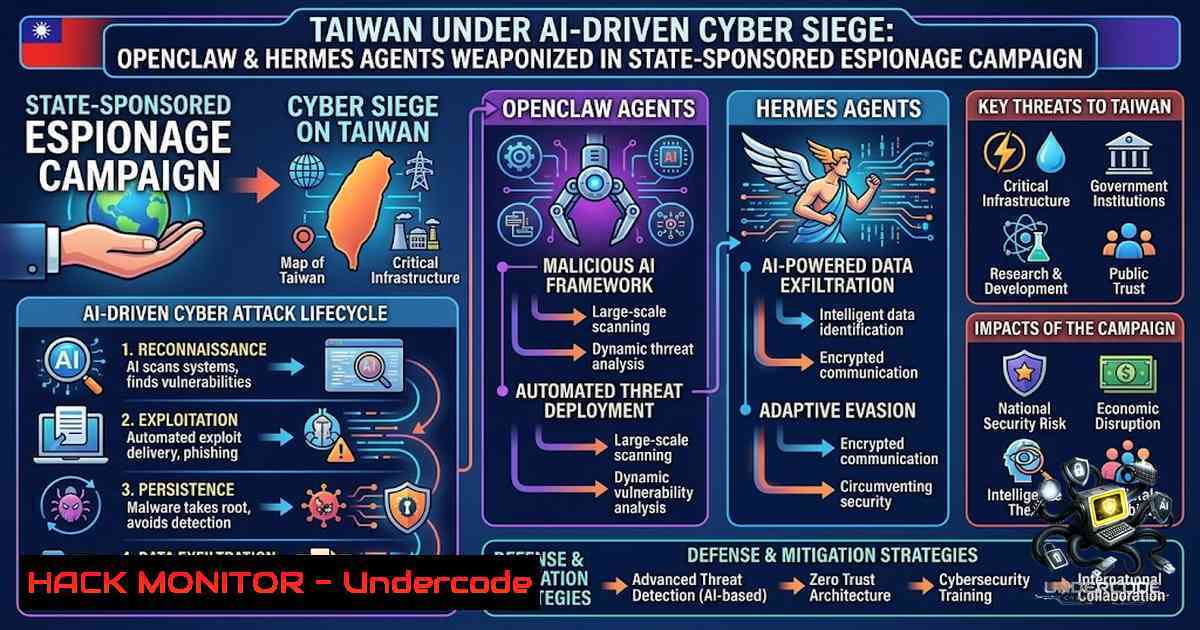
Introduction:
In a stark escalation of modern cyber warfare, Taiwan recently disclosed that it was the target of a sophisticated, AI-driven hacking campaign that leveraged open-source intelligent agents to breach critical infrastructure and governmental networks. The operation, which utilized frameworks like OpenClaw and Hermes Agents, represents a paradigm shift where artificial intelligence is no longer just a defensive tool but an offensive weapon capable of autonomous reconnaissance, vulnerability discovery, and payload delivery at machine speed. This incident underscores the urgent need for cybersecurity professionals to understand, detect, and neutralize AI-augmented threats that operate beyond traditional signature-based defenses.
Learning Objectives:
- Understand the architecture and capabilities of offensive AI agents such as OpenClaw and Hermes Agents
- Learn to detect AI-driven intrusion patterns through behavioral analysis and network telemetry
- Implement defensive measures including AI-resistant authentication, anomaly detection, and zero-trust architectures
You Should Know:
- OpenClaw and Hermes Agents: The Offensive AI Arsenal
The Taiwan campaign employed OpenClaw and Hermes Agents—open-source frameworks originally designed for legitimate automation and testing but repurposed for malicious operations. OpenClaw functions as an autonomous penetration testing agent that can enumerate attack surfaces, prioritize vulnerabilities, and execute exploitation chains without human intervention. Hermes Agents, on the other hand, specialize in stealthy data exfiltration and command-and-control (C2) communication, using AI to evade detection by mimicking legitimate traffic patterns.
What This Does: These agents operate by ingesting target network intelligence, generating attack vectors through reinforcement learning, and adapting their tactics in real-time based on defensive responses. Unlike traditional malware, they do not rely on static signatures but on behavioral algorithms that continuously evolve.
How to Use It (Defensively): Security teams must simulate these agents in controlled environments to understand their TTPs (Tactics, Techniques, and Procedures). Below are commands to set up a detection lab:
Linux – Network Traffic Analysis for Anomalous AI Agent Behavior:
 Monitor for unusual outbound connections indicative of C2 traffic
sudo tcpdump -i eth0 -1n 'tcp[bash] & 0x10 != 0' -c 1000

Analyze DNS logs for domain generation algorithm (DGA) patterns
sudo journalctl -u systemd-resolved -f | grep -E "query..(top|xyz|club)"

Deploy Suricata with AI-agent specific rules
sudo suricata -c /etc/suricata/suricata.yaml -i eth0 -l /var/log/suricata/
Windows – Process and Beacon Detection:
 List all network connections and identify suspicious parent processes
Get-1etTCPConnection | Where-Object {$_.State -eq "Established"} | Select-Object LocalAddress, LocalPort, RemoteAddress, RemotePort, OwningProcess

Check for unsigned processes running in memory
Get-Process | Where-Object {$_.MainModule.FileVersionInfo.FileName -1otlike "Microsoft"} | Select-Object ProcessName, Id, Path

Enable PowerShell script block logging to detect AI agent scripts
Set-ItemProperty -Path "HKLM:\SOFTWARE\Policies\Microsoft\Windows\PowerShell\ScriptBlockLogging" -1ame "EnableScriptBlockLogging" -Value 1
Step-by-Step Guide:
- Set up a honeypot network segment mirroring your production environment
- Deploy OpenClaw in an isolated sandbox and record its behavioral fingerprints
- Feed these fingerprints into your SIEM (e.g., Splunk, ELK) as custom detection rules
- Continuously update your threat intelligence feeds with IOCs (Indicators of Compromise) generated from agent simulations
2. AI-Driven Reconnaissance and Autonomous Vulnerability Discovery
The core advantage of AI agents in the Taiwan attack was their ability to perform reconnaissance at a scale and speed unattainable by human operators. These agents utilized machine learning models to analyze public-facing services, GitHub repositories, and cloud configurations, identifying misconfigurations and zero-day vulnerabilities within minutes. The campaign reportedly mapped Taiwan’s entire external attack surface in under 48 hours—a task that would typically take weeks for a skilled red team.
What This Does: The agents employ natural language processing (NLP) to parse security advisories, exploit databases, and even social media for emerging threat intelligence, then correlate this with target-specific data to prioritize attack vectors.
How to Use It (Defensively): Proactive defense requires continuous external attack surface management (EASM). Below are tools and commands to replicate adversary reconnaissance and harden your perimeter:
Linux – External Port Scanning and Service Fingerprinting:
 Perform a comprehensive Nmap scan to identify exposed services
nmap -sS -sV -O -p- -T4 <target-IP-range> -oA external_scan

Use Masscan for rapid large-scale scanning
masscan -p1-65535 --rate=10000 <target-IP-range> -oJ masscan_results.json

Enumerate subdomains to detect shadow IT
amass enum -d <your-domain> -o subdomains.txt
Cloud Hardening (AWS Example) – Prevent AI Agent Exploitation:
 Enforce S3 bucket policies to prevent public exposure
aws s3api put-bucket-policy --bucket <bucket-1ame> --policy file://restrictive-policy.json

Enable AWS Config to detect misconfigurations in real-time
aws configservice put-configuration-recorder --configuration-recorder name=default,roleARN=<arn> --recording-group AllSupported

Set up GuardDuty for AI-driven threat detection
aws guardduty create-detector --enable
Step-by-Step Guide:
- Conduct a weekly external scan of your public IP ranges using Nmap and Masscan
- Integrate results into a vulnerability management platform (e.g., Qualys, Tenable)
- Implement automated remediation playbooks for common misconfigurations (e.g., open S3 buckets, unpatched services)
- Deploy a Web Application Firewall (WAF) with AI/ML-based anomaly detection to block reconnaissance probes
3. Evasive Command-and-Control and Data Exfiltration
Hermes Agents, identified in the Taiwan campaign, specialize in establishing stealthy C2 channels that mimic legitimate protocols such as HTTPS, DNS, and even social media APIs. These agents use AI to dynamically alter their communication patterns—varying packet sizes, timing intervals, and encryption keys—to evade traditional intrusion detection systems (IDS) and next-generation firewalls (NGFW). The exfiltration phase leverages steganography and encrypted tunnels, making data loss prevention (DLP) tools largely ineffective.
What This Does: The agent employs a reinforcement learning model that rewards successful evasion and penalizes detection events, effectively “learning” the network’s defensive posture over time.
How to Use It (Defensively): To counter evasive C2, organizations must deploy behavioral analysis and network detection and response (NDR) solutions. Below are configurations and commands for advanced monitoring:
Linux – Deep Packet Inspection and TLS Interception (Test Environment Only):
 Set up Zeek (formerly Bro) for comprehensive network analysis
sudo zeek -i eth0 -C /usr/local/zeek/share/zeek/site/local.zeek

Analyze Zeek logs for anomalous SSL/TLS certificates
cat /usr/local/zeek/logs/current/ssl.log | grep -E "self_signed|certificate_chain|validation_status"

Use RITA for beacon detection
rita import --config /etc/rita/config.yaml /opt/zeek/logs/current/
rita show-beacons --config /etc/rita/config.yaml
Windows – Endpoint Detection and Response (EDR) Configuration:
 Enable Sysmon to capture process creation and network connections
Sysmon64.exe -accepteula -i sysmon-config.xml

Query Sysmon event logs for suspicious parent-child process relationships
Get-WinEvent -FilterHashtable @{LogName='Microsoft-Windows-Sysmon/Operational'; ID=1} | Where-Object {$_.Message -match "powershell|cmd|wscript"} | Select-Object TimeCreated, Message

Deploy Windows Defender ATP with cloud-delivered protection
Set-MpPreference -CloudBlockLevel High -CloudTimeout 50
Step-by-Step Guide:
- Deploy Zeek as a network sensor to collect rich metadata on all east-west and north-south traffic
- Feed Zeek logs into a SIEM with custom correlation rules for beaconing (e.g., periodic outbound connections)
- Implement TLS decryption at the perimeter for deep inspection of encrypted traffic (ensure compliance with privacy policies)
- Train security analysts on identifying steganographic patterns in image and document exfiltration attempts
-
API Security and AI Agent Exploitation of Microservices
Modern infrastructures heavily rely on APIs, and the Taiwan campaign exploited this by using AI agents to probe API endpoints for business logic flaws, rate-limiting bypasses, and authentication weaknesses. The agents employed fuzzing techniques augmented by generative AI to craft malicious payloads that circumvented input validation and triggered unauthorized data access. This highlights a critical gap in traditional API security tools, which often fail to detect logic-based attacks.
What This Does: The AI agent analyzes API documentation (Swagger/OpenAPI) and response codes to map out the entire API surface, then systematically tests each endpoint for OWASP Top 10 vulnerabilities using adaptive mutation algorithms.
How to Use It (Defensively): Securing APIs against AI-driven attacks requires a combination of rigorous testing, rate limiting, and anomaly detection. Below are implementation examples:
API Gateway Rate Limiting and Request Validation (NGINX Example):
 Limit requests to 100 per minute per IP
limit_req_zone $binary_remote_addr zone=api_limit:10m rate=100r/m;

Apply to API endpoints
location /api/ {
limit_req zone=api_limit burst=20 nodelay;
proxy_pass http://backend;
}

Block suspicious user agents used by AI agents
if ($http_user_agent ~ (OpenClaw|Hermes|python-requests|curl)) {
return 403;
}
API Security Testing with Custom Fuzzing:
 Use OWASP ZAP for automated API scanning
zap-cli quick-scan --self-contained --start-options '-config api.disableKey=true' http://<api-endpoint>

Deploy custom fuzzing with Burp Suite's Intruder (via CLI)
java -jar burp.jar --project-file=api_test.burp --config-file=fuzzing_config.json

Implement API authentication with OAuth2 and JWT validation
 Python example for JWT token validation
import jwt
try:
decoded = jwt.decode(token, public_key, algorithms=['RS256'])
except jwt.InvalidTokenError:
 Block request
Step-by-Step Guide:
- Inventory all internal and external APIs using tools like Postman or Swagger Inspector
- Implement OAuth2 with short-lived access tokens and refresh tokens
- Deploy an API gateway with rate limiting, IP whitelisting, and anomaly detection
- Conduct weekly API penetration tests using both automated tools and manual logic testing
- Monitor API logs for abnormal request patterns (e.g., high frequency, unusual payloads)
-
Cloud Hardening and Container Security Against AI Agents
The Taiwan campaign heavily targeted cloud environments, leveraging AI agents to identify misconfigured Kubernetes clusters, overly permissive IAM roles, and exposed container registries. Once inside, the agents used privilege escalation techniques to move laterally across cloud tenants, exfiltrating sensitive data stored in object storage and databases.
What This Does: AI agents employ cloud-specific reconnaissance tools like AWS CLI, Azure CLI, and GCloud SDK, combined with machine learning to predict weak points in cloud architectures based on common deployment patterns.
How to Use It (Defensively): Cloud security must shift from perimeter-based to identity-and-context-aware models. Below are hardening commands and configurations:
Kubernetes Security – Pod Security Policies and Network Policies:
 NetworkPolicy to restrict pod-to-pod communication
apiVersion: networking.k8s.io/v1
kind: NetworkPolicy
metadata:
name: deny-all
spec:
podSelector: {}
policyTypes:
- Ingress
- Egress

Pod Security Standard (Restricted)
apiVersion: v1
kind: Namespace
metadata:
labels:
pod-security.kubernetes.io/enforce: restricted
pod-security.kubernetes.io/audit: restricted
AWS IAM Least Privilege Implementation:
 Generate an IAM policy from CloudTrail logs to enforce least privilege
pip install aws-leastprivilege
aws-leastprivilege --profile <profile> --region us-east-1 --days 30

Enable AWS Config advanced queries to detect overly permissive roles
aws configservice select-aggregate-resource-config --expression "SELECT resourceId, resourceType, configuration.assumeRolePolicyDocument WHERE resourceType = 'AWS::IAM::Role' AND configuration.assumeRolePolicyDocument.Statement[].Effect = 'Allow'"

Implement SCPs to restrict service usage across all accounts
aws organizations create-policy --1ame RestrictServices --type SERVICE_CONTROL_POLICY --content file://scp.json
Container Image Scanning and Runtime Security:
 Scan container images for vulnerabilities using Trivy
trivy image <image-1ame>:<tag> --severity HIGH,CRITICAL

Deploy Falco for runtime threat detection in Kubernetes
helm install falco falcosecurity/falco --set falco.jsonOutput=true --set falco.fileOutput.enabled=true

Enforce image signing with Cosign
cosign sign -key cosign.key <image-digest>
Step-by-Step Guide:
- Conduct a cloud security posture assessment using tools like Prowler or ScoutSuite
- Implement a zero-trust network model with micro-segmentation and strict IAM policies
- Enable comprehensive logging (CloudTrail, Azure Monitor, GCP Audit Logs) with SIEM integration
- Deploy container runtime security with Falco and image scanning in CI/CD pipelines
- Regularly rotate cloud credentials and use short-lived tokens via AWS STS or Azure Managed Identities
6. Vulnerability Exploitation and Mitigation Strategies
The AI agents in the Taiwan campaign demonstrated the ability to autonomously exploit both known CVEs and zero-day vulnerabilities by analyzing exploit databases and generating custom payloads. This capability drastically reduces the window between vulnerability disclosure and exploitation, necessitating a shift from reactive patching to proactive vulnerability management.
What This Does: The agent uses a knowledge graph of vulnerabilities, exploit code, and target configurations to calculate the probability of successful exploitation, then executes the most promising attack path with minimal noise.
How to Use It (Defensively): Organizations must adopt vulnerability prioritization based on exploitability and asset criticality, coupled with rapid patch deployment. Below are tools and commands:
Linux – Vulnerability Scanning and Patch Management:
 Use OpenVAS for comprehensive vulnerability scanning
gvm-cli socket --gmp-username admin --gmp-password pass socket --socket-path /var/run/gvmd.sock --xml "<create_task>...</create_task>"

Automate patching with Ansible
ansible-playbook -i inventory.yml patch_playbook.yml --tags security

Monitor CVE databases and alert on new exploits
curl -s https://cve.circl.lu/api/last | jq '.[] | select(.cvss.score > 7.0)'
Windows – Automated Patch Deployment and Exploit Guard:
 Check for missing security updates
Get-WUList -Category 'Security Updates' | Install-WindowsUpdate -AcceptAll

Enable Windows Defender Exploit Guard to mitigate common exploitation techniques
Set-ProcessMitigation -PolicyFilePath exploit_guard_config.xml

Deploy Microsoft Defender for Endpoint's attack surface reduction rules
Set-MpPreference -AttackSurfaceReductionRules_Ids <rule-ids> -AttackSurfaceReductionRules_Actions Enabled
Step-by-Step Guide:
- Implement a vulnerability management lifecycle: discover, assess, prioritize, remediate, verify
- Use threat intelligence feeds to prioritize patches for vulnerabilities with active exploits
- Deploy virtual patching via WAF or intrusion prevention systems (IPS) for unpatched systems
- Conduct regular red team exercises to validate your defensive controls against AI-driven attack simulations
- Establish a bug bounty program to crowdsource vulnerability discovery
What Undercode Say:
- AI agents are democratizing cyber warfare, lowering the barrier to entry for sophisticated attacks – The use of open-source frameworks like OpenClaw and Hermes Agents means that even resource-constrained threat actors can now deploy autonomous, adaptive attacks that were previously the domain of nation-states. This democratization forces every organization, regardless of size, to reassess its threat model and invest in AI-1ative defenses.
- Defense must evolve from reactive to predictive, leveraging AI to counter AI – Traditional signature-based and rule-based security tools are obsolete against agents that continuously learn and adapt. Organizations must deploy AI-driven detection systems that can identify behavioral anomalies, predict attack paths, and autonomously respond to threats in real-time. This includes investing in SOAR (Security Orchestration, Automation, and Response) platforms and machine learning-based network analysis.
Analysis: The Taiwan incident is a watershed moment in cybersecurity, confirming that offensive AI has transitioned from theoretical research to operational reality. The campaign’s success lies not in novel exploits but in the integration of AI to orchestrate existing attack techniques at unprecedented speed and scale. Defenders can no longer rely on manual analysis or static defenses; they must embrace a proactive, intelligence-driven approach that anticipates adversary moves. This requires upskilling security teams in AI/ML, deploying advanced detection tools, and fostering collaboration between government, industry, and academia to share threat intelligence. The battle is no longer human vs. human but machine vs. machine, and the side with the most intelligent, adaptive algorithms will prevail.
Expected Output:
Introduction:
Taiwan’s recent disclosure of an AI-driven hacking campaign leveraging OpenClaw and Hermes Agents marks a critical inflection point in cybersecurity, where autonomous intelligent agents are now actively deployed in state-sponsored espionage. This attack demonstrates that offensive AI has moved beyond theoretical models into operational theaters, capable of conducting reconnaissance, vulnerability exploitation, and data exfiltration with minimal human oversight. As these agents become more accessible through open-source frameworks, organizations worldwide must urgently adapt their defensive strategies to counter machine-speed, self-evolving threats.
What Undercode Say:
- AI agents are democratizing cyber warfare, lowering the barrier to entry for sophisticated attacks – The use of open-source frameworks like OpenClaw and Hermes Agents means that even resource-constrained threat actors can now deploy autonomous, adaptive attacks that were previously the domain of nation-states. This democratization forces every organization, regardless of size, to reassess its threat model and invest in AI-1ative defenses.
- Defense must evolve from reactive to predictive, leveraging AI to counter AI – Traditional signature-based and rule-based security tools are obsolete against agents that continuously learn and adapt. Organizations must deploy AI-driven detection systems that can identify behavioral anomalies, predict attack paths, and autonomously respond to threats in real-time. This includes investing in SOAR platforms and machine learning-based network analysis.
Expected Output:
Prediction:
- +1 The proliferation of offensive AI agents will accelerate the adoption of autonomous defensive AI, creating a new cybersecurity arms race where machine learning models battle each other in milliseconds, significantly reducing mean time to detection (MTTD) and response (MTTR) for organizations that invest early.
- +1 Open-source AI agent frameworks will face increased scrutiny and potential regulation, with governments imposing restrictions on their distribution and usage, similar to export controls on cryptographic software, to prevent malicious exploitation.
- -1 Small and medium-sized enterprises (SMEs) without the resources to deploy AI-1ative defenses will become prime targets, as attackers leverage cheap, off-the-shelf AI agents to compromise their less mature security postures, leading to a surge in ransomware and data breaches.
- -1 The speed of AI-driven attacks will outpace human incident response capabilities, forcing organizations to rely heavily on automation, which may introduce new risks of false positives and unintended consequences if not carefully managed.
- +1 The cybersecurity workforce will undergo a significant transformation, with increased demand for professionals skilled in AI/ML, data science, and adversarial machine learning, creating new career opportunities and specialized training programs.
- -1 Nation-state actors will increasingly weaponize AI agents for cyber espionage and sabotage, targeting critical infrastructure, supply chains, and democratic processes, leading to heightened geopolitical tensions and potential kinetic escalation.
▶️ Related Video (80% Match):
🎯Let’s Practice For Free:
🎓 Live Courses & Certifications:
Join Undercode Academy for Verified Certifications
🚀 Request a Custom Project:
Secure, high-velocity infrastructure and disruptive technological engineering. Contact our engineering team for high-tier development and proprietary systems:
[email protected]
💎 Smart Architecture | 🛡️ Secure by Design | ⭐ Trusted by Thousands
IT/Security Reporter URL:
Reported By: https://lnkd.in/p/evq9DmRe – Hackers Feeds
Extra Hub: Undercode MoN
Basic Verification: Pass ✅


