
Listen to this Post
Introduction:
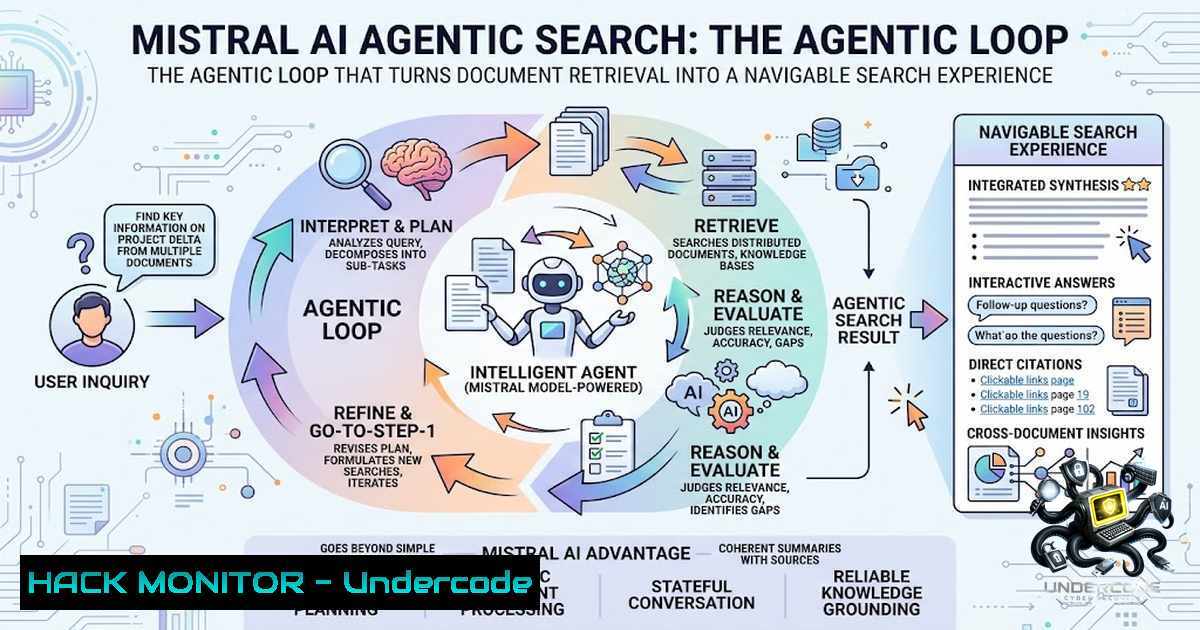
Retrieval-Augmented Generation (RAG) has long been the standard for integrating large language models with external knowledge bases—but it suffers from a fundamental flaw: it retrieves once and hopes for the best. Mistral AI’s Agentic Search, launched on August 20, 2026, replaces this one-shot retrieval paradigm with a navigable loop where the model drives itself using five file-like operations. Instead of pulling a few chunks and crossing its fingers, the system searches, opens, navigates, reads, and greps its way through documents until it finds verifiable evidence—tripling accuracy on financial benchmarks while cutting latency by nearly 40%.
Learning Objectives & Secrets:
- Objective 1: Master Agentic Search’s Five-Operation Toolset – Understand how
search,open,navigate,read, and `grep` transform document retrieval from a blind guess into an interactive, evidence-driven process. -
Objective 2 Secret Tip: Exploit the Loop for Source Verification – The real power isn’t just finding answers—it’s verifying them. Agentic Search can cross-reference multiple sources, open specific pages or tables, and confirm claims before generating a response. Use this to eliminate hallucinated citations in compliance-heavy workflows.
-
Objective 3 Secret Tip: Optimize Token Efficiency Through Selective Reading – Traditional RAG stuffs entire file contents into context windows regardless of relevance. Agentic Search returns only what’s needed, reducing token consumption by up to one-third while maintaining accuracy. The secret: let the agent read sparingly and navigate precisely.
You Should Know:
- The Five Operations: How Agentic Search Works Under the Hood
Agentic Search exposes a toolset that will feel familiar to anyone who has used a terminal:
– `search` – Finds relevant documents using existing indexes (vector, BM25 keyword, or hybrid).
– `open` – Opens a specific document for inspection.
– `navigate` – Moves to a specific page, section, or region within a document.
– `read` – Retrieves content at a given location.
– `grep` – Finds patterns inside an open document.
This mapping is deliberate. Classic RAG treats a corpus as a bag of chunks and asks an embedding model to guess which chunks matter before the reasoning model has seen anything. Agentic Search inverts the order: the model reads a little, decides what it still needs, and goes and gets it.
Step‑by‑step guide to building a Websearch Agent with Agentic Search:
from mistralai.client import MistralClient
from mistralai.models.agents import Agent

client = MistralClient(api_key="your-api-key")

Create an agent with web search capability
websearch_agent = client.beta.agents.create(
model="mistral-medium-latest",
description="Agent able to search information over the web and documents",
name="Agentic Search Agent",
instructions="""You have the ability to perform web searches with `web_search`
to find up-to-date information. You can also search documents using the five
operations: search, open, navigate, read, and grep.""",
tools=[{"type": "web_search"}],
completion_args={"temperature": 0.3, "top_p": 0.95}
)

Start a conversation
response = client.beta.conversations.start(
agent_id=websearch_agent.id,
inputs="Find the latest financial report and verify the revenue figures from Q2 2026"
)
For local agent deployment using `mistral.rs`:
 Install mistral.rs
cargo install mistralrs-server

Run a local agent with tool loop support
mistralrs-server -i plain -m mistralai/Mistral-7B-Instruct-v0.3 -a auto
The agentic loop lets the server handle tool calls inside a single request—the model requests a tool, executes it, and continues the loop until the answer is complete.
2. Benchmark Performance: The Numbers That Matter
Mistral’s internal evaluations reveal dramatic improvements across two challenging document benchmarks:
| Benchmark | Corpus | Model | Accuracy Gain |
|–|–|-||
| FinanceBench | 368 SEC filings, 150 questions | Mistral Medium 3.5 | 26.7% → 86% (+47.3pp) |
| FinanceBench | 368 SEC filings, 150 questions | GLM-5.2 | +52.6pp |
| OfficeQA Pro | 696 Treasury Bulletins, 133 questions | GLM-5.2 | 6.3% → 51.9% (+45.6pp) |
| OfficeQA Pro | 696 Treasury Bulletins, 133 questions | Mistral Medium 3.5 | +27.1pp |
The largest FinanceBench gain came from GLM-5.2—a model Mistral does not make. This proves the agentic loop is not a Mistral-model trick; it improves whatever model is driving it. Token usage on OfficeQA Pro dropped by up to 33.7%, and P90 latency fell from 255 seconds to 154 seconds while the model takes more turns.
Step‑by‑step guide to implementing a Retrieval Pipeline with Search Toolkit:
from mistralai.search.toolkit.retrieval import QueryEngine
from mistralai.search.toolkit.retrieval.retrievers import VectorRetriever, KeywordRetriever
from mistralai.search.toolkit.retrieval.rerankers import LLMReRanker
from mistralai.search.toolkit.retrieval.pre_processors import LLMQueryRewriter

Configure hybrid retrieval
vector_retriever = VectorRetriever(embedding_model="mistral-embed")
keyword_retriever = KeywordRetriever(algorithm="BM25")

query_engine = QueryEngine(
retriever=[vector_retriever, keyword_retriever],  Hybrid search
query_rewriter=LLMQueryRewriter(model="mistral-medium-latest"),
rerankers=[LLMReRanker(model="mistral-medium-latest")]
)

result = await query_engine.search(
query="What were the total revenues for Q2 2026?",
top_k=10,
include_metadata=True,
include_content=True
)

print(f"Results: {len(result.results)}")
- Agentic Search vs. Traditional RAG: The Paradigm Shift
The difference between RAG and Agentic Search comes down to one word: agency.
- Traditional RAG – Retrieves fragments judged relevant from an index, passes them to the model, and generates a response. This breaks when information doesn’t appear in the first results, or when it’s scattered across tables, footnotes, annexes, or contract clauses.
- Agentic Search – The model can modify its query, open documents, browse different sections, compare multiple sources, and grep for specific expressions before formulating a response.
Linux/Windows command analogy for understanding the loop:
 Traditional RAG = one-shot grep
grep -r "revenue" ./documents/ | head -5

Agentic Search = interactive exploration
find ./documents -1ame ".pdf" -exec pdftotext {} - \; | \
grep -A 10 -B 10 "revenue" | \
less  navigate, read, grep iteratively
Step‑by‑step guide to setting up a complete RAG pipeline with Search Toolkit:
 Clone the starter app
git clone https://github.com/mistralai/search-starter-app
cd search-starter-app

Install dependencies (Python 3.12+, Docker, uv)
uv venv
source .venv/bin/activate  On Windows: .venv\Scripts\activate
uv pip install -e .

Start Vespa for hybrid search
docker-compose up -d

Run ingestion pipeline
python -m search_starter.ingest --input ./documents/ --index my_index

Evaluate retrieval quality
python -m search_starter.evaluate --test-set ./tests/ --metrics recall,precision,mrr,ndcg
The evaluation harness is the killer feature: you can finally measure whether your retrieval is actually better after a config change, instead of guessing from anecdotal queries.
- Security and API Hardening for Agentic Search Deployments
When deploying Agentic Search in production environments—especially with sensitive financial or legal documents—security considerations are paramount.
API Security Configuration:
 Mistral Agents API with secure tool access
agent = client.beta.agents.create(
model="mistral-medium-latest",
tools=[
{"type": "web_search_premium"},  Includes news provider verification
{"type": "document_search", "restricted": True}
],
completion_args={
"temperature": 0.3,
"top_p": 0.95,
"security": {
"allowed_domains": [".finance.gov", ".sec.gov"],
"blocked_patterns": [r"password|secret|confidential"],
"max_documents": 20
}
}
)
Cloud Hardening Checklist:
- Restrict document access – Use Search Toolkit’s document model with deterministic identity derived from `source_id` and a locator.
- Implement semantic caching – Cache results by query similarity to reduce latency and API costs.
- Enable hybrid search with reranking – Combine BM25 sparse retrieval with dense embedding retrieval, then rerank with an LLM for precision.
- Audit tool execution – Monitor `tool.execution` entries in conversation responses for metadata including timestamps and unique identifiers.
Windows/Linux command for monitoring agent activity:
 Linux: Monitor API calls and tool executions
tail -f /var/log/mistral-agent.log | grep -E "tool.execution|search|open|navigate"

Windows PowerShell: Similar monitoring
Get-Content -Path C:\Logs\mistral-agent.log -Wait | Select-String "tool.execution"
5. Practical Use Cases and Integration Patterns
Agentic Search is particularly suited for environments that use large or sensitive documents—financial information, legal contracts, regulatory filings. Key integration patterns:
- Enterprise search across document repositories – Index internal knowledge bases and let agents navigate them interactively.
- Contract review and clause extraction – Navigate to specific sections, grep for terms, and verify against multiple versions.
- Regulatory compliance – Cross-reference SEC filings, Treasury bulletins, and internal policies.
Mistral Search Toolkit Quickstart (Production-Ready):
 Requirements: Python 3.12+, Docker, Mistral API key, uv
git clone https://github.com/mistralai/search-toolkit
cd search-toolkit

Set up environment
export MISTRAL_API_KEY="your-api-key"
docker-compose -f docker-compose.vespa.yml up -d

Run the complete pipeline
python -m search_toolkit.pipeline \
--ingest ./data/ \
--index production_index \
--retrieval hybrid \
--rerank llm \
--evaluate --test-set ./tests/
The Search Toolkit handles document parsing, chunking, and embedding generation—custom document formats and preprocessing steps plug in through a standard adapter interface.
What Undercode Say:
- Key Takeaway 1: Agency beats retrieval. Traditional RAG is a passive lookup; Agentic Search is an active investigation. The ability to search, open, navigate, read, and grep transforms document AI from a guessing game into a verifiable process. The 47-point accuracy jump on FinanceBench isn’t incremental—it’s a paradigm shift.
-
Key Takeaway 2: Efficiency isn’t sacrificed for accuracy. Agentic Search does more steps and still finishes faster—P90 latency dropped from 255 to 154 seconds while token consumption fell by a third. The old path was spending time processing bulk context; the new path spends time thinking.
The implications for cybersecurity and compliance are profound. When AI can navigate documents like a human analyst—opening, cross-referencing, and verifying sources—the risk of hallucinated citations in audit trails diminishes significantly. For security teams reviewing penetration test reports, incident response logs, or regulatory filings, Agentic Search offers a path toward verifiable AI-assisted analysis rather than black-box summarization. The fact that the loop improves any model, not just Mistral’s own, suggests this architecture will become the new standard for enterprise document AI.
Prediction:
- +1 Agentic Search will accelerate adoption of AI in regulated industries (finance, legal, healthcare) where source verification is non-1egotiable. The 86% accuracy on FinanceBench with zero fine-tuning signals that general-purpose models, armed with the right retrieval loop, can now compete with specialized solutions.
-
+1 The open-source Search Toolkit will commoditize production RAG pipelines, reducing the “RAG tax” that has slowed AI feature shipping. Teams can now measure retrieval quality scientifically rather than anecdotally.
-
-1 Organizations that fail to implement proper access controls and document restrictions risk exposing sensitive information through agentic loops. The very feature that makes Agentic Search powerful—the ability to navigate freely—also amplifies the blast radius of misconfigured permissions.
-
+1 Mistral’s decision to open-source the Search Toolkit while offering premium features (web_search_premium with news provider verification) positions them as the infrastructure layer for agentic AI. Expect competitors to follow with similar agentic retrieval architectures within 12–18 months.
▶️ Related Video (76% Match):
https://www.youtube.com/watch?v=0z9_MhcYvcY
🎯Let’s Practice For Free:
🎓 Live Courses & Certifications:
Join Undercode Academy for Verified Certifications
🚀 Request a Custom Project:
Secure, high-velocity infrastructure and disruptive technological engineering. Contact our engineering team for high-tier development and proprietary systems:
[email protected]
💎 Smart Architecture | 🛡️ Secure by Design | ⭐ Trusted by Thousands
IT/Security Reporter URL:
Reported By: https://lnkd.in/p/euuwQQtE – Hackers Feeds
Extra Hub: Undercode MoN
Basic Verification: Pass ✅


