
Listen to this Post
Introduction:
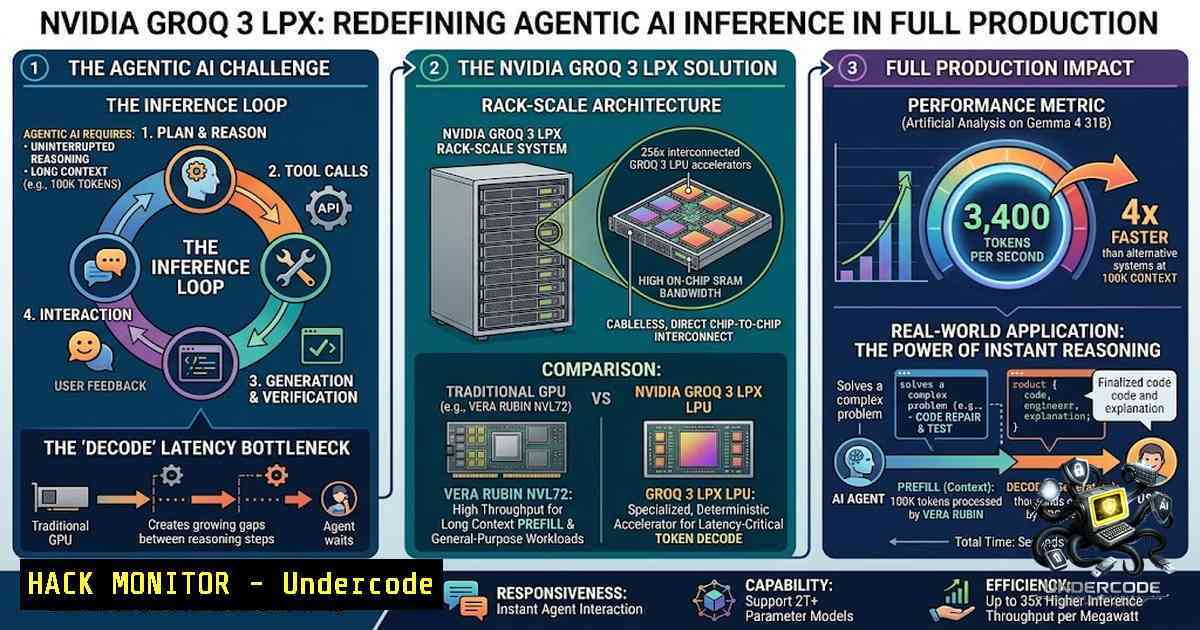
Agentic AI represents a fundamental shift from traditional generative AI—rather than responding to a single user query, agentic systems autonomously reason, plan, call external tools, and execute multi-step tasks across hundreds or thousands of iterative cycles. This paradigm demands two distinct computational capabilities: massive context processing and ultra-low-latency token generation. NVIDIA’s newly announced Groq 3 LPX inference accelerator, now in full production and unveiled at the Hot Chips 2026 semiconductor conference, directly addresses the latter challenge. By delivering a record-breaking 3,400 output tokens per second on the open-source Gemma 4 31B model with a 100,000-token context window—4x faster than the nearest alternative platform—Groq 3 LPX eliminates the historical tradeoff between throughput, interactivity, and intelligence.
Learning Objectives & Secrets:
- Objective 1: Understand Agentic AI Inference Architecture — Learn how Groq 3 LPX disaggregates context processing (handled by NVIDIA Rubin GPUs with high-bandwidth HBM memory) from latency-sensitive token decoding (offloaded to LPU accelerators with deterministic SRAM-based compute).
- Objective 2: Master Benchmarking and Performance Tuning — Secret tip: The 3,400 tokens/sec benchmark was achieved on a private pre-release endpoint with a 100,000-token context. For production deployments, optimize KV-cache sizing and context reuse to maintain performance at scale.
- Objective 3: Deploy and Scale with Hybrid GPU-LPU Inference — Secret tip: Each LPX rack supports up to 256 interconnected LP30 accelerators with 500 MB SRAM per LPU, 150 TB/s SRAM bandwidth, and 2.5 TB/s scale-up bandwidth. Co-design your inference pipeline to route prefill computations to Rubin GPUs and decode phases to Groq LPUs for optimal per-MW throughput—up to 35x higher for trillion-parameter models.
You Should Know:
1. Understanding the Agentic AI Inference Bottleneck
Agentic workloads differ dramatically from conventional LLM inference. In traditional generative AI, a single user query receives one response. Agentic systems, however, unfold reasoning across hundreds to thousands of steps—each step requiring context retrieval, tool calls, code execution, and iterative refinement. This creates two distinct compute challenges: efficiently processing enormous context windows (often exceeding 100,000 tokens) and generating tokens with extremely low latency for each reasoning step.
NVIDIA’s solution is extreme co-design: the Vera Rubin NVL72 platform integrates seven specialized chips across five rack types. Rubin GPUs handle large-scale context ingestion and prefill computation using high-bandwidth HBM4 memory (up to 288 GB per GPU at 22 TB/s bandwidth). Groq 3 LPX, built on technology licensed from Groq Inc., offloads the latency-sensitive decode phase using 256 LPU accelerators per rack, each with 500 MB of on-chip SRAM delivering 150 TB/s bandwidth.
2. Benchmarking and Performance Validation
Independent benchmarking by Artificial Analysis validated NVIDIA’s performance claims. Running the open-source Gemma 4 31B agentic model with a 100,000-token context window, Groq 3 LPX achieved 3,400 output tokens per second—the fastest performance ever recorded for that model. For context, this means an agentic coding task that might take hours on alternative platforms can complete in minutes.
Key benchmarking command (simulated environment):
 Simulate agentic inference latency test with vLLM
python -m vllm.entrypoints.openai.api_server \
--model google/gemma-4-31b \
--tensor-parallel-size 8 \
--max-1um-seqs 256 \
--enable-prefix-caching \
--kv-cache-dtype fp8 \
--gpu-memory-utilization 0.95
For production monitoring, use NVIDIA’s DCGM to track inference latency:
 Monitor GPU and LPU utilization
dcgmi stats -g 0 -s pcie,sm,memory,power --verbose
nvidia-smi dmon -s pucvmet -c 10
3. Deploying Groq 3 LPX in Production Environments
Groq 3 LPX is designed as a rack-scale system. Each 2U liquid-cooled compute tray houses 16 Groq 3 LPUs, host CPU, expansion logic, DRAM, and either BlueField-4 DPUs or ConnectX-9 network cards. The front panel features 32 LPU chip-to-chip optical links and 400Gb/s Ethernet interfaces.
Sample Kubernetes deployment for hybrid inference:
apiVersion: v1
kind: Pod
metadata:
name: groq-inference-pod
spec:
containers:
- name: inference-engine
image: nvcr.io/nvidia/groq-inference:latest
resources:
limits:
nvidia.com/gpu: 4  Rubin GPUs for context
nvidia.com/lpu: 16  Groq LPUs for decoding
env:
- name: CONTEXT_DEVICE
value: "GPU"
- name: DECODE_DEVICE
value: "LPU"
- name: KV_CACHE_SIZE
value: "100000"
Nebius has been announced as the first AI cloud to adopt Groq 3 LPX, integrating it into the Nebius Token Factory production inference service.
4. Network Architecture and Scaling
Scaling agentic inference requires more than compute—networking is equally critical. NVIDIA Spectrum-X Multiplane enables scaling up to 512,000 GPUs without a third switching tier. Each GPU can achieve up to 1,600 Gbit/s using ConnectX-9 SuperNICs. The eight-plane architecture retains approximately 90% bandwidth after a single plane failure and recovers 11x faster than software-based load balancing.
Network performance validation:
 Test multi-plane network latency
ib_write_lat -d mlx5_0 -x 0 -1 10000 --report-errors
 Monitor Spectrum-X fabric health
spectrum-x-cli fabric show --detail
5. Security and Isolation in AI Factories
Agentic AI systems execute code, access files, and call external APIs—creating significant attack surfaces. BlueField-4 DPUs provide hardware-accelerated security isolation, storage acceleration, and observability. Each BlueField-4 implements DOCA (Data Center-on-a-Chip Architecture) with Scale-In functions for access control, storage encryption, and network security.
Security hardening checklist:
 Enable secure boot and TPM
sudo mokutil --enable-validation
sudo tpm2_clear

Configure BlueField-4 DPU firewall
doca firewall add-rule --src-ip 10.0.0.0/8 --dst-port 443 --action allow
doca firewall add-rule --src-ip 0.0.0.0/0 --action drop

Encrypt KV-cache storage
sudo cryptsetup luksFormat /dev/nvme0n1
sudo cryptsetup open /dev/nvme0n1 kv-cache
For API security, implement token-level authentication with mutual TLS:
 Generate client certificates
openssl req -1ew -1ewkey rsa:4096 -days 365 -1odes -x509 \
-subj "/CN=agentic-client" -keyout client.key -out client.crt

Configure nginx reverse proxy with mTLS
server {
listen 443 ssl;
ssl_client_certificate /etc/ssl/ca.crt;
ssl_verify_client on;
location /inference {
proxy_pass http://groq-inference:8000;
}
}
6. Economics of Agentic Inference
Agentic systems consume up to 15x more tokens than traditional AI applications. With Groq 3 LPX paired with Vera Rubin NVL72, organizations achieve up to 35x higher throughput per megawatt for trillion-parameter models. NVIDIA projects this enables 10x more revenue per watt through tiered pricing models that distinguish between standard and premium token generation.
Cost optimization script:
 Estimate inference cost per million tokens
import math
def estimate_cost(tokens_per_sec, model_size, context_len):
 Simplified cost model
base_cost = 0.001  $ per million tokens for standard
if model_size > 1e12:  trillion-parameter
base_cost = 2.5
if context_len > 100000:
base_cost = 1.5
return base_cost  (tokens_per_sec / 3400)  normalized to Groq 3 LPX
What Undercode Say:
- Key Takeaway 1: Groq 3 LPX represents a fundamental architectural shift—NVIDIA is moving beyond monolithic GPU dominance to a heterogeneous compute fabric where specialized LPUs handle latency-critical token decoding while GPUs manage massive context processing. This disaggregation is essential for agentic AI at scale.
-
Key Takeaway 2: The 3,400 tokens/sec benchmark is impressive, but the real story is the ecosystem: Spectrum-X Multiplane scaling to 512,000 GPUs, BlueField-4 security isolation, and Nebius as the first production adopter. NVIDIA is not selling a chip; it’s selling an integrated AI factory.
Analysis: The agentic AI inference market is still nascent, but NVIDIA’s aggressive push with Groq 3 LPX signals that inference, not training, will be the next battleground. Competitors like AMD (with Infera) and specialized startups are racing to optimize token generation, but NVIDIA’s extreme co-design advantage—controlling the entire stack from silicon to networking—creates a formidable moat. The licensing deal with Groq Inc. for LPU technology also demonstrates NVIDIA’s willingness to acquire rather than build when speed to market is critical. For enterprises, the key decision will be whether to adopt NVIDIA’s integrated platform or build custom inference pipelines using open-source tools like vLLM with Mooncake distributed KV caching. The latter offers flexibility but requires significant engineering investment to match the 35x per-MW throughput advantage of Vera Rubin with LPX.
Prediction:
- +1 Groq 3 LPX will accelerate enterprise adoption of agentic AI by 18-24 months, as the 4x latency improvement makes real-time multi-step reasoning commercially viable for customer service, coding, and research applications.
- +1 The disaggregated prefill-decode architecture will become industry standard by 2028, with competitors adopting similar GPU-LPU hybrid designs.
- -1 Organizations without specialized inference infrastructure will face a 3-5x cost disadvantage per million tokens, potentially widening the AI capability gap between large cloud providers and smaller enterprises.
- -1 The complexity of managing heterogeneous GPU-LPU clusters will increase operational overhead; SRE teams must develop new observability and orchestration skills to avoid performance degradation.
▶️ Related Video (76% Match):
🎯Let’s Practice For Free:
🎓 Live Courses & Certifications:
Join Undercode Academy for Verified Certifications
🚀 Request a Custom Project:
Secure, high-velocity infrastructure and disruptive technological engineering. Contact our engineering team for high-tier development and proprietary systems:
[email protected]
💎 Smart Architecture | 🛡️ Secure by Design | ⭐ Trusted by Thousands
IT/Security Reporter URL:
Reported By: https://lnkd.in/p/eiQgj2Qm – Hackers Feeds
Extra Hub: Undercode MoN
Basic Verification: Pass ✅


