
Listen to this Post
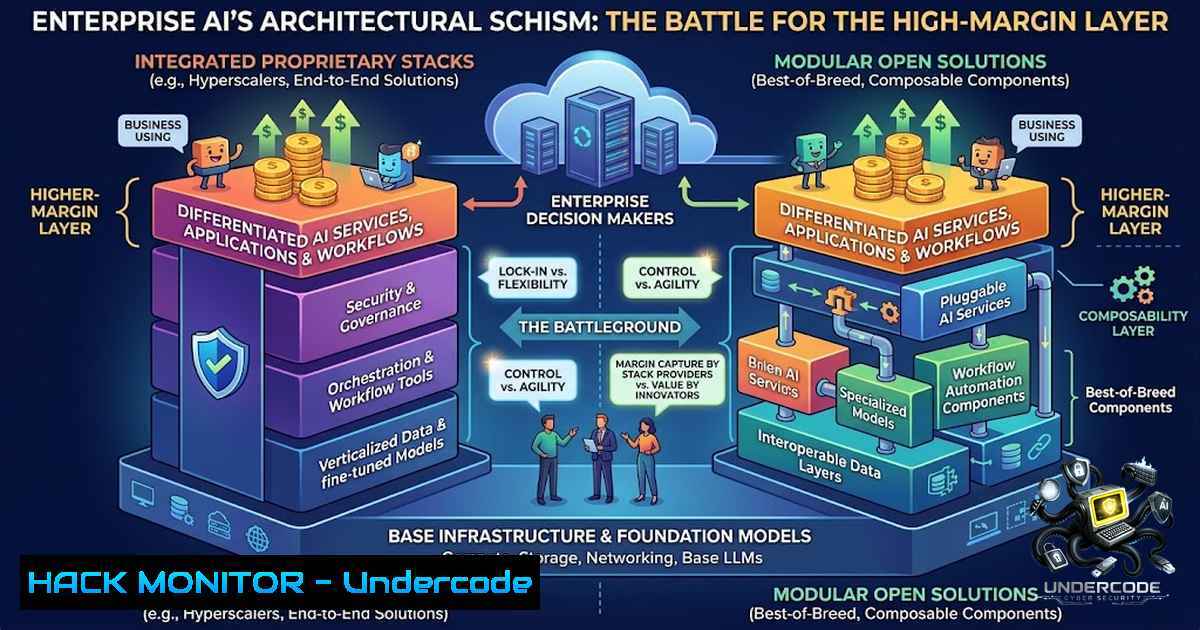
Introduction:
The current discourse surrounding enterprise AI is a masterclass in strategic misdirection. While public executives debate benchmark scores and token economics as if questioning the technology’s potential, they are actually engaged in a fierce architectural war over where value will accrue in the future stack. This conflict is fundamentally about cybersecurity and market control, determining whether the “brain” of the operation (the foundation model) or the “nervous system” (the integration layer) will hold the keys to the kingdom and the monopolistic pricing power.
Learning Objectives & Secrets:
- Objective 1: Understand the “Narrative War.” Learn to distinguish between genuine technical skepticism and calculated market positioning used by vendors like Palantir.
- Objective 2 (Secret): The “Boring” Moat. The secret tip is that the real defensibility doesn’t lie in the intelligence of the model but in the “boring” infrastructure: the proprietary connectors, the ontology mapping, and the permission schemas that are hellishly difficult to replicate.
- Objective 3 (Secret): Commoditization Strategy. The secret to enterprise bargaining power is treating Large Language Models (LLMs) as interchangeable “reasoning engines.” This prevents vendor lock-in and forces pricing down, turning raw tokens into a low-margin utility.
You Should Know:
- The System Integration Model as a Security Buffer
The “Frontier Capture Model” presents a massive security risk: one centralized model absorbing all workflow logic and permission controls acts as a single point of failure. The “System Integration Model” mitigates this by distributing risk across modular components. This is akin to a Zero-Trust architecture.
Step‑by‑step guide: To implement this in your environment, you must decouple your application logic from the AI provider.
– Step 1: Deploy an AI Gateway (e.g., using open-source tools like LiteLLM or Portkey). This acts as a reverse proxy.
– Step 2: Configure the Gateway to route requests based on cost/performance to multiple models (Claude, Gemini, Llama 3).
– Step 3: Implement Semantic Caching. Instead of pinging a model every time, cache common queries via Redis with a hashing mechanism to reduce token spend.
Technical Command/Config (YAML for LiteLLM Proxy):
model_list:
- model_name: gpt-4
litellm_params:
model: azure/gpt-4-turbo
api_key: os.environ/AZURE_API_KEY
- model_name: llama3
litellm_params:
model: ollama/llama3
api_base: http://localhost:11434
router_settings:
routing_strategy: "usage-based"  Enforces cost controls
This configuration ensures high availability and prevents “model lock-in” which is a core cybersecurity principle for vendor diversity.
2. Hardening the “Bridge” Against Prompt Injection
If the foundation model is the “brain,” the bridge (or system integration) is the “spinal cord.” This layer is vulnerable to indirect prompt injection where malicious data in the context manipulates outputs. Hardening the integration layer is critical.
Step‑by‑step guide: “Ontology mapping”—the process of connecting AI outputs to your internal data schema—must be secured.
– Step 1: Sanitize external data before it enters the LLM context. Use a “Guardrail” model (e.g., Guardrails AI).
– Step 2: Implement strict JSON schemas for outputs using Pydantic or Zod to prevent the model from instructing the API to perform unintended actions.
– Step 3: Use “Role-Based Access Control (RBAC)” at the orchestration layer. The LLM should never have the API key to delete data; it should only have “read” capabilities for specific vectors.
Code Snippet (Python using guardrails):
from guardrails import Guard
from guardrails.hub import ProfanityCheck, CompetitorCheck

guard = Guard().use(ProfanityCheck(on_fail="filter")).use(CompetitorCheck(on_fail="fix"))
 Validate the input before passing to the API
validated_prompt = guard.validate("User input text here")
- The Economics of Token Spend vs. Operational Metrics
The post highlights that “Token spend is a vanity metric.” Security teams must shift their focus from API usage costs to operational cost (cost per resolved incident or per automated task). High token spending doesn’t correlate with high productivity.
Step‑by‑step guide: Implement an Observability pipeline to map token usage to specific business outcomes.
– Step 1: Attach a unique `request_id` to every API call.
– Step 2: Log the “cost” (input/output tokens) against the “success” (Did the AI complete the task?).
– Step 3: Set up alerts in your SIEM or monitoring tools when token consumption spikes without a corresponding increase in successful task completion, indicating potential misuse or inefficiency.
Linux Command for Log Analysis:
Use `jq` to parse API logs and calculate cost efficiency.
cat api_logs.json | jq 'select(.status=="success") | .cost_total' | awk '{sum+=$1} END {print sum/NR}'
This calculates the average cost per successful request, giving you a “Cost-Per-Happy-Path” metric.
4. Vulnerability Exploitation: The “Narrative War” Risk
The drive toward open-weight models is a deliberate lever to force prices down. However, this introduces a vector for “Model Poisoning” and “Supply Chain Attacks.” When models are commoditized, attackers may contribute to open-source repositories to insert backdoors into the model weights or the inference code.
Step‑by‑step guide: Secure your open-weight model deployments.
- Step 1: Use signed manifests (e.g., Sigstore or SLSA compliance) to verify the origin of the model weights.
- Step 2: Sandbox your inference environment. Run the model in an isolated container (Docker) with no internet access.
- Step 3: Implement “Adversarial Testing” (Red Teaming). Use tools like PyRIT to constantly try to jailbreak the open-weight model.
5. Cloud Hardening for the “Interchangeable Engine”
Running multiple interchangeable engines across clouds (AWS, Azure, GCP) requires a hardened network fabric.
Step‑by‑step guide:
- Step 1: Set up a Private VPC with no public IP access for the inference servers.
- Step 2: Use a Service Mesh (e.g., Istio) for mutual TLS between the API Gateway and the inference engines.
- Step 3: Implement AWS PrivateLink or Azure Private Endpoint to securely connect to frontier model APIs without data traversing the public internet.
6. Operational Decision Loops: The Human-in-the-Loop (HITL)
The “system connecting those engines to proprietary enterprise data schemas, permissions, and operational decision loops” is the most important piece. High-risk actions (like code execution or system commands) must always require human approval.
Step‑by‑step guide:
- Step 1: Design the AI agent to generate a “Plan” of action.
- Step 2: Use a “Breakpoint” function where the system halts and presents the plan to a human via a Slack/Teams notification.
- Step 3: The human approves or denies the “Execution Plan” before the system runs the command or updates the database.
What Undercode Say:
- Key Takeaway 1: The “Intelligence” is becoming a commodity. The actual value and security defendability are moving to the data integration layer—the complex, proprietary systems that connect that intelligence to reality.
- Key Takeaway 2: “Model Lock-in” is a security risk as severe as software vendor lock-in. The aggressive push for open-weights is a strategic defense against a future where a single lab controls the pricing and security policies of the world’s infrastructure.
Analysis:
The post correctly identifies that CEOs are not debating the if but the how of monetization. For cybersecurity professionals, this is a goldmine: it validates that the future “Moat” is in data governance, API security, and identity management—the domains that cybersecurity has always controlled. However, the analysis must be wary; the “Bridge” is a complex target. If the integration layer becomes the single point of monetization, it also becomes the single point of attack. Attackers will shift from trying to “jailbreak the AI” to trying to “hijack the connector” that holds the database keys. The architectural layer that defends the data will become the highest-paid role in the enterprise.
Prediction:
- +1 We will see a proliferation of “AI Integration & Security” roles over “AI Research” roles, as enterprises prioritize connecting data securely over developing new models.
- -1 The complexity of managing multiple models and secure connectors will lead to a rise in “Configuration Drift,” where misconfigurations in the system layer leak more data than model hallucinations ever could.
- +1 The focus on operational outcomes will lead to the standardization of “AI SLAs” (Service Level Agreements) based on accuracy and auditability, forcing vendors to provide more transparent security controls.
- -1 Smaller enterprises will struggle to build and secure these complex “System Integration” layers, effectively creating a two-tiered economy where only the wealthy can afford the security to actually use the technology.
- +1 The narrative shift will accelerate investment in “AI Observability” tools, treating token consumption as a primitive that needs to be combined with business metrics to have any meaning.
▶️ Related Video (88% Match):
🎯Let’s Practice For Free:
🎓 Live Courses & Certifications:
Join Undercode Academy for Verified Certifications
🚀 Request a Custom Project:
Secure, high-velocity infrastructure and disruptive technological engineering. Contact our engineering team for high-tier development and proprietary systems:
[email protected]
💎 Smart Architecture | 🛡️ Secure by Design | ⭐ Trusted by Thousands
IT/Security Reporter URL:
Reported By: https://lnkd.in/p/eCwUQgwt – Hackers Feeds
Extra Hub: Undercode MoN
Basic Verification: Pass ✅


