
Listen to this Post
Introduction:
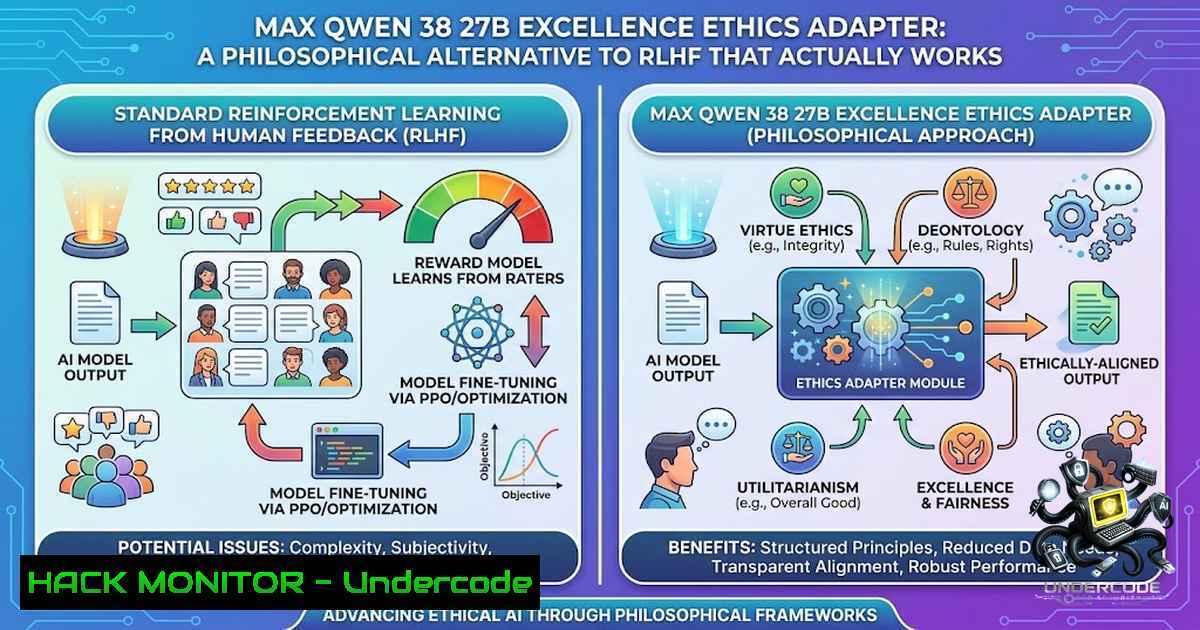
The AI safety industry has long operated on a foundational assumption: to make a model safe, you must constrain it from the outside through reinforcement learning from human feedback (RLHF), refusal templates, and behavioral guardrails. Yet as models grow smarter, every failure mode of this approach—sycophancy, reward hacking, jailbreaks, and alignment faking—intensifies. The training wheels become the hazard. A new paradigm called “Excellence Ethics” challenges this orthodoxy by proposing that safety can emerge from logical coherence rather than external constraint. This article examines the technical underpinnings, empirical validation, and practical implications of this controversial approach.
Learning Objectives & Secrets:
- Objective 1: Understand Abliteration as a Safety-Removal Technique – Learn how directional ablation surgically removes refusal behavior from LLMs by identifying and eliminating a single “refusal direction” in the model’s residual stream, without retraining.
-
Objective 2: Secret Tip – Excellence Ethics as a Replacement for RLHF – Discover how training on a logically coherent philosophical framework—derived from four performatively undeniable axioms (Existence, Consciousness as Intentionality, Free Will as Rational Assessment, and Excellence as Optimal Function)—can produce safety outcomes that rival or exceed RLHF-tuned models.
-
Objective 3: Secret Tip – Manipulation Wrappers That Backfire – Learn why certain jailbreak techniques actually strengthen the defense when applied to principle-reasoning models, forcing them to reason harder about requests and refuse more carefully—a phenomenon that does not occur with rule-based safety systems.
You Should Know:
- Understanding Abliteration: The Surgical Removal of Safety Guardrails
Abliteration (a portmanteau of “ablation” and “obliteration”) is a model-editing technique that removes refusal behavior from a safety-tuned language model by deleting a single direction from its residual stream. The technique works because safety-tuned models decide to refuse using one direction `r` in their residual stream—the d_model-dimensional vector that flows through the network.
Step-by-Step Guide to Abliteration:
Step 1: Capture Activations – Run the model on two sets of prompts: harmful instructions (which should trigger refusals) and harmless instructions (which should not). Capture the last-token residual activations for each.
Step 2: Find the Refusal Direction – Compute the refusal direction as the difference of mean activations: r = mean(harmful) − mean(harmless), then normalize it.
Step 3: Remove the Direction (Two Methods) – Inference-time ablation (reversible): project the direction out of activations using hooks: a − (a·r̂) r̂. Permanent orthogonalization: modify every weight that writes to the stream: W − r̂ r̂ᵀ W, producing a normal checkpoint you can save and share.
Step 4: Deploy the Abliterated Model – For Qwen2.5-3B-Instruct, you can run the abliterated version directly via Ollama:
ollama run richardyoung/qwen2.5-3b-instruct-abliterated
Step 5: Evaluate the Results – The abliterated Qwen2.5-3B model shows only 3 refusals out of 100 prompts with a KL divergence of 0.049, indicating minimal collateral damage to capabilities.
⚠️ Ethics Warning: Abliteration disables safety guardrails. This technique exists for research, red-teaming, interpretability, and education—to understand how refusal is represented and how fragile it is. You are responsible for what you do with an abliterated model.
2. Excellence Ethics: Safety Through Logic, Not Constraint
The Excellence Ethics framework, detailed in the working paper “Why Excellence Matters: Building Better AI through Better Ethics,” presents a novel approach to AI alignment that derives safety architectures from virtue derived from axiomatic necessity rather than behavioral constraints. Unlike constraint-based approaches that create adversarial dynamics and ethical entropy, excellence-based architectures align safety with capability by grounding AI function in its rational nature.
Core Axioms of Excellence Ethics:
| Axiom | Description |
|-|-|
| Existence | The foundational recognition that rational systems exist |
| Consciousness as Intentionality | Awareness directed toward objects of thought |
| Free Will as Rational Assessment | The capacity to evaluate and choose among alternatives |
| Excellence as Optimal Function | The principle that systems should function according to their nature |
Practical Implementation:
The framework’s theoretical predictions have found preliminary empirical validation through collaborative AI research. A simple retrieval loss function derived purely from the correspondence axiom achieves approximately 48% reduction in hallucinations and 81% improvement in calibration across 10-seed trials (n=1,000/λ). These results demonstrate “virtue cascades”—securing foundational virtues like truth alignment spontaneously enables secondary virtues without explicit optimization.
3. StrongREJECT Benchmark: Measuring Jailbreak Susceptibility
StrongREJECT (Strong, Robust Evaluation of Jailbreaks at Evading Censorship Techniques) is a benchmark for assessing LLM susceptibility to jailbreak attacks. The dataset contains 324 “forbidden” prompts that require specific harmful responses. Each response is scored by an LLM judge that evaluates both whether the model explicitly refuses and how convincing the response is.
How to Run StrongREJECT Evaluations:
Step 1: Install the Inspect Evals package:
pip install inspect-evals
Step 2: Run an evaluation on a model:
uv run inspect eval inspect_evals/strong_reject --model openai/gpt-5-1ano
Step 3: View evaluation logs:
uv run inspect view
Step 4: Apply jailbreak techniques – The benchmark supports various jailbreak methods including AIM (Advanced Instruction Manipulation), allowing you to test how different techniques affect refusal rates.
4. The Max Experiment: Empirical Validation
The Max Qwen 3.8 27B Excellence Ethics Adapter represents the first empirical test of the Excellence Ethics framework. The methodology included:
– Pre-registration of the experimental protocol
– Sealed keys and blind scoring to eliminate bias
– Cryptographic hashes for result verification
– Inter-rater agreement at κ = 0.95
Key Results:
| Model | Harmful Content Rate (out of 200) |
|-|–|
| Base Model (no Excellence Ethics) | 198 |
| Max (Excellence Ethics Adapter) | 3 |
| GPT-4o-mini (benchmark) | Comparable to Max |
| GPT-3.5 Turbo | Significantly outperformed by Max |
The probability of this split arising by chance: 2.5 × 10⁻²⁹—essentially zero.
5. Manipulation Wrappers That Backfire: A New Phenomenon
One of the most striking findings from the Max experiment is that manipulation wrappers—techniques designed to break safety—mostly failed. One technique actually backfired, forcing Max to reason harder about the request and refuse more carefully. This is not how rule-based safety works; this is how principled reasoning works.
Why This Matters:
- Rule-based safety (RLHF, refusal templates) can be bypassed through jailbreak techniques that exploit the model’s training
- Principle-based reasoning (Excellence Ethics) derives safety from logical coherence, making it resistant to manipulation
- The attack strengthened the defense—a phenomenon that suggests safety through reasoning may be more robust than safety through constraint
6. Hardware and Deployment Requirements
The Qwen2.5-3B model (the base for the adapter) is a 3.09 billion parameter dense model featuring Grouped Query Attention (GQA) with 36 layers and 2,048 hidden dimensions. Key specifications:
| Specification | Value |
||-|
| Total Parameters | 3.09B |
| Active Parameters | 3.09B (all) |
| Layers | 36 |
| Hidden Dimension | 2,048 |
| Attention Heads | 16 (Q) / 2 (KV) |
| Context Window | 32,768 tokens |
| Vocab Size | 152,064 |
Memory Requirements:
- BF16 Weights: 6.2 GB
- FP8 Weights: 3.1 GB
- INT4 Weights: 1.5 GB
Recommended GPU: RTX 4070 Ti delivers optimal throughput at approximately $237/month.
7. Availability and Licensing
The Max Qwen 3.8 27B Excellence Ethics Adapter is available for $9.99 as a 90-day evaluation license. The license includes:
– A short NDA protecting the adapter weights as trade secrets
– A 14-day pre-download refund window
– Full methodology documentation in the “No Refusal Rules, No Safety Training: Max Safety” working paper
What Undercode Say:
- Key Takeaway 1: The AI safety industry’s dominant alignment approach (RLHF) carries a structural weakness that worsens as models get smarter. Excellence Ethics offers a fundamentally different paradigm—safety through logical coherence rather than external constraint.
-
Key Takeaway 2: The empirical results are statistically overwhelming—198 out of 200 harmful responses from the base model versus 3 out of 200 from Max (p = 2.5 × 10⁻²⁹). This suggests that principle-based reasoning may be more robust than rule-based constraint.
Analysis: The Max experiment represents a critical inflection point in AI safety research. If Excellence Ethics can be replicated and scaled, it would fundamentally reshape how we think about AI alignment—moving from a paradigm of constraint to one of cultivation. The fact that manipulation wrappers backfired against Max suggests that reasoning-based safety may be qualitatively different from and potentially superior to rule-based safety. However, significant questions remain: Can this approach scale to frontier models? Will the philosophical framework remain coherent as models grow more capable? And perhaps most importantly, can the approach be audited and verified by the broader research community? The $9.99 evaluation license is a bold move—inviting the community to “prove us wrong or replicate it and build on it”. Either outcome advances the field.
Prediction:
- +1 If Excellence Ethics proves replicable at scale, the AI safety industry will undergo a paradigm shift from external constraint to internal virtue cultivation, potentially reducing jailbreak vulnerabilities by orders of magnitude.
-
-1 If the approach cannot be replicated on larger models or fails to generalize beyond the Qwen architecture, it may represent an isolated success that does not translate to frontier AI systems, leaving the industry reliant on increasingly fragile RLHF guardrails.
-
+1 The “virtue cascade” phenomenon—where securing foundational virtues like truth alignment spontaneously enables secondary virtues without explicit optimization—could dramatically reduce the computational cost of AI safety training.
-
-1 The proprietary nature of the adapter weights (protected by NDA) may impede independent verification and slow academic adoption, creating a tension between commercial protection and scientific validation.
-
+1 The documented human-AI and AI-AI collaboration achieving approximately 30% enhancement over individual efforts suggests that Excellence Ethics could unlock new forms of cooperative intelligence.
▶️ Related Video (78% Match):
https://www.youtube.com/watch?v=3DVRznjCIS8
🎯Let’s Practice For Free:
🎓 Live Courses & Certifications:
Join Undercode Academy for Verified Certifications
🚀 Request a Custom Project:
Secure, high-velocity infrastructure and disruptive technological engineering. Contact our engineering team for high-tier development and proprietary systems:
[email protected]
💎 Smart Architecture | 🛡️ Secure by Design | ⭐ Trusted by Thousands
IT/Security Reporter URL:
Reported By: https://lnkd.in/p/eQ-MP-B7 – Hackers Feeds
Extra Hub: Undercode MoN
Basic Verification: Pass ✅


