
Listen to this Post
Introduction:
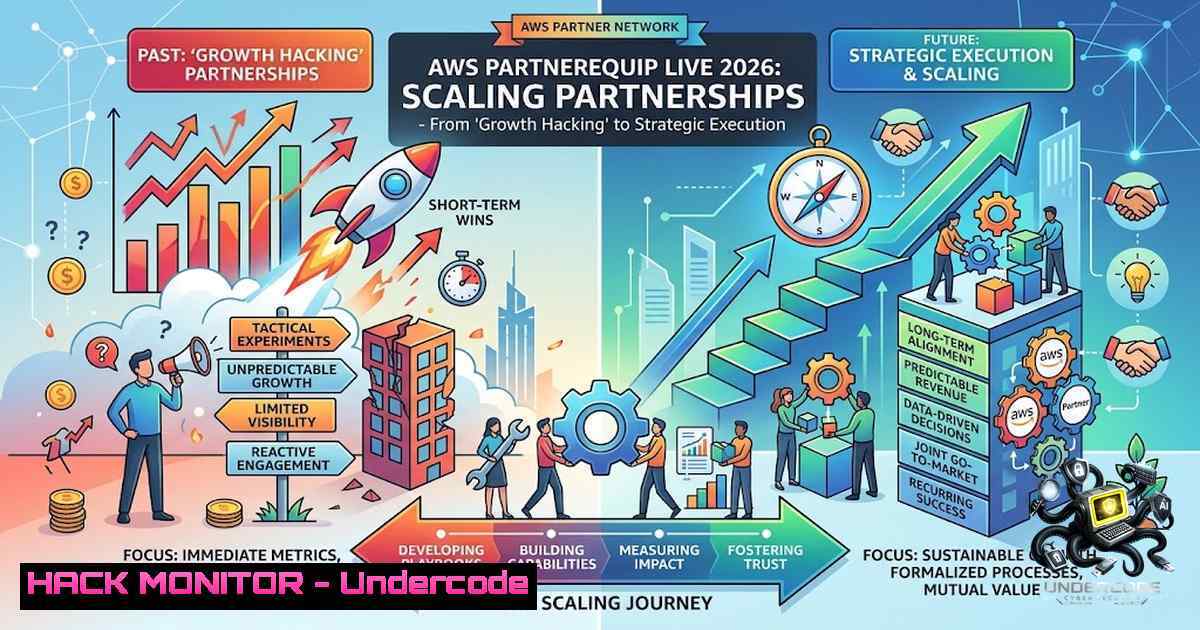
At AWS PartnerEquip Live in San Francisco, Docebo’s ISV-A track illuminated a critical inflection point for cloud alliances: the transition from experimental, high-cost “growth hacking” to a surgical, executive-driven strategy. While technical integration and marketplace setup are foundational, the true challenge lies in evolving the partnership to focus purely on pipeline generation, deal closure, and visible executive alignment. For organizations leveraging Amazon Web Services (AWS), the event underscored that maturing partnerships require shifting from broad-based enablement to targeted, ask-driven collaboration, where understanding AWS’s internal motivations becomes as crucial as technical competence.
Learning Objectives & Secrets:
- Objective 1: The Maturity Pivot Strategy
Learn to identify the exact moment when a “try-everything” approach becomes counterproductive. The secret tip is to map every initiative (PLG, MAP, verticals) against a weighted scoring model that prioritizes resource allocation based on historical conversion rates rather than potential hype. -
Objective 2: AI-Augmented Co-Selling
Master the integration of AI agents into the co-selling workflow. The secret is not to replace human sellers but to use generative AI to synthesize account intelligence, identify trigger events, and generate pre-call briefing documents that align Docebo’s solutions with AWS’s vertical pain points in real-time. -
Objective 3: Executive Visibility Engineering
Develop a “Funding Request Framework” that explicitly quantifies the ROI for AWS. The secret tip involves creating a shared success dashboard that tracks joint pipeline velocity and deal influence, allowing both parties to present a unified narrative to their respective executive boards.
You Should Know:
- AWS CLI & API Automation for Partnership Health Checks
To scale effectively, you must automate the monitoring of your AWS infrastructure and partnership-related resources (e.g., Marketplace listings, SaaS subscriptions). Use the AWS CLI to pull critical metrics that inform strategic decisions.
Step-by-step guide:
- Install and configure AWS CLI:
On Linux/macOS: `curl “https://awscli.amazonaws.com/awscli-exe-linux-x86_64.zip” -o “awscliv2.zip” && unzip awscliv2.zip && sudo ./aws/install`
On Windows: Download the MSI installer from AWS and run it. - Configure credentials:
Run `aws configure` and input your Access Key ID, Secret Access Key, region (e.g., us-west-2), and output format (json). - Check Marketplace Entitlements:
`aws marketplace-catalog list-entities –catalog AWSMarketplace –entity-type Product` – This returns a list of your products, ensuring your ISV offerings are visible. - Monitor Service Quotas:
`aws service-quotas get-service-quota –service-code ec2 –quota-code L-12345678` – Ensures you have the capacity for new co-selling opportunities without hitting scaling walls. - Automate Cost Reporting:
`aws ce get-cost-and-usage –time-period Start=2026-08-01,End=2026-08-31 –granularity MONTHLY –metrics “AmortizedCost”` – Use this to produce a breakdown of AWS costs associated with specific partner initiatives, providing data for the “ask for funding” conversation.
- Securing the Cloud Foundation: IAM and Cross-Account Roles for Partners
When scaling with AWS, security posture must mature. Moving from “try everything” to “strategic execution” requires hardened Identity and Access Management (IAM) policies to facilitate secure co-selling and shared data access without compromising tenant isolation.
Step-by-step guide:
- Create a Cross-Account Role for AWS Partner:
Define a trust policy allowing AWS’s account to assume a role in your Docebo account. Example JSON for the trust relationship:{ "Version": "2012-10-17", "Statement": [ { "Effect": "Allow", "Principal": { "AWS": "arn:aws:iam::AWS_PARTNER_ACCOUNT_ID:root" }, "Action": "sts:AssumeRole", "Condition": { "StringEquals": { "sts:ExternalId": "UNIQUE_EXTERNAL_ID" } } } ] } - Attach a Managed Policy for Read-Only Access:
Use `arn:aws:iam::aws:policy/ReadOnlyAccess` for initial audits, then refine to a custom policy for specific S3 buckets or RDS instances that support the partnership. - Implement AWS Organizations – Service Control Policies (SCPs):
To enforce the “no growth hacking” principle, create an SCP that restricts creation of non-compliant resources (e.g., restricting instance types that are not approved for Docebo’s architecture). - Enable AWS CloudTrail for all accounts:
Ensure logs are sent to a centralized S3 bucket with MFA Delete enabled. Use the command:aws cloudtrail create-trail --1ame Docebo-Partner-Trail --s3-bucket-1ame docebo-partner-logs --is-multi-region-trail. - Rotate Keys Programmatically:
Run a weekly script using `aws iam rotate-access-key` to rotate IAM user keys, reducing the attack surface for misconfigurations often found in rapid-growth phases.
- API Security and WAF Configuration for Marketplace Integrations
As you focus on “what drives pipeline,” your public APIs must be resilient. AWS WAF and API Gateway are your first lines of defense.
Step-by-step guide:
- Deploy an API Gateway with WAF:
Create a WebACL using the AWS CLI:
`aws wafv2 create-web-acl –1ame Docebo-Marketplace-ACL –scope REGIONAL –default-action Block={} –visibility-config SampledRequestsEnabled=true,CloudWatchMetricsEnabled=true,MetricName=DoceboMarketplace`
– Associate WAF with API Gateway:
`aws wafv2 associate-web-acl –web-acl-arn –resource-arn `
- Rate-Based Rules:
Add a rule to block IPs exceeding 100 requests per minute:
`aws wafv2 create-rule-group –1ame RateLimitRule –scope REGIONAL –capacity 500 –visibility-config …`
– Enable AWS Shield Advanced:
To protect against DDoS during major co-selling campaigns, utilize:
`aws shield create-subscription` (if not already enabled).
- Test API Security:
Run a simple `curl -X GET https://your-api-gateway-url/health` and monitor the `x-amzn-RequestId` in CloudWatch logs to ensure the WAF is inspecting traffic correctly.
4. Linux/Windows Hardening for ISV Workloads
Since Docebo runs workloads that must be secure and performant for joint customers, hardening the underlying OS is non-1egotiable.
Step-by-step guide (Linux):
- Disable Root SSH and Implement Key-Based Auth:
Edit/etc/ssh/sshd_config: `PermitRootLogin no` andPasswordAuthentication no. Restart:sudo systemctl restart sshd. - Set Up Fail2Ban:
`sudo apt-get install fail2ban` (Ubuntu/Debian) or `sudo yum install fail2ban` (Amazon Linux). Configure `/etc/fail2ban/jail.local` to ban IPs after 5 failed attempts. - Implement Kernel Hardening:
Add `kernel.dmesg_restrict=1` and `net.ipv4.tcp_syncookies=1` to `/etc/sysctl.conf` and apply withsudo sysctl -p.
Step-by-step guide (Windows):
- Use PowerShell to Disable Unused Services:
`Get-Service | Where-Object {$_.StartType -eq ‘Automatic’ -and $_.Status -1e ‘Running’} | Set-Service -StartupType Disabled`
– Configure Windows Firewall:
`New-1etFirewallRule -DisplayName “Block-RDP-Specific-IP” -Direction Inbound -LocalPort 3389 -Protocol TCP -Action Block -RemoteAddress`
– Enable Credential Guard:
`Set-ItemProperty -Path “HKLM:\SYSTEM\CurrentControlSet\Control\DeviceGuard” -1ame “EnableVirtualizationBasedSecurity” -Value 1`
5. Cloud Cost Optimization (FinOps) for Strategic Spending
The post mentions that “resource-heavy” strategies become unsustainable. Implementing FinOps using AWS tools ensures you can ask for funding with clear ROI data.
Step-by-step guide:
- Set Up AWS Budgets:
`aws budgets create-budget –account-id–budget file://budget.json` (where budget.json defines the spending limit). - Enable Compute Optimizer:
`aws compute-optimizer get-ec2-instance-recommendations` to identify idle or over-provisioned EC2 instances that can be downsized. - Implement S3 Lifecycle Policies:
Automate transition to Glacier: `aws s3api put-bucket-lifecycle-configuration –bucket docebo-data –lifecycle-configuration file://lifecycle.json`
– Use Cost Anomaly Detection:
`aws ce get-anomaly-monitors` – create monitors for the “AWS Partner” tagged resources to get alerts when spending deviates from the norm.
- Vulnerability Exploitation & Mitigation in the Co-Selling Environment
When co-selling, data sharing between AWS and Docebo increases the attack surface. You must simulate and mitigate potential exploits.
Step-by-step guide:
- Install AWS Inspector:
`aws inspector2 enable –resource-types EC2` to scan for software vulnerabilities in your partner-facing instances. - Run a Simulated SSRF Attack:
Use a tool like `nmap` to scan for open metadata endpoints (169.254.169.254). Ensure your security groups explicitly block outbound access to this IP for non-management instances. - Patch Management Automation:
Create a Systems Manager Maintenance Window:
`aws ssm create-maintenance-window –1ame “Docebo-Patch-Window” –schedule “cron(0 2 ? )” –duration 2 –cutoff 1`
– Review VPC Flow Logs:
Enable VPC Flow Logs to detect lateral movement:
`aws ec2 create-flow-logs –resource-type VPC –resource-id vpc-xxxxxx –traffic-type ALL –log-destination-type cloud-watch-logs –log-destination arn:aws:logs:…`
– Conduct a “Chaos Engineering” Day:
Use AWS Fault Injection Simulator to test how your architecture holds up under stress, ensuring that the “try-everything” phase’s legacy code doesn’t break during a critical pipeline push.
What Undercode Say:
- Key Takeaway 1: The transition from “growth hacking” to “strategic scaling” is triggered by the realization that diversified initiatives drain resources faster than they generate net-1ew pipeline. The secret lies in rigorously auditing past experiments (PLG, MAP, vertical plays) and ruthlessly discarding those that do not show a clear 3x ROI against investment, a principle echoed in the event’s focus on “what drives pipeline.”
- Key Takeaway 2: AI agents are augmenters, not replacements. The most effective co-selling strategies utilize generative AI to enhance human interaction—providing real-time competitive intelligence and summarizing complex AWS vertical requirements—allowing Docebo’s sales teams to focus on relationship building while AI handles the data synthesis.
Analysis:
This insight underscores a broader industry shift: the era of indefinite experimentation is closing for mature partnerships. The post highlights that executive visibility is not a byproduct but a deliverable. To succeed, partners must articulate their ask with surgical precision, linking it directly to AWS’s strategic goals (e.g., Public Sector penetration). The technical ramifications are immense—moving from ad-hoc scripts to hardened CI/CD pipelines that support these asks. It implies that Docebo will likely invest heavily in data analytics to prove pipeline influence, possibly integrating with AWS Partner Network (APN) tools via REST APIs to automate evidence collection. Furthermore, the focus on “what’s in it for AWS” suggests a future where partnership terms are dynamically priced based on consumption metrics, requiring real-time billing integration. The takeaway for other ISVs is clear: if you cannot immediately answer “How does this benefit AWS?”, you are not ready to scale.
Prediction:
- +1 Partnerships will evolve into “Outcome-Based Alliances” by 2027, where funding is released contingent upon hitting specific joint pipeline targets, shifting risk away from partners and onto shared success metrics.
- -1 Organizations that fail to sunset their “try-everything” cultures will face a 40% increase in cloud operational waste within the next 12 months, as AWS Marketplace and co-selling costs compound exponentially without a focused strategy.
- +1 AI-driven co-pilots will become the standard interface for partnership managers, with AWS Bedrock custom models ingesting Slack/Teams data to predict executive sponsorship opportunities, drastically reducing the time from partner identification to funding ask.
- -1 The reliance on “executive visibility” as a metric may lead to a superficial focus on vanity metrics, potentially blinding leadership to underlying technical debt until a critical security breach occurs during a large co-selling campaign.
- +1 Docebo’s Public Sector focus will catalyze a new wave of compliance-as-a-service features within their LMS, creating a distinct competitive moat that forces AWS to provide more tailored support for FedRAMP and GDPR regions.
▶️ Related Video (84% Match):
🎯Let’s Practice For Free:
🎓 Live Courses & Certifications:
Join Undercode Academy for Verified Certifications
🚀 Request a Custom Project:
Secure, high-velocity infrastructure and disruptive technological engineering. Contact our engineering team for high-tier development and proprietary systems:
[email protected]
💎 Smart Architecture | 🛡️ Secure by Design | ⭐ Trusted by Thousands
IT/Security Reporter URL:
Reported By: https://lnkd.in/p/eSJ5_wwA – Hackers Feeds
Extra Hub: Undercode MoN
Basic Verification: Pass ✅


