Listen to this Post
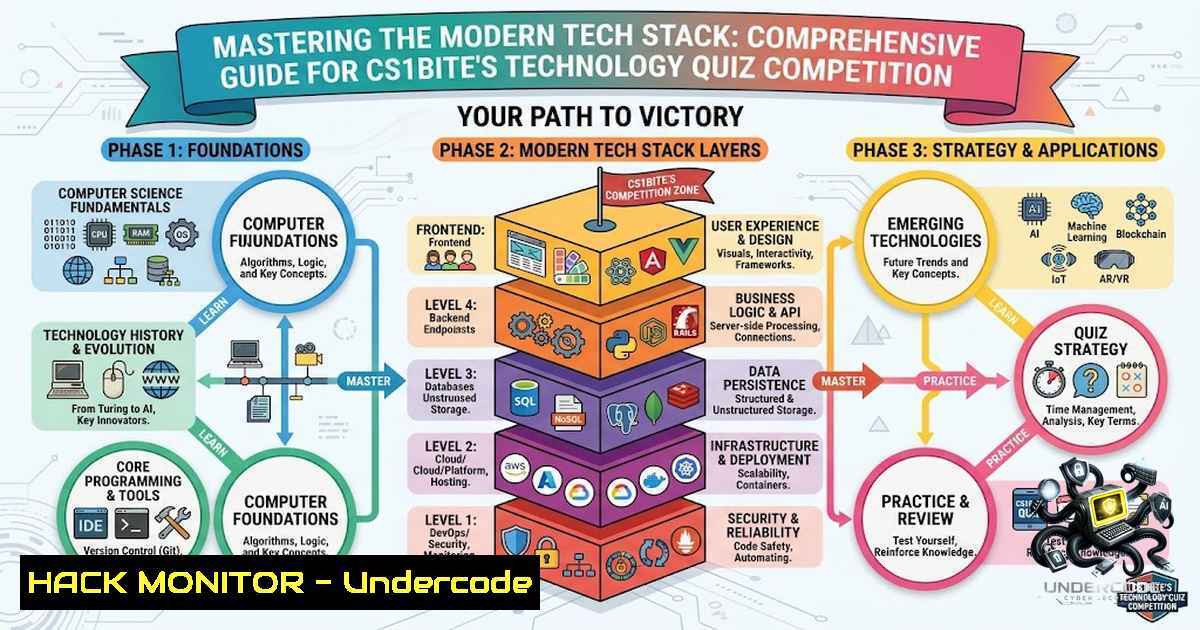
Introduction:
In an era where digital transformation dictates market relevance, the ability to navigate complex IT ecosystems—from cloud infrastructure to AI security—is no longer optional but mandatory. The CS1BITE Technology Quiz Competition emerges as a critical benchmark for professionals and students to validate their cross-domain technical proficiency. This event serves as a stress-test for your knowledge across programming, networking, and cybersecurity, simulating real-world scenarios where integrated technical skills are essential for problem-solving.
Learning Objectives & Secrets:
- Objective 1: Master Core Programming Logic: Develop the ability to write efficient code in C, Python, and Java by understanding memory management and algorithmic complexity. Secret Tip: Focus on recursion and pointer arithmetic in C to solve complex logical puzzles quickly.
- Objective 2: Decode Web and Database Vulnerabilities: Learn to identify SQL injection and XSS flaws in web applications using React and Node.js. Secret Tip: Always test query parameters with sleep commands (e.g.,
' OR SLEEP(5)--) to detect blind SQL injection points during pentesting. - Objective 3: Operationalize AI and Cloud Security: Implement MLOps pipelines on AWS/GCP while securing endpoints with IAM policies. Secret Tip: Use `aws sts assume-role` to test privilege escalation paths in cloud environments before deploying models.
You Should Know:
1. Comprehensive Guide to Programming and Database Fundamentals
This section expands on the post’s emphasis on programming (C, C++, Python, Java) and databases (SQL). To succeed in the quiz and real-world applications, understanding the interplay between application logic and data storage is vital. For instance, in Python, memory management via garbage collection can impact performance, while in SQL, query optimization determines response times. Let’s explore a practical setup for a Python application connecting to a PostgreSQL database, which is a common architecture.
Start by installing PostgreSQL on Linux: sudo apt-get install postgresql postgresql-contrib. For Windows, download the installer from PostgreSQL official site. Once installed, create a database and user:
CREATE DATABASE quiz_db;
CREATE USER quiz_user WITH PASSWORD 'secure_pass';
GRANT ALL PRIVILEGES ON DATABASE quiz_db TO quiz_user;
Now, integrate this with a Python script using psycopg2. This script demonstrates connection pooling and parameterized queries to prevent SQL injection:
import psycopg2
from psycopg2 import pool

try:
connection_pool = psycopg2.pool.SimpleConnectionPool(1, 20, user="quiz_user",
password="secure_pass",
host="127.0.0.1",
port="5432",
database="quiz_db")
conn = connection_pool.getconn()
cursor = conn.cursor()
cursor.execute("SELECT  FROM users WHERE username = %s;", ("admin",))
print(cursor.fetchone())
except Exception as e:
print(f"Error: {e}")
finally:
connection_pool.putconn(conn)
This code not only addresses database connectivity but also highlights best practices in API security—a key topic in the quiz.
2. Network Security and Ethical Hacking Techniques
The quiz covers networking and cybersecurity, which require hands-on knowledge of packet analysis and vulnerability exploitation. For ethical hacking, mastering `nmap` for network scanning and `Wireshark` for traffic analysis is fundamental. Let’s walk through a network hardening exercise on a Linux server.
First, identify open ports using nmap -sV 192.168.1.100. This reveals services like SSH (port 22) and HTTP (port 80). To harden SSH, edit /etc/ssh/sshd_config:
PermitRootLogin no
PasswordAuthentication no
AllowUsers tech_user
Restart SSH: sudo systemctl restart sshd. For Windows, use PowerShell to configure Windows Firewall: New-1etFirewallRule -DisplayName "Block Port 23" -Direction Inbound -Protocol TCP -LocalPort 23 -Action Block. These commands mitigate brute-force attacks—a common threat discussed in cybersecurity modules.
Additionally, understanding MITM attacks is crucial. Use `arpspoof` on Kali Linux to test network defenses: arpspoof -i eth0 -t 192.168.1.1 192.168.1.100. This redirects traffic to your machine. Mitigate this by enabling port security on switches or using static ARP entries. These practical steps prepare you for both the quiz and real-world security roles.
3. Cloud Computing and Infrastructure as Code (IaC)
Cloud computing is a major quiz topic, and mastering IaC tools like Terraform is essential. Terraform allows you to provision cloud resources securely. Here’s a step-by-step guide to deploying a hardened AWS EC2 instance using Terraform.
Install Terraform on Linux: wget https://releases.hashicorp.com/terraform/1.5.0/terraform_1.5.0_linux_amd64.zip` and unzip. On Windows, download the binary and add it to PATH. Create a `main.tf` file:
provider "aws" {
region = "us-east-1"
}
resource "aws_security_group" "web_sg" {
name = "web_sg"
description = "Allow HTTP and SSH"
ingress {
from_port = 80
to_port = 80
protocol = "tcp"
cidr_blocks = ["0.0.0.0/0"]
}
ingress {
from_port = 22
to_port = 22
protocol = "tcp"
cidr_blocks = ["203.0.113.0/24"]  Restrict SSH to specific IP
}
}
resource "aws_instance" "web" {
ami = "ami-0c55b159cbfafe1f0"
instance_type = "t2.micro"
security_groups = [aws_security_group.web_sg.name]
user_data = <<-EOF
!/bin/bash
yum update -y
yum install httpd -y
systemctl start httpd
EOF
}
Run `terraform init` andterraform apply`. This sets up a web server with restricted SSH access, demonstrating cloud hardening—a topic likely featured in the competition.
4. AI/ML Security and MLOps Implementation
With AI and Machine Learning on the quiz roster, understanding model security is paramount. Adversarial attacks, such as data poisoning, can compromise model integrity. To counter this, implement input validation and encryption for training data. For instance, in Python, use `cryptography` library to encrypt datasets before training:
from cryptography.fernet import Fernet
key = Fernet.generate_key()
cipher = Fernet(key)
with open('data.csv', 'rb') as file:
data = file.read()
encrypted_data = cipher.encrypt(data)
with open('data.enc', 'wb') as file:
file.write(encrypted_data)
During inference, decrypt only in-memory. Additionally, use adversarial training by injecting noise into inputs to make models robust. These practices are essential for securing AI systems—a niche skill that sets you apart in competitions like CS1BITE.
5. IoT and Emerging Technologies Security
IoT devices are notoriously insecure, yet they’re integral to modern IT. The quiz includes IoT, so knowing how to secure these devices is vital. For example, many IoT devices run on Linux with default credentials. Use `nmap` to scan for IoT devices: nmap -O 192.168.1.0/24. If you find a device, attempt to login via SSH or Telnet. To secure, change default passwords and disable unnecessary services. For a Raspberry Pi running a web server, implement firewall rules:
sudo iptables -A INPUT -p tcp --dport 22 -j ACCEPT
sudo iptables -A INPUT -p tcp --dport 80 -j ACCEPT
sudo iptables -A INPUT -j DROP
This restricts access to essential ports. Furthermore, consider using MQTT with TLS for secure communication between IoT devices and the cloud. These steps are critical for mitigating risks in smart environments.
6. Blockchain and Secure Transactions
Blockchain technology emphasizes immutable ledgers, but smart contract vulnerabilities are common. The quiz may cover basic blockchain security. For instance, reentrancy attacks in Solidity can be prevented by using ReentrancyGuard. Let’s simulate a simple smart contract check using Python and web3.py:
from web3 import Web3
w3 = Web3(Web3.HTTPProvider('https://mainnet.infura.io/v3/YOUR_PROJECT_ID'))
contract_address = '0xYourContractAddress'
contract_abi = [...]  ABI array
contract = w3.eth.contract(address=contract_address, abi=contract_abi)
balance = contract.functions.balanceOf('0xUserAddress').call()
print(f"Balance: {balance}")
This connects to Ethereum and checks balances. To secure, ensure you use audit tools like MythX to detect vulnerabilities before deployment. These practices ensure robust blockchain implementations.
What Undercode Say:
- Key Takeaway 1: The competition’s breadth—from AI to blockchain—emphasizes the necessity for T-shaped skills, where deep expertise in one domain is complemented by broad knowledge across others.
- Key Takeaway 2: Practical, hands-on exercises like those outlined above are more valuable than theoretical knowledge. The commands and code provided here are directly applicable to the quiz’s technical sections and to daily IT challenges.
- Analysis: The CS1BITE competition mirrors industry demands where integration is key. For instance, a developer must understand how their Python code interacts with SQL databases and how this chain can be exploited or hardened. The emphasis on cybersecurity across all topics—web, network, cloud—reflects the current threat landscape, where perimeter defenses are obsolete. Participants who master these cross-disciplinary skills will not only excel in the quiz but also become invaluable assets to their organizations.
Prediction:
- +1 The competition will drive a new wave of holistic tech education, encouraging participants to build multi-layered skill sets that align with CISO (Chief Information Security Officer) roles.
- +1 Organizations will increasingly adopt quiz-like assessments to screen candidates, reducing hiring time by 30% while ensuring technical proficiency.
- -1 However, the rapid evolution of AI and cloud technologies may render current quiz content outdated within two years, necessitating continuous curriculum updates.
- +1 Open-source tools and scripts shared in such competitions will foster community collaboration, leading to faster vulnerability disclosures and patches.
- -1 Overemphasis on quiz scores might lead to “teaching to the test,” where participants memorize commands without understanding underlying systems, potentially creating a false sense of security competence.
▶️ Related Video (82% Match):
🎯Let’s Practice For Free:
🎓 Live Courses & Certifications:
Join Undercode Academy for Verified Certifications
🚀 Request a Custom Project:
Secure, high-velocity infrastructure and disruptive technological engineering. Contact our engineering team for high-tier development and proprietary systems:
[email protected]
💎 Smart Architecture | 🛡️ Secure by Design | ⭐ Trusted by Thousands
IT/Security Reporter URL:
Reported By: https://lnkd.in/p/eUjwxmvJ – Hackers Feeds
Extra Hub: Undercode MoN
Basic Verification: Pass ✅


