
Listen to this Post
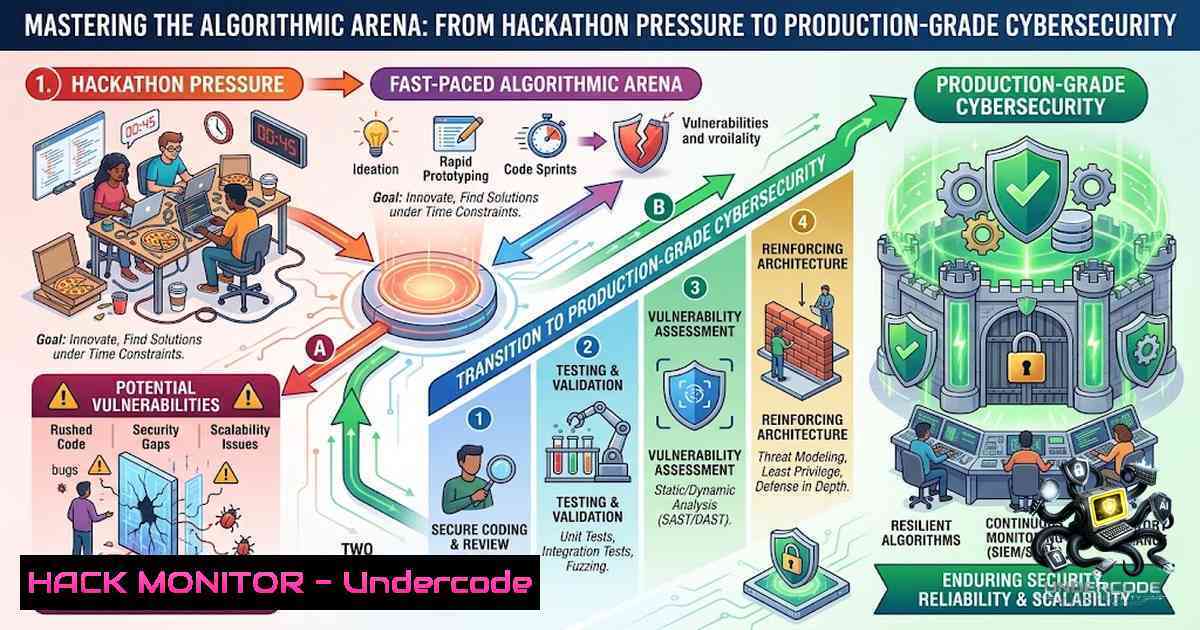
Introduction:
In the high-stakes environment of modern software engineering and cybersecurity, competitive hackathons like the Adobe University Hackathon serve as a crucible for validating technical prowess. These events not only test algorithmic problem-solving under extreme time constraints but also mirror the rapid incident response required in IT and AI security operations. For participants like Sangani Kavya, such platforms benchmark raw coding ability against national talent, transforming abstract academic knowledge into actionable insights for developing resilient AI systems and secure software architectures.
Learning Objectives & Secrets:
- Objective 1: High-Performance Algorithm Design – Master the design of time-optimal algorithms (O(log n) or O(1)) crucial for reducing latency in real-time security threat detection systems and large-scale data pipelines.
- Objective 2: Stress-Testing Logic Under Duress – Cultivate the ability to write syntactically correct, edge-case-proof code without the aid of an IDE’s autocomplete, a secret tip for auditing kernel-level code or debugging zero-day exploits in production.
- Objective 3: Scalable Solution Architecture – Learn to implement modular code structures that can be swiftly converted into microservices or cloud-based functions, ensuring that hackathon solutions are immediately deployable in CI/CD environments like GitHub Actions or AWS CodePipeline.
You Should Know:
1. Deploying a Local Algorithm Testing Sandbox
To practice hackathon-level problem-solving securely, you must set up an isolated testing environment that mirrors production constraints, preventing system-wide crashes during benchmarking.
Step‑by‑step guide:
- Linux/macOS: Create a jailed directory using `mkdir ~/hackathon_lab && cd ~/hackathon_lab` to contain all test scripts.
- Windows: Open PowerShell as Administrator and run `New-Item -ItemType Directory -Path “C:\HackLab”` followed by `Set-ExecutionPolicy -ExecutionPolicy RemoteSigned -Scope Process` to enable script execution safely.
- Install a lightweight Python virtual environment to prevent dependency conflicts: `python3 -m venv venv && source venv/bin/activate` (Linux/macOS) or `.\venv\Scripts\activate` (Windows).
- Use `time` command to measure execution: `time python3 solution.py < input.txt` to benchmark performance metrics essential for optimizing search algorithms (e.g., binary search vs. hash maps).
- Harnessing AI for Code Optimization and Vulnerability Prediction
Integrating AI models (like OpenAI’s Codex or Google’s Vertex AI) into your hackathon toolkit can accelerate debugging and predict potential stack overflows before they occur.
Step‑by‑step guide:
- Install the OpenAI Python library: `pip install openai` and set your API key using `set OPENAI_API_KEY=your_key_here` (Windows) or `export OPENAI_API_KEY=”your_key_here”` (Linux/macOS).
- Create a script `ai_review.py` to analyze your code for algorithmic inefficiencies:
import openai with open('solution.py', 'r') as f: code = f.read() response = openai.Completion.create(engine="code-davinci-002", prompt=f"Optimize this Python code for O(n) complexity:\n{code}", max_tokens=500) print(response.choices[bash].text) - Run `python ai_review.py` to receive suggestions for improving variable scoping and loop unrolling, which are critical for handling large datasets (e.g., 1M+ entries) without memory leaks.
- To harden the AI pipeline, implement rate-limiting and input sanitization using `re.sub(r'[^a-zA-Z0-9\s]’, ”, user_input)` to prevent prompt injection attacks.
3. Implementing Secure Cloud Functions for Hackathon Deployments
To simulate real-world deployment, you need to publish your hackathon solution as a serverless function on AWS Lambda or Google Cloud Functions, ensuring API security is enforced.
Step‑by‑step guide:
- Install AWS CLI: `pip install awscli` and configure with `aws configure` (providing Access Key ID and Secret Key).
- Package your code using `zip -r function.zip .` (Linux) or Compress-Archive (PowerShell) and upload:
aws lambda create-function --function-1ame HackathonSolver --runtime python3.9 --role arn:aws:iam::account-id:role/execution_role --handler solution.handler --zip-file fileb://function.zip. - Configure environment variables for security:
aws lambda update-function-configuration --function-1ame HackathonSolver --environment "Variables={SECRET_KEY=xyz, DEBUG=false}". - Test the function with a sample payload: `aws lambda invoke –function-1ame HackathonSolver –payload ‘{“input”: [1,2,3]}’ output.txt` and review `output.txt` to validate performance under load.
- Hardening the CI/CD Pipeline with Static Application Security Testing (SAST)
Incorporate automated code scanning to ensure hackathon solutions do not introduce vulnerabilities into the enterprise ecosystem.
Step‑by‑step guide:
- Integrate SonarQube locally using Docker:
docker run -d --1ame sonarqube -p 9000:9000 sonarqube:latest. - Run a scan on your project directory: `sonar-scanner -Dsonar.projectKey=hackathon -Dsonar.sources=. -Dsonar.host.url=http://localhost:9000`.
- Review the generated report for “Blocker” and “Critical” issues, such as SQL injection risks or hardcoded secrets.
- For GitHub repositories, set up a GitHub Actions workflow (
.github/workflows/sast.yml) that triggers on everygit push:name: SAST Check on: [bash] jobs: sonarqube: runs-on: ubuntu-latest steps:</li> <li>uses: actions/checkout@v2</li> <li>name: Run SonarQube Scan run: sonar-scanner -Dsonar.host.url=${{ secrets.SONAR_URL }}
5. Leveraging Memory Forensics for Algorithmic Edge Cases
Understanding memory allocation is vital for optimizing algorithms, especially when dealing with massive arrays or recursive functions.
Step‑by‑step guide:
- Use `valgrind` (Linux) to profile C/C++ solutions: `valgrind –tool=memcheck –leak-check=yes ./solution` to identify memory leaks that could crash enterprise servers.
- On Windows, utilize Windows Performance Toolkit: `xperf -on DiagEasy` to trace heap allocations, followed by `xperf -d trace.etl` and analyzing with Windows Performance Analyzer.
- Implement garbage collection hints in Python using `import gc; gc.collect()` after processing large data chunks to force memory reclamation, a trick that reduces latency spikes in real-time inference engines.
6. API Endpoint Hardening and Rate Limiting
If your hackathon solution exposes an API, you must prevent DDoS attacks and implement rate limiting.
Step‑by‑step guide:
- Build a Flask endpoint with Flask-Limiter:
from flask import Flask, request from flask_limiter import Limiter app = Flask(<strong>name</strong>) limiter = Limiter(app, key_func=lambda: request.remote_addr) @app.route('/solve') @limiter.limit("10 per minute") def solve(): data = request.get_json() return {"result": sorted(data['arr'])} - Deploy behind Nginx with rate limiting: add `limit_req_zone $binary_remote_addr zone=mylimit:10m rate=5r/s;` and `limit_req zone=mylimit burst=10;` to the configuration.
- Test with Apache Bench: `ab -1 1000 -c 100 http://your-api/solve` and monitor error logs to fine-tune throttling parameters.
What Undercode Say:
- Key Takeaway 1: Hackathons are not merely coding competitions but intensive bootcamps for developing the analytical discipline required to counter advanced persistent threats (APTs) and design intrusion detection algorithms.
- Key Takeaway 2: The strategic layering of AI for debugging, SAST for vulnerability scanning, and serverless deployment for scalability creates a holistic skill set that directly translates to building robust, self-healing systems in financial tech and healthcare IT.
Analysis: The convergence of hackathon problem-solving and cybersecurity engineering is inevitable as AI becomes more pervasive. The ability to rapidly prototype under pressure, sanitize inputs to prevent injection, and deploy fault-tolerant cloud functions is precisely what distinguishes a junior developer from a lead security architect. Sangani Kavya’s engagement with Adobe’s hackathon epitomizes this synergy, signaling a shift where hiring managers value demonstrable performance in simulated adversarial environments over static resumes. The industry must recognize that algorithmic agility is the new firewall—protecting data integrity not just through perimeter defenses, but through inherently efficient and secure code logic.
Prediction:
- +1 Over the next 3–5 years, major tech enterprises will integrate hackathon-style “red team” coding sprints into their quarterly security audits to proactively identify architectural weaknesses.
- +1 AI-assisted code analysis tools will become mandatory in CI/CD pipelines, reducing the time to detect zero-day vulnerabilities by over 60% through algorithmic pattern recognition.
- -1 The increasing pressure to deliver optimized code rapidly may lead to a surge in “optimization drift,” where developers neglect secure coding practices (like input validation) in favor of performance, potentially creating new classes of race-condition exploits.
- -1 Reliance on cloud serverless functions for hackathon projects could inadvertently expose API keys and environment secrets if misconfigured, requiring a parallel rise in automated secret-scanning tools like GitLeaks and HashiCorp Vault integration.
▶️ Related Video (88% Match):
🎯Let’s Practice For Free:
🎓 Live Courses & Certifications:
Join Undercode Academy for Verified Certifications
🚀 Request a Custom Project:
Secure, high-velocity infrastructure and disruptive technological engineering. Contact our engineering team for high-tier development and proprietary systems:
[email protected]
💎 Smart Architecture | 🛡️ Secure by Design | ⭐ Trusted by Thousands
IT/Security Reporter URL:
Reported By: https://lnkd.in/p/eb5ajhiF – Hackers Feeds
Extra Hub: Undercode MoN
Basic Verification: Pass ✅


