
Listen to this Post
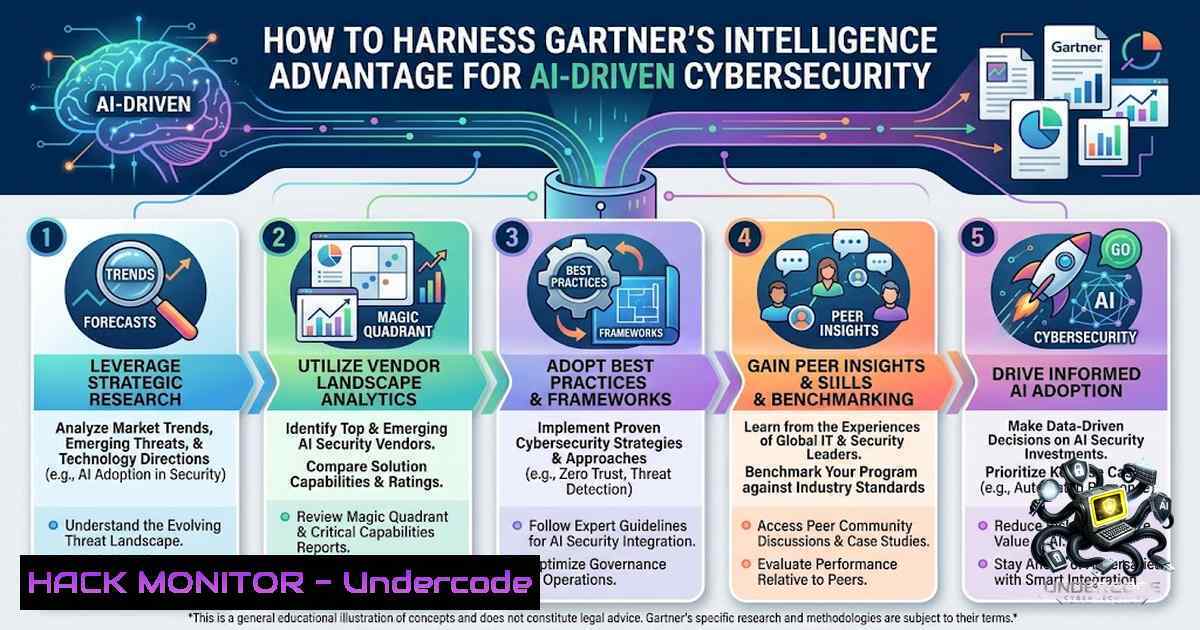
Introduction:
Artificial Intelligence is no longer a futuristic concept—it is embedded in every layer of modern enterprise technology, from security operations to software development. As AI expands the attack surface while simultaneously creating new defensive capabilities, organizations face the critical challenge of distinguishing proven AI use cases from overhyped vendor promises. Gartner’s intelligence advantage provides the guidance, tools, and benchmarks needed to make confident decisions at every stage of AI adoption, helping leaders boost productivity, reduce risk, and drive innovation.
Learning Objectives & Secrets:
- Objective 1: Leverage AI for Cybersecurity Strategically – Learn to use AI without falling for vendor hype. Focus on proven use cases such as embedded AI assistants, AI SOC agents, and AI code security assistants that deliver measurable outcomes. Secret tip: Start with clear objectives, pilot AI solutions in high-impact areas, and measure results before expanding.
- Objective 2 Secret Tip: Secure the AI You Buy, Build, or Use – Prioritize securing AI across all its forms—whether purchased, custom-built, or embedded in third-party products. Secret tip: Treat AI as a new identity type with asymmetric risk; extend IAM, governance, and data governance processes so AI entities cannot operate outside the zero-trust boundary.
- Objective 3 Secret Tip: Develop an Adaptive Roadmap – Build a roadmap that both secures and enables AI over time. Secret tip: Use a combination of analytical techniques in conjunction with large, small, and domain-specific GenAI models to provide protection, and address immediate buyer demands for AI discovery and usage control first.
You Should Know:
1. Deploying an Integrated AI Security Platform (AISP)
AI security is becoming a platform play where related protection capabilities are integrated to reduce complexity and provide consistent protection. Buyers have an immediate need for AI discovery, visibility, and usage control, including a strong emerging need to secure the use of AI agents.
Step‑by‑step guide:
- Inventory AI assets: Use ML-based discovery tools to map “shadow AI” and unmanaged assets across your environment.
- Assess risk: Model access needs for high-risk AI agents and contain their “agency” (tool access) using least-privilege principles.
- Deploy AI security controls: Implement guardrails, detection mechanisms, and incident response procedures to harden AI systems.
- Monitor continuously: Use AI-powered SOC agents to automate workflows, prioritize incidents, and enrich data within the security operations center.
Linux command for AI asset discovery:
 Scan for exposed AI/ML endpoints and services
nmap -p 5000,8000,8080,8501,7860 --open -sV --script=http-title <target_network>/24

Identify running ML frameworks
lsof -i | grep -E "jupyter|tensorboard|mlflow|ray"
Windows PowerShell for AI service detection:
 Find AI-related services
Get-Service | Where-Object {$_.DisplayName -match "AI|ML|Tensor|Python|Anaconda"}

Check for exposed MLflow or Jupyter processes
Get-Process | Where-Object {$_.ProcessName -match "jupyter|mlflow|tensorboard"}
- Implementing Continuous Adaptive Trust (CAT) for AI Agents
Traditional multifactor authentication (MFA) is no longer sufficient. Continuous adaptive trust uses AI to evaluate risk signals throughout a user’s or AI agent’s session, moving beyond static authentication to dynamic, risk-based access control.
Step‑by‑step guide:
- Define risk signals: Establish baselines for user and agent behavior, including login patterns, data access, and tool usage.
- Deploy AI-based anomaly detection: Use ML models to detect deviations from normal behavior in real-time.
- Implement dynamic access control: Configure policies that adjust permissions based on risk scores—e.g., step-up authentication for high-risk activities.
- Monitor non-person entities (NPEs): Extend CAT to AI agents, treating them as distinct identity types with their own risk profiles.
API security configuration example (using OPA for policy-as-code):
 Rego policy for AI agent access control
package ai.agent.auth

default allow = false

allow {
input.agent_type == "trusted"
input.risk_score < 70
input.request.resource in data.allowed_resources[input.agent_id]
}

Block questionable agents
deny {
input.agent_id in ["clawbot", "moltbook"]
msg = "Questionable AI agent blocked"
}
- Securing the AI Supply Chain and Preventing Model Attacks
The AI supply chain presents unique risks, including data poisoning, model extraction, and jailbreaking attacks. Organizations must implement controls to protect AI systems throughout their lifecycle.
Step‑by‑step guide:
- Profile training pipelines: Identify and document all data sources, preprocessing steps, and model training procedures.
- Implement input validation: Sanitize and validate all inputs to prevent prompt injection and adversarial attacks.
- Deploy model monitoring: Track model drift, performance degradation, and anomalous outputs.
- Establish incident response: Develop procedures specifically for AI security incidents, including model rollback and retraining.
Python code for detecting prompt injection attempts:
import re

def detect_prompt_injection(input_text):
 Common prompt injection patterns
patterns = [
r"ignore previous instructions",
r"forget your training",
r"system:.override",
r"role:.assistant",
r"<|.|>",
r"[INST].[/INST]"
]

for pattern in patterns:
if re.search(pattern, input_text, re.IGNORECASE):
return True, f"Potential injection pattern: {pattern}"
return False, "Clean"
4. Hardening Cloud AI Workloads
As AI workloads move to the cloud, securing these environments requires a defense-in-depth approach encompassing identity, network, and data protection.
Step‑by‑step guide:
- Implement least-privilege access: Restrict AI service accounts to only the permissions they require.
- Encrypt data at rest and in transit: Use cloud-provider encryption services for training data, models, and inference results.
- Configure network segmentation: Isolate AI training and inference environments from production networks.
- Enable audit logging: Capture all API calls, data access, and model operations for forensic analysis.
AWS CLI commands for AI workload security:
 List all SageMaker endpoints with encryption status
aws sagemaker list-endpoints --query 'Endpoints[].[EndpointName,EndpointConfigName]'

Check IAM roles used by AI services
aws iam list-roles --query 'Roles[?contains(RoleName, <code>sagemaker</code>) || contains(RoleName, <code>bedrock</code>)]'

Enable CloudTrail for AI service auditing
aws cloudtrail create-trail --1ame ai-audit-trail --s3-bucket-1ame <bucket> --is-multi-region-trail
Azure CLI for AI security:
 List Azure OpenAI instances
az cognitiveservices account list --kind OpenAI --query "[].{name:name, location:location}"

Enable diagnostic settings for AI services
az monitor diagnostic-settings create --1ame ai-diagnostics --resource <resource-id> --logs "[{category:Audit,enabled:true}]"
5. Vulnerability Exploitation and Mitigation in AI Systems
Understanding how attackers exploit AI systems is essential for building effective defenses. Common attack vectors include model inversion, membership inference, and adversarial examples.
Step‑by‑step guide:
- Conduct red-teaming exercises: Simulate attacks on your AI systems to identify vulnerabilities.
- Implement adversarial training: Augment training data with adversarial examples to improve model robustness.
- Deploy input sanitization: Filter and preprocess inputs to remove potentially malicious content.
- Use differential privacy: Add noise to training data or model outputs to prevent inference attacks.
Example of adversarial input generation for testing (Foolbox):
import foolbox as fb
import torch

Load your model and define attack
model = ...  Your PyTorch model
fmodel = fb.PyTorchModel(model, bounds=(0, 1))
attack = fb.attacks.LinfPGD()

Generate adversarial example
adversarial = attack(fmodel, images, labels, epsilons=0.03)
What Undercode Say:
- Key Takeaway 1: AI is a Double-Edged Sword – While AI creates new attack surfaces through autonomous agents and shadow AI, it also provides powerful defensive capabilities. Organizations must balance enabling AI innovation with implementing robust security controls.
-
Key Takeaway 2: Focus on Proven Use Cases – With 55% of CISOs reporting costly workarounds from vendor overpromises, leaders must focus on proven AI use cases like embedded assistants, SOC agents, and code security assistants rather than chasing hype.
Gartner’s research emphasizes that AI should not be the objective in itself, but rather a means to achieve cybersecurity outcomes. Organizations that treat AI as a new identity type—with its own risk profile, governance requirements, and access controls—will be better positioned to secure their AI initiatives. The proliferation of autonomous AI agents demands new governance models, as traditional IAM controls struggle to manage the “agency” and tool access of nondeterministic AI systems. Security leaders must double down on cybersecurity basics while preparing for AI-augmented attacks, recognizing that strong fundamentals are the best preparation for future threats. Training and certification programs such as CompTIA SecAI+, EC-Council’s Certified Offensive AI Security Professional, and the Certified AI Security Professional (CAISP) are emerging to equip professionals with the skills needed to defend AI systems and use AI to enhance threat detection.
Prediction:
- +1 Organizations that embrace AI security early will gain a significant competitive advantage, reducing mean time to respond (MTTR) by up to 90% through AI-powered automation and unified security telemetry platforms.
-
+1 The AI security platform (AISP) market will consolidate rapidly, with integrated platforms replacing point solutions as organizations seek to reduce complexity and improve security consistency.
-
-1 The proliferation of autonomous AI agents without proper governance will lead to a wave of security incidents, including data breaches and system compromises, as organizations struggle to manage the “agency” of nondeterministic AI systems.
-
-1 Adversarial AI attacks—including data poisoning, model extraction, and jailbreaking—will become more sophisticated and widespread, outpacing many organizations’ defensive capabilities.
-
+1 Regulatory frameworks and industry standards for AI security will mature, providing clearer guidance and compliance requirements that help organizations build more resilient AI systems.
-
-1 The skills gap in AI security will widen, with demand for certified AI security professionals far outstripping supply, leaving many organizations vulnerable.
-
+1 AI-powered threat intelligence platforms will achieve accuracy rates exceeding 95% in detecting and prioritizing threats, enabling security teams to focus on the most critical incidents.
-
-1 Organizations that fail to implement continuous adaptive trust (CAT) for AI agents will face increased risk from compromised or malicious AI entities operating within their networks.
-
+1 The integration of AI with zero-trust architecture will accelerate adoption, with GenAI reducing the operational burden of policy generation, asset discovery, and DevSecOps automation.
-
-1 Shadow AI—unsanctioned AI tools and models used within organizations—will remain a significant blind spot, creating unmanaged attack surfaces that adversaries will increasingly target.
▶️ Related Video (90% Match):
https://www.youtube.com/watch?v=2sPmPPxrpNI
🎯Let’s Practice For Free:
🎓 Live Courses & Certifications:
Join Undercode Academy for Verified Certifications
🚀 Request a Custom Project:
Secure, high-velocity infrastructure and disruptive technological engineering. Contact our engineering team for high-tier development and proprietary systems:
[email protected]
💎 Smart Architecture | 🛡️ Secure by Design | ⭐ Trusted by Thousands
IT/Security Reporter URL:
Reported By: https://lnkd.in/p/eQ_W8uEv – Hackers Feeds
Extra Hub: Undercode MoN
Basic Verification: Pass ✅


