
Listen to this Post
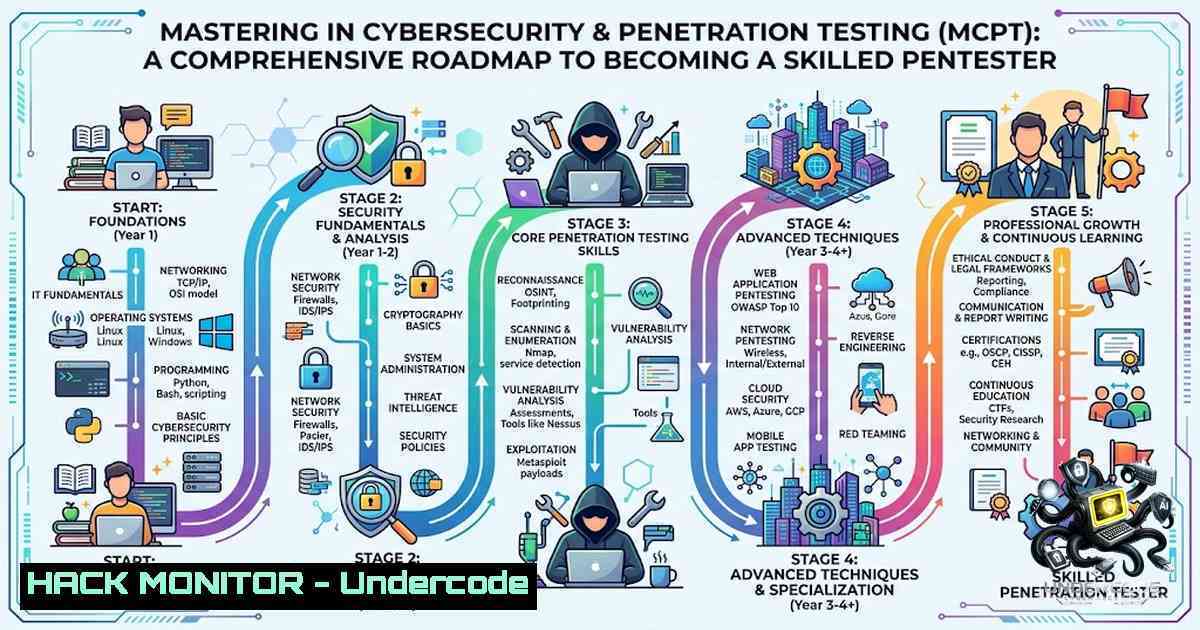
Introduction:
The cybersecurity industry is currently facing a paradox: while the demand for skilled professionals is at an all-time high, the market is flooded with individuals who possess theoretical knowledge but lack practical, hands-on experience. Transitioning from a tool operator to a seasoned penetration tester requires a profound understanding of the attack lifecycle—from passive reconnaissance to professional report writing. Programs like HackToLive Academy’s “Mastering in Cybersecurity & Penetration Testing (MCPT)” are designed to bridge this gap, offering a structured environment that simulates real-world attack scenarios to cultivate true cybersecurity expertise.
Learning Objectives & Secrets:
- Objective 1: Master the Art of Reconnaissance (OSINT). Learn to uncover sensitive information from public sources, social media, and search engines using advanced Google Dorking and Shodan queries to build a comprehensive attack surface map.
- Secret Tip: Combine OSINT with automated tools like `theHarvester` and `Recon-1g` to automate data correlation, effectively reducing the time spent on initial footprinting by up to 60%.
- Objective 2: Exploitation and Lateral Movement (Post-Exploitation). Move beyond simple vulnerability scanning to actually exploiting misconfigurations and pivoting within a network to simulate advanced persistent threat (APT) movements.
- Secret Tip: Use `Mimikatz` for credential dumping on Windows and `LinPEAS` for Linux privilege escalation. Mastering the “pass-the-hash” technique is crucial for bypassing modern endpoint detection systems.
- Objective 3: Professional Reporting for Client Engagement. A pentest is only as good as the report it produces; learn to translate technical vulnerabilities into business risks to justify security spending.
- Secret Tip: Utilize reporting frameworks like the DREAD model to quantify risk. Tailor your executive summaries to highlight financial loss scenarios rather than just technical flaws to ensure your findings are actionable by non-technical stakeholders.
You Should Know:
1. Network Enumeration & Service Discovery
Network enumeration is the backbone of ethical hacking. Before exploiting a system, you must thoroughly understand the environment. Tools like Nmap and Masscan are essential for mapping out the network infrastructure.
– Step-by-step guide:
1. Host Discovery: Identify live hosts in a target network using the command `nmap -sn 192.168.1.0/24` to perform a ping sweep without port scanning.
2. Port Scanning: Use `nmap -sS -sV -p- -T4 192.168.1.100` to perform a SYN stealth scan, detect service versions, and scan all 65,535 ports.
3. Script Scanning: Utilize the Nmap Scripting Engine (NSE) to search for specific vulnerabilities, e.g., nmap --script vuln 192.168.1.100.
4. Windows Equivalent: For Windows environments, use `Test-1etConnection -ComputerName 192.168.1.100 -Port 80` to test specific port availability.
2. Vulnerability Assessment & Fuzzing
Identifying Common Vulnerabilities and Exposures (CVEs) is only half the battle; fuzzing allows pentesters to discover zero-day vulnerabilities in web applications and APIs. Tools like Burp Suite and OWASP ZAP facilitate this process by intercepting and manipulating HTTP traffic.
– Step-by-step guide for API Security Testing:
1. Configure Proxy: Set your browser to use Burp Suite (port 8080) and intercept the API request.
2. Send to Intruder: Send the API request to Intruder for automated payload injection. Use an “Upload” function to test file restrictions.
3. Fuzzing: Load the SecLists “Fuzzing” payloads to attempt to bypass file upload restrictions (e.g., .php.jpg).
4. Cloud Hardening: For cloud environments, use `aws s3 ls s3://target-bucket –1o-sign-request` to check for publicly accessible S3 buckets exposing sensitive data.
3. Authentication Bypass Techniques
Modern applications rely heavily on complex authentication mechanisms. Bypassing these requires a strategic approach involving session fixation, brute-force, and JWT (JSON Web Token) manipulation.
– Step-by-step guide:
1. Capture Session: Intercept the login request and analyze the cookie structure.
2. Modify Claims: If a JWT is used, decode it using `jwt.io` to view the payload. Try modifying the “alg” to “none” to test for algorithm confusion vulnerabilities.
3. Password Spraying: Against Active Directory environments, use `crackmapexec smb 192.168.1.1 -u users.txt -p ‘Password123!’ –continue-on-success` to test multiple users with a single common password to avoid account lockouts.
4. Post-Exploitation: Privilege Escalation
Once you have a foothold, escalating privileges is critical. This often involves checking for misconfigured services, weak file permissions, or unpatched kernels. For Linux, focus on SUID binaries and `sudo` misconfigurations.
– Step-by-step guide (Linux):
1. Check Sudo Rights: Use `sudo -l` to check if the user can run any commands as root without a password.
2. Find SUID Binaries: Run `find / -perm -u=s -type f 2>/dev/null` to locate executables that run with root privileges.
3. Exploit Python: If Python is found with `sudo` rights, you can spawn a root shell via sudo python -c 'import pty;pty.spawn("/bin/bash")'.
– Step-by-step guide (Windows):
1. Check Privileges: Use `whoami /priv` to view current enabled tokens.
2. PowerUp Script: Use PowerSploit’s PowerUp to check for common windows misconfigurations: . .\PowerUp.ps1; Invoke-AllChecks.
5. Pentest Lab Configuration & Isolation
Setting up a proper lab environment is crucial to avoid legal repercussions. HackToLive mentions 20+ Pentest Labs; you should emulate this using virtualization platforms like VMware or Proxmox to isolate your attack machines.
– Step-by-step guide (Network Setup):
1. Virtual Switches: Create a host-only network (Host-Only Adapter) to keep your attack machine (Kali) and target machines isolated from your physical network.
2. Server Configuration: Deploy vulnerable versions of Ubuntu Server and Windows Server, applying specific CVEs (e.g., BlueKeep or EternalBlue) for practice.
3. VPN Connectivity: For remote labs, use OpenVPN to connect to the academy’s internal range without interfering with your local IP configuration.
What Undercode Say:
- Key Takeaway 1: The transition from “tool” to “professional” hinges on the ability to perform manual exploit writing and understand the underlying server-side logic, not merely running automated scripts like Nessus.
- Key Takeaway 2: Reporting and communication are equally, if not more, important than technical prowess. A technical find is irrelevant if management cannot comprehend the financial implications of the risk.
Analysis:
The MCPT curriculum emphasizes a pipeline from “theoretical” to “practical execution.” The integration of CTF-style challenges (19 hands-on challenges) alongside a structured curriculum ensures that students are constantly applying learned skills, reinforcing retention. The focus on “Professional Pentest Report Writing” addresses a massive industry criticism where pentesters often lack communication skills to articulate risk effectively. A pentester who can enumerate, exploit, and document effectively ensures re-engagement contracts, creating a sustainable career. The initiative is bridging the gap between “hobbyist” and “professional” by offering business context alongside technical hacking skills.
Prediction:
- +1 The market will witness a significant surge in “vetted” cybersecurity professionals from Indian subcontinent academies offering micro-credentials, leading to a shift in global hiring practices towards skills-based assessment over degrees.
- +1 Courses like MCPT will increase the “Average Salary” of junior pentesters in the region by 15-20% by equipping them with globally recognized practical skills, reducing the dependency on expensive Western certifications like OSCP.
- -1 As more professionals enter the field, there may be a saturation of junior-level talent in the next two years, making specialization (like Cloud Security or IOT Pentesting) a necessity rather than a bonus for career growth.
- -1 Over-reliance on lab environments can lead to “Lab Syndrome” where professionals struggle with the unpredictable nature and regulatory constraints (GDPR, PCI-DSS) of real-world engagements.
- +1 The emphasis on report writing and business communication will foster a new generation of “Cyber Consultants” rather than just “hackers,” increasing the influence of security teams in C-level board meetings.
▶️ Related Video (78% Match):
🎯Let’s Practice For Free:
🎓 Live Courses & Certifications:
Join Undercode Academy for Verified Certifications
🚀 Request a Custom Project:
Secure, high-velocity infrastructure and disruptive technological engineering. Contact our engineering team for high-tier development and proprietary systems:
[email protected]
💎 Smart Architecture | 🛡️ Secure by Design | ⭐ Trusted by Thousands
IT/Security Reporter URL:
Reported By: https://lnkd.in/p/efzAfgCB – Hackers Feeds
Extra Hub: Undercode MoN
Basic Verification: Pass ✅


