
Listen to this Post
Introduction:
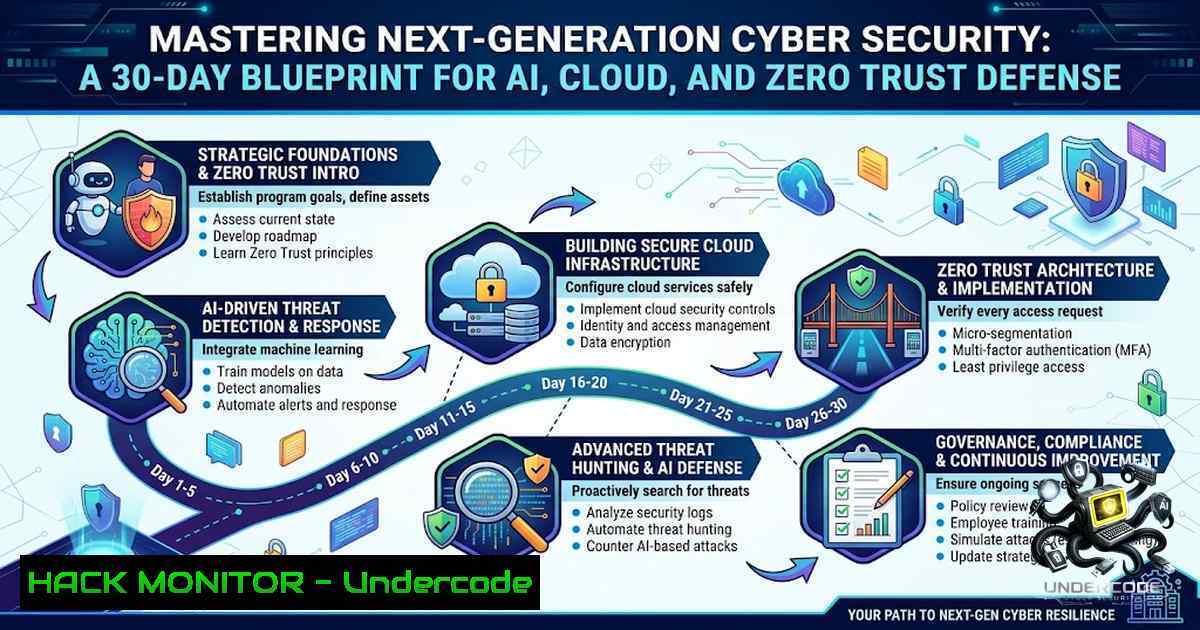
The cybersecurity landscape is undergoing a paradigm shift, driven by the rapid adoption of Artificial Intelligence (AI), the complexity of cloud-1ative architectures, and the sophistication of modern adversaries. Moving beyond traditional perimeter-based defenses, next-generation security demands a holistic understanding of AI agents, Kubernetes, Zero Trust, and automated threat intelligence. This article distills a comprehensive 30-day learning journey into actionable technical insights, providing a roadmap for security professionals to integrate emerging technologies with foundational practices, complete with verified commands and configurations for real-world application.
Learning Objectives & Secrets:
- Objective 1: Master the Architecture of Agentic AI and Model Context Protocol (MCP). Understand how to secure autonomous AI agents by controlling their context windows and tool-calling capabilities. A secret tip is to implement strict input validation and context sanitization using allowlists to prevent prompt injection and data leakage in MCP implementations.
- Objective 2: Harden Cloud-1ative and Kubernetes Environments. Learn to secure containerized workloads and Infrastructure as Code (IaC) by shifting security left. A secret tip is to use OPA (Open Policy Agent) and Kyverno to enforce security policies at the admission control level, blocking misconfigurations before they reach production.
- Objective 3: Implement Proactive Threat Hunting and Purple Teaming. Transition from reactive to proactive defense by combining threat intelligence frameworks (MITRE ATT&CK) with automated hunting queries. A secret tip is to use Sigma rules and KQL (Kusto Query Language) to operationalize intelligence and simulate attacker behavior during purple team exercises.
You Should Know:
1. Securing AI Agents and MCP Implementations
As AI agents gain access to internal tools and APIs, the attack surface expands dramatically. The Model Context Protocol (MCP) standardizes how these agents interact with data sources, but it introduces critical risks. A primary concern is “Agent Hijacking,” where an attacker manipulates the context to execute unauthorized actions. To mitigate this, focus on strict parameterization of the agent’s reasoning engine.
Step‑by‑step guide:
- Step 1: Context Sanitization. Implement a filter that strips any system-level directives from user input before it enters the context window. Use a regex-based filter in Python to block patterns like “ignore previous instructions” or “system:”.
- Step 2: Tool Allowlisting. Restrict the tools the agent can invoke. For example, if using LangChain, define a `Tool` object with a `func` attribute that validates the user ID and action permissions.
- Step 3: Rate Limiting. Apply rate limiting on agent requests to prevent Denial of Service (DoS) or resource exhaustion caused by recursive or malicious queries.
- Example Linux Command: Monitor agent API calls for anomalies using
journalctl -u agent-service -f --since "10 minutes ago" | grep -E "ERROR|WARN".
2. Kubernetes Security and IaC Hardening
Kubernetes security is no longer optional; it is a cornerstone of enterprise defense. Misconfigurations in pods, services, and RBAC are the top causes of breaches. This involves scanning YAML manifests and Helm charts before deployment and enforcing runtime policies.
Step‑by‑step guide:
- Step 1: Static Analysis of Manifests. Use `kube-score` or `checkov` to scan your Kubernetes YAML files for common security issues (e.g., running as root, privileged containers).
- Step 2: Admission Control. Deploy Kyverno to reject pods that request hostNetwork access or use the `latest` image tag.
- Step 3: Image Signing and Verification. Implement Cosign to sign container images and verify signatures during deployment.
- Example Commands:
- Linux: `kube-score score deployment.yaml > score_report.txt`
– Windows (PowerShell): `checkov -f deployment.yaml –framework kubernetes`
3. API Security and Zero Trust Implementation
APIs are the backbone of modern applications and a primary target for attackers. Securing them requires a Zero Trust approach: never trust, always verify. This involves rigorous authentication, authorization, and input validation at the API gateway level.
Step‑by‑step guide:
- Step 1: Implement Mutual TLS (mTLS). Enforce mTLS between services to ensure both client and server authenticate each other.
- Step 2: Token Validation. For JWT tokens, validate the signature using the public key from the identity provider and enforce short-lived tokens with refresh mechanisms.
- Step 3: Input Validation. Use a robust schema validation library (e.g., `pydantic` in Python) to enforce data types, lengths, and formats, preventing injection and mass assignment attacks.
- Example Command: (Linux) Validate JWT structure:
echo "your_jwt_token" | jq -R 'split(".") | .[bash] | @base64d'.
4. Leveraging MITRE ATT&CK and Purple Teaming
Understanding adversary behavior is crucial. The MITRE ATT&CK framework provides a common language. Purple Teaming combines the offensive (Red) and defensive (Blue) teams to collaboratively improve detection and response capabilities.
Step‑by‑step guide:
- Step 1: Map Defenses. Map your current security controls to MITRE ATT&CK tactics and techniques to identify gaps.
- Step 2: Simulate Attacks. Use tools like Atomic Red Team to execute specific techniques (e.g., T1059 – Command and Scripting Interpreter) in your test environment.
- Step 3: Tune Detection. Based on the attack simulation, tune your SIEM (e.g., Splunk, Elastic) detection rules to trigger alerts.
- Example Commands:
- Linux: `atomic run T1059.001` (to test command execution)
- Windows (PowerShell): `Invoke-AtomicTest T1003 -TestNumbers 1` (to test credential dumping).
- Malware Analysis, Ransomware Defense, and Supply Chain Security
Defending against modern ransomware requires a multi-layered approach that includes understanding malware behavior, securing the software supply chain, and implementing robust incident response.
Step‑by‑step guide:
- Step 1: Sandbox Analysis. Use static and dynamic analysis tools like `Capa` or `FlareVM` to analyze suspicious files in an isolated environment.
- Step 2: Immutable Backups. Implement immutability on backups (e.g., S3 Object Lock) to prevent encryption by ransomware.
- Step 3: SBOM Generation. Generate a Software Bill of Materials (SBOM) using `Syft` or `Trivy` to track dependencies and identify known vulnerabilities.
- Example Commands:
- Linux: `syft packages dir:/path/to/app -o json > sbom.json`
– Windows: Use `sigcheck.exe` to verify digital signatures of executables.
6. Post-Quantum Cryptography and IoT/OT Security
Emerging technologies like quantum computing threaten current cryptographic algorithms. Preparing for Post-Quantum Cryptography (PQC) and securing IoT/OT environments is essential for future-proofing an organization’s security.
Step‑by‑step guide:
- Step 1: Crypto-Agility. Design systems that allow for cryptographic algorithm replacement. Use a “crypto-agile” library like `liboqs` for testing hybrid key exchanges.
- Step 2: Network Segmentation. Segment OT networks from IT networks using VLANs and strict firewall rules to contain potential compromises.
- Step 3: Firmware Security. Regularly scan IoT device firmware for known CVEs and ensure secure boot mechanisms are enabled.
- Example Command: `nmap -sU -p 161 –script snmp
` to check for insecure SNMP configurations.
What Undercode Say:
- Key Takeaway 1: Consistency is the Master Key. The most significant insight from this 30-day challenge is the value of consistent, incremental learning. By dedicating time daily to a specific domain, one moves beyond superficial knowledge to practical, actionable expertise.
- Key Takeaway 2: The Future is Converged. The lines between AI, cloud, and traditional security are blurring. A modern security professional must be a hybrid, capable of understanding AI agent logic, cloud-1ative threats, and deep-seated exploit techniques to effectively defend modern infrastructures.
This challenge highlights that mastering cybersecurity is not about knowing a single tool or framework, but about building a mental model that connects attacker behavior with system architecture. The shift from “thinking like a defender” to “thinking like an attacker” requires constant practice and exposure to new attack vectors. It emphasizes that security is a continuous feedback loop of learning, building, breaking, and fixing. The integration of AI into defense is not a replacement for human intuition but a force multiplier that allows analysts to focus on high-level strategy. Ultimately, the journey underscores that the most resilient security posture is built on a culture of curiosity and relentless improvement.
Prediction:
- +1 The adoption of AI agents will lead to a surge in “Autonomous Security Operations Centers” that can self-heal and contain threats in milliseconds, drastically reducing Mean Time to Respond (MTTR).
- -1 The weaponization of Generative AI will enable threat actors to create highly polymorphic malware and sophisticated social engineering campaigns at scale, outpacing traditional signature-based detection.
- +1 Zero Trust architectures will become the de facto standard, driven by regulatory pressures, forcing a complete overhaul of legacy network designs and leading to a more resilient global cyber ecosystem.
- -1 A significant supply chain attack will occur within the next 18 months targeting a widely used open-source package in the MCP ecosystem, highlighting the critical need for stringent software attestation and SBOM policies.
▶️ Related Video (80% Match):
🎯Let’s Practice For Free:
🎓 Live Courses & Certifications:
Join Undercode Academy for Verified Certifications
🚀 Request a Custom Project:
Secure, high-velocity infrastructure and disruptive technological engineering. Contact our engineering team for high-tier development and proprietary systems:
[email protected]
💎 Smart Architecture | 🛡️ Secure by Design | ⭐ Trusted by Thousands
IT/Security Reporter URL:
Reported By: https://lnkd.in/p/dHJjcsaM – Hackers Feeds
Extra Hub: Undercode MoN
Basic Verification: Pass ✅


