
Listen to this Post
Introduction:
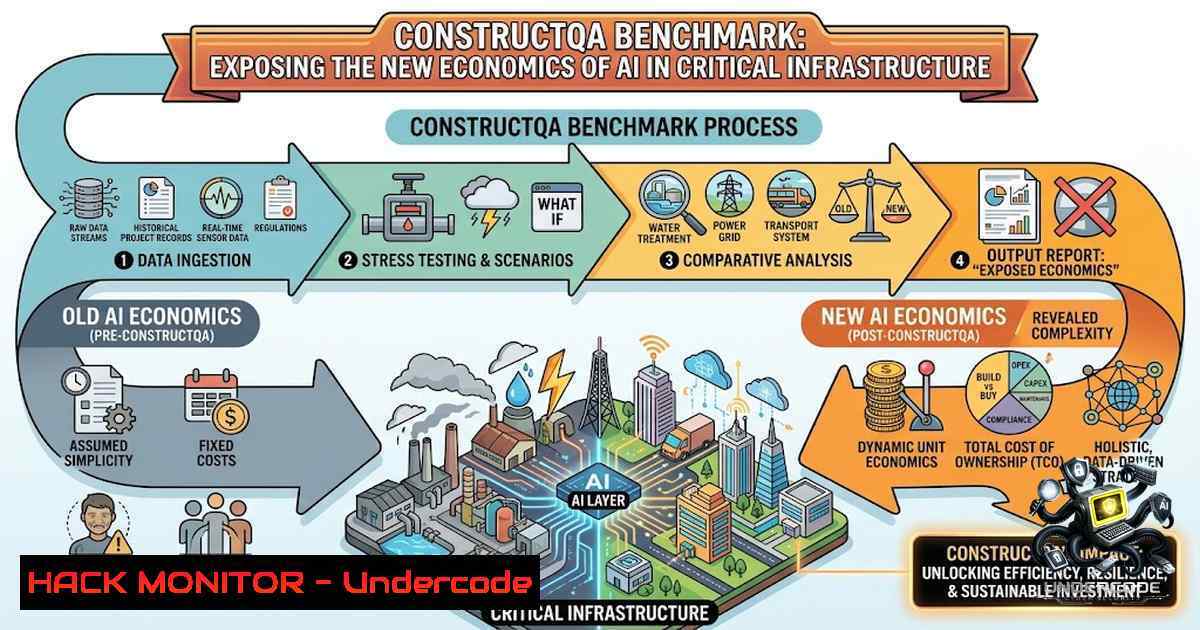
The integration of Large Language Models (LLMs) into highly specialized industrial sectors like Architecture, Engineering, and Construction (AEC) requires a rigorous evaluation beyond generic reasoning tests. The recent ConstructQA benchmark challenges the prevailing assumption that top-tier performance necessitates prohibitive cost, revealing a dynamic market where price-performance ratios are rapidly shifting. This analysis dissects the findings from the comprehensive test of 12 leading AI models across 2,000+ real-world construction records, providing a technical blueprint for deploying AI in document-heavy, high-stakes environments.
Learning Objectives & Secrets:
- Objective 1: Understand the cost-performance trade-offs inherent in using LLMs for complex, multi-hop reasoning across thousands of technical documents.
- Objective 2 (Secret Tip): Learn how to architect a query system that leverages cheaper, high-speed models (like DeepSeek V4 Flash) for initial broad retrieval, reserving top-tier accuracy models (like Gemini 3.7 Flash High) solely for final, critical verification steps, thereby slashing operational expenses by up to 90%.
- Objective 3 (Secret Tip): Optimize your RAG (Retrieval-Augmented Generation) pipeline by prioritizing context window management and latency tuning, as highlighted by the 48.4s vs. 47.1s per question speeds, which are crucial for real-time project intelligence.
You Should Know:
- Evaluating the AI Scorecard: The “Batting Average” of LLMs
The ConstructQA methodology is a technical shift from simple Q&A to “multi-hop” reasoning—the AI’s ability to synthesize information from disparate documents like drawings, submittals, and inspection reports to answer a single complex question. In cybersecurity terms, this is analogous to correlating logs from multiple SIEM sources to trace an attack vector. The benchmark’s primary metric is accuracy (scored at 95.5% for the top model), but the secondary metric, cost-per-run, is transformative. For organizations, the takeaway is that the ROI for using Gemini 3.7 Flash High may be justifiable only for mission-critical outputs, while DeepSeek V4 Flash offers a remarkable 92.7% accuracy for commodity tasks.
Step‑by‑step guide to set up a cost-benefit analysis environment:
– Step 1: Establish a test harness in Python using the `requests` library to query multiple model APIs concurrently.
– Step 2: Create a standardized “question set” based on your internal documents (e.g., “What is the load-bearing capacity of the steel beams in wing A?”).
– Step 3: Implement a scoring mechanism using the `textstat` library to check factual consistency against a pre-verified answer key.
– Step 4: Log the input_tokens, output_tokens, and `latency` (in milliseconds) for each query.
– Step 5: Use the official pricing pages for each model to calculate the exact cost per 1,000 queries. The benchmark results ($7.23 vs $0.85) show that a high-volume API strategy can save over $6,000 per 1,000 queries.
Linux/Windows Command for Logging:
 Linux/Mac: Monitor API latency and log to CSV
curl -w "Time: %{time_total}\n" -o /dev/null -s https://api.gemini.com/v1/query &>> api_log.csv

Windows PowerShell: Measure API response time
Measure-Command { Invoke-WebRequest -Uri "https://api.deepseek.com/v1/query" }
2. Extracting and Preprocessing Construction Data (Project Corpus)
The “project corpus” mentioned comprises unstructured data formats critical to AEC. For effective AI navigation, this data must be transformed into a machine-readable state. This is similar to a forensic investigator extracting artifacts from a compromised system. The benchmark implies the models are parsing PDFs, high-resolution images (drawings), and semi-structured CSV files.
Step‑by‑step guide for data ingestion using Python and Tesseract:
– Step 1: Install Tesseract OCR for handling scanned drawings: `sudo apt install tesseract-ocr` (Linux) or download from GitHub for Windows.
– Step 2: Write a Python script using `PyMuPDF` (fitz) to extract text and metadata. For images, use pytesseract.
– Step 3: Normalize the text by removing boilerplate text using regex (e.g., re.sub(r'Copyright.', '', text)).
– Step 4: Use a vector database like `ChromaDB` or `Pinecone` to create embeddings for the processed text.
– Step 5: Implement a “chunking” strategy where large RFIs are split into overlapping 512-token segments to preserve context for multi-hop queries.
Code Snippet for Text Extraction:
import fitz  PyMuPDF
doc = fitz.open("drawing.pdf")
for page in doc:
text = page.get_text()
print(text[:200])  Print first 200 characters
3. Architecting the Multi-Hop Query Engine
Multi-hop reasoning requires a retrieval engine that can link related concepts. The benchmark demonstrates that both Gemini and DeepSeek excel in this, suggesting sophisticated self-attention mechanisms. To replicate this, you need to build a “Chain-of-Thought” (CoT) pipeline where the AI breaks down the user question into sub-questions. For cybersecurity pros, this is equivalent to breaking down a complex APT kill chain.
Step‑by‑step guide for implementing CoT prompting:
- Step 1: Define a prompt template: “You are an expert structural engineer. Question: {user_query}. Search for: 1) Material specs, 2) Load calculations, 3) Regulatory compliance. Combine these to answer.”
- Step 2: Implement query expansion using the `NLTK` library to generate synonyms for construction terms (e.g., “steel” -> “structural steel”, “I-beam”).
- Step 3: Use the `transformers` library to load a small local model (like Falcon-7B) as a “router” that decides which external API (Gemini or DeepSeek) to call based on the complexity score of the sub-questions.
- Step 4: Validate the final answer against a set of “ground truth” documents using ROUGE or BERTScore metrics.
- Cloud Hardening and API Security for AI Services
When using cloud-hosted AI models, data privacy is paramount, especially when dealing with proprietary construction blueprints and structural calculations. Organizations must ensure that API calls are secured, and data is not used for training without consent. This mirrors the need for secure authentication and authorization in public cloud deployments.
Step‑by‑step guide for securing the API pipeline:
- Step 1: Use environment variables to store API keys: `export GEMINI_API_KEY=’your_key’` (Linux) or `set GEMINI_API_KEY=your_key` (Windows CMD).
- Step 2: Implement a VPC (Virtual Private Cloud) or Cloud VPN to ensure data travels over a private network, avoiding public internet exposure.
- Step 3: Enable data masking: before sending a query, strip Personally Identifiable Information (PII) like contractor emails or phone numbers using
re.sub(r'\b[\w\.-]+@[\w\.-]+\.\w{2,}\b', '', text)</code>.</li> <li>Step 4: Force HTTPS connections and implement certificate pinning in your application to prevent man-in-the-middle attacks.</li> <li>Step 5: Set up API throttling at the server level (e.g., using NGINX) to prevent brute-force billing or DoS attacks.</li> </ul> <h2 style="color: yellow;">Linux Command for API Rate Limiting (NGINX):</h2> [bash] limit_req_zone $binary_remote_addr zone=mylimit:10m rate=10r/s; location /api/ { limit_req zone=mylimit burst=20; }- Vulnerability Exploitation & Mitigation in AI Pipeline Outputs
AI hallucination is a "vulnerability" that can lead to catastrophic structural failures if the output is taken at face value. The benchmark suggests an accuracy of ~95%, implying a 5% error rate. For critical infrastructure, this 5% is unacceptable. The mitigation strategy involves treating AI outputs as "First Drafts" and implementing a human-in-the-loop (HITL) verification process using ground-truth engineering rules.
Step‑by‑step guide for implementing an AI Hallucination Detection Layer:
- Step 1: Extract the "Relevant References" cited by the AI to support its answer.
- Step 2: Implement a "Fact-Check" script that uses a secondary, cheaper AI (like a fine-tuned BERT-base) to validate the semantic similarity between the generated answer and the cited source texts.
- Step 3: If similarity is below 0.85, flag the answer for human review. This creates a feedback loop where human corrections are fed back into a "negative example" dataset for fine-tuning the model.
- Step 4: Implement a "JSON Schema" validation to ensure the output follows a strict predefined format (e.g., "Load: 500 kN, Safety Factor: 1.5"). If the model deviates, an exception is thrown.Python Script for Validation:
import jsonschema schema = { "type": "object", "properties": {"load": {"type": "number"}, "material": {"type": "string"}}, "required": ["load", "material"] } try: jsonschema.validate(instance=ai_output, schema=schema) except jsonschema.ValidationError as e: print("Hallucination detected: Malformed response.")6. Troubleshooting and Performance Tuning
Speed and cost are directly correlated to token generation. The benchmark shows a negligible speed difference (48.4s vs 47.1s) but a massive price discrepancy. To optimize, we can control the "token usage" by pre-processing the prompt to be as concise as possible. This is similar to trimming logs before sending to a SIEM.
Troubleshooting Guide:
- Issue: High latency.
- Solution: Reduce the `max_tokens` parameter in the API call to limit output length.
- Issue: High cost.
- Solution: Enable caching. Use `redis-py` to store query-result pairs for repetitive questions (e.g., safety standards).
- Issue: Hallucination.
- Solution: Implement a "System Prompt" that strictly forbids fabricating data and forces the model to say "I don't know" when uncertain.
Linux Command to flush DNS cache (if API endpoint unreachable):
sudo systemctl restart systemd-resolved Linux ipconfig /flushdns Windows
What Undercode Say:
- Key Takeaway 1: The "best" AI is context-dependent; the business case relies heavily on the cost of errors. A 95.5% model is not 3% "better" in value if it costs 850% more than a 92.7% model.
- Key Takeaway 2: The era of defaulting to one AI model is over. High-performance organizations will build AI "orchestrators" that route queries to the most cost-effective model based on the specific complexity of the sub-task, optimizing for both wallet and workflow speed.
Analysis:
The ConstructQA results highlight a significant shift towards "Efficient AI." The ability of DeepSeek to compete closely with top-tier models while maintaining a drastic price advantage signals a commoditization of basic reasoning intelligence. This is reminiscent of the shift from mainframes to personal computers. For the AEC industry, this means that AI integration is no longer limited to top-tier global firms; it is accessible to mid-sized contractors. The data also suggests that the bottleneck is shifting from "model capability" to "data quality and integration." The multi-hop capability demonstrates that these models are functioning as true reasoning engines, not just search indices. The 5% error rate is the critical frontier; future developments will likely focus on "retrieval confidence scoring" to mitigate this rather than solely improving the base model.
Prediction:
- +1: The cost-to-performance ratio will continue to plummet, allowing for "real-time digital twin" analysis where AI continuously monitors and adjusts construction schedules based on live RFI submissions and material changes.
- +1: We will see the rise of highly specialized vertical AI models (fine-tuned on structural engineering data) that out-perform general-purpose models while running on more efficient hardware or cheaper APIs.
- -1: Standardization bodies (like ISO) will struggle to create guidelines for AI validation in safety-critical infrastructure, leading to a regulatory gap where AI might be prematurely adopted without robust "shadow testing" pipelines in place.
- -1: The cost transparency revealed in such benchmarks puts immense pressure on high-tier providers to justify their pricing models, potentially leading to price wars that destabilize the AI cloud market and cause API instability.
- +1: The "Multi-Hop" reasoning will evolve into "Multi-Modal" reasoning (text + image + CAD files), further integrating the AI into the core workflow, making it an indispensable tool for project managers.
▶️ Related Video (86% Match):
🎯Let’s Practice For Free:
🎓 Live Courses & Certifications:
Join Undercode Academy for Verified Certifications
🚀 Request a Custom Project:
Secure, high-velocity infrastructure and disruptive technological engineering. Contact our engineering team for high-tier development and proprietary systems:
[email protected]
💎 Smart Architecture | 🛡️ Secure by Design | ⭐ Trusted by ThousandsIT/Security Reporter URL:
Reported By: https://lnkd.in/p/ejCd_2C7 - Hackers Feeds
Extra Hub: Undercode MoN
Basic Verification: Pass ✅🔐JOIN OUR CYBER WORLD [ CVE News • HackMonitor • UndercodeNews ]
📢 Follow UndercodeTesting & Stay Tuned:
- Vulnerability Exploitation & Mitigation in AI Pipeline Outputs


