
Listen to this Post
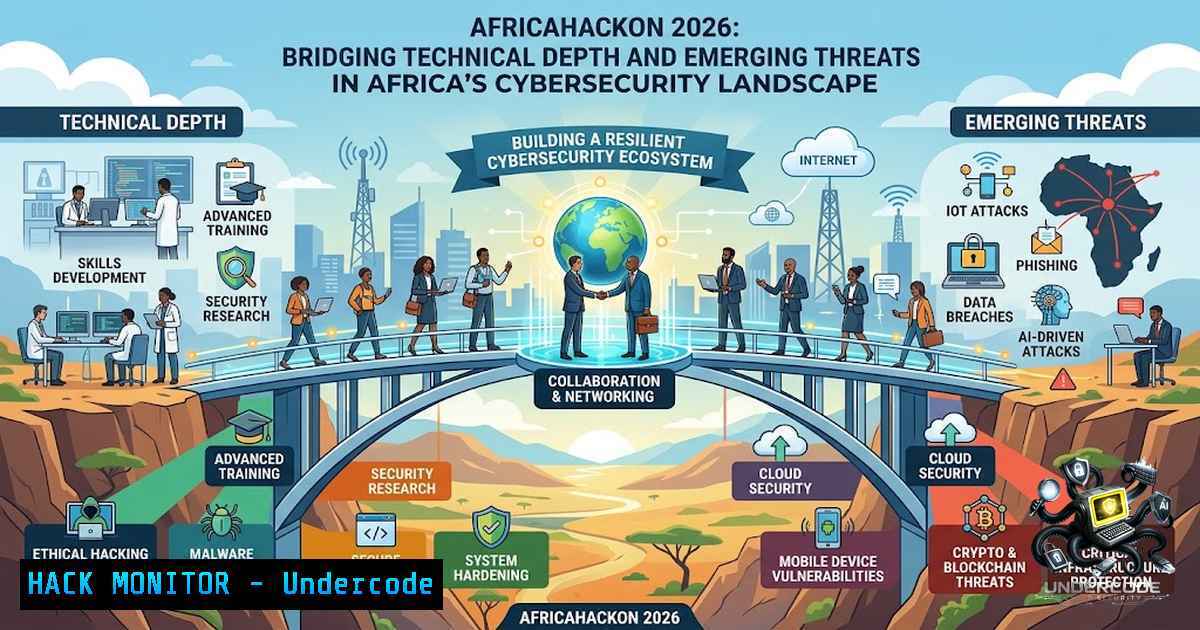
Introduction:
The convergence of traditional security pillars with emergent AI-driven attack surfaces defined the discourse at the AfricaHackon Cyber Security Summit 2026. While Day 1 and Day 2 delved into core operational disciplines—penetration testing, threat intelligence, and GRC—the summit’s pivot to privacy, cloud hardening, and adversarial machine learning on Day 3 highlighted a critical industry shift. This synthesis underscores a fundamental truth: modern resilience demands equal proficiency in exploiting legacy vulnerabilities and securing algorithmic decision-making pipelines, a balance central to the continent’s digital sovereignty.
Learning Objectives & Secrets:
- Objective 1: Operationalizing Threat Intelligence Feeds. Master the integration of STIX/TAXII into SIEM platforms for real-time indicator ingestion, moving beyond static IOCs to behavioral analytics.
- Objective 2: DevSecOps Pipeline Hardening (Secret Tip). Implement runtime application self-protection (RASP) within containerized workloads using eBPF hooks, bypassing traditional WAF limitations by monitoring syscalls during pod execution.
- Objective 3: AI Supply Chain Security (Secret Tip). Mitigate model poisoning by implementing cryptographic hashing and verifiable credentials for dataset provenance, ensuring that training data integrity is cryptographically attested before pipeline ingestion.
You Should Know:
- Cloud Security Posture Management (CSPM) for Hybrid African Deployments
The summit emphasized that cloud misconfigurations remain the primary attack vector, especially in multi-cloud environments popular across the continent. A robust CSPM strategy involves continuous assessment against frameworks like CIS Benchmarks and the MITRE ATT&CK Cloud Matrix. The critical nuance is automating remediation without disrupting legacy on-premise dependencies.
Step‑by‑step guide to audit Azure/AWS security controls using CLI:
– Linux/macOS (AWS): `aws configure set region af-south-1 && aws configservice put-configuration-aggregator –configuration-aggregator-1ame AfricaAggregator –account-aggregation-sources ‘[{“AccountIds”: [“123456789012”]}]’ –region af-south-1`
– Windows (Azure): `az login –tenant YourTenantID` then `az security assessment list –query “[?status.code==’Unhealthy’]”`
– Check for public exposure: `aws ec2 describe-instances –filters “Name=instance.group-1ame,Values=default” –query ‘Reservations[].Instances[].PublicIpAddress’` to identify drift from the zero-trust model discussed.
2. Database Security and Smart Contract Auditing
Day 2’s deep dive into database security covered both SQL injection mitigation in legacy systems and the unique attack surfaces of blockchain-based storage. For traditional RDBMS, parameterized queries are insufficient; implementing a Web Application Firewall (WAF) with custom rule sets to monitor anomalous query structures is vital. For smart contracts, the focus was on reentrancy and access control vulnerabilities in DeFi protocols common in African fintech.
Step‑by‑step guide to audit a Postgres database and a Solidity contract:
– Linux Database Hardening: `sudo grep “log_connections = on” /etc/postgresql/15/main/postgresql.conf` and enable `log_disconnections` to track brute-force attempts.
– Smart Contract Analysis (Slither): `slither –print human-summary ./contracts/Vault.sol` and `solc –bin –abi ./contracts/Vault.sol -o build/` to dissect the bytecode for opcode-level vulnerabilities like `DELEGATECALL` misuse.
3. Computational Defence and AI Security
Day 3’s “computational defence” track addressed adversarial machine learning (AML). The core insight was that AI models are susceptible to gradient-based evasion attacks, necessitating the implementation of defensive distillation and differential privacy during training. The practice involves validating model input distributions against training data to detect anomalies indicative of adversarial perturbations.
Step‑by‑step guide to implement adversarial validation in Python:
import numpy as np
from scipy.stats import ks_2samp
 Reference training distribution
train_dist = np.load('train_activations.npy')
 Incoming inference request activations
infer_dist = np.load('infer_activations.npy')
 Kolmogorov-Smirnov test for drift
stat, p = ks_2samp(train_dist, infer_dist)
if p < 0.05: print("Potential adversarial input detected")
– Tool recommendation: Deploy the Adversarial Robustness Toolbox (ART) to benchmark model resilience against FGSM and PGD attacks.
4. GRC and ISO 27001:2022 Implementation
The summit stressed that compliance is not antithetical to agility. The transition to ISO 27001:2022 requires integrating threat intelligence into the risk assessment process (Clause 6.1). A key secret tip involves automating control implementation tracking using a centralized GRC platform that maps to the Annex A controls, specifically addressing cloud services (A.5.23) and information security for use of cloud services.
Step‑by‑step guide to automate ISO 27001 readiness on Linux:
– Install `openvas` (Greenbone) for vulnerability scanning to satisfy control A.8.8.
– Command: `gvm-cli socket –gmp-username admin –gmp-password pass socket –xml “
– For documentation, use `pandoc` to convert `risk_register.md` to `risk_register.pdf` for audit trails: pandoc risk_register.md -o risk_register.pdf --metadata title="ISO27001_RA".
5. Vendor Risk Management and Bug Bounty Integration
The conversation around vendor risks highlighted that third-party APIs are the new perimeter. It’s crucial to implement automated vendor security assessments using SIG questionnaires and validate their security posture through continuous scanning. The secret is to leverage bug bounty platforms (like Intigriti or HackerOne) as an external validation layer for your vendor’s security claims.
Step‑by‑step guide to API endpoint security validation (Windows/Linux):
- Windows (Nmap): `nmap -sV –script=http-vuln target-api.com`
– Linux (ffuf for endpoint fuzzing): `ffuf -u https://target-api.com/FUZZ -w /usr/share/wordlists/dirb/common.txt -ac` to discover hidden vendor endpoints. - Monitor OAuth2 tokens: `curl -X GET “https://vendor.com/api/v1/data” -H “Authorization: Bearer $TOKEN” -v` to check for excessive scope permissions, a key vendor risk indicator.
What Undercode Say:
- Key Takeaway 1: Africa’s cybersecurity community is maturing beyond foundational practices to tackle sovereign challenges like data localization and AI governance, indicating a shift from “importing” security to “engineering” contextualized solutions.
- Key Takeaway 2: The intersection of GRC with deep technical code-level security (smart contracts, ML pipelines) is the new frontier. Professionals must break down silos between compliance officers and engineers to foster effective DevSecOps.
Analysis: The emphasis on computational defence reflects a proactive stance against AI risks, which is critical given the proliferation of generative AI in African banking and telecommunications. However, the gap between Day 1’s penetration testing topics and Day 3’s AI security shows a skills pipeline challenge. To bridge this, continuous upskilling in adversarial machine learning and cloud forensics is imperative. The summit’s focus on community and knowledge sharing is the linchpin for this upskilling—cybersecurity is fundamentally a team sport, and Africa’s collaborative ecosystem is its greatest asset against global threat actors.
Prediction:
- +1 Africa will see a 40% increase in regional bug bounty programs by 2027, driven by local talent showcased at events like AfricaHackon, reducing reliance on external security researchers.
- -1 The lack of standardized AI security frameworks across the continent will lead to a significant data poisoning attack targeting a major financial institution within the next 18 months.
- +1 Cross-border data protection harmonization efforts will accelerate, spurred by the privacy discussions on Day 3, potentially establishing a “African GDPR” model by 2028.
- -1 Vendor risk management will remain the weakest link, with at least two high-profile breaches in 2026 originating from compromised API keys shared with third-party logistics providers.
- +1 Adoption of eBPF-based runtime security tools will become mainstream in Nairobi and Lagos tech hubs, offering low-overhead visibility into containerized workloads.
- +1 The GRC community will leverage AI for automated control mapping, reducing ISO 27001 audit preparation time from 6 months to 6 weeks for mature organizations.
- -1 The skills gap in smart contract auditing will create a localized bubble, with salaries inflating rapidly, potentially leading to rushed audits and subsequent DeFi hacks.
- +1 Cloud security posture management will evolve to include automated remediation, with providers offering Africa-specific compliance benchmarks to simplify regulatory adherence.
- -1 Legacy database systems in African utilities will face increased SQL injection attempts as attackers shift focus from financial to critical national infrastructure.
- +1 AfricaHackon 2027 will introduce a dedicated “Blue Team” competition focused on AI defense, solidifying the continent’s role in the global cybersecurity research community.
▶️ Related Video (84% Match):
🎯Let’s Practice For Free:
🎓 Live Courses & Certifications:
Join Undercode Academy for Verified Certifications
🚀 Request a Custom Project:
Secure, high-velocity infrastructure and disruptive technological engineering. Contact our engineering team for high-tier development and proprietary systems:
[email protected]
💎 Smart Architecture | 🛡️ Secure by Design | ⭐ Trusted by Thousands
IT/Security Reporter URL:
Reported By: https://lnkd.in/p/ejPZMKkf – Hackers Feeds
Extra Hub: Undercode MoN
Basic Verification: Pass ✅


