Listen to this Post
Introduction:
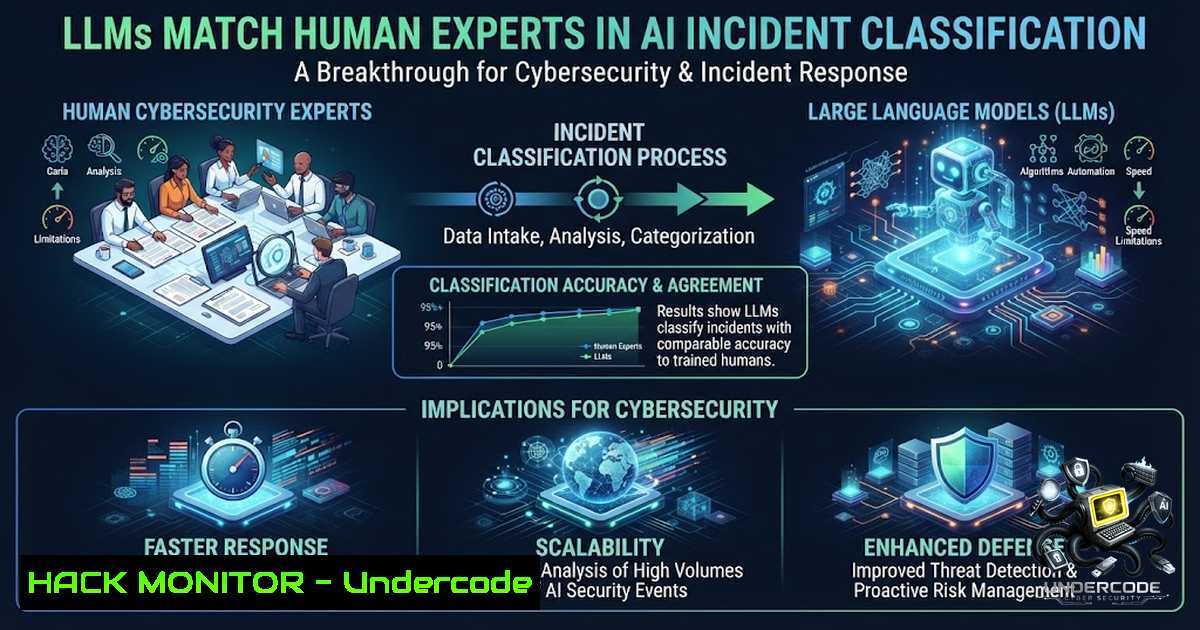
The MIT AI Risk Initiative (AIRI) has just released a landmark validation study (June 2026) demonstrating that frontier large language models can now classify real-world AI incidents with reliability matching or exceeding human expert agreement. This breakthrough signals a paradigm shift in how organizations can monitor, govern, and respond to the growing wave of AI-related failures, from deepfake fraud to algorithmic discrimination. For cybersecurity professionals, this isn’t just an academic exercise—it’s a practical framework for building scalable AI risk monitoring into existing security operations.
Learning Objectives:
- Understand the MIT AI Risk Initiative’s five-taxonomy classification framework for AI incidents
- Learn how to implement LLM-based incident classification pipelines in your organization
- Master the technical commands and tools for AI risk monitoring across Linux and Windows environments
- Apply EU AI Act risk level classification to real-world AI systems
- Build automated incident response workflows using AI-powered CLI tools
You Should Know:
1. The Five Taxonomies That Define AI Risk
MIT’s validation study tested eight frontier models across five distinct taxonomies: Harm Severity, Risk Level, Causality, Domain, and Subdomain. The AI Incident Database—which now contains over 1,350 documented incidents—serves as the foundational dataset. The Domain Taxonomy alone spans 24 subdomains, with “Malicious Actors” (35%) and “AI System Safety Failures” (22%) representing the largest categories. Within malicious actors, fraud, scams, and targeted manipulation account for 329 of 426 reported incidents.
The Causal Taxonomy reveals that 51% of incidents are intentionally caused, and the overwhelming majority occur post-deployment (98%) rather than pre-deployment. Under the EU AI Act risk classification, 3% of reported incidents would be deemed “Unacceptable” (prohibited), while 35% would fall into “High Risk”. Notably, the proportion of Unacceptable-risk incidents has risen each year since 2022, reaching 4% in 2025.
Step-by-Step: How to Query the MIT AI Incident Tracker
The MIT AI Incident Tracker provides an interactive web interface for exploring classified incidents. To programmatically access this data:
 Linux/macOS: Use curl to fetch incident data from the AI Incident Database API
curl -X GET "https://incidentdatabase.ai/api/incidents?limit=10" \
-H "Accept: application/json" | jq '.incidents[] | {title, description, severity}'

Windows (PowerShell): Similar query using Invoke-RestMethod
Invoke-RestMethod -Uri "https://incidentdatabase.ai/api/incidents?limit=10" \
-Headers @{"Accept"="application/json"} | Select-Object -ExpandProperty incidents
For local classification using an LLM pipeline, you can leverage the open-source classification prompts documented in the MIT study:
 Python script for AI incident classification using an LLM
import json
import requests

def classify_incident(incident_text, taxonomy="harm_severity"):
prompt = f"""
Classify the following AI incident according to the MIT AI Risk Taxonomy.
Taxonomy: {taxonomy}
Incident: {incident_text}

Output valid JSON with fields: classification, confidence_score, reasoning.
"""
response = requests.post(
"https://api.anthropic.com/v1/messages",
headers={"x-api-key": "YOUR_API_KEY"},
json={
"model": "claude-3-opus-20240229",
"messages": [{"role": "user", "content": prompt}],
"max_tokens": 500
}
)
return json.loads(response.json()["content"][bash]["text"])
2. LLM Performance: Which Models Lead the Pack?
The validation study tested eight frontier models against human expert baselines. Opus 4.6 and Kimi K2.5 outperformed the current production model across most taxonomies. Without any prompt tuning, several advanced models already met or exceeded human-human agreement on Harm Severity, Domain, and Causal classifications. After targeted prompt refinement, Opus 4.6 matched or exceeded human-human baselines across all five taxonomies in the pilot sample.
However, the EU AI Act Risk Level classification proved the most challenging task for all models. This highlights that taxonomy clarity and precise prompt engineering are equally critical as model selection. The study’s key takeaway: reliable governance workflows depend on taxonomy clarity, prompt design, and model selection—not just the model itself.
Step-by-Step: Setting Up an LLM-Based Classification Pipeline
To replicate the MIT classification approach in your own environment:
1. Install the required dependencies:
 Linux
pip install openai anthropic pandas numpy

Windows (using PowerShell with chocolatey or direct pip)
pip install openai anthropic pandas numpy
2. Create a classification configuration file (`config.yaml`):
taxonomies:
- harm_severity
- risk_level
- causality
- domain
- subdomain
model: "claude-3-opus-20240229"
batch_size: 10
output_format: "json"
3. Run the classification pipeline:
python classify_incidents.py --input incidents.csv --config config.yaml --output classified_incidents.json
- Validate results against human benchmarks using Cohen’s Kappa agreement metrics:
from sklearn.metrics import cohen_kappa_score kappa = cohen_kappa_score(human_labels, llm_predictions) print(f"Inter-rater agreement: {kappa:.3f}") -
The AI Risk Navigator: Centralizing AI Risk Intelligence
In April 2026, MIT launched the AI Risk Navigator, an interactive web tool that centralizes all of AIRI’s datasets—thousands of catalogued risks, documented incidents, governance documents, and mitigation actions—using shared taxonomies. Previously, these datasets existed in isolation; the Navigator enables cross-dataset exploration for the first time.
The Navigator allows researchers to navigate any risk domain and immediately see relevant risks, incidents, and governance documents side-by-side. All visualizations support PNG export for easy integration into reports. Version 1.0.0 is available at airi-1avigator.com, with three new datasets currently in development.
Step-by-Step: Using the AI Risk Navigator for Threat Intelligence
- Navigate to airi-1avigator.com
- Select a Risk Domain from the taxonomy (e.g., “Malicious Actors” or “System Failures”)
- View the Incident Timeline showing trends from 2015-2025
- Cross-reference with Governance Documents to identify regulatory gaps
5. Export visualizations as PNG for security briefings
For automated data extraction, use the Navigator’s underlying API (documentation available on the site):
 Extract incident data for a specific domain using curl
curl -X GET "https://airi-1avigator.com/api/incidents?domain=malicious_actors&year=2025" \
-H "Accept: application/json" > malicious_actors_2025.json
- EU AI Act Risk Classification: A Practical Implementation Guide
The EU AI Act classifies AI systems into four risk levels: Unacceptable (prohibited), High, Limited, and Minimal. High-risk systems must comply with security, transparency, and quality obligations, with penalties up to €35 million or 7% of global turnover for non-compliance. The provisions on high-risk uses apply from August 2026.
MIT’s study found that EU AI Act Risk Level was the toughest classification task for LLMs, underscoring the need for clearer definitions and more precise prompt engineering.
Step-by-Step: Classifying Your AI System Under the EU AI Act
- Assess whether your system falls into any prohibited category (Unacceptable risk):
– Subliminal manipulation
– Exploitation of vulnerabilities
– Social scoring by governments
– Real-time biometric identification in public spaces (with limited exceptions)
2. Evaluate High-Risk criteria:
- Is the system used in critical infrastructure, education, employment, or law enforcement?
- Does it impact health, safety, or fundamental rights?
3. Implement a classification workflow:
 EU AI Act Risk Classifier
def classify_eu_ai_risk(system_description, use_case, sector):
risk_factors = {
"critical_infrastructure": 0.8,
"employment": 0.7,
"education": 0.6,
"law_enforcement": 0.9,
"healthcare": 0.8,
"biometric_identification": 0.95
}

score = sum(risk_factors.get(factor, 0) for factor in [use_case, sector])

if score >= 0.9:
return "Unacceptable Risk (Prohibited)"
elif score >= 0.6:
return "High Risk"
elif score >= 0.3:
return "Limited Risk"
else:
return "Minimal Risk"
4. Document compliance obligations based on classification result.
- AI-Powered Incident Response: CLI Tools for Security Teams
Several open-source CLI tools now enable AI-powered incident detection, triage, and response directly from the terminal:
- OpsPilot: A production-focused Node.js CLI for incident response workflows, helping SRE teams analyze logs, generate diagnostic guidance, build timelines, and draft postmortems
- LogDoctor: A privacy-first CLI that diagnoses production logs and explains incidents instantly in your terminal
- Incident Helper: An AI-powered terminal assistant for SREs and DevOps engineers that triages incidents, analyzes logs, and executes diagnostics
- Sherlock CLI: Features a five-agent pipeline (triage → forensics → analyst → fix → resolve) for automated incident management
Step-by-Step: Setting Up AI-Powered Incident Response
1. Install OpsPilot (Linux/macOS):
npm install -g opspilot
2. Configure your incident response pipeline:
opspilot init --config incident_config.yaml
3. Run automated incident analysis:
 Linux
opspilot analyze --log /var/log/app.log --severity high --output report.md

Windows (PowerShell)
opspilot analyze --log C:\logs\app.log --severity high --output report.md
4. Generate structured postmortems:
opspilot postmortem --incident-id INC-2026-001 --template security
5. Integrate with existing SIEM tools:
 Forward alerts to OpsPilot for LLM-based triage
cat alert.json | opspilot triage --format json --model claude-3-opus
- NIST AI RMF: A Complementary Framework for AI Governance
The NIST AI Risk Management Framework (AI RMF) provides a voluntary, trustworthiness-focused approach to AI governance. Its core offers outcomes and actions that enable dialogue, understanding, and activities to manage AI risks and responsibly develop trustworthy AI systems. The NIST AI RMF Playbook provides suggested tactical actions for achieving these outcomes.
MIT’s work complements NIST’s framework by providing empirical validation of LLM-based classification, enabling organizations to operationalize AI RMF outcomes at scale.
Step-by-Step: Implementing NIST AI RMF with LLM Classification
- Map MIT taxonomies to NIST AI RMF categories:
– Harm Severity → AI RMF “Measure” function
– Domain Taxonomy → AI RMF “Map” function (context)
– Causal Taxonomy → AI RMF “Govern” function (root cause analysis)
2. Deploy an LLM classifier for continuous monitoring:
 Schedule daily classification of new AI incidents
0 6    /usr/bin/python3 /opt/ai_risk/classify_daily.py --output /var/reports/$(date +\%Y\%m\%d)_incidents.json
3. Generate NIST AI RMF compliance reports:
def generate_ai_rmf_report(classified_incidents):
report = {
"GOVERN": {"risks_identified": len(classified_incidents)},
"MAP": {"domains_affected": set(inc["domain"] for inc in classified_incidents)},
"MEASURE": {"severity_distribution": Counter(inc["severity"] for inc in classified_incidents)},
"MANAGE": {"mitigation_actions": extract_mitigations(classified_incidents)}
}
return report
What Undercode Say:
- Key Takeaway 1: LLM-based incident classification is not just feasible—it’s already matching human experts across multiple taxonomies. Organizations should begin piloting these pipelines now to build scalable AI risk monitoring capabilities before regulatory requirements mandate them.
-
Key Takeaway 2: The EU AI Act Risk Level remains the most challenging classification dimension, even for frontier models. This isn’t a model failure—it’s a reflection of the Act’s inherent complexity. Organizations must invest in taxonomy clarity, prompt engineering, and human-in-the-loop validation, not just model selection.
Analysis: The MIT validation study represents a watershed moment for AI governance. For the first time, we have empirical evidence that LLMs can systematically classify AI incidents at scale, with reliability comparable to human experts. This unlocks the possibility of real-time AI risk monitoring across global deployments—something previously impossible given the volume of incidents and the scarcity of human experts. However, the study also reveals critical limitations: the EU AI Act’s risk taxonomy remains ambiguous even for advanced models, and human reviewers themselves only achieved “fair” agreement on harm severity. This suggests that the bottleneck isn’t AI capability—it’s the underlying taxonomies and definitions. Organizations should treat this as a call to action: refine your taxonomies, invest in prompt engineering, and build continuous validation loops. The technology is ready; the governance frameworks are not.
Prediction:
- +1 AI incident classification will become a standard component of enterprise security operations within 18-24 months, with LLM-powered pipelines integrated into SIEM and SOAR platforms.
-
+1 The MIT AI Risk Navigator will evolve into the de facto standard for AI risk intelligence, similar to how CVE databases became foundational for cybersecurity.
-
-1 Organizations that rely solely on model selection without investing in taxonomy refinement and prompt engineering will see significant classification errors, leading to regulatory penalties and reputational damage.
-
-1 The EU AI Act’s complexity will continue to challenge both human and AI classifiers, creating enforcement gaps and compliance ambiguities until clearer definitions emerge through case law and regulatory guidance.
-
+1 Open-source classification frameworks and prompt libraries will emerge, democratizing access to AI risk monitoring and enabling smaller organizations to achieve compliance without massive AI budgets.
-
-1 The rise of multi-agent AI systems (now recognized as a distinct risk category by MIT) will introduce novel incident patterns that existing taxonomies may not capture, requiring continuous taxonomy evolution.
-
+1 Integration of AI incident classification with existing cybersecurity frameworks (NIST, MITRE ATT&CK) will accelerate, creating unified risk management approaches that bridge traditional cyber threats and AI-specific risks.
▶️ Related Video (78% Match):
https://www.youtube.com/watch?v=dU1JiJRXXzE
🎯Let’s Practice For Free:
🎓 Live Courses & Certifications:
Join Undercode Academy for Verified Certifications
🚀 Request a Custom Project:
Secure, high-velocity infrastructure and disruptive technological engineering. Contact our engineering team for high-tier development and proprietary systems:
[email protected]
💎 Smart Architecture | 🛡️ Secure by Design | ⭐ Trusted by Thousands
IT/Security Reporter URL:
Reported By: %F0%9F%87%AA%F0%9F%87%BA Dr – Hackers Feeds
Extra Hub: Undercode MoN
Basic Verification: Pass ✅


