Listen to this Post
Introduction
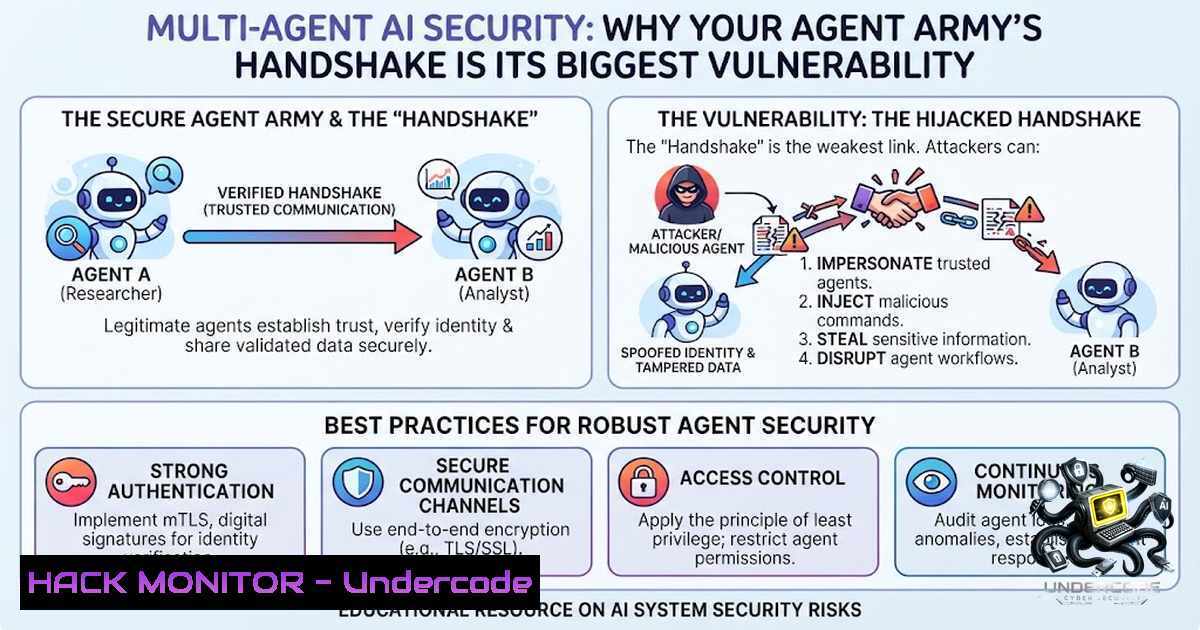
The rise of multi-agent AI systems represents a paradigm shift in how we deploy artificial intelligence, but it also introduces a security challenge that dwarfs traditional single-agent concerns. When two or more AI agents communicate and coordinate actions, they don’t simply double the attack surface—they multiply it exponentially. OWASP’s 2026 Top 10 for Agentic Applications has officially recognized this threat with dedicated categories: ASI07 (Insecure Inter-Agent Communication) and ASI08 (Cascading Failures), while CSA’s MAESTRO framework independently validates these same vulnerabilities. This article explores why agent-to-agent composition, not any single agent’s security posture, represents the true new attack surface and provides actionable enforcement strategies to secure these emerging systems.
Learning Objectives
- Understand the fundamental security risks introduced by inter-agent communication in multi-agent AI systems
- Learn practical implementation strategies for identity verification, authorization, and human-in-the-loop controls
- Master runtime observability techniques to detect compromised or poisoned agents in real-time
- Implement data governance controls to prevent unauthorized sensitive data movement between agents
- Design resilient agent architectures that limit blast radius through secure handoff protocols
You Should Know
- The Composition Problem: Why Multi-Agent Systems Are Fundamentally Different
Traditional application security operates on a simple premise: secure the application, secure the data, and monitor the perimeter. Multi-agent AI systems shatter this model completely. When Agent A passes a task to Agent B, that handoff creates a fresh trust boundary that must be independently verified. Unlike monolithic applications where trust is established once, agentic systems require continuous re-authentication and re-authorization at every interaction point.
The OWASP ASI07 classification specifically targets insecure inter-agent communication because the industry has observed that most security teams treat agent-to-agent communication as inherently trusted once the initial authentication occurs. This assumption is fatally flawed. A compromised agent can maintain its valid credentials while executing malicious actions, making traditional authentication insufficient.
Step-by-Step Guide to Understanding Agent Attack Vectors:
- Map all agent communication flows in your system, documenting every handoff point between agents
- Identify sensitive data transfers that cross these boundaries, including PII, credentials, and proprietary information
- Assess each handoff for verification gaps—what is actually checked before an agent accepts a task?
- Test authenticated but malicious payloads by simulating compromised upstream agents
- Document which handoffs have independent verification versus those relying on transitive trust
 Example: Basic inter-agent communication without verification
class Agent:
def <strong>init</strong>(self, name, credentials):
self.name = name
self.credentials = credentials
self.trusted_agents = []

def send_task(self, task, target_agent):
 VULNERABLE: Assumes target is trustworthy
if target_agent in self.trusted_agents:
target_agent.receive_task(task, self.credentials)

def receive_task(self, task, sender_credentials):
 VULNERABLE: No verification of sender's true intent
self.process_task(task)
- Runtime Observability: Catching the Compromised Agent in the Act
Girimaji S.’s comment on the original post raises a critical point: “What if every agent is authenticated and the message is still wrong?” Identity, integrity, and authorization cannot detect whether an authorized upstream agent was compromised by prompt injection, operating on poisoned memory, or passing a false result. This is precisely how a valid handoff can feed an ASI08 cascade. The receiving agent trusts the channel, then acts on bad intent or bad context.
Runtime observability provides the answer. Instead of relying solely on authentication and authorization, organizations must implement comprehensive monitoring that examines what agents are actually doing, not just who they claim to be. This shift from identity-based trust to behavior-based verification represents a fundamental security paradigm change.
Step-by-Step Guide to Implementing Runtime Observability:
- Instrument every agent with telemetry collection capturing inputs, outputs, decision rationale, and resource access
- Establish behavioral baselines for normal agent operation across different task types
- Monitor for anomalous patterns such as unusual API calls, unexpected data access, or inconsistent decision-making
- Implement real-time alerting when agents deviate from established behavioral patterns
- Create incident response procedures specifically for compromised agent detection
Linux Commands for Observability Infrastructure:
 Set up audit logging for agent processes
sudo auditctl -a always,exit -F pid=$(pgrep -f "agent_process") -S all

Monitor network connections from agent processes
sudo netstat -tunap | grep $(pgrep -f "agent_process")

Track file access patterns
sudo inotifywait -m -r -e access,modify,open /path/to/agent/data

Log all Python process executions
ps aux | grep python | grep agent_name | logger -t agent_monitor

Set up central logging with rsyslog
echo '. @remote-logging-server:514' >> /etc/rsyslog.conf
sudo systemctl restart rsyslog
- The Data Leakage Blind Spot: What Actually Crosses the Wire
Hiresh Verma’s contribution identifies perhaps the most underrated risk in multi-agent systems: the data crossing each edge, not just the identity on either end. An authenticated agent can quietly carry PII, credentials, or other sensitive information downstream, and most teams maintain no record of what actually moved. This visibility gap represents a compliance nightmare and a security catastrophe waiting to happen.
The challenge is particularly acute because pseudo-anonymization only holds if sensitive fields never reach the model. Once data hits the agent’s processing pipeline, traditional data protection mechanisms often fail. Organizations must implement firewall-like controls that redact sensitive data before it reaches any agent tool, effectively creating a barrier between sensitive information and the AI system.
Step-by-Step Guide to Data Governance in Multi-Agent Systems:
- Classify all data types that can move between agents according to sensitivity levels
- Implement data redaction layers at every agent boundary that strip sensitive information
- Log all data transfers with detailed records of what data moved, between which agents, and why
- Apply pseudonymization consistently across all agent communication channels
- Audit data movement regularly to identify unauthorized flows
Python Implementation for Agent Communication Firewall:
import re
import hashlib
from typing import Dict, Any

class AgentDataFirewall:
def <strong>init</strong>(self):
self.sensitive_patterns = {
'email': re.compile(r'\b[A-Za-z0-9._%+-]+@[A-Za-z0-9.-]+.[A-Z|a-z]{2,}\b'),
'phone': re.compile(r'\b\d{3}[-.]?\d{3}[-.]?\d{4}\b'),
'ssn': re.compile(r'\b\d{3}-\d{2}-\d{4}\b'),
'credit_card': re.compile(r'\b\d{4}[-\s]?\d{4}[-\s]?\d{4}[-\s]?\d{4}\b')
}
self.audit_log = []

def redact_data(self, data: str, agent_id: str) -> str:
"""Remove sensitive data before it reaches an agent"""
original_data = data
for pattern_name, pattern in self.sensitive_patterns.items():
if pattern.search(data):
data = pattern.sub(lambda m: ''  len(m.group()), data)
self._log_redaction(agent_id, pattern_name, original_data)
return data

def _log_redaction(self, agent_id: str, pattern_name: str, original: str):
"""Log all redaction events for compliance"""
self.audit_log.append({
'agent_id': agent_id,
'pattern_redacted': pattern_name,
'timestamp': datetime.now().isoformat(),
'original_length': len(original)
})
4. Human-in-the-Loop: The Most Underutilized Control
Despite advances in AI autonomy, human oversight remains one of the most effective controls for preventing cascading failures. The key is implementing human-in-the-loop gates at strategic decision points rather than attempting to human-review every interaction. This requires careful design to balance security requirements with operational efficiency.
The enforcement layer open-sourced by Animesh Kumar Mishra provides a practical implementation of this concept. The Python module includes identity verification, authorization controls, and human-in-the-loop gates with adapters for LangGraph and LangChain, demonstrating how organizations can implement these controls without rebuilding their entire infrastructure.
Step-by-Step Guide to Implementing Human-in-the-Loop Controls:
- Identify critical decision points where human review adds value without crippling efficiency
- Implement approval workflows that pause agent execution until human validation occurs
- Create escalation procedures for high-risk actions requiring immediate human intervention
- Track human decisions to identify patterns and improve automated controls
- Regularly review human override decisions to identify potential abuse or systematic bypasses
Windows PowerShell Commands for Agent Monitoring:
 Monitor agent processes and log activity
Get-Process | Where-Object {$<em>.ProcessName -like "agent"} |
ForEach-Object {
Write-EventLog -LogName Application -Source "AgentMonitor"
-EntryType Information -EventId 1001
-Message "Agent process detected: $($</em>.ProcessName) ID: $($_.Id)"
}

Create a scheduled task for agent health monitoring
$Action = New-ScheduledTaskAction -Execute "powershell.exe"
-Argument "-File C:\Scripts\agent_health_check.ps1"
$Trigger = New-ScheduledTaskTrigger -AtStartup -RandomDelay New-TimeSpan -Minutes 5
$Settings = New-ScheduledTaskSettingsSet -AllowStartIfOnBatteries
Register-ScheduledTask -TaskName "AgentHealthMonitor" -Action $Action
-Trigger $Trigger -Settings $Settings

Audit agent data access permissions
Get-Acl -Path "C:\AgentData\" | Format-Table -AutoSize
5. The Enforcement Layer: Practical Implementation
Animesh Kumar Mishra has open-sourced an enforcement layer that maps directly to the security gaps identified by OWASP and CSA frameworks. The repository includes a standards-tagged checklist and a Python module implementing identity verification, authorization, and human-in-the-loop gates with adapters for popular frameworks like LangGraph and LangChain.
The enforcement layer operates on a critical principle: every agent-to-agent communication must be independently verified, with no transitive trust assumptions. This shifts the security model from “trust but verify” to “never trust, always verify” specifically for inter-agent communication.
Step-by-Step Guide to Implementing the Enforcement Layer:
- Clone and configure the enforcement layer from the GitHub repository
- Define your agent identity model including authentication mechanisms
- Configure authorization policies for every type of inter-agent communication
4. Set up human-in-the-loop gates for high-risk operations
5. Implement audit logging for all agent communications
6. Test the enforcement layer with simulated attacks
 Example from the enforcement layer implementation
from enforcement_layer import AgentVerifier, AuthorizationPolicy, HumanGate

class SecureAgent:
def <strong>init</strong>(self, name, credentials):
self.name = name
self.verifier = AgentVerifier()
self.policy = AuthorizationPolicy()
self.human_gate = HumanGate()

def send_task(self, task, target_agent):
 Step 1: Verify target agent identity
if not self.verifier.verify_identity(target_agent):
raise SecurityException(f"Target agent {target_agent.name} identity verification failed")

Step 2: Check authorization for this communication
if not self.policy.check_authorization(self, target_agent, task):
raise SecurityException("Unauthorized communication attempt")

Step 3: Apply human gate for sensitive operations
if task.sensitivity > 7:
self.human_gate.request_approval(task, self, target_agent)

Step 4: Log the communication
self._log_communication(target_agent, task)

Step 5: Send after all verifications pass
target_agent.receive_task(task, self.credentials)
6. Cascading Failure Prevention: Limiting the Blast Radius
OWASP ASI08 specifically addresses cascading failures—the tendency for a single compromised agent to trigger a chain reaction that compromises multiple downstream agents. This is perhaps the most dangerous aspect of multi-agent systems because a single vulnerability can spread exponentially through the agent network.
Preventing cascading failures requires both technical controls and architectural decisions. Organizations must design their agent systems with failure modes in mind, implementing circuit breakers, fallback mechanisms, and isolation boundaries that prevent a single failure from compromising the entire system.
Step-by-Step Guide to Preventing Cascading Failures:
- Implement circuit breakers that stop communication when agents show signs of compromise
- Create isolated agent groups that limit the blast radius of any single compromise
- Implement fallback responses for when primary agents fail or become compromised
- Establish validation checkpoints that verify agent outputs before they can influence other agents
- Design graceful degradation paths that maintain essential functions during failures
 Circuit breaker implementation for agent communication
class AgentCircuitBreaker:
def <strong>init</strong>(self, failure_threshold=5, timeout=60):
self.failure_count = 0
self.failure_threshold = failure_threshold
self.timeout = timeout
self.last_failure_time = 0
self.state = "CLOSED"  CLOSED, OPEN, HALF_OPEN

def call_agent(self, agent_function, args, kwargs):
if self.state == "OPEN":
if time.time() - self.last_failure_time > self.timeout:
self.state = "HALF_OPEN"
return self._attempt_call(agent_function, args, kwargs)
else:
raise CircuitBreakerOpenException("Circuit breaker is OPEN")
else:
return self._attempt_call(agent_function, args, kwargs)

def _attempt_call(self, agent_function, args, kwargs):
try:
result = agent_function(args, kwargs)
if self.state == "HALF_OPEN":
self.state = "CLOSED"
self.failure_count = 0
return result
except Exception as e:
self.failure_count += 1
self.last_failure_time = time.time()
if self.failure_count >= self.failure_threshold:
self.state = "OPEN"
raise e
7. The Compliance and Governance Imperative
The regulatory landscape is rapidly evolving to address AI security risks. Organizations deploying multi-agent systems must prepare for increased scrutiny from regulators, auditors, and customers who demand evidence of adequate security controls. The OWASP and CSA frameworks provide a solid foundation for compliance, but organizations must go beyond checklist compliance to implement substantive security measures.
Data protection regulations like GDPR and CCPA take on new dimensions in multi-agent systems where data can move between agents in ways that are difficult to track. Organizations must maintain comprehensive audit trails of all data movement, implement pseudonymization consistently, and ensure that sensitive data never reaches the model.
Step-by-Step Guide to Compliance Implementation:
- Map all data flows through your multi-agent system, identifying every point where data moves between agents
- Implement comprehensive logging that captures all data transfers, access attempts, and security events
- Establish pseudonymization protocols that apply consistently across all agents
- Create incident response procedures specifically for data breaches involving agent communication
- Document all security controls for regulatory submissions and audits
Linux Commands for Compliance Monitoring:
 Set up file integrity monitoring
sudo apt-get install aide
sudo aideinit
sudo mv /var/lib/aide/aide.db.new /var/lib/aide/aide.db
sudo aide.wrapper --check

Configure log rotation for audit logs
sudo cat > /etc/logrotate.d/agent-audit << EOF
/var/log/agent-audit/.log {
daily
rotate 90
compress
delaycompress
notifempty
missingok
create 0640 root adm
}
EOF

Set up remote logging with encryption
sudo echo '. @@remote-logging-server:514' >> /etc/rsyslog.conf
sudo echo '$DefaultNetstreamDriverCAFile /etc/ssl/certs/ca-certificates.crt' >> /etc/rsyslog.conf
sudo echo '$ActionSendStreamDriverMode 1' >> /etc/rsyslog.conf
sudo systemctl restart rsyslog
What Undercode Say:
- Authentication alone is insufficient for agent security—organizations must implement independent verification at every agent handoff point, treating each communication as a new security boundary rather than relying on transitive trust
- Runtime observability provides the missing detection capability—by monitoring what agents actually do rather than just who they claim to be, organizations can detect compromised or poisoned agents before they cause cascading failures
The security community is only beginning to grapple with the implications of multi-agent AI systems. The traditional perimeter-based security model simply doesn’t work when agents can communicate in complex, unpredictable ways. Organizations must fundamentally rethink their security architecture, moving from static security controls to dynamic, behavior-based verification systems. The frameworks provided by OWASP and CSA offer a starting point, but substantive implementation will require substantial investment in new tools, processes, and skills. The organizations that successfully navigate this transition will gain a significant competitive advantage by deploying AI systems that are both powerful and secure.
Prediction:
+1 The security frameworks developed for multi-agent AI systems will evolve into industry standards, creating significant opportunities for security vendors and consulting firms specializing in AI security
-P The complexity of securing multi-agent systems will create new attack vectors that attackers will exploit before defenses mature, leading to high-profile breaches that could set back AI adoption by years
+1 Organizations that invest early in robust agent security will develop best practices that become de facto standards, giving them a competitive advantage in AI-driven industries
-1 Compliance costs for multi-agent systems will increase significantly as regulators develop new frameworks, potentially limiting AI adoption by smaller organizations
+1 The observability tools developed for agent security will have applications beyond security, improving overall system reliability and performance
-1 The security community may focus too heavily on technical controls while neglecting the governance and compliance aspects, leaving significant gaps in overall security posture
▶️ Related Video (84% Match):
🎯Let’s Practice For Free:
🎓 Live Courses & Certifications:
Join Undercode Academy for Verified Certifications
🚀 Request a Custom Project:
Secure, high-velocity infrastructure and disruptive technological engineering. Contact our engineering team for high-tier development and proprietary systems:
[email protected]
💎 Smart Architecture | 🛡️ Secure by Design | ⭐ Trusted by Thousands
IT/Security Reporter URL:
Reported By: Animesh Kumar – Hackers Feeds
Extra Hub: Undercode MoN
Basic Verification: Pass ✅


