
Listen to this Post
Introduction:
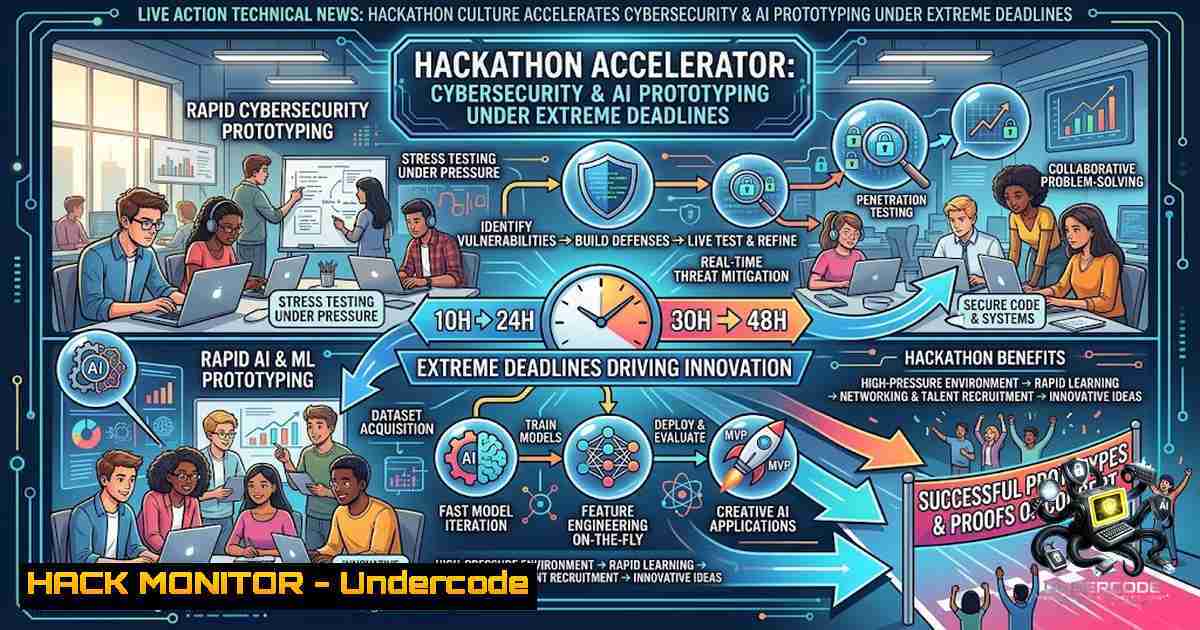
The rapid-fire environment of a hackathon is a microcosm of modern cybersecurity and AI development, where teams must ideate, build, and secure a functional prototype within a crushing time limit. Events like DROP HACK’26 force developers to implement real-time API security, cloud hardening, and vulnerability mitigation alongside feature development, mimicking the “build and defend” mentality required in today’s DevOps and DevSecOps pipelines. For the participants of DROP HACK’26, the intense 8-hour sprint was not just about winning, but about learning to architect resilient systems and debug under pressure—a skill set directly translatable to enterprise IT resilience and AI model deployment.
Learning Objectives & Secrets:
- Objective 1: Rapid API Security Implementation
Learn to secure RESTful APIs in under 30 minutes using middleware authentication, JWT validation, and input sanitization to prevent injection attacks. - Objective 2 Secret Tips: Leverage AI for Bug Hunting
Use AI code assistants (like GitHub Copilot or local LLMs) to instantly scan for logical flaws and hardcoded secrets in your codebase, reducing debugging time by 40%. - Objective 3 Secret Tips: Cloud-Hardening on the Fly
Quickly configure cloud firewalls (AWS Security Groups, Azure NSGs) to allow only necessary ports (443, 22 with IP whitelisting) and implement IAM least-privilege principles before deploying your prototype.
You Should Know:
- Securing the AI Prototype Backend with OWASP Top 10 Mitigations
During a hackathon, the pressure to ship code often leads to exposed endpoints and unvalidated inputs. For a project like “TRACE,” which presumably leverages AI/ML, security is paramount to prevent data poisoning or model theft.
Step‑by‑step guide for securing a Flask/FastAPI AI backend:
- Step 1: Implement input validation using Pydantic models. Create a validator that checks incoming JSON for unexpected keys or types to prevent mass assignment attacks.
from pydantic import BaseModel, validator class PredictionInput(BaseModel): data: str @validator('data') def prevent_injection(cls, v): if len(v) > 255 or any(c in v for c in [';', '--', '/']): raise ValueError('Invalid characters detected') return v - Step 2: Enforce rate-limiting to prevent brute-force or DoS attacks on the AI endpoint. For Linux servers, use `nginx` and
limit_req; for cloud-1ative, utilize API Gateway throttling. - Step 3: Deploy a Web Application Firewall (WAF) rule set. On cloud platforms (AWS WAF), create rules to block SQL injection and cross-site scripting (XSS) traffic.
- Debugging and Vulnerability Scanning with Open Source Tools
In the post-event analysis, teams often realize they deployed vulnerable containers. To avoid this, integrate SAST (Static Application Security Testing) early.
Step‑by‑step guide for scanning Python/Node dependencies:
- Step 1: Install `safety` (Python) or `npm audit` (Node) to check for known CVEs.
Linux/Windows Command:
 For Python
pip install safety
safety check -r requirements.txt
 For Node
npm audit --production
– Step 2: Use `gitleaks` to scan Git history for hardcoded secrets (e.g., Paytm API keys). Linux/Mac Command: `gitleaks detect –source . –verbose`
– Step 3: Run a lightweight container scan using Trivy. Command: `trivy image your-image:latest –severity HIGH,CRITICAL`
– Step 4: Implement logging and monitoring. Install `Prometheus` for metrics and `Grafana` for dashboards to detect anomalies in API response times.
3. Configuration Hardening for Hackathon Deployments (Linux/Windows)
Prototypes are often deployed on cloud VMs or bare-metal servers. Hardening the OS is crucial to prevent lateral movement if an attacker compromises the application.
Step‑by‑step guide (Windows Server / Linux):
- Linux: Disable root SSH login and enforce key-based authentication.
sudo sed -i 's/PermitRootLogin yes/PermitRootLogin no/' /etc/ssh/sshd_config
sudo systemctl restart sshd
- Windows: Disable SMBv1 and unnecessary services via PowerShell.
Disable-WindowsOptionalFeature -Online -FeatureName SMB1Protocol
- Network: Limit outbound traffic. On Linux, use `iptables` to restrict connections to only downstream databases.
sudo iptables -A OUTPUT -p tcp -d 0.0.0.0/0 --dport 443 -m state --state NEW,ESTABLISHED -j ACCEPT
4. API Key Management and Vault Integration
Teams using Paytm’s ecosystem must securely manage API keys. Avoid .env files in the repository.
Step‑by‑step guide for using HashiCorp Vault (or cloud native):
– Step 1: Start Vault in development mode (for testing).
– Step 2: Store secrets via CLI: `vault kv put secret/paytm api_key=xxxx`
– Step 3: Retrieve secrets inside your application using the Vault API, ensuring environment variables are not exposed in logs.
5. AI Model Security: Protecting Against Adversarial Inputs
Given the hackathon’s focus on AI, ensuring model robustness against adversarial attacks is a key differentiator.
Step‑by-step guide for input sanitization for text-based AI:
- Step 1: Implement a “clean-text” function that removes special characters and normalizes input.
- Step 2: Use a library like `Adversarial Robustness Toolbox (ART)` to test your model against common evasion techniques.
- Step 3: Implement a confidence threshold—if the AI model outputs a prediction with less than 70% confidence, reject the output and log the event for analysis.
6. Collaboration and CI/CD Security
During an 8-hour sprint, teams used Git. Securing the CI/CD pipeline prevents supply chain attacks.
Step‑by‑step guide for GitHub Actions security:
- Step 1: Use GitHub’s Dependabot to automatically update dependencies.
- Step 2: Restrict environment branches to `main/production` only.
- Step 3: Ensure GitHub Actions log outputs are stripped of secrets (using ::add-mask::).
7. Post-Hackathon Hardening (Retrospective)
After the event, teams should “shift left” and automate security testing.
- Step 1: Run `OWASP ZAP` against the live endpoint to generate a vulnerability report.
- Step 2: Generate a Software Bill of Materials (SBOM) using
Syft. Command: `syft packages . -o json > sbom.json`
– Step 3: Review the log files to identify any “break-fix” events that indicated a potential security flaw.
What Undercode Say:
- Key Takeaway 1: Hackathons are a proxy for incident response—building under pressure forces teams to prioritize critical security controls (like authentication and input validation) over aesthetics, which is a core cybersecurity principle.
- Key Takeaway 2: Mentorship is vital. External perspectives often catch obvious security gaps that developers overlook, such as misconfigured CORS policies or insecure direct object references (IDOR) in APIs.
Analysis:
The DROP HACK’26 experience highlights the shift toward “built-in” security rather than “bolt-on.” Rudra’s team, “TRACE,” likely faced challenges in keeping their application secure while integrating with third-party partners like Paytm. The strategic use of AI for debugging and the implementation of rapid cloud hardening techniques demonstrate a maturity in handling modern DevSecOps challenges. The event underscores that security is not a hindrance to innovation but a framework that ensures the innovation is viable and trustworthy. The collaborative environment fosters a culture where vulnerabilities are spotted and fixed collectively, proving that human intelligence, alongside AI tools, is the ultimate defense.
Prediction:
- +1 – AI-assisted secure coding will become standard in hackathons, reducing the number of insecure prototypes deployed to production.
- +1 – The demand for “Hackathon DevSecOps” specialists will rise, bridging the gap between rapid development and enterprise security compliance.
- -1 – There is a risk of “security theater” where teams implement superficial fixes to pass demos, potentially ignoring deep-rooted architectural flaws.
- +1 – Mentorship rounds like those seen at DROP HACK’26 will evolve into “Security Audits,” where mentors critically assess the application’s resilience, leading to safer applications in the ecosystem.
- -1 – Over-reliance on AI for code generation may lead to hidden vulnerabilities if the training data is biased or contains insecure patterns, requiring manual oversight.
- +1 – The integration of ecosystem partners like Paytm encourages stricter compliance with PCI-DSS and data privacy standards from the conception phase.
- +1 – The open-source nature of hackathon projects will lead to more community-driven security patches.
- -1 – The “Build in Public” trend may expose proprietary logic or API keys if not carefully managed, emphasizing the need for better secret scanning tools.
- +1 – The skills acquired in these 8-hour sprints will translate into faster patch management in large organizations.
- +1 – Ultimately, hackathons like DROP HACK’26 are breeding grounds for the next generation of cybersecurity leaders who understand that speed and safety are not mutually exclusive.
▶️ Related Video (80% Match):
🎯Let’s Practice For Free:
🎓 Live Courses & Certifications:
Join Undercode Academy for Verified Certifications
🚀 Request a Custom Project:
Secure, high-velocity infrastructure and disruptive technological engineering. Contact our engineering team for high-tier development and proprietary systems:
[email protected]
💎 Smart Architecture | 🛡️ Secure by Design | ⭐ Trusted by Thousands
IT/Security Reporter URL:
Reported By: https://lnkd.in/p/eKK-ryQa – Hackers Feeds
Extra Hub: Undercode MoN
Basic Verification: Pass ✅


