
Listen to this Post
Introduction:
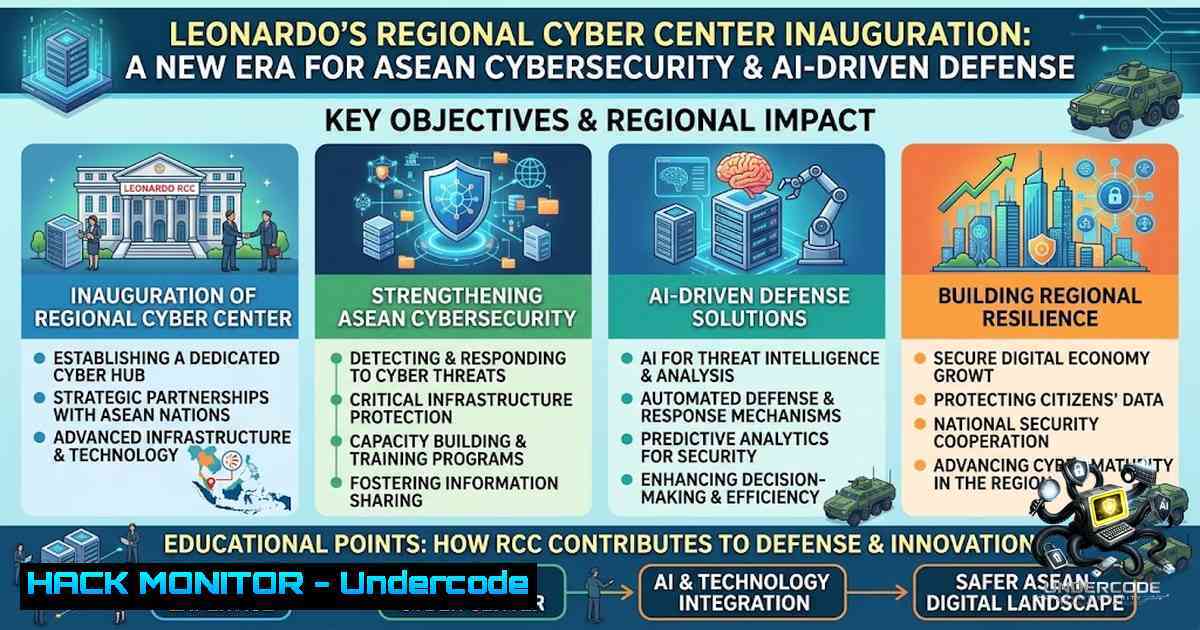
The geopolitical landscape of Southeast Asia is undergoing a profound digital transformation, with cybersecurity emerging as a critical pillar of national sovereignty and economic stability. On December 3, 2025, Leonardo officially inaugurated its new Regional Cyber Center in Kuala Lumpur, Malaysia, marking a significant escalation in the region’s defensive capabilities against sophisticated cyber and hybrid threats. This facility, integrated into Leonardo’s Global CyberSec Centre (GCC) network—which already includes strategic hubs in Chieti, Brussels, Bristol, and Riyadh—represents a shift from isolated national defenses to a federated, intelligence-driven security model. By leveraging proprietary technologies in cybersecurity, physical security, and mission-critical communications, the center aims to provide predictive protection for strategic assets while ensuring strict data sovereignty for member nations.
Learning Objectives & Secrets:
- Objective 1: Master Federated Threat Intelligence Sharing – Understand how the GCC’s federated model enables real-time threat correlation across international borders without compromising national data control, utilizing secure multi-party computation and encrypted threat intelligence feeds.
- Objective 2 Secret Tips: Leveraging AI for Predictive Defense – Learn to deploy Trustworthy AI frameworks that move beyond reactive signature-based detection to proactive anomaly prediction, utilizing behavioral analysis and big data analytics to anticipate zero-day exploits before they manifest.
- Objective 3 Secret Tips: Hardening Critical National Infrastructure (CNI) – Gain insights into securing National Cloud and Security Operation Centers (SOCs) through secure-by-design architectures, emphasizing the integration of physical security controls with cyber-defense mechanisms to counter hybrid warfare tactics.
You Should Know:
- Deploying a Federated Threat Intelligence Platform (Linux Focus)
The core of Leonardo’s GCC strategy relies on the secure aggregation and dissemination of threat data. For security engineers, setting up a federated query system mimics this architecture. A common implementation involves using OpenCTI or MISP instances that connect via secure APIs. To verify the integrity of incoming threat feeds, you can use GPG signatures and SHA-256 checksums.
Step‑by‑step guide:
- Install MISP on Ubuntu 22.04: `sudo apt-get install misp misp-modules` (follow the comprehensive install script from the MISP GitHub repository).
- Configure PyMISP for API interactions:
pip install pymisp. - Script to pull and verify intelligence:
from pymisp import PyMISP
import hashlib
import gnupg</li>
</ul>

misp = PyMISP('https://misp.local', 'YOUR_API_KEY', ssl=False)
events = misp.search(controller='events', return_format='json')

for event in events:
 Simulate hash verification for downloaded payloads
file_hash = hashlib.sha256(b"sample_payload").hexdigest()
print(f"Verifying hash: {file_hash}")
 In production, cross-reference with VirusTotal or local YARA rules
– Implement Logstash for centralized logging: Forward syslog and auditd logs to a central Elasticsearch instance for correlation.
– Result: You now have a baseline for a federated intelligence collector.2. Implementing “Secure-by-Design” in Cloud Environments (Azure/AWS)
The Kuala Lumpur center emphasizes “secure-by-design” architectures. This means shifting security left into the CI/CD pipeline. For cloud engineers, this involves rigorous Infrastructure-as-Code (IaC) scanning and runtime protection.
Step‑by‑step guide:
- Azure Policy for Compliance: Enforce policies that deny the creation of public storage accounts.
{ "if": { "allOf": [ { "field": "type", "equals": "Microsoft.Storage/storageAccounts" }, { "field": "Microsoft.Storage/storageAccounts/allowBlobPublicAccess", "equals": "true" } ] }, "then": { "effect": "deny" } } - AWS GuardDuty Enablement: Activate GuardDuty via CLI to monitor for unusual API calls or compromised instances:
aws guardduty create-detector --enable. - Container Scanning: Integrate Trivy or Snyk into your GitHub Actions workflow to scan images for CVEs before deployment.
- Implementation: This ensures that infrastructure is immutable and misconfigurations are caught pre-deployment.
3. Mitigating Hybrid Threats: Physical and Cyber Convergence
The new center integrates physical security with cyber defense. In practical terms, this involves connecting badge-access systems with SIEM tools.
Step‑by‑step guide (Windows Server + Linux SIEM):
- Windows (Active Directory): Enable Advanced Audit Policy to log `Authentication` and `Special Group Logon` events (Event IDs 4624, 4672).
- Linux (Syslog-1g): Configure syslog-1g to forward `auth.log` to a central server.
- Correlation Rule (Example – Splunk Query): `index=main sourcetype=WinEventLog:Security EventCode=4624 | stats count by User, Workstation_Name | where count > 50` (Identifies potential brute-force or tailgating anomalies).
- Action: Integrate this with an API that triggers physical security alerts (e.g., locking turnstiles) when a cyber breach is detected on a specific subnet.
4. API Security and Zero-Trust Architecture
With the rise of interconnected systems, API security is paramount. Leonardo’s model requires strict zero-trust principles.
Step‑by‑step guide:
- Implement OAuth 2.0 with PKCE: Ensure all internal APIs use short-lived JWTs.
- Rate Limiting (NGINX): Protect against DDoS and brute-force.
limit_req_zone $binary_remote_addr zone=mylimit:10m rate=10r/s; server { location /api/ { limit_req zone=mylimit burst=20 nodelay; proxy_pass http://backend; } } - API Gateway Validation: Use Kong or AWS API Gateway to validate incoming payloads against a strict JSON schema to prevent injection attacks.
- Result: This significantly reduces the attack surface for application-layer DDoS attacks, which have seen a significant increase in frequency.
- Vulnerability Exploitation and Mitigation (Red Team vs. Blue Team)
Understanding the adversary is key. The GCC focuses on “cyber mission assurance”.
Step‑by‑step guide (Penetration Testing with Metasploitable):
- Reconnaissance: `nmap -sV -p- 192.168.1.100` to identify open ports.
- Exploitation: Use `searchsploit` to find known exploits for services like SMB or Apache.
- Mitigation (Linux): Harden kernel parameters.
Disable IP forwarding and source routing
sysctl -w net.ipv4.ip_forward=0
sysctl -w net.ipv4.conf.all.accept_source_route=0
Enable TCP SYN cookies to prevent SYN flood attacks
sysctl -w net.ipv4.tcp_syncookies=1
- Persistence: Implement `fail2ban` to automatically block IPs after repeated failed login attempts.
6. Training and Workforce Development (AI Integration)
The center aims to develop “high specialised local human capital”. Training courses now increasingly focus on AI-assisted defense.
Step‑by‑step guide (Building an AI-Assisted SOC Analyst Environment):
- Data Collection: Use `Zeek` (formerly Bro) to generate network logs.
- Processing: Feed logs into a Python script using `pandas` and `scikit-learn` to detect anomalies (Isolation Forest algorithm).
from sklearn.ensemble import IsolationForest
import numpy as np
Assuming 'data' is a matrix of network flow features
model = IsolationForest(contamination=0.01)
model.fit(data)
predictions = model.predict(data)  -1 = anomaly
- Automation: Trigger a SOAR playbook (e.g., via TheHive) when an anomaly is detected, automatically isolating the endpoint via CrowdStrike or Defender APIs.
- Result: Analysts focus on high-fidelity alerts rather than noise, reducing fatigue.
What Undercode Say:
- Key Takeaway 1: The inauguration of the Kuala Lumpur Cyber Center is not merely an expansion of physical infrastructure but a strategic move to establish “cyber self-reliance” as the “new currency of stability” in the Asia-Pacific region. By integrating physical, cyber, and communications security, Leonardo is setting a new benchmark for how nations defend against hybrid warfare.
- Key Takeaway 2: The reliance on a federated Global CyberSec Centre (GCC) network highlights a critical industry truth: isolated defense is no longer viable. The future of cybersecurity lies in trusted, sovereign partnerships where threat intelligence flows seamlessly across borders while respecting data privacy laws. This model balances the need for global threat visibility with local control, a delicate act that will define the next decade of international cyber policy.
Prediction:
- +1: The establishment of this center will catalyze a wave of investment in local ASEAN cybersecurity talent, creating a robust regional job market and potentially positioning Malaysia as a leading exporter of cybersecurity services.
- +1: The emphasis on “Trustworthy AI” and automated threat hunting will accelerate the adoption of AI in defensive security, moving the industry from reactive patching to predictive resilience.
- -1: The concentration of such advanced cyber capabilities in a single hub may create a “honeypot” effect, potentially increasing the frequency and sophistication of state-sponsored attacks targeting the center to test its defenses.
- -1: As the federated model relies heavily on data sharing, the risk of a supply chain compromise or a zero-day exploit against the GCC’s encrypted communication channels could have cascading effects across all member nations, potentially paralyzing critical infrastructure simultaneously.
▶️ Related Video (80% Match):
🎯Let’s Practice For Free:
🎓 Live Courses & Certifications:
Join Undercode Academy for Verified Certifications
🚀 Request a Custom Project:
Secure, high-velocity infrastructure and disruptive technological engineering. Contact our engineering team for high-tier development and proprietary systems:
[email protected]
💎 Smart Architecture | 🛡️ Secure by Design | ⭐ Trusted by ThousandsIT/Security Reporter URL:
Reported By: https://lnkd.in/p/e4z2Sf-s – Hackers Feeds
Extra Hub: Undercode MoN
Basic Verification: Pass ✅🔐JOIN OUR CYBER WORLD [ CVE News • HackMonitor • UndercodeNews ]
📢 Follow UndercodeTesting & Stay Tuned:
- Azure Policy for Compliance: Enforce policies that deny the creation of public storage accounts.


