
Listen to this Post
Introduction:
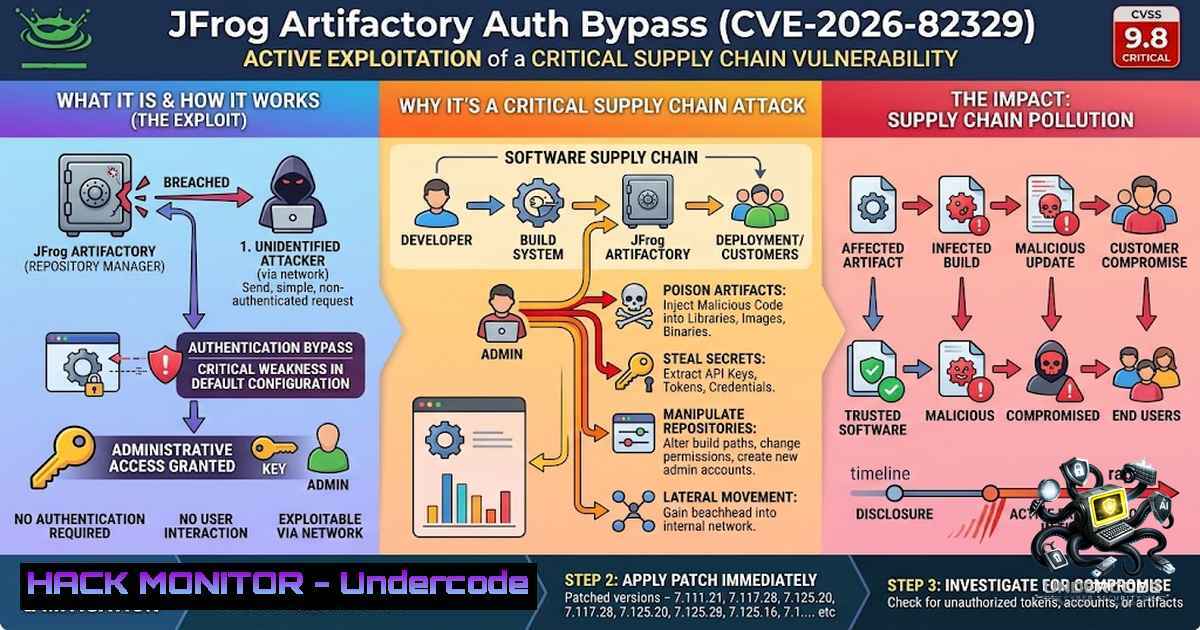
A critical authentication bypass vulnerability in JFrog Artifactory, tracked as CVE-2026-82329 with a CVSS score of 9.8, is being actively exploited in the wild just days after its public disclosure on August 28, 2026. The flaw allows unauthenticated attackers with network access to forge administrator-level tokens and gain full administrative control over affected self-hosted Artifactory instances. Because Artifactory serves as a central hub for managing packages, container images, and build dependencies within CI/CD pipelines, successful exploitation poses a severe risk to the software supply chain—attackers can tamper with repository settings, steal stored secrets, inject malicious artifacts, and push compromised updates downstream to customers.
Learning Objectives & Secrets:
- Objective 1: Understand the Attack Mechanism — Learn how the authentication bypass works at a technical level, including the “phantom” join key vulnerability in JFrog Access that enables unauthenticated admin token generation.
- Objective 2 Secret Tip: Deploy Immediate Mitigation — Know exactly which patched versions to upgrade to, how to verify your instance’s status, and emergency workarounds if patching is not immediately possible.
- Objective 3 Secret Tip: Hunt for Indicators of Compromise — Master forensic techniques, log analysis commands, and detection signatures to determine whether your Artifactory instance has already been compromised.
You Should Know:
- Attack Breakdown — How the Authentication Bypass Works
The vulnerability resides in JFrog Access, the component responsible for issuing and validating credentials within the Artifactory ecosystem. Under default configurations, self-hosted instances without an explicitly configured additional join key receive an implicit “phantom” join key. Attackers can abuse this predictable key as an HMAC secret to forge a cluster “join” JWT.
The unauthenticated attack chain consists of four steps:
Step 1: Forge a cluster “join” JWT. The bug leaves a blank join key in the trusted verifier set on a default install. `getSigningKey(“”)` = `pkcs7(alg=HS256, kid = SHA256(""), fresh iat, any service_id, and skip_node_registration=true.
Step 2: Send `POST /access/api/v1/registry/join` (RegistryNoAuthResource — no authentication required). A successful request returns HTTP 201 with a `SERVICE` token bearing `admin` scope.
Step 3: Use that token to call `POST /access/api/v1/tokens` with `scope=applied-permissions/admin&audience=` — generating a full administrator platform access token.
Step 4: Use the admin token to read the entire server configuration, list and steal every access token, and on Pro/Enterprise, create admin users and repositories.
2. Affected Versions and Patch Status
JFrog released patches on August 28, 2026, with Artifactory version 7.161.20. The vulnerability affects the following self-hosted release branches:
| Affected Versions | Patched Versions |
|||
| 7.161.0 through 7.161.19 | 7.161.20 |
| 7.146.0 through 7.146.36 | 7.146.38 |
| 7.133.0 through 7.133.28 | 7.133.29 |
| 7.125.0 through 7.125.19 | 7.125.20 |
| 7.117.0 through 7.117.27 | 7.117.28 |
| 7.111.4 through 7.111.21 | 7.111.21 |
JFrog has confirmed that its cloud environments have already been fortified—customers using the vendor-managed cloud service do not need to take action. However, organizations running self-hosted Artifactory must upgrade immediately to a fixed release on their supported branch.
- Verification Commands — Check Your Version and Exposure
To confirm your current Artifactory version, use the following command:
 Check Artifactory version via REST API
curl -s http://<ARTIFACTORY_URL>:8082/artifactory/api/system/version | jq '.version'

Or check via the JFrog CLI
jf rt curl /api/system/version
To assess external exposure of your Artifactory management interfaces:
 Scan for open Artifactory ports (default: 8081 for HTTP, 8082 for HTTPS)
nmap -p 8081,8082 <TARGET_IP>

Check if the vulnerable registry/join endpoint is accessible
curl -X POST http://<TARGET_IP>:8082/access/api/v1/registry/join \
-H "Content-Type: application/json" \
-d '{"service_id":"test"}' \
-w "\n%{http_code}\n"
A `201` or `200` response on an unpatched instance indicates the endpoint is reachable and potentially exploitable.
4. Detection and Forensic Analysis — Identifying Compromise
Security teams should investigate whether any unexpected administrator tokens, new privileged users, unusual API activity, or configuration changes were created around the time the vulnerable instance was exposed.
Key log analysis commands:
 Check Artifactory access logs for token generation events
grep -i "CreateToken" /var/log/artifactory/access-audit.log

Look for POST requests to the vulnerable registry/join endpoint
grep "POST /access/api/v1/registry/join" /var/log/artifactory/access-request.log

Identify unusual source IP addresses accessing administrative endpoints
grep -E "/access/api/v1/tokens|/artifactory/api/system" /var/log/artifactory/access-request.log \
| awk '{print $1}' | sort | uniq -c | sort -1r

Check for admin token creation via the Access REST API
curl -s -u <admin_user>:<admin_password> \
http://<ARTIFACTORY_URL>:8082/access/api/v1/tokens | jq '.[] | select(.scope | contains("admin"))'
Sigma rule detection pattern for SIEM integration: Detects attempts to create administrative tokens in JFrog Artifactory via the API endpoint associated with CVE-2026-82329 exploitation—look for `POST` requests to `/access/api/v1/registry/join` or `/access/api/v1/tokens` with scope parameters indicating admin privileges.
5. Hardening and Mitigation — Securing Your Instance
Immediate Actions:
Step 1: Upgrade Immediately — Apply the appropriate patched version from the list above. This is the only complete fix.
Step 2: If Patching Is Not Immediately Possible — Restrict administrative network access to trusted internal IP addresses as a stopgap measure. Update reverse-proxy and firewall rules to ensure only trusted networks can reach administrative endpoints.
 Example: Restrict access using iptables (Linux)
iptables -A INPUT -p tcp --dport 8082 -s <TRUSTED_SUBNET> -j ACCEPT
iptables -A INPUT -p tcp --dport 8082 -j DROP

Example: Restrict access using Windows Firewall
New-1etFirewallRule -DisplayName "Artifactory Admin Restrict" \
-Direction Inbound -LocalPort 8082 -Protocol TCP \
-RemoteAddress <TRUSTED_IP_RANGE> -Action Allow
Step 3: Post-Patch Cleanup — After patching, organizations must:
– Revoke and reissue all administrator tokens
– Review all privileged accounts for unauthorized additions
– Validate repository integrity
– Examine CI/CD credentials that may have been accessible
– Rotate exposed passwords, API keys, signing secrets, and connected service credentials
 Revoke all existing admin tokens via API
curl -X DELETE http://<ARTIFACTORY_URL>:8082/access/api/v1/tokens/all \
-u <admin_user>:<admin_password>

Reissue tokens for legitimate administrators only
 (Perform this manually through the Artifactory UI or via authenticated API calls)
6. Hardening Checklist — Long-Term Security
- Network Segmentation: Ensure Artifactory management interfaces are never exposed directly to the internet
- Join Key Configuration: Explicitly configure a strong, unique join key to prevent reliance on the default “phantom” key
- Monitoring: Implement continuous monitoring for unusual token-generation events, failed authentication attempts, and calls to user/permission/repository administration APIs
- Audit Logging: Enable comprehensive audit logging and ship logs to a SIEM for real-time alerting
- Least Privilege: Regularly review and prune administrator accounts and tokens
- CI/CD Credential Rotation: Implement automated rotation of CI/CD credentials stored in or accessed through Artifactory
What Undercode Say:
- Key Takeaway 1: The speed of exploitation—just three to four days after public disclosure—demonstrates that threat actors are aggressively targeting software supply chain systems. Organizations can no longer afford delayed patch cycles for critical infrastructure.
-
Key Takeaway 2: The vulnerability’s root cause—a default blank join key—highlights a recurring theme in cybersecurity: default configurations are often the weakest link. Security teams must audit and harden default settings, not assume vendor defaults are secure.
The WatchTowr research team noted that broad-scale scanning and mass exploitation has not yet been observed, but that is unlikely to remain the case for long. As Vercel CEO Guillermo Rauch warned, “It’s an RCE bomb because Artifactory hosts binaries, so you can basically poison everything”. This isn’t just about protecting a single application—it’s about securing the entire software delivery pipeline. Attackers with admin-level access to Artifactory can tamper with build pipelines, move laterally into production systems, and push malicious changes downstream to customers. Every organization running self-hosted Artifactory should treat any internet-exposed, unpatched deployment as potentially compromised and act with urgency.
Prediction:
- -1 The exploitation window for CVE-2026-82329 will widen significantly in the coming weeks as more threat actors incorporate the PoC into automated scanning and attack frameworks.
- -1 Organizations that fail to patch within the next 7–14 days face a high probability of compromise, particularly those with internet-exposed Artifactory instances.
- +1 This incident will accelerate adoption of automated patch management and runtime vulnerability detection for CI/CD infrastructure.
- +1 Expect increased scrutiny of default configurations in repository managers and other DevOps tools, leading to improved security baselines across the industry.
- -1 Supply chain attacks leveraging compromised Artifactory instances will likely increase, with attackers injecting malicious artifacts into trusted build workflows.
- -1 Organizations that have already been compromised may not discover the breach until malicious artifacts reach production or customers, making incident response particularly challenging.
▶️ Related Video (82% Match):
🎯Let’s Practice For Free:
🎓 Live Courses & Certifications:
Join Undercode Academy for Verified Certifications
🚀 Request a Custom Project:
Secure, high-velocity infrastructure and disruptive technological engineering. Contact our engineering team for high-tier development and proprietary systems:
[email protected]
💎 Smart Architecture | 🛡️ Secure by Design | ⭐ Trusted by Thousands
IT/Security Reporter URL:
Reported By: https://lnkd.in/p/e_EzccXe – Hackers Feeds
Extra Hub: Undercode MoN
Basic Verification: Pass ✅


