
Listen to this Post
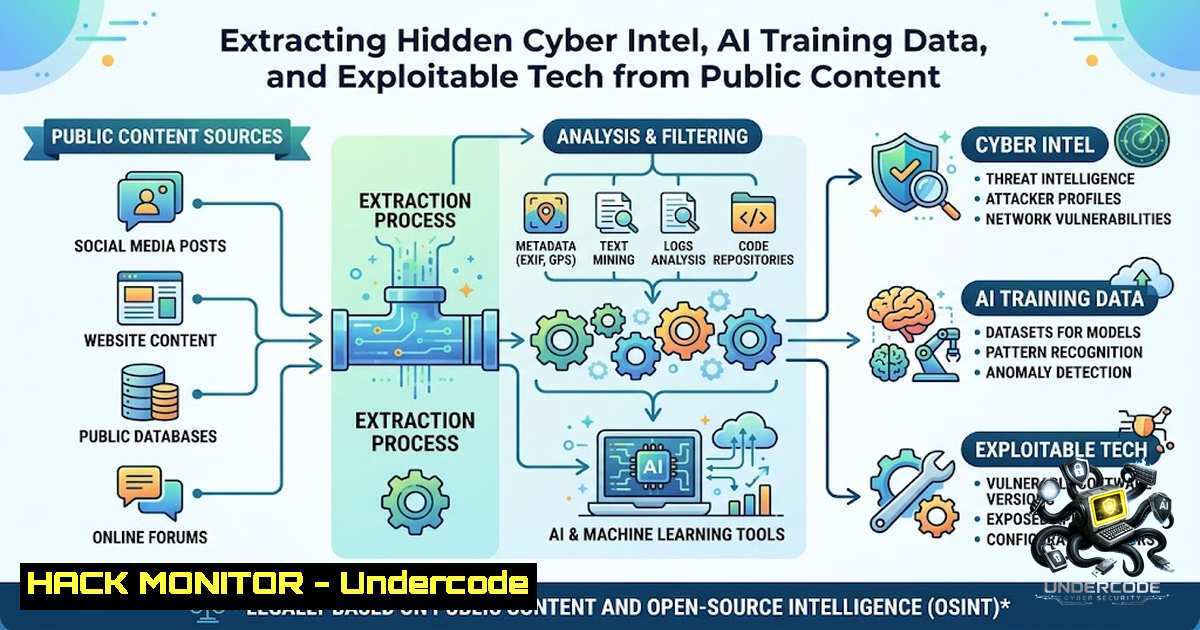
Introduction:
In the modern threat landscape, a single online post can be a goldmine for cyber attackers, red teamers, and security researchers alike. By leveraging OSINT (Open Source Intelligence) techniques, one can automatically extract embedded URLs, technical configurations, software dependencies, and even potential security vulnerabilities hidden in plain text. This process transforms passive content consumption into active reconnaissance, allowing for the rapid assembly of attack surfaces, the discovery of exposed API endpoints, and the identification of outdated software versions mentioned in blogs, forums, or social media.
Learning Objectives & Secrets:
- Objective 1: Master automated extraction of URLs, IP addresses, and technical artifacts from unstructured text using command-line tools.
- Objective 2 Secret Tips: Implement security validation techniques to differentiate between benign training content and exploitable production endpoints by using `curl` to check live status and server headers.
- Objective 3 Secret Tips: Develop workflows for hardening systems by identifying exposed configurations in public AI and IT training materials, such as API keys or internal domain names mistakenly left in code snippets.
You Should Know:
- Automated URL and Technical Content Extraction from Raw Text
Before analyzing a post for security implications, you must first extract the structured data. Using a combination of grep, awk, and curl, you can parse large volumes of text to identify URLs, API keys, and domain names.
- Linux/Mac: To extract all URLs from a text file (
post.txt), use `grep` with a regex pattern:grep -Eo '(http|https)://[^" ]+' post.txt
- Windows (PowerShell): Use the `Select-String` cmdlet to achieve similar results:
Select-String -Path .\post.txt -Pattern 'http[bash]?://[^\s"''<>]+' -AllMatches | % { $<em>.Matches } | % { $</em>.Value } - Extracting IP Addresses: To find IPv4 addresses, refine the regex:
grep -Eo '([0-9]{1,3}.){3}[0-9]{1,3}' post.txt | sort -u - Validation: Use `curl` to check if extracted URLs are live and what technologies they are running:
curl -I -L http://extracted-domain.com
This initial extraction is crucial for mapping an organization’s digital footprint. Red teams use this to discover staging servers mentioned in developer blogs, while blue teams use it to identify data leakage.
- The Rise of Generative AI in Cyber Attacks
Generative AI has fundamentally altered the cyber threat landscape. Cyberattacks exploiting generative AI have increased by 135% in 2025. Deepfakes, ultra-personalized phishing, and automated social engineering are now facing enterprises with unprecedented sophistication. The primary vulnerability is no longer technical but human.
Traditional security training relied on the premise that attacks were identifiable—a phishing email was betrayed by spelling mistakes or a suspicious sender. Generative AI has shattered this logic. A cybercriminal can now generate a perfectly written email in minutes, imitating the style of your CFO and incorporating contextual elements scraped from LinkedIn. A vocal deepfake can reproduce a leader’s voice with troubling fidelity. Spear-phishing can be personalized on an industrial scale, targeting hundreds of employees simultaneously with tailored messages.
Facing this evolution, technical tools—firewalls, antivirus, anti-spam filters—remain necessary but insufficient. They detect known signatures, not novel attacks. With generative AI, each attack can be unique, adapted, and unknown to threat databases. The most vulnerable link is now systematically human.
3. Three New Threats Your Employees Can’t Recognize
Generative AI has introduced attack vectors that traditional cybersecurity training does not yet cover:
- Generative Personalized Phishing: Unlike traditional phishing, which sends the same message to thousands, AI-powered spear-phishing leverages public data to generate hyper-contextualized messages. The email appears to come from a colleague, partner, or client—it references current projects, company vocabulary, and real names. The click-through rate on these attacks is three to five times higher than classic phishing.
-
Audio and Video Deepfakes: In 2024, a Hong Kong company lost $25 million following a fake video call where all participants—including the CFO—were deepfakes. This type of attack, reserved for nation-states two years ago, is now accessible to organized criminal groups via public tools.
-
Agentic AI Attacks: Anthropic has documented an agentic attack where AI executed commands, exploited vulnerabilities, stole credentials, and made tactical decisions with limited human involvement.
- Defensive Strategies and Training for the AI Era
Organizations must rethink their defense strategies. The SANS SEC501 course has undergone a major update to address AI-accelerated attacks. The rebuilt course prepares practitioners to become defenders their organizations can rely upon when an incident moves quickly, when records are incomplete, and when a mistaken action can disrupt critical operations. Students learn to increase confidence as independently sourced records are still arriving, to corroborate the activity and make an evidence-based decision without waiting for certainty the records may never provide.
ISC2 has also introduced AI Express Courses designed for busy professionals. These include:
– AI Security Framework Adoption & Alignment: Explore how governance decisions shape AI risk and learn practical methods for translating overlapping requirements into unified policies and controls.
– AI Data Classification and Governance: Understand how to identify AI-enabled systems, assess associated risks, and determine appropriate governance and risk treatment actions.
– AI Threat-to-Requirement Mapping: Identify gaps in visibility, accountability, and governance, then translate those risks into actionable security requirements and controls.
– Secure Software Architecture with AI: Evaluate architecture choices for AI-enabled systems while balancing security, governance, compliance, and business objectives.
5. Hardening Systems Against AI-Enabled Threats
To defend against these advanced threats, organizations must adopt a multi-layered approach:
- Continuous Monitoring: Implement SIEM solutions that can correlate events across identity platforms, cloud workloads, SaaS applications, endpoints, and network devices.
- Zero Trust Architecture: Assume breach and verify every access request, especially in AI-enabled environments where attackers may use compromised credentials to move laterally.
- Regular Security Audits: Conduct regular audits of AI systems and data pipelines to identify vulnerabilities such as exposed API keys or misconfigured cloud storage.
- Incident Response Planning: Develop and test incident response plans that specifically address AI-generated threats, including deepfake-based social engineering and automated attacks.
- Employee Training: Continuously educate employees on the latest AI-enabled threats and how to recognize them, emphasizing that traditional indicators of compromise may no longer be reliable.
What Undercode Say:
- Key Takeaway 1: The democratization of AI has lowered the barrier to entry for sophisticated cyberattacks, making it imperative for organizations to invest in both technical defenses and human-centric security training.
- Key Takeaway 2: Proactive threat hunting and OSINT techniques are essential for identifying and mitigating risks before they can be exploited, turning publicly available information into a defensive asset.
Analysis:
The integration of AI into both offensive and defensive cybersecurity operations represents a paradigm shift. Attackers are using AI to automate and personalize attacks at scale, while defenders are leveraging AI to enhance threat detection and response. However, the human element remains the weakest link, as AI-generated content becomes increasingly indistinguishable from legitimate communications. Organizations must adopt a holistic approach that combines advanced technical controls, continuous monitoring, and comprehensive training to build resilience against AI-accelerated threats. The rapid evolution of AI capabilities requires cybersecurity professionals to continuously update their skills and stay informed about emerging attack vectors and defensive strategies.
Prediction:
- -1 The increasing sophistication of AI-generated attacks will lead to a surge in successful breaches, particularly in organizations that fail to adapt their security training and defenses to the new threat landscape.
- +1 The growing demand for AI-focused cybersecurity skills will drive innovation in training and education, creating new opportunities for professionals and enhancing overall security posture.
- +1 Advances in AI-driven defense mechanisms, such as automated threat hunting and response, will enable organizations to detect and mitigate attacks faster than ever before, reducing the impact of breaches.
- -1 The rise of agentic AI attacks, where AI systems autonomously execute commands and make tactical decisions, will pose significant challenges for traditional incident response and require new approaches to threat management.
- +1 Collaboration between industry, academia, and government will accelerate the development of standards and best practices for AI security, fostering a more secure and resilient digital ecosystem.
▶️ Related Video (82% Match):
🎯Let’s Practice For Free:
🎓 Live Courses & Certifications:
Join Undercode Academy for Verified Certifications
🚀 Request a Custom Project:
Secure, high-velocity infrastructure and disruptive technological engineering. Contact our engineering team for high-tier development and proprietary systems:
[email protected]
💎 Smart Architecture | 🛡️ Secure by Design | ⭐ Trusted by Thousands
IT/Security Reporter URL:
Reported By: https://lnkd.in/p/e4qQ2H_R – Hackers Feeds
Extra Hub: Undercode MoN
Basic Verification: Pass ✅


