
Listen to this Post
Introduction
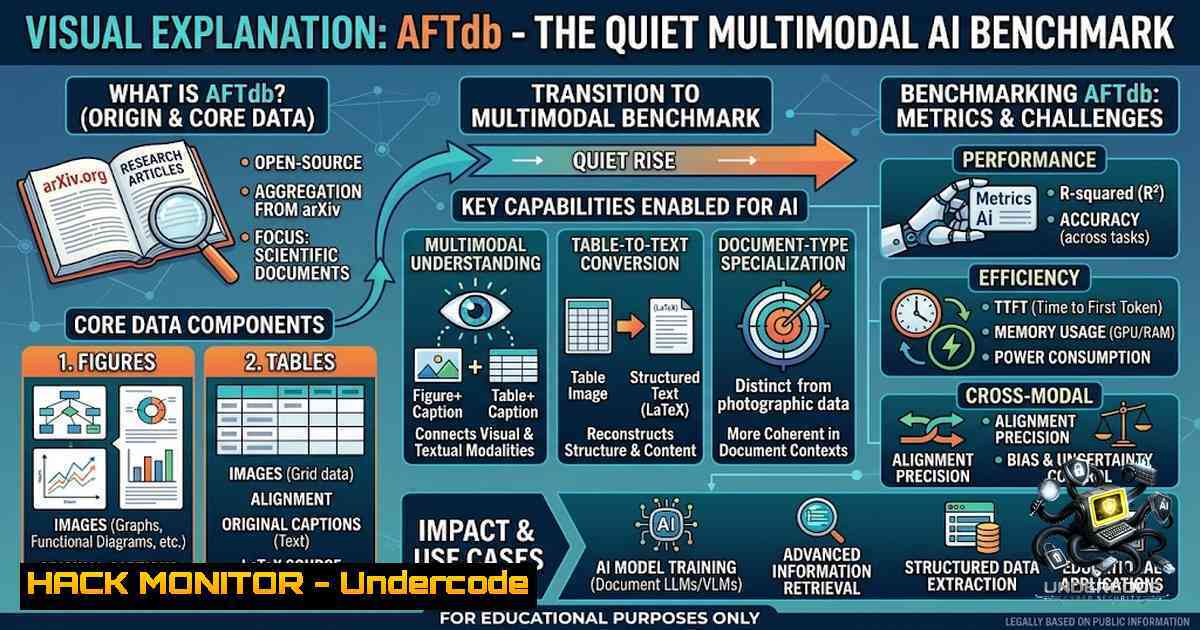
The open-source ecosystem thrives on unexpected contributions—projects released into the wild, often forgotten by their creators, yet quietly shaping the future of technology. Cyrile Delestre’s AFTdb (Arxiv Figure Table Database), a dataset of figures and tables extracted from arXiv articles, is a perfect example. Originally published and left to evolve on its own, AFTdb was later discovered to have been integrated by Jina AI into their JinaVDRTableVQARetrieval task, which now forms part of the Massive Text Embedding Benchmark (MTEB)—a reference benchmark for evaluating embedding models. This story underscores a critical reality in AI and cybersecurity: the impact of open-source artifacts is notoriously difficult to measure. A paper has citations and Google Scholar; a dataset or model can be repurposed, transformed, integrated into another dataset, then into a benchmark, and its lineage becomes nearly impossible to trace.
Learning Objectives & Secrets
- Objective 1: Understand the Open-Source Impact Paradox – Learn how datasets like AFTdb can gain unexpected secondary lives, influencing benchmark development and model evaluation years after their initial release, and why traditional impact metrics fail to capture this reality.
- Objective 2 Secret Tip: Trace Dataset Lineage Through Benchmarks – Instead of relying on direct citations, track where your dataset appears in benchmark suites like MTEB. Use the `mteb` Python library to inspect task compositions and identify which datasets are embedded within evaluation frameworks.
- Objective 3 Secret Tip: Leverage Multimodal Embedding Evaluation – When building or evaluating multimodal retrieval systems, prioritize benchmarks that include visually rich content like tables and charts. Jina-VDR and MTEB’s visual retrieval tasks provide a more realistic assessment than text-only benchmarks.
You Should Know
1. Understanding AFTdb: Structure, Content, and Loading
AFTdb aggregates figures and tables from scientific articles sourced from arXiv, specifically targeting document-type images—graphs, functional diagrams, tables—rather than photographic content. The dataset includes captions for each object and, for tables, the LaTeX source code, enabling tasks like image-to-LaTeX conversion. Textual data is available in both English and French.
The dataset is hosted on Hugging Face and can be loaded as follows:
from datasets import load_dataset

Load figures in streaming mode (large dataset)
aftdb_figure = load_dataset("cmarkea/aftdb", "figure", streaming=True)

Load tables locally (smaller dataset)
aftdb_table = load_dataset("cmarkea/aftdb", "table")

Load both simultaneously (default configuration)
aftdb = load_dataset("cmarkea/aftdb", "figure+table", streaming=True)
Statistical Overview: The dataset comprises 22,893 articles, 157,944 training figures, 16,415 test tables, and over 8.5 million words of captions.
2. Jina Embeddings v4: Architecture and Capabilities
Jina-embeddings-v4 is a 3.8 billion parameter multimodal embedding model that unifies text and image representations. It supports both single-vector and multi-vector embeddings in a late-interaction style and incorporates task-specific Low-Rank Adaptation (LoRA) adapters. The model excels at processing visually rich content such as tables, charts, diagrams, and mixed-media formats.
Key Technical Specifications:
- Architecture: Multimodal transformer with late-interaction multi-vector support
- Parameters: 3.8 billion
- Adapters: LoRA-based for retrieval, semantic similarity, and code search
- Benchmark: Jina-VDR for visually rich image retrieval
Example: Evaluating an Embedding Model on JinaVDRTableVQARetrieval
import mteb

task = mteb.get_task("JinaVDRTableVQARetrieval")
evaluator = mteb.MTEB([bash])
model = ...  Your embedding model instance
results = evaluator.run(model)
3. MTEB and the JinaVDRTableVQARetrieval Task
The Massive Text Embedding Benchmark (MTEB) is a reference suite for evaluating embedding models. JinaVDRTableVQARetrieval is a text-to-image retrieval task that queries scientific tables based on LLM-generated queries. It is part of MTEB’s visual document retrieval category, designed to assess models’ ability to handle visually complex documents.
Task Details:
- Category: Text-to-Image (t2i)
- Domains: Academic
- Source Dataset: jinaai/table-vqa_beir
- Evaluation Code: Use `mteb.get_task(“JinaVDRTableVQARetrieval”)`
4. Building a Multimodal Retrieval Pipeline
To build a retrieval system leveraging these tools:
Step 1: Index visually rich documents – Use Jina-embeddings-v4 to generate embeddings for images and text.
from jina import Document, DocumentArray
from jina_embeddings_v4 import JinaEmbeddingsV4

model = JinaEmbeddingsV4()
docs = DocumentArray([Document(text="query text"), Document(uri="image.png")])
embeddings = model.encode(docs)
Step 2: Evaluate on MTEB – Benchmark your pipeline using MTEB tasks.
pip install mteb
python -c "import mteb; print(mteb.list_tasks())"  List all available tasks
Step 3: Fine-tune with LoRA – Adapt the model to your domain using LoRA adapters.
from peft import LoraConfig, get_peft_model

lora_config = LoraConfig(r=16, lora_alpha=32, target_modules=["q_proj", "v_proj"])
model = get_peft_model(base_model, lora_config)
5. Security and Compliance Considerations for Multimodal AI
When deploying multimodal embedding systems, consider:
- Data Privacy: Ensure that images and documents processed do not contain sensitive information. Use on-premise deployment if handling PII.
- Model Provenance: Track dataset lineages to comply with open-source licenses. AFTdb is openly available, but derivative works may carry different restrictions.
- Adversarial Robustness: Visually rich documents can be manipulated; implement input validation and adversarial detection.
 Linux: Scan for potential sensitive data in images
exiftool -all= .png  Remove metadata
 Windows: Use PowerShell to hash files for integrity checks
Get-FileHash -Algorithm SHA256 .png
6. API Security for Embedding Services
If exposing embedding models via API:
- Rate Limiting: Prevent abuse with token-bucket algorithms.
- Authentication: Use API keys with scoped permissions.
- Input Sanitization: Validate and sanitize all inputs to prevent injection attacks.
 FastAPI example with rate limiting
from fastapi import FastAPI, Depends
from slowapi import Limiter, _rate_limit_exceeded_handler

limiter = Limiter(key_func=lambda: request.client.host)
app = FastAPI()
app.state.limiter = limiter

@app.post("/embed")
@limiter.limit("100/minute")
async def embed(request: Request, data: dict):
 Process embedding
pass
What Undercode Say
- Key Takeaway 1: Open-source impact is nonlinear and often invisible through traditional metrics. A dataset released without fanfare can become foundational to benchmark development years later, as AFTdb did with MTEB.
- Key Takeaway 2: The integration of AFTdb into Jina-VDR and MTEB highlights the growing importance of multimodal evaluation. As AI systems increasingly process tables, charts, and diagrams, benchmarks must evolve accordingly.
Analysis: The AFTdb story is a microcosm of the open-source AI ecosystem—contributions are reused, transformed, and attributed in ways that defy easy tracking. For cybersecurity professionals, this raises questions about supply chain transparency: if a dataset’s lineage is opaque, how can we trust the models trained on it? For AI practitioners, it underscores the value of releasing data and models openly, as their ultimate impact may far exceed initial expectations. The Jina-embeddings-v4 paper, with its focus on visually rich content, signals a shift toward multimodal retrieval that will likely accelerate as more document-heavy industries adopt AI.
Prediction
- +1 The integration of community-driven datasets into major benchmarks like MTEB will increase, creating a virtuous cycle where open-source contributions gain visibility and influence.
- +1 Multimodal embedding models will become standard in enterprise search, particularly for industries like legal, healthcare, and finance that rely on document-heavy workflows.
- -1 The difficulty of tracing dataset lineage will create supply chain vulnerabilities, as models trained on unvetted data may inherit biases or security flaws.
- -1 As benchmarks become more complex, the barrier to entry for new embedding models will rise, potentially consolidating power among well-funded AI labs.
- +1 The success of AFTdb may inspire more researchers to release datasets, knowing that even if immediate citations are low, long-term impact can be significant.
- -1 Without standardized dataset provenance tracking, the AI community risks repeating the errors of the past, where critical dependencies go unnoticed until a failure occurs.
▶️ Related Video (86% Match):
🎯Let’s Practice For Free:
🎓 Live Courses & Certifications:
Join Undercode Academy for Verified Certifications
🚀 Request a Custom Project:
Secure, high-velocity infrastructure and disruptive technological engineering. Contact our engineering team for high-tier development and proprietary systems:
[email protected]
💎 Smart Architecture | 🛡️ Secure by Design | ⭐ Trusted by Thousands
IT/Security Reporter URL:
Reported By: https://lnkd.in/p/eic6rT8c – Hackers Feeds
Extra Hub: Undercode MoN
Basic Verification: Pass ✅


