
Listen to this Post
Introduction:
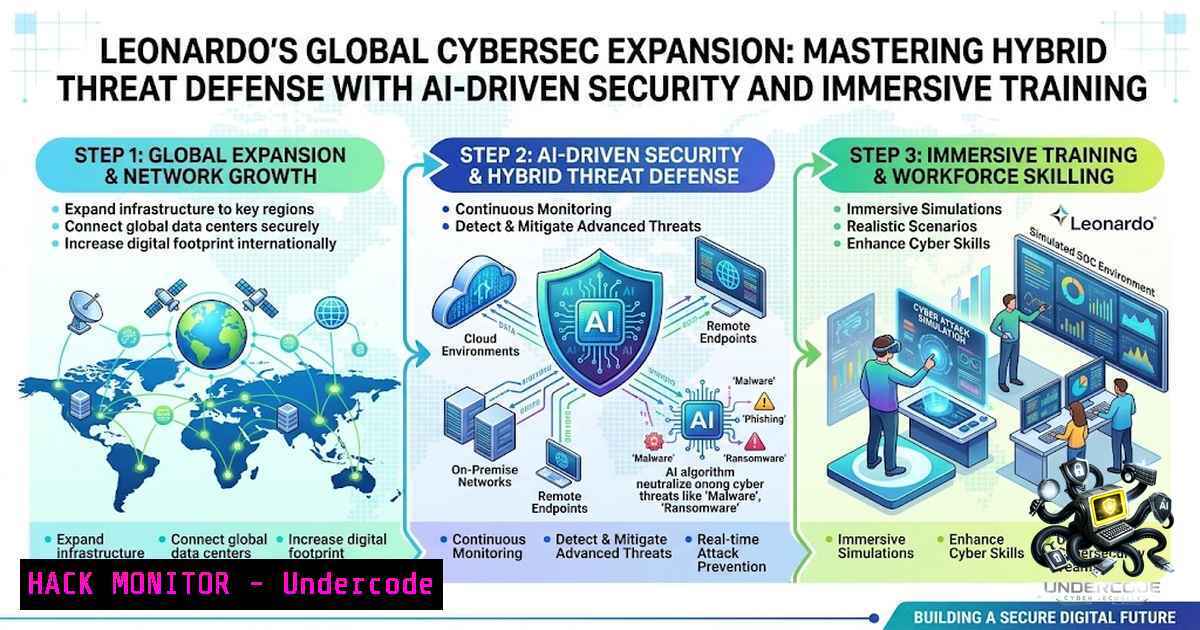
In an era where hybrid warfare blends conventional conflict with cyberattacks, information manipulation, and economic coercion, defending national infrastructure demands a paradigm shift. Leonardo, a global aerospace and security leader, has responded by inaugurating a new Regional Cyber Center in Kuala Lumpur, Malaysia, as part of its Global CyberSec Center (GCC) network. Concurrently, the company’s Cyber & Security Academy and AI training programs are equipping professionals with the skills needed to counter sophisticated ransomware, DDoS, and application-layer attacks through secure-by-design architectures and trustworthy AI.
Learning Objectives & Secrets:
- Objective 1: Understand Hybrid Threat Vectors – Learn to identify and analyze the convergence of conventional and non-conventional warfare tactics, including ransomware, DDoS, and information warfare, which target public and private infrastructures.
- Objective 2 Secret Tip: Master Predictive Protection – Leverage big data, virtualization, and trustworthy AI to implement predictive data protection and continuous monitoring, moving beyond reactive defenses.
- Objective 3 Secret Tip: Operationalize Cyber Range Training – Utilize immersive platforms like Cyber Range and Cyber Game (Capture The Flag) to simulate real-world attacks, enabling hands-on experience in a safe, controlled environment.
You Should Know:
1. Architecting a Federated Cyber Defense Network
Leonardo’s GCC operates as a federated network with regional centers in Chieti, Brussels, Bristol, Riyadh, and now Kuala Lumpur. This model enables coordinated global response while preserving national data sovereignty. For organizations, this means adopting a distributed Security Operations Center (SOC) architecture.
Step‑by‑step guide to setting up a federated SOC:
- Step 1: Deploy regional SIEM (Security Information and Event Management) nodes that correlate logs locally.
- Step 2: Implement a centralized threat intelligence platform that aggregates IOCs (Indicators of Compromise) from all nodes.
- Step 3: Use VPN or dedicated MPLS links to ensure secure, low-latency communication between centers.
- Step 4: Establish a unified incident response playbook that respects local data privacy laws (e.g., GDPR, Malaysia’s PDPA).
- Step 5: Conduct regular cross-center tabletop exercises to test coordination.
Linux Command for Log Aggregation:
Using rsyslog to forward logs to a central server:
echo ". @@central-soc.example.com:514" >> /etc/rsyslog.conf
systemctl restart rsyslog
Windows Command (PowerShell) for Event Forwarding:
wevtutil set-log Microsoft-Windows-Sysmon/Operational /enabled:true
winrm quickconfig
2. Hardening Against Application-Layer DDoS Attacks
Leonardo’s approach to DDoS defense emphasizes application-layer protection, moving beyond simple network-level filtering. The company’s platforms monitor approximately 115,000 security events per second and manage over 1,800 cyber alarms daily.
Step‑by‑step guide to implement application-layer DDoS protection:
- Step 1: Deploy a Web Application Firewall (WAF) with custom rule sets to filter malicious HTTP/S traffic.
- Step 2: Implement rate limiting on API endpoints to prevent brute-force and credential-stuffing attacks.
- Step 3: Use behavioral analysis to distinguish between legitimate users and botnets.
- Step 4: Configure geo-IP filtering to block traffic from known malicious regions.
- Step 5: Regularly update DDoS protection rules based on emerging threat intelligence.
Linux Command for Rate Limiting with iptables:
iptables -A INPUT -p tcp --dport 80 -m connlimit --connlimit-above 20 -j REJECT
iptables -A INPUT -p tcp --dport 443 -m connlimit --connlimit-above 20 -j REJECT
3. Implementing Zero Trust Architecture
Leonardo has integrated Zero Trust as a key component of its security offering, operating under the principle that trust is never implicit. This model is essential for protecting critical infrastructures from increasingly complex threats.
Step‑by‑step guide to deploy Zero Trust:
- Step 1: Implement identity and access management (IAM) with multi-factor authentication (MFA) for all users.
- Step 2: Deploy micro-segmentation to isolate workloads and limit lateral movement.
- Step 3: Enforce least-privilege access policies across all systems and data.
- Step 4: Continuously monitor and validate user and device trustworthiness.
- Step 5: Integrate with SIEM for real-time anomaly detection and automated response.
Windows Command to Enable Advanced Audit Policies:
auditpol /set /subcategory:"Logon" /success:enable /failure:enable
auditpol /set /subcategory:"Privilege Use" /success:enable /failure:enable
4. AI-Driven Security and Predictive Protection
Leonardo leverages trustworthy AI to implement predictive data protection and continuous monitoring. The company’s Multi-Agentic AI Platforms enable autonomous survivability, ensuring mission continuity even during sophisticated, multi-vector attacks.
Step‑by‑step guide to implement AI-driven security:
- Step 1: Deploy AI-powered threat detection tools that use machine learning to identify anomalies.
- Step 2: Integrate threat intelligence feeds to train AI models on the latest attack patterns.
- Step 3: Implement automated response workflows that trigger based on AI-detected threats.
- Step 4: Regularly retrain AI models with new data to maintain accuracy and reduce false positives.
- Step 5: Conduct red-team exercises to test AI model robustness against adversarial attacks.
Linux Command to Monitor System Logs with AI Tools:
journalctl -f | grep -i "error|fail|attack" | while read line; do
 Integrate with AI threat detection API
curl -X POST https://ai-threat-detector.example.com/analyze -d "$line"
done
5. Cyber Range and Immersive Training
Leonardo’s Cyber & Security Academy offers immersive training courses on the most current security topics, leveraging digital twins, virtualization, and cooperation as technological pillars. The Academy provides standard courses, customizable courses, Cyber Exercise and White Phishing activities, and courses for obtaining Pearson VUE certifications.
Step‑by‑step guide to set up a Cyber Range:
- Step 1: Deploy virtualization platforms (e.g., VMware, Proxmox) to create isolated lab environments.
- Step 2: Install vulnerable machines and simulated network topologies.
- Step 3: Integrate with CTF (Capture The Flag) platforms for gamified learning.
- Step 4: Develop realistic attack scenarios based on current threat intelligence.
- Step 5: Monitor and evaluate trainee performance with automated scoring and feedback systems.
Linux Command to Set Up a Simple CTF Environment:
docker pull vulnerables/web-dvwa
docker run -d -p 80:80 vulnerables/web-dvwa
6. Incident Response and Ransomware Mitigation
The recent ransomware attack on Leonardo by the ThreeAM group highlights the importance of robust incident response capabilities. Leonardo monitors around 115,000 security events per second and manages over 1,800 cyber alarms daily, demonstrating the scale of threat detection required.
Step‑by‑step guide to ransomware incident response:
- Step 1: Immediately isolate affected systems to prevent lateral movement.
- Step 2: Activate the incident response team and notify relevant stakeholders.
- Step 3: Collect forensic evidence for analysis and preservation.
- Step 4: Restore systems from clean backups following a verified recovery plan.
- Step 5: Conduct a post-incident review to identify lessons learned and improve defenses.
Windows Command to Isolate a System from the Network:
New-1etFirewallRule -DisplayName "Block-All-Outbound" -Direction Outbound -Action Block
New-1etFirewallRule -DisplayName "Block-All-Inbound" -Direction Inbound -Action Block
7. Compliance and Regulatory Frameworks
Leonardo emphasizes compliance with frameworks like NIS2 and the AI Act as the baseline for true resilience. Organizations must move beyond individual protection to secure the vital ecosystem flows between nations.
Step‑by‑step guide to achieve NIS2 compliance:
- Step 1: Conduct a risk assessment to identify critical assets and vulnerabilities.
- Step 2: Implement security measures for network and information systems.
- Step 3: Establish incident reporting procedures to notify authorities within 24 hours.
- Step 4: Ensure business continuity through robust backup and disaster recovery plans.
- Step 5: Regularly review and update security policies to align with evolving threats.
Linux Command to Check for Open Ports and Vulnerabilities:
nmap -sV -p- -T4 192.168.1.1
What Undercode Say:
- Key Takeaway 1: The convergence of AI-driven security and immersive training is essential for building cyber resilience in 2026 and beyond.
- Key Takeaway 2: A federated SOC architecture, combined with Zero Trust principles, provides a robust defense against sophisticated hybrid threats.
Analysis:
Leonardo’s Global CyberSec expansion and the establishment of its Cyber & Security Academy represent a strategic response to the growing complexity of cyber threats. The integration of AI-driven predictive protection and immersive training platforms like Cyber Range equips professionals with the skills needed to counter evolving attack vectors. However, the recent ransomware attack on Leonardo serves as a stark reminder that even industry leaders are vulnerable. This incident underscores the need for continuous improvement in incident response and the adoption of Zero Trust architectures. Leonardo’s commitment to training and compliance with frameworks like NIS2 and the AI Act positions it as a key player in shaping the future of cybersecurity.
Prediction:
- +1: Leonardo’s investment in AI-driven security and training will likely set new industry standards, driving widespread adoption of predictive protection and immersive training.
- +1: The expansion of the Global CyberSec Center network will enhance international cooperation in cybersecurity, fostering a more resilient global defense posture.
- -1: The ransomware attack on Leonardo highlights the persistent threat of sophisticated ransomware groups, which will continue to target high-value organizations.
- -1: The increasing complexity of hybrid threats will require continuous innovation and investment, posing challenges for organizations with limited resources.
▶️ Related Video (80% Match):
🎯Let’s Practice For Free:
🎓 Live Courses & Certifications:
Join Undercode Academy for Verified Certifications
🚀 Request a Custom Project:
Secure, high-velocity infrastructure and disruptive technological engineering. Contact our engineering team for high-tier development and proprietary systems:
[email protected]
💎 Smart Architecture | 🛡️ Secure by Design | ⭐ Trusted by Thousands
IT/Security Reporter URL:
Reported By: https://lnkd.in/p/ehzUdQ_N – Hackers Feeds
Extra Hub: Undercode MoN
Basic Verification: Pass ✅


