
Listen to this Post
Introduction:
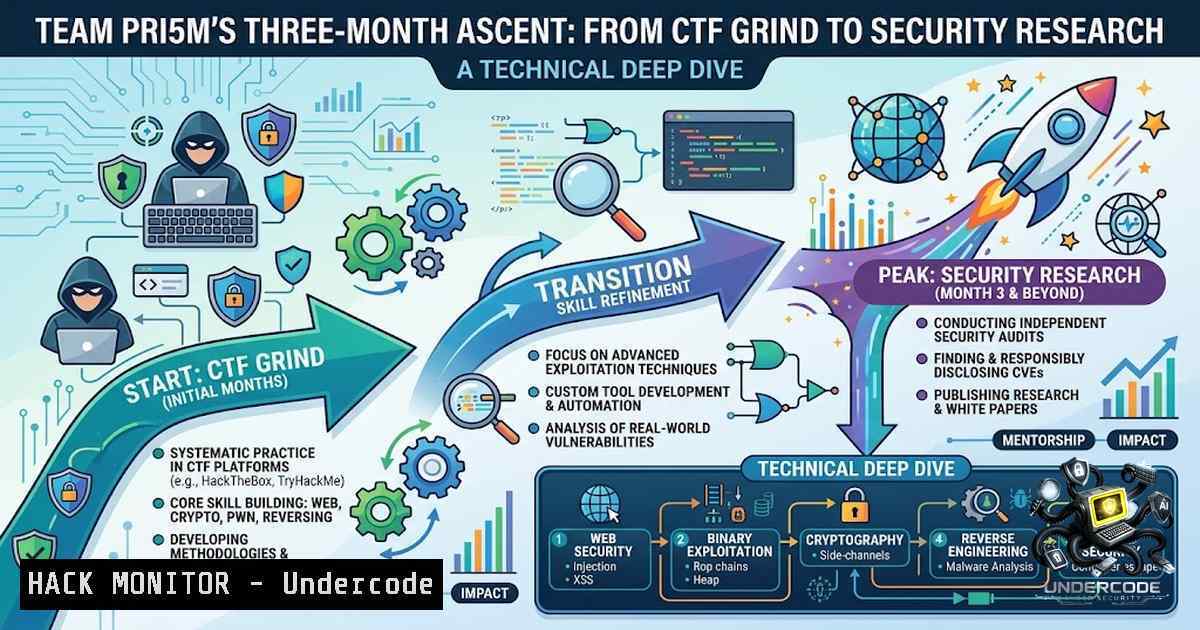
The Capture The Flag (CTF) circuit has evolved far beyond a casual hobby; it is now a primary proving ground for next-generation security talent. Over June, July, and August 2026, Team Pri5m demonstrated this evolution through a relentless competition schedule, securing top placements in events like the PTNxOWASP 13th Anniversary CTF (1), KAVACH CTF (1), and Universal CTF (3), while climbing from roughly 395 to 145 worldwide on CTFtime. Beyond the scoreboard, the team’s progression—bolstered by individual deep-dives into Hack The Box (achieving Holo rank) and CyberDefenders DFIR labs—highlights a critical shift: modern security mastery demands a fusion of offensive exploitation, digital forensics, and systematic team collaboration.
Learning Objectives & Secrets:
- Objective 1: Master the Offensive-Defensive Spectrum. Effective CTF performance requires fluency across web exploitation, binary exploitation, reverse engineering, and cryptography. The secret is to treat every failed exploit as a data point—documenting the wrong assumptions and broken solvers is where the deepest learning occurs.
-
Objective 2: Operationalize DFIR for Incident Reconstruction. Digital forensics is no longer a blue-team-only discipline. The secret is to integrate memory analysis (Volatility 3), disk forensics, and network investigation (Wireshark) into your workflow, using platforms like CyberDefenders to practice with real memory dumps, disk images, and PCAPs. This builds the intuition needed to reconstruct attacks from artifacts.
-
Objective 3: Build a Collaborative, Tool-Agnostic Workflow. The biggest leap for Team Pri5m was moving from isolated solves to a shared knowledge pipeline. The secret is to implement a triage system where partial findings are handed between specialists, approaches are reviewed, and every solve is documented—turning individual wins into team capabilities.
You Should Know:
- Systematic Reconnaissance and Exploitation with Nmap and Metasploit
Effective CTF and penetration testing begin with methodical reconnaissance. A structured methodology—systematic network reconnaissance, targeted exploitation, and post-exploitation with privilege escalation—covers approximately 80% of the attack surface. The optimal learning rhythm is 3 to 5 machines per week with complete documentation.
Step‑by‑step guide:
- Network Discovery: Use `nmap -sV -sC -O -A
` to perform a comprehensive scan that identifies open ports, service versions, default scripts, OS detection, and traceroute. - Service Enumeration: For web services, use `gobuster dir -u
-w ` to discover hidden directories. For SMB, use `enum4linux -a ` to enumerate shares and users. - Exploit Selection: Search for known vulnerabilities using `searchsploit
` or within Metasploit using search <service>. - Exploitation: In Metasploit, use
use <exploit>,set RHOSTS <target>,set PAYLOAD <payload>, and `run` to execute. For manual exploitation, leverage tools like `sqlmap` for SQL injection (sqlmap -u <url> --dbs) or `Burp Suite` for web application testing. - Post-Exploitation: Once access is gained, use `shell` to get a system shell, then run
whoami,id, and `uname -a` to understand the environment. Escalate privileges using `sudo -l` or by checking for kernel exploits withlinux-exploit-suggester.sh.
2. Binary Exploitation and Reverse Engineering Workflow
Reverse engineering and binary exploitation are core to high-level CTF performance. The toolkit has matured significantly, with options ranging from open-source to commercial solutions.
Step‑by‑step guide:
- Static Analysis: Begin with `file
` to determine the file type. Use `checksec ` to see security protections (NX, PIE, RELRO, Canary). Disassemble with `objdump -d ` or radare2 -A <binary>. - Decompilation: Load the binary into Ghidra or IDA Free for a high-level decompiled view. For quick analysis, use online decompilers like dogbolt.org.
- Dynamic Analysis: Use `gdb
` with plugins like pwndbg or gef. Set breakpoints ( break <address>), examine registers (info registers), and step through instructions (nexti,stepi). - Exploit Development: For buffer overflows, use `pattern create
` to generate a cyclic pattern, find the offset with pattern offset <value>, and craft your exploit. For return-oriented programming (ROP), use `ROPgadget –binary–ropchain` to generate a ROP chain. - Automation: Use pwntools in Python to script your exploit:
from pwn import ; p = process('./binary'); p.sendline(payload); p.interactive().
- Digital Forensics and Incident Response (DFIR) with Volatility and Wireshark
DFIR skills are increasingly vital, bridging the gap between offensive and defensive security. Platforms like CyberDefenders offer labs with real forensic artifacts, providing depth for incident response training.
Step‑by‑step guide:
- Memory Forensics with Volatility 3: First, identify the OS profile: `vol -f
windows.info` or vol -f <memory.dump> linux.info. List running processes: `vol -fwindows.pslist` or vol -f <memory.dump> linux.pslist. Dump a suspicious process:vol -f <memory.dump> windows.dumpfiles --pid <PID>. - Network Forensics with Wireshark: Open the PCAP file. Use filters like `http.request` to see web requests, `dns` to see DNS queries, or `tcp.stream eq
` to follow a TCP stream. Extract objects with File > Export Objects > HTTP. - Disk Forensics: Use `Autopsy` or `The Sleuth Kit` for file system analysis. Use `fls -r
` to list files and `icat ` to extract a specific file. - Malware Analysis: Use `strings
` to extract readable strings. Submit suspicious files to VirusTotal for hash and behavioral analysis without execution. Use binwalk to extract embedded files from firmware or images.
4. Web Application Security and API Hardening
Web exploitation remains a dominant CTF category. The OWASP Top 10 provides a framework for understanding critical vulnerabilities like injection, broken authentication, and sensitive data exposure.
Step‑by‑step guide:
- Reconnaissance: Use `Burp Suite` to intercept and modify HTTP traffic. Map the application by spidering or using the `Target` tab.
- SQL Injection: Use `sqlmap -u “
?id=1″ –batch –dbs` to automate detection and exploitation. For manual testing, use single quotes ( ') to break queries and observe error messages. - Cross-Site Scripting (XSS): Inject test payloads like `` into input fields. Use Burp Scanner or XSStrike for automated detection.
- API Security: Test for insecure direct object references (IDOR) by modifying object IDs in API requests (e.g., `/api/user/123` to
/api/user/124). Check for mass assignment by adding unexpected parameters to JSON payloads. - Authentication Testing: Use Hydra for brute-force attacks:
hydra -l admin -P <wordlist> <target> http-post-form "/login:user=^USER^&pass=^PASS^:Invalid". Test for JWT weaknesses by decoding tokens at jwt.io and checking for `none` algorithm or weak secrets.
5. Cryptographic Attacks and Tooling
Cryptography challenges require a blend of mathematical understanding and practical tooling. Modern CTFs often involve custom ciphers or flawed implementations.
Step‑by‑step guide:
- Classic Ciphers: Use CyberChef for rapid encoding/decoding (Base64, Hex, ROT13, etc.). For Vigenère, use `xortool -x -c 20
` to guess the key length. - Hashing: Identify hash types with `hashid
` or hashcat --example-hashes. Crack them using `hashcat -m-a 0 ` or john --wordlist=<wordlist> <hashfile>. - RSA: Use `openssl rsa -in
-text -1oout` to inspect keys. For small exponents or low entropy, use tools like RsaCtfTool to factor and decrypt. - Custom Cryptography: Reverse-engineer custom algorithms using Python or SageMath. For block ciphers, implement the cipher locally to test and brute-force small key spaces.
6. Leveraging AI and Automation in CTF Workflows
The 2026 CTF landscape is being reshaped by autonomous AI agents that can solve challenges in minutes, sometimes outperforming human teams. While this raises questions about the future of CTF, it also presents an opportunity to augment human capabilities.
Step‑by‑step guide:
- Automated Reconnaissance: Use tools like Nmap and masscan for rapid port scanning. Integrate them with scripts that automatically parse output and launch further enumeration.
- Solver Scripts: Write Python scripts using pwntools for binary exploitation or requests for web challenges. Automate the entire exploit chain from connection to flag submission.
- AI-Assisted Analysis: Use AI-powered tools for code review or to suggest exploit strategies. For example, some modern tools can automatically suggest
ret2libc,ret2win, or ROP chains. - Collaborative Platforms: Adopt platforms that combine persistent terminals with markdown playbooks and real-time multi-user collaboration to streamline team efforts.
What Undercode Say:
- Key Takeaway 1: The gap between 4 and 2 in Nepal, and 395 to 145 globally, was closed not through talent alone, but through a disciplined cycle of competing, failing, documenting, and refining—a process that mirrors professional security operations.
-
Key Takeaway 2: The integration of offensive CTF skills with defensive DFIR practice (Holo rank on HTB, CyberDefenders labs) creates a T-shaped security professional who can both break and build—a profile increasingly demanded by the industry.
The past three months for Team Pri5m represent a microcosm of the broader cybersecurity landscape. The team’s progression—from a focus on competition to a broader vision encompassing research, challenge development, and knowledge sharing—reflects the maturation of the field. The failed exploits and broken solvers are not setbacks but the very fabric of learning. This journey underscores a vital truth: in cybersecurity, consistent, documented, and collaborative effort is the most potent exploit of all. The team’s trajectory, from Nepal’s 4 to a close second, and from 395 to ~145 globally, is a testament to this philosophy. As they shift their gaze beyond the scoreboard to research and development, they are not just closing the gap on the scoreboard; they are building the foundation for the next generation of security innovation.
Prediction:
- +1 The rise of AI agents in CTF will force a reevaluation of what constitutes “skill,” pushing human competitors toward more creative, complex, and multi-step problem-solving that AI cannot easily replicate.
-
+1 The emphasis on DFIR and blue-team skills within offensive communities will lead to a more holistic security workforce, better equipped to handle the full incident response lifecycle.
-
-1 As AI automates more of the “grunt work” in CTF and penetration testing, entry-level positions may become more competitive, requiring professionals to demonstrate higher-order thinking and specialized expertise sooner in their careers.
▶️ Related Video (78% Match):
https://www.youtube.com/watch?v=__1wZP97khA
🎯Let’s Practice For Free:
🎓 Live Courses & Certifications:
Join Undercode Academy for Verified Certifications
🚀 Request a Custom Project:
Secure, high-velocity infrastructure and disruptive technological engineering. Contact our engineering team for high-tier development and proprietary systems:
[email protected]
💎 Smart Architecture | 🛡️ Secure by Design | ⭐ Trusted by Thousands
IT/Security Reporter URL:
Reported By: https://lnkd.in/p/eYpQhQrH – Hackers Feeds
Extra Hub: Undercode MoN
Basic Verification: Pass ✅


