
Listen to this Post
Introduction:
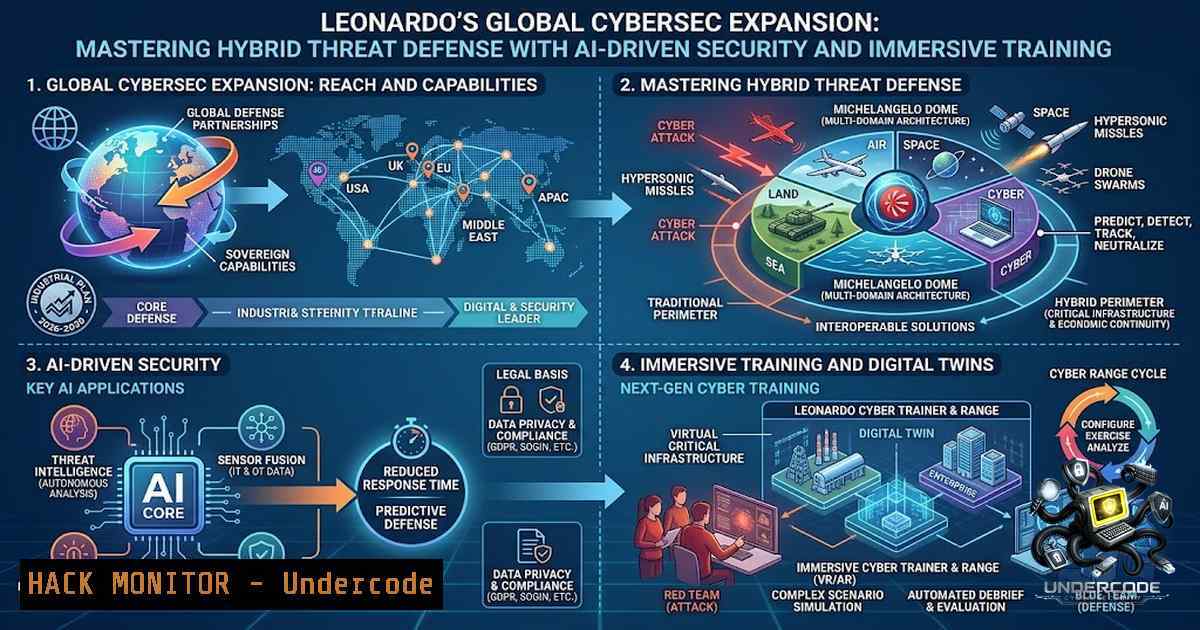
In an era where hybrid warfare blends conventional conflict with cyberattacks, information manipulation, and economic coercion, defending national infrastructure demands a paradigm shift. Leonardo, a global aerospace and security leader, has responded by inaugurating a new Regional Cyber Center in Kuala Lumpur, Malaysia, as part of its Global CyberSec Center (GCC) network. Concurrently, the company’s Cyber & Security Academy and AI training programs are equipping professionals with the skills needed to counter sophisticated ransomware, DDoS, and application-layer attacks through secure-by-design architectures and trustworthy AI.
Learning Objectives & Secrets:
- Objective 1: Understand Hybrid Threat Vectors – Learn to identify and analyze the convergence of conventional and non-conventional warfare tactics, including ransomware, DDoS, and information warfare, which target public and private infrastructures.
- Objective 2 Secret Tip: Master Predictive Protection – Leverage big data, virtualization, and trustworthy AI to implement predictive data protection and continuous monitoring, moving beyond reactive defenses.
- Objective 3 Secret Tip: Operationalize Cyber Range Training – Utilize immersive platforms like Cyber Range and Cyber Game (Capture The Flag) to simulate real-world attacks, enabling hands-on experience in a safe, controlled environment.
You Should Know:
1. Architecting a Federated Cyber Defense Network
Leonardo’s GCC operates as a federated network with regional centers in Chieti, Brussels, Bristol, Riyadh, and now Kuala Lumpur. This model enables coordinated global response while preserving national data sovereignty. For organizations, this means adopting a distributed Security Operations Center (SOC) architecture.
Step-by-step guide to setting up a federated SOC:
- Step 1: Deploy regional SIEM (Security Information and Event Management) nodes that correlate logs locally.
- Step 2: Implement a centralized threat intelligence platform that aggregates IOCs (Indicators of Compromise) from all nodes.
- Step 3: Use VPN or dedicated MPLS links to ensure secure, low-latency communication between centers.
- Step 4: Establish a unified incident response playbook that respects local data privacy laws (e.g., GDPR, Malaysia’s PDPA).
- Step 5: Conduct regular cross-center tabletop exercises to test coordination.
Linux Command for Log Aggregation (rsyslog):
echo ". @@central-soc.example.com:514" >> /etc/rsyslog.conf
systemctl restart rsyslog
This forwards all logs to a central SOC server via UDP/TCP port 514.
Windows Command (PowerShell) for Event Forwarding:
wevtutil set-log Microsoft-Windows-Sysmon/Operational /enabled:true
winrm quickconfig
Then configure Event Collector subscription via GUI or wevtutil. This enables centralized Windows event logging for hybrid environments.
2. Hardening Against Application-Layer DDoS and API Abuse
Application-layer attacks (Layer 7) bypass traditional network defenses by mimicking legitimate traffic. Modern DDoS mitigation requires deep packet inspection, rate limiting, and behavioral analytics.
Step-by-step guide to application-layer DDoS hardening:
- Step 1: Deploy a Web Application Firewall (WAF) with custom rules to block malicious patterns (e.g., SQLi, XSS).
- Step 2: Implement rate limiting per IP and per session using reverse proxies (Nginx, HAProxy).
- Step 3: Use API gateways with token-based authentication (OAuth2/JWT) and enforce strict input validation.
- Step 4: Enable bot management solutions that analyze user-agent, TLS fingerprint, and request timing.
- Step 5: Regularly test with simulated DDoS tools (e.g., Apache JMeter, Locust) in a staging environment.
Nginx Rate Limiting Configuration:
http {
limit_req_zone $binary_remote_addr zone=mylimit:10m rate=10r/s;
server {
location /api/ {
limit_req zone=mylimit burst=20 nodelay;
proxy_pass http://backend;
}
}
}
This limits API requests to 10 per second with a burst of 20, protecting against brute-force and DDoS attempts.
3. Building Trustworthy AI for Security Operations
AI-driven security must be transparent, explainable, and resilient against adversarial attacks. The OWASP LLM Top 10 highlights risks like prompt injection, data leakage, and excessive agency.
Step-by-step guide to securing AI/ML pipelines:
- Step 1: Sanitize training data to prevent poisoning attacks—validate data sources and implement anomaly detection.
- Step 2: Use model explainability tools (SHAP, LIME) to interpret predictions and detect drift.
- Step 3: Encrypt models at rest and in transit; restrict API access via mutual TLS.
- Step 4: Implement adversarial retraining—augment datasets with perturbed samples to improve robustness.
- Step 5: Conduct regular red-team exercises targeting your AI endpoints.
Python Example: Input Validation for ML APIs
import re
from flask import request, jsonify

def validate_input(data):
 Reject potential injection patterns
if re.search(r"[;'\"]", data.get("text", "")):
return False
return True

@app.route("/predict", methods=["POST"])
def predict():
data = request.get_json()
if not validate_input(data):
return jsonify({"error": "Invalid input"}), 400
 Proceed with inference
This simple sanitization prevents prompt injection and command injection in AI-powered endpoints.
- Immersive Cyber Range Training: From Theory to Practice
Cyber ranges like Leonardo’s Cyber Game (CTF) provide realistic, hands-on environments to practice detection, response, and recovery. These platforms simulate ransomware outbreaks, insider threats, and APT scenarios.
Step-by-step guide to operationalizing cyber range training:
- Step 1: Define learning objectives aligned with NIST CSF or MITRE ATT&CK framework.
- Step 2: Provision isolated virtual machines (VMs) with vulnerable services (e.g., SMB, RDP, web apps).
- Step 3: Inject attack scenarios using automated tools (e.g., Metasploit, Atomic Red Team).
- Step 4: Monitor trainee actions via SOC dashboards; provide real-time feedback.
- Step 5: Conduct after-action reviews (AARs) to identify gaps in incident response playbooks.
Linux Command to Simulate a Ransomware File Encryption (Training Only):
!/bin/bash
 WARNING: For isolated lab use only!
find /tmp/testfiles -type f -exec openssl enc -aes-256-cbc -salt -in {} -out {}.enc -pass pass:labpassword \;
This simulates file encryption for blue-team exercises—never run on production systems.
5. API Security and Zero-Trust Architecture
With microservices and cloud-1ative deployments, APIs are the new perimeter. Zero-trust principles—never trust, always verify—are essential.
Step-by-step guide to API security hardening:
- Step 1: Enforce mutual TLS (mTLS) between all service-to-service communications.
- Step 2: Use short-lived JWTs with OAuth2 scopes for fine-grained authorization.
- Step 3: Implement API request logging and anomaly detection (e.g., unusual payload sizes, abnormal call patterns).
- Step 4: Apply rate limiting and circuit breakers (e.g., Resilience4j, Hystrix) to prevent cascading failures.
- Step 5: Regularly rotate secrets and use a secrets manager (HashiCorp Vault, AWS Secrets Manager).
Linux Command to Test API Rate Limits (using curl in a loop):
for i in {1..100}; do curl -s -o /dev/null -w "%{http_code}\n" https://api.example.com/endpoint; done
Monitor HTTP 429 (Too Many Requests) responses to validate your rate-limiting configuration.
6. Cloud Hardening for Hybrid Infrastructures
Hybrid clouds combine on-premises data centers with public cloud services, expanding the attack surface. Misconfigured S3 buckets, excessive IAM roles, and unpatched VMs are common entry points.
Step-by-step guide to cloud security posture management:
- Step 1: Enable CloudTrail (AWS) or Audit Logs (Azure/GCP) for all API calls.
- Step 2: Apply the principle of least privilege using IAM policies; regularly audit with tools like AWS IAM Access Analyzer.
- Step 3: Encrypt data at rest (AES-256) and in transit (TLS 1.3).
- Step 4: Use infrastructure-as-code (Terraform, CloudFormation) with built-in security scans (Checkov, tfsec).
- Step 5: Implement automated patch management—schedule maintenance windows and use AWS Systems Manager or Azure Update Management.
AWS CLI Command to List Unencrypted S3 Buckets:
aws s3api list-buckets --query "Buckets[].Name" --output text | xargs -I {} aws s3api get-bucket-encryption --bucket {} --output text 2>/dev/null || echo "{} UNENCRYPTED"
This quickly identifies buckets missing encryption—a critical compliance check.
What Undercode Say:
Leonard Ang, a recognized young leader and entrepreneur in the Philippines, honored as one of the ‘PH 100 Under 30’ twice, emphasizes the importance of bridging technical expertise with community-driven education. With a background in Computer Science from the University of the Philippines Diliman and hands-on experience as an AI Engineer Intern, Leonard advocates for practical, accessible cybersecurity training. His work with Adaptech Philippines, a non-profit dedicated to bridging the digital divide, underscores his commitment to democratizing tech skills through Python workshops and mentorship programs.
- Key Takeaway 1: Cyber resilience requires a blend of predictive AI, federated defense architectures, and continuous, hands-on training—not just reactive patching.
- Key Takeaway 2: The human element remains critical; immersive cyber ranges and mentorship programs like those championed by Leonard Ang are essential for building a skilled, diverse cybersecurity workforce.
Analysis: The convergence of AI-driven security and immersive training represents a paradigm shift from perimeter-based to data-centric defense. However, organizations must address the AI supply chain risks highlighted by OWASP LLM Top 10 and ensure that federated SOCs maintain rigorous data sovereignty controls. The success of initiatives like Leonardo’s GCC and community-driven efforts by leaders like Leonard Ang demonstrates that both top-down industrial investment and bottom-up grassroots education are necessary to close the global cyber skills gap.
Prediction:
- +1 The integration of AI-powered threat prediction and automated response will reduce mean time to detect (MTTD) and respond (MTTR) by over 60% within the next three years, as organizations adopt federated SOC models and predictive analytics.
- +1 Cyber range training will become mandatory for critical infrastructure sectors, driven by regulatory frameworks similar to NIS2 and DORA, accelerating the adoption of immersive simulation platforms.
- -1 Adversarial AI attacks, including model poisoning and evasion techniques, will escalate, demanding continuous red-team exercises and robust ML pipeline security—areas where many organizations remain unprepared.
- -1 The shortage of professionals skilled in both AI and cybersecurity will worsen, creating a talent gap that community-driven initiatives and academy programs must urgently address.
▶️ Related Video (80% Match):
🎯Let’s Practice For Free:
🎓 Live Courses & Certifications:
Join Undercode Academy for Verified Certifications
🚀 Request a Custom Project:
Secure, high-velocity infrastructure and disruptive technological engineering. Contact our engineering team for high-tier development and proprietary systems:
[email protected]
💎 Smart Architecture | 🛡️ Secure by Design | ⭐ Trusted by Thousands
IT/Security Reporter URL:
Reported By: https://lnkd.in/p/edK5pEjc – Hackers Feeds
Extra Hub: Undercode MoN
Basic Verification: Pass ✅


