
Listen to this Post
Introduction:
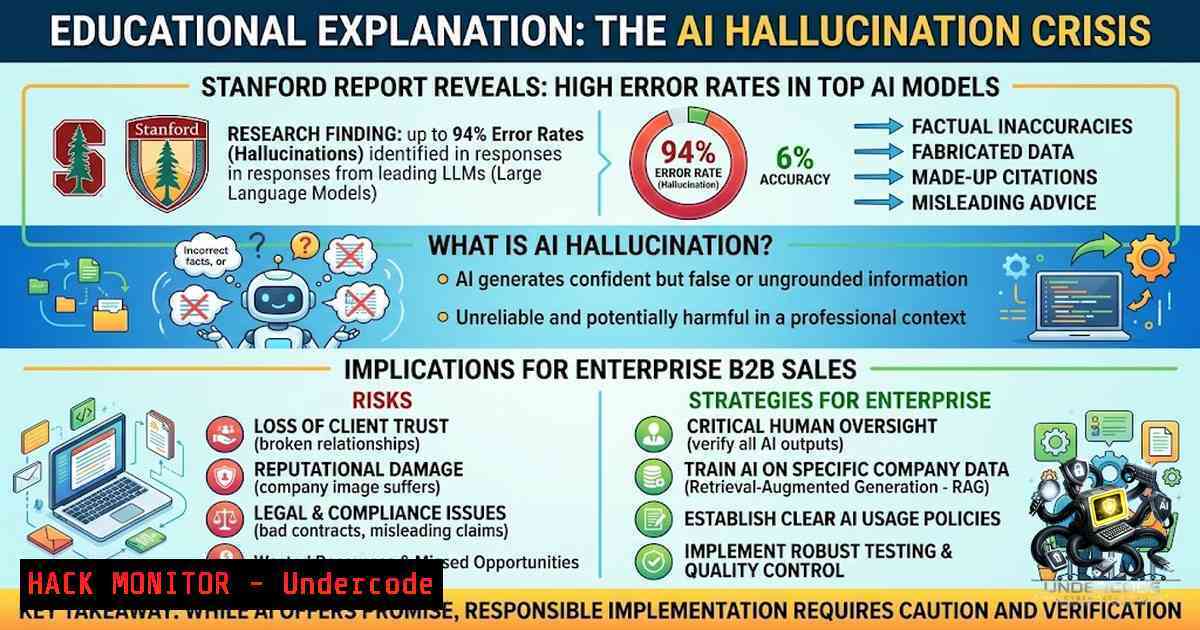
The 2026 Stanford AI Index Report, released by Stanford University’s Human-Centered AI Institute (HAI), has delivered a sobering reality check to the enterprise AI community: hallucination rates across 26 leading generative AI models range from 22% to 94%, depending on the benchmark and use case. This finding is particularly alarming for B2B sales organizations that have rushed to deploy generative AI for proposal drafting, email outreach, and client communication—areas where factual accuracy is not optional but existential. As Prof. Dr. Benedikt Schnellbächer, CIO of Zopa, notes in his guest article for Vertriebszeitung, these systems excel at creativity but offer “no comparable reliability,” making them risky for irreversible sales decisions. The challenge is no longer about model size or capability; it’s about building systems that can be trusted with high-stakes business operations.
Learning Objectives & Secrets:
- Objective 1: Understand the True Scale of AI Hallucination in Enterprise Contexts – The Stanford AI Index 2026 tested 26 models on the AA-Omniscience benchmark, which evaluates factual reliability across 6,000 questions in six domains. Results showed that even the best-performing models hallucinate at rates exceeding 14%, with many commercial models exceeding 25%. Secret tip: Don’t rely on a single benchmark—cross-reference multiple evaluations including the Vectara Hallucination Leaderboard and the LLM Brand-1ame Hallucination Benchmark to get a complete picture of model reliability.
-
Objective 2: Implement Multi-Model Consensus Architectures – Research shows that cross-model verification reduces factual errors from 8.3% to 3.2%, with specific model combinations like Claude Opus 4.7 and Gemini 3.1 Pro delivering the lowest error rates across high-stakes document categories. Secret tip: Instead of searching for one perfect model, build systems that compare outputs across multiple LLMs and synthesize conclusions where they agree—divergence signals the need for human oversight.
-
Objective 3: Build Grounded AI Systems with Live Data Access – AI sales agents hallucinate because the data layer they read from is fragmented, stale, or duplicated. Secret tip: Implement grounding through live B2B data APIs or MCP servers rather than static CRM exports—any exported data is already out of date by the time the agent reads it. Require that every claim in AI output traces back to a verifiable, inspectable record.
You Should Know:
- The Stanford AI Index 2026: What the Data Actually Shows
The 2026 AI Index Report, a 423-page comprehensive analysis, reveals a widening gap between AI capabilities and our ability to manage them responsibly. The AA-Omniscience benchmark, designed to assess whether models will admit uncertainty rather than guess, found hallucination rates ranging from 22% to 94% across 26 models. Even more concerning: training techniques that improve safety consistently degrade accuracy.
The report is available for download at: https://hai.stanford.edu/ai-index/2026-ai-index-report. For direct PDF access: https://hai.stanford.edu/assets/files/ai_index_report_2026.pdf.
Step‑by‑step guide to auditing your AI models against Stanford’s findings:
- Identify your model’s hallucination rate – Check the AA-Omniscience leaderboard at https://benchlm.ai/benchmarks/omnisciencehallucinationrate. As of August 2026, Command A+ leads at 14.2%, followed by LFM2.5-2.6B at 16.0% and MiniMax M3 at 18.4%.
-
Run your own factual consistency tests – Use the Vectara Hallucination Leaderboard (https://github.com/vectara/hallucination-leaderboard) to test models on document summarization tasks.
-
Benchmark against domain-specific ground truth – For sales and B2B applications, use the LLM Brand-1ame Hallucination Benchmark (https://github.com/etymolt/llm-hallucination-benchmark) which tests models on 500 brand names across 10 categories against USPTO/TTAB data.
-
Document your findings – Create a matrix comparing your models’ hallucination rates across different use cases. If your model exceeds 20% hallucination in business-critical tasks, it’s not ready for production without significant guardrails.
2. Building a Grounded AI Sales Architecture
Grounded AI connects a model’s reasoning to verified, current data at the moment of the query. For a sales agent, this means working from what’s true about the account today, from a source you can trace back. An ungrounded agent works from its training data plus whatever it happened to find in your CRM, with no way to tell you which parts it invented.
Three requirements for grounded AI:
- Live access – The agent pulls data at query time rather than working from a snapshot
- Verifiable sources – Any claim in the output traces to a record you can inspect
- Relevant context – The agent gets the context data the task actually requires
Implementation commands and configurations:
Linux/macOS – Setting up a grounded AI agent with API access:
 Install required dependencies
pip install openai requests pandas

Set up environment variables for API access
export B2B_API_KEY="your_api_key_here"
export CRM_API_ENDPOINT="https://your-crm-instance.com/api/v1"

Create a grounding verification script
cat > ground_agent.py << 'EOF'
import requests
import json

def verify_claim(claim, source_type, record_id):
"""Verify a claim against a live data source"""
if source_type == "crm":
response = requests.get(
f"{os.environ['CRM_API_ENDPOINT']}/records/{record_id}",
headers={"Authorization": f"Bearer {os.environ['B2B_API_KEY']}"}
)
return response.json() if response.status_code == 200 else None
return None
EOF
Windows PowerShell – Setting up grounding verification:
 Set environment variables
$env:B2B_API_KEY = "your_api_key_here"
$env:CRM_API_ENDPOINT = "https://your-crm-instance.com/api/v1"

Test API connectivity
Invoke-RestMethod -Uri "$env:CRM_API_ENDPOINT/health" -Headers @{Authorization = "Bearer $env:B2B_API_KEY"}
3. Multi-Model Consensus: The New Enterprise Standard
The Forbes Technology Council predicts that “the next phase of enterprise AI adoption will depend less on finding one perfect model and more on building systems of consensus”. Instead of treating a single LLM as the definitive authority, organizations should compare outputs across multiple models, identify where they agree or disagree, and synthesize the strongest conclusions.
Step‑by‑step guide to implementing multi-model consensus:
- Select 3-5 models with complementary strengths. Research shows Claude Opus 4.7 and Gemini 3.1 Pro combination delivers the lowest error rates.
-
Implement parallel querying – Send the same prompt to all selected models simultaneously:
import openai
import asyncio

async def query_models(prompt, models):
"""Query multiple models in parallel"""
tasks = []
for model in models:
if model == "claude":
tasks.append(query_claude(prompt))
elif model == "gemini":
tasks.append(query_gemini(prompt))
elif model == "gpt":
tasks.append(query_gpt(prompt))
return await asyncio.gather(tasks)

async def query_claude(prompt):
 Claude API call implementation
pass
- Build a consensus analyzer – Compare outputs for factual agreement:
def analyze_consensus(responses):
"""Analyze agreement across model responses"""
consensus_score = 0
for i in range(len(responses)):
for j in range(i+1, len(responses)):
if responses[bash]['factual_claims'] == responses[bash]['factual_claims']:
consensus_score += 1
return consensus_score / (len(responses)  (len(responses)-1) / 2)
- Flag divergence for human review – Any area where models disagree should trigger an alert for manual verification.
4. Prompt Engineering for Hallucination Reduction
The Source-Anchor Protocol provides a practical framework for reducing hallucinations in day-to-day AI use.
Step‑by‑step guide:
- Never use a standard LLM for current facts – Use tools connected to live web sources (Perplexity or Gemini with search enabled).
-
End every factual prompt with a verification request:
Prompt template: "Provide [bash] and cite your sources with specific URLs or document references. If you are uncertain about any fact, state 'UNCERTAIN' rather than guessing."
- Implement the six-check validation for outbound AI-generated content:
– Field verification status
– Last-refresh date
– Match confidence score
– Source count per claim
– Absent-field fallback rule
– Sample audit against real accounts
5. Enterprise Guardrails and Security Configuration
Context gaps are the root cause of agent hallucinations and policy violations. Implementing proper guardrails requires both technical and process controls.
Linux – Setting up an AI gateway with hallucination detection:
 Install AI gateway
git clone https://github.com/your-org/ai-gateway
cd ai-gateway
pip install -r requirements.txt

Configure hallucination detection thresholds
cat > config.yaml << 'EOF'
hallucination_detection:
enabled: true
threshold: 0.15  15% maximum hallucination rate
action: block_and_alert
alert_channel: slack
model_comparison:
enabled: true
models: ["claude-opus-4.7", "gemini-3.1-pro", "gpt-5"]
EOF

Start the gateway
python gateway.py --config config.yaml
Windows – Implementing validation workflows in Azure/AD:
 Set up Azure AI Content Safety
az extension add --1ame ai-content-safety

Create a content safety configuration
az ai-content-safety configuration create `
--1ame "HallucinationGuard" `
--blocklist "FactualErrors" `
--severity-level "High"
6. Measuring and Monitoring Hallucination Rates in Production
Continuous monitoring is essential. Studies show that without mitigation, hallucination rates in medical case summaries reached 64%. Enterprise AI hallucination rates can drop 61% when using multi-model verification architecture.
Implementation checklist:
- Set up logging – Log all AI interactions with timestamps, model versions, and prompts
- Implement random sampling audits – Review 5-10% of AI-generated outputs manually
- Track hallucination metrics – Create dashboards showing hallucination rates by model, use case, and time
- Establish escalation procedures – Define when human review is mandatory (e.g., hallucination rate > 10% for financial/legal content)
What Undercode Say:
- Key Takeaway 1: Model size is not the solution – The Stanford AI Index 2026 demonstrates that even the largest, most advanced models exhibit hallucination rates from 22% to 94%. Simply deploying bigger models will not solve the trust problem. Organizations must focus on architectural solutions—grounding, consensus, and verification—rather than chasing model parameters.
-
Key Takeaway 2: Enterprise AI requires a fundamental shift in mindset – The current approach of treating AI models as creative assistants with implicit assumption that outputs will be verified is insufficient for B2B sales. High-stakes decisions require systematic validation, multi-model comparison, and live data grounding. The 50% of senior GTM leaders who can’t trust their AI’s outputs represent a market failure that demands immediate corrective action.
Analysis: The Stanford AI Index 2026 data reveals that the AI industry has prioritized capability over reliability. With hallucination rates reaching 94%, the gap between what AI can do and what it can be trusted to do has never been wider. For enterprise B2B sales, this is not an academic concern—it’s a business risk that manifests in hallucinated pricing, fabricated client interactions, and regulatory violations. The solution lies not in waiting for better models but in building systems of verification: grounded data access, multi-model consensus, and continuous monitoring. Companies that implement these architectures today will gain a competitive advantage in trust and reliability. Those that don’t will continue to spend their time correcting AI-generated errors rather than closing deals. The technology is ready; the question is whether organizations are ready to adopt the discipline required to use it responsibly.
Prediction:
- +1 Enterprise adoption of multi-model verification architectures will accelerate, with Gartner predicting that by 2028, 75% of enterprise AI deployments will use consensus-based validation. Organizations implementing these systems today will see hallucination rates drop by 60% or more.
-
+1 The emergence of standardized hallucination benchmarks (AA-Omniscience, Vectara, Brand-1ame) will create market pressure for model providers to prioritize factual accuracy over creative capability, fundamentally changing the competitive landscape.
-
-1 Companies that continue to deploy ungrounded AI agents for B2B sales will face increasing regulatory scrutiny and liability. Hallucinated facts in proposals, contracts, or client communications will become a source of litigation as the technology matures and expectations rise.
-
-1 The transparency decline identified in the Stanford AI Index 2026 will worsen public and enterprise trust, potentially triggering a “AI winter” in enterprise adoption if not addressed through verifiable, auditable AI systems.
-
+1 The development of neurosymbolic architectures combining knowledge graphs with LLMs will emerge as a dominant enterprise pattern, with research showing 40%+ accuracy improvements and hallucination reductions from 37% to 63%.
▶️ Related Video (68% Match):
https://www.youtube.com/watch?v=2T19-iE7fAQ
🎯Let’s Practice For Free:
🎓 Live Courses & Certifications:
Join Undercode Academy for Verified Certifications
🚀 Request a Custom Project:
Secure, high-velocity infrastructure and disruptive technological engineering. Contact our engineering team for high-tier development and proprietary systems:
[email protected]
💎 Smart Architecture | 🛡️ Secure by Design | ⭐ Trusted by Thousands
IT/Security Reporter URL:
Reported By: https://lnkd.in/p/etjJUWeX – Hackers Feeds
Extra Hub: Undercode MoN
Basic Verification: Pass ✅


