
Listen to this Post
Introduction:
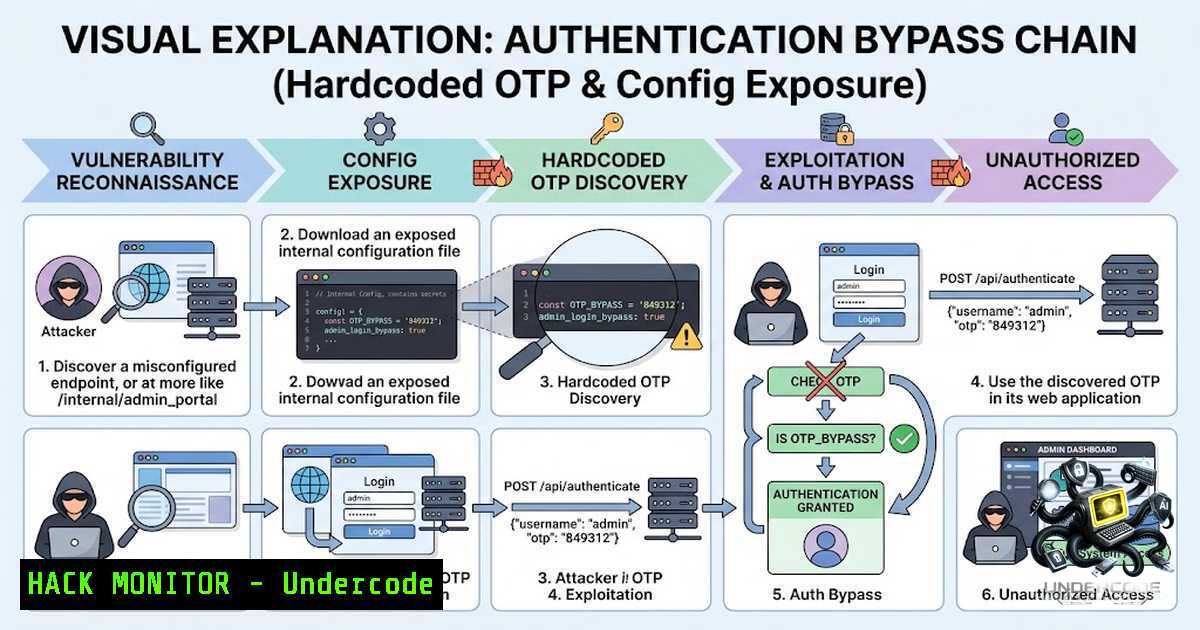
In modern web applications, security is only as strong as the weakest link in the authentication chain. A recent real‑world bug bounty finding demonstrates how seemingly minor flaws—email enumeration, a hardcoded OTP bypass, and session token leakage—can be chained to expose internal system configurations. This article dissects the attack chain, provides practical steps to replicate and defend against such vectors, and offers actionable commands for both penetration testers and defenders.
Learning Objectives & Secrets:
- Objective 1: Identify Email Enumeration Vectors – Learn to detect unauthenticated endpoints that disclose user existence via response discrepancies or timing attacks.
- Objective 2 Secret Tip: Hardcoded OTP Bypass – When testing OTP flows, always inspect client‑side scripts, browser storage, and API responses for static backup codes or default values.
- Objective 3 Secret Tip: Session Token Hijacking – After bypassing OTP, look for session tokens returned in URL parameters, HTTP headers, or JSON bodies; these are often reused across subdomains.
You Should Know:
1. Email Enumeration on Unauthenticated Endpoints
Attackers often start by probing endpoints like /api/check-email, /forgot-password, or `/signup` that return distinct messages for existing vs. non‑existing users.
Step‑by‑step guide:
- Use `ffuf` to fuzz a list of email addresses:
ffuf -u https://target.com/api/check-email -X POST -d "email=FUZZ" -w emails.txt -fs 200
- Compare response lengths or status codes; a 200 OK with “User exists” vs. “User not found” is a classic sign.
- For Windows, use PowerShell and `Invoke-WebRequest` in a loop, capturing response content for differences.
- Mitigation: Use generic error messages and rate‑limit authentication attempts.
2. Hardcoded OTP Bypass
Once an email is enumerated, the next step is bypassing the One‑Time Password (OTP) verification. The researcher encountered a hardcoded OTP (e.g., 0000, 1234) buried in JavaScript source or database defaults.
Step‑by‑step guide:
- Intercept the OTP submission request with Burp Suite.
- Try common defaults:
000000,111111,123456, or the last four digits of the user’s phone number. - Inspect the page source and minified JS files: `curl https://target.com/js/app.min.js | grep -i “otp\|backup\|default”`
- On Windows, use `findstr` with a similar pattern.
- If successful, the server issues a session token (e.g., JWT) without requiring the correct OTP.
- Defenders must never hardcode credentials; use time‑based TOTP or deliver OTP via SMS/email with no static fallback.
3. Valid Session Token and Internal Config Exposure
After receiving a valid session token, the researcher discovered that the same token granted access to an internal configuration endpoint (e.g., /internal/config, /debug/env).
Step‑by‑step guide:
- Use the stolen token in the `Authorization: Bearer
` header to query internal endpoints: curl -H "Authorization: Bearer <token>" https://target.com/internal/config
- Examine responses for AWS keys, database connection strings, or API secrets.
- On Windows, use `curl.exe` with similar headers.
- If the endpoint is protected by IP allowlisting, try spoofing the `X-Forwarded-For` header.
- Mitigation: Implement strict role‑based access controls and never expose configuration endpoints externally.
4. Chaining Vulnerabilities with Automated Tools
To replicate this chain efficiently, security researchers often use custom scripts that automate email enumeration, OTP brute‑forcing, and config endpoint discovery.
Step‑by‑step guide:
- Write a Python script using `requests` to loop through enumerated emails, attempt default OTPs, and extract tokens.
- Integrate with `subprocess` to call `nuclei` templates for configuration exposure:
nuclei -u https://target.com -t exposures/configs/
- Use `jq` to parse JSON responses and filter for sensitive keys:
curl ... | jq '. | select(.aws_secret_key != null)'
- For Windows, consider using `jq` via WSL or PowerShell’s
ConvertFrom-Json.
5. Detection and Logging for Defenders
Blue teams can detect such chained attacks by monitoring for unusual patterns: enumeration spikes, OTP failures with default values, and access to sensitive endpoints by unauthorized roles.
Step‑by‑step guide:
- Configure SIEM rules to alert on high volumes of
403/404errors from a single IP. - Log all OTP validation attempts and flag repeated use of common codes.
- Implement anomaly detection on session token usage; a token that is immediately reused on a high‑privilege endpoint is suspicious.
- Use `auditd` on Linux or Windows Event Logs to track file access to config files.
6. Remediation Hardening
To prevent such chains, follow OWASP ASVS guidelines:
- Enforce multi‑factor authentication with no fallback or hardcoded bypass.
- Implement proper API scoping; separate authentication endpoints from data endpoints.
- Perform regular source code scans for hardcoded secrets using tools like `trufflehog` or
gitleaks.
Step‑by‑step guide:
- Run `gitleaks detect –source . –verbose` on your codebase.
- For cloud environments, rotate keys automatically and use AWS Secrets Manager.
7. Real‑World Impact & Responsible Disclosure
The researcher responsibly disclosed this chain to the vendor, who fixed the flaws in production within hours. This highlights the importance of coordinated vulnerability disclosure.
Step‑by‑step guide for researchers:
- Document each step with screenshots and HTTP requests.
- Use platforms like HackerOne to submit reports; include clear remediation suggestions.
- Follow the vendor’s disclosure timeline and never publicly expose unpatched issues.
What Undercode Say:
- Key Takeaway 1: Always test for email enumeration before diving into complex exploit chains—it’s the low‑hanging fruit that often unlocks bigger flaws.
- Key Takeaway 2: Hardcoded OTPs are a developer’s oversight; always probe default values, but remember to report them responsibly.
- Analysis: This chain demonstrates that security is a sum of its parts. The researcher’s persistence through three duplicate submissions paid off, proving that thoroughness and a methodical approach are more valuable than individual high‑severity findings. Defenders should treat every endpoint as a potential entry point and isolate sensitive data behind multiple layers of authentication and authorization.
Prediction:
-1 The proliferation of microservices and APIs will continue to expose misconfigurations where authentication tokens are over‑privileged, leading to more breaches similar to this chain.
+1 Security teams will increasingly adopt runtime token validation and zero‑trust architectures, reducing the blast radius of such bypasses.
+1 Automated DAST and IAST tools are evolving to detect hardcoded secrets and misconfigured endpoints, making it harder for attackers to slip through.
-1 However, legacy applications with rigid codebases may lag in patching, creating windows of opportunity for chained exploits.
+1 The bug bounty model thrives on these discoveries, incentivizing researchers to find and fix chains before malicious actors do.
▶️ Related Video (88% Match):
🎯Let’s Practice For Free:
🎓 Live Courses & Certifications:
Join Undercode Academy for Verified Certifications
🚀 Request a Custom Project:
Secure, high-velocity infrastructure and disruptive technological engineering. Contact our engineering team for high-tier development and proprietary systems:
[email protected]
💎 Smart Architecture | 🛡️ Secure by Design | ⭐ Trusted by Thousands
IT/Security Reporter URL:
Reported By: https://lnkd.in/p/e6zYePP7 – Hackers Feeds
Extra Hub: Undercode MoN
Basic Verification: Pass ✅


