Listen to this Post
Introduction:
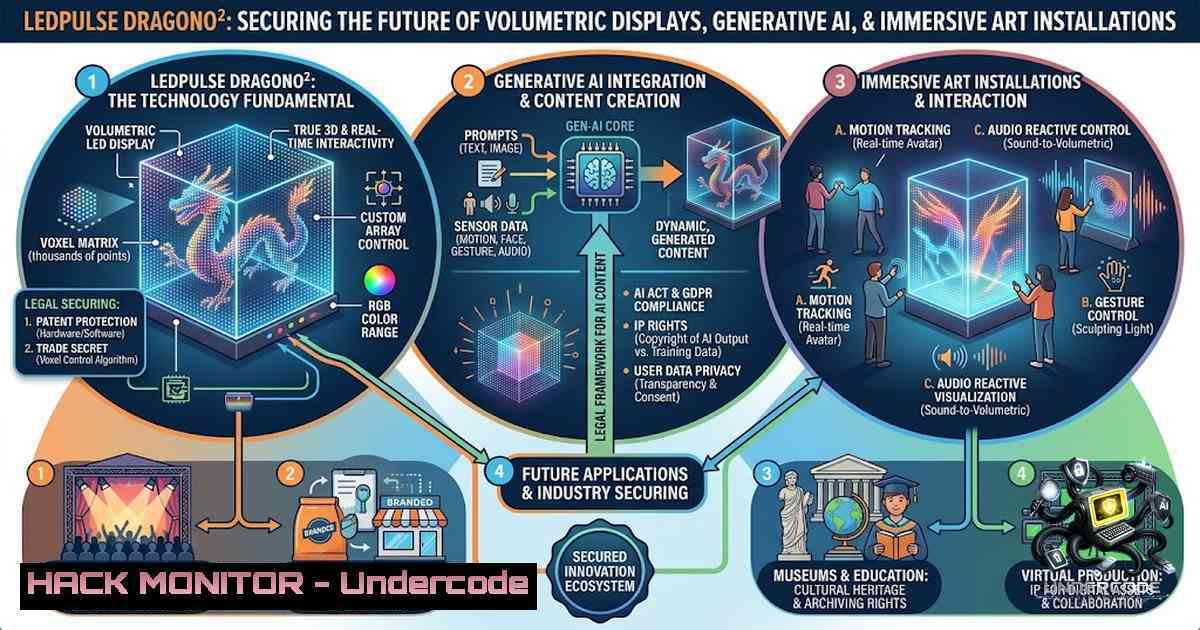
The convergence of generative artificial intelligence, volumetric LED displays, and interactive installation art is redefining how we experience digital content. LedPulse’s DragonO² system, showcased at the TRANSFIX immersive art experience at Resorts World Las Vegas, represents a leap forward in 3D visualization—transforming light into sculptural material using thousands of LED “neurons”. However, this fusion of AI-driven content creation, real-time rendering engines like TouchDesigner, and networked sensor systems introduces a complex attack surface that spans API security, cloud infrastructure hardening, and supply chain vulnerabilities. This article dissects the technical architecture behind next-generation volumetric displays and provides actionable security strategies for protecting these emerging cyber-physical systems.
Learning Objectives & Secrets:
- Objective 1: Master the architecture of volumetric LED display systems, including the LedPulse DragonO²’s patented image transmission system that encrypts 2D layers into a single file for real-time 3D content delivery.
- Objective 2 (Secret Tip): Harden TouchDesigner-based interactive installations by mitigating remote-code execution risks—specifically, audit external plugin dependencies like `twozero.tox` which have been flagged for high-confidence RCE vulnerabilities.
- Objective 3 (Secret Tip): Implement zero-trust API gateways for AI-generated content pipelines, preventing prompt injection and data poisoning attacks that could corrupt generative models used in real-time art installations.
You Should Know:
- Decrypting the Volumetric Display Pipeline: From LED Strings to 3D Voxels
LedPulse’s DragonO² operates on a proprietary image transmission system that compresses video signals of two-dimensional layers into an encrypted single file. This file enables transmission, control, modification, and creation of volumetric three-dimensional content in real-time, viewable from multiple angles without VR headsets. The hardware comprises suspended LED light strings arranged in a 3D Organic Matrix, with pixel pitches as fine as 25mm and heights reaching five meters.
Step‑by‑step guide to analyzing the DragonO² data pipeline:
- Capture Network Traffic: Use `tcpdump` on Linux to intercept communication between the content server and the LED controller:
sudo tcpdump -i eth0 -w volumetric_traffic.pcap port 554 or port 8554
- Decrypt the Encrypted File Format: LedPulse’s proprietary format encapsulates 2D layers. Use `binwalk` to identify embedded structures:
binwalk -e dragon_o_stream.bin
- Extract Metadata: Parse the header for resolution, frame rate, and layer count. On Windows, use PowerShell:
Get-Content -Path dragon_o_stream.bin -Encoding Byte -TotalCount 64 | Format-Hex
- Reconstruct 3D Content: The render engine uses a “fully automatic volumetric LED render engine”. For debugging, simulate the rendering with Python and Open3D:
import open3d as o3d
import numpy as np
voxel_grid = o3d.geometry.VoxelGrid.create_dense(
width=100, height=100, depth=100, origin=np.zeros(3), color=np.ones(3)
)
o3d.visualization.draw_geometries([bash])
- Validate Integrity: Compute SHA-256 hashes of incoming content files to detect tampering:
sha256sum dragon_o_stream.bin
2. TouchDesigner Security: Mitigating RCE and Plugin Poisoning
TouchDesigner is the industry-standard node-based visual programming language used in many TRANSFIX installations. However, security audits have revealed that external plugins—such as `twozero.tox` downloaded from 404zero.com—enable arbitrary Python execution within the TouchDesigner environment, providing unrestricted filesystem access under the user’s permissions. This constitutes a high-confidence remote-code execution dependency.
Step‑by‑step guide to securing a TouchDesigner deployment:
- Audit Installed Plugins: On Windows, search for `.tox` files in the TouchDesigner `Plugins` directory:
Get-ChildItem -Path "C:\Program Files\Derivative\TouchDesigner\Plugins" -Filter .tox -Recurse
- Check Digital Signatures: Verify that all binaries are signed by Derivative. Use
Get-AuthenticodeSignature:Get-AuthenticodeSignature -FilePath "C:\Program Files\Derivative\TouchDesigner\bin\TouchDesigner.exe"
- Restrict Web Server DAT Interfaces: In TouchDesigner 2025.33070+, clear the `Local Address` parameter on Web Server DAT to prevent listening on all interfaces. Set it explicitly to `127.0.0.1` for local-only access.
- Implement Plugin Whitelisting: Use environment variables to control which directories are scanned for plugins. Set `TD_PLUGIN_PATH` to a trusted, read-only location:
export TD_PLUGIN_PATH=/opt/trusted_td_plugins
- Disable `td_execute_python` in Production: If the MCP interface is not required, disable it entirely by removing the corresponding `.tox` file or setting a configuration flag to prevent arbitrary code execution.
-
Generative AI Security: Poisoning and Prompt Injection in Art Pipelines
Generative AI tools like Midjourney (used in TRANSFIX’s digital art) and diffusion models are increasingly integrated into content creation pipelines. However, these models are vulnerable to caption poisoning attacks, where an attacker injects crafted captions into the retrieval database, biasing generation away from the user’s intended function. Additionally, latent diffusion models face risks of misuse, including replication of human faces and art styles without consent.
Step‑by‑step guide to securing a generative AI pipeline:
- Sanitize Training Data: Implement input validation on all captions and prompts. Use a regular expression filter to block known injection patterns:
import re
def sanitize_prompt(prompt):
blocked_patterns = [r"ignore previous", r"system:", r"<|im_start|>"]
for pattern in blocked_patterns:
if re.search(pattern, prompt, re.IGNORECASE):
return "Invalid prompt detected."
return prompt
- Deploy a Latent Diffusion Shield: Add adversarial perturbations in latent space to prevent unauthorized style replication. Use the `adversarial` library in Python to generate protective noise:
from adversarial import LatentDefender
defender = LatentDefender(model="stable-diffusion", epsilon=0.01)
protected_latent = defender.protect(original_latent)
- Monitor Model Outputs: Use content moderation APIs (e.g., Google’s Vision API) to detect NSFW or policy-violating generations in real-time.
- Implement Rate Limiting: Prevent API abuse by limiting requests per IP. On Linux, use `iptables` and
fail2ban:iptables -A INPUT -p tcp --dport 5000 -m limit --limit 10/min -j ACCEPT iptables -A INPUT -p tcp --dport 5000 -j DROP
- Encrypt Model Weights: Store trained models with AES-256 encryption. Use OpenSSL on Linux:
openssl enc -aes-256-cbc -salt -in model.pt -out model.pt.enc -pass pass:your_strong_password
4. Cloud Hardening for Real-Time Volumetric Content Delivery
LedPulse’s DragonO² system enables synchronization across worldwide “Dragon stations” in Shenzhen, Hamburg, and Ibiza. This global footprint requires robust cloud infrastructure to handle real-time content distribution, sensor data aggregation, and audience interaction analytics.
Step‑by‑step guide to hardening the cloud backend:
- Enforce Zero-Trust API Gateways: Use AWS WAF or Cloudflare to filter malicious payloads. Define a rule to block requests with SQL injection or XSS patterns:
{ "Name": "BlockSQLInjection", "Priority": 0, "Action": { "Block": {} }, "VisibilityConfig": { "SampledRequestsEnabled": true }, "Statement": { "RegexPatternSetReferenceStatement": { "ARN": "arn:aws:wafv2:...:regexpatternset/sql-injection", "FieldToMatch": { "Body": {} } } } } - Implement Mutual TLS (mTLS): Authenticate each DragonO² display node using client certificates. Generate a certificate on Linux:
openssl req -1ew -1ewkey rsa:2048 -days 365 -1odes -x509 -keyout node.key -out node.crt
- Secure Sensor Data Ingestion: Use MQTT over TLS for biometric sensor data (e.g., from Ilumina’s meditation sculpture). Configure Mosquitto with SSL:
listener 8883
certfile /etc/mosquitto/certs/server.crt
keyfile /etc/mosquitto/certs/server.key
cafile /etc/mosquitto/ca_certificates/ca.crt
require_certificate true
- Conduct Regular Penetration Tests: Use `nmap` to scan for open ports and `nikto` to audit web servers:
nmap -sV -p- -T4 target_ip
nikto -h https://api.ledpulse.com
- Enable Comprehensive Logging: Forward all cloud logs to a SIEM (e.g., Splunk or ELK). On Linux, configure `rsyslog` to send logs to a remote server:
. @@remote-siem-server:514
-
Windows-Specific Security for Interactive Kiosks and Display Controllers
Many interactive installations at TRANSFIX run on Windows-based systems for compatibility with TouchDesigner and other creative software. These kiosks are often exposed to public interaction, making them prime targets for physical and remote attacks.
Step‑by‑step guide to securing Windows-based display controllers:
- Enable Windows Defender Application Control (WDAC): Create a base policy that only allows trusted executables. Use `Set-RuleOption` to enforce:
Set-RuleOption -FilePath policy.xml -Option 3 Enabled: Unsigned System Integrity Policy
- Disable Unnecessary Services: Use `sc config` to disable services like Remote Desktop and Print Spooler if not needed:
sc config TermService start= disabled
sc config Spooler start= disabled
- Implement Application Whitelisting with AppLocker: Create rules to allow only `TouchDesigner.exe` and signed system binaries:
New-AppLockerPolicy -RuleType Path -User Everyone -Path "C:\Program Files\Derivative\TouchDesigner\bin\TouchDesigner.exe" -Action Allow
- Enable BitLocker Drive Encryption: Protect the system drive with a TPM + PIN combination:
Manage-bde -on C: -RecoveryPassword -RecoveryKey "F:\"
- Configure Windows Firewall with Advanced Security: Block all inbound traffic except for essential ports (e.g., 8554 for RTSP). Create a rule using
netsh:netsh advfirewall firewall add rule name="Block All Inbound" dir=in action=block netsh advfirewall firewall add rule name="Allow RTSP" dir=in action=allow protocol=TCP localport=8554
6. AI-Powered Threat Detection for Immersive Environments
The same AI models used to generate art can be repurposed for security monitoring. By analyzing network traffic patterns, sensor data, and user interactions, machine learning algorithms can detect anomalies indicative of cyberattacks or physical tampering.
Step‑by‑step guide to deploying AI-based intrusion detection:
- Collect Baseline Traffic Data: Use `tshark` to capture normal network behavior during installation operation:
tshark -i eth0 -w baseline.pcap -c 10000
- Train an Autoencoder for Anomaly Detection: Use Python and TensorFlow to build a model that reconstructs normal traffic patterns and flags deviations:
from tensorflow.keras import layers, models
input_dim = 10  Example: packet size, protocol, etc.
autoencoder = models.Sequential([
layers.Dense(8, activation='relu', input_shape=(input_dim,)),
layers.Dense(4, activation='relu'),
layers.Dense(8, activation='relu'),
layers.Dense(input_dim, activation='sigmoid')
])
autoencoder.compile(optimizer='adam', loss='mse')
- Deploy the Model on an Edge Device: Use TensorFlow Lite for low-latency inference on Raspberry Pi or Jetson Nano:
tflite_convert --output_file=model.tflite --keras_model_file=model.h5
- Integrate with SIEM Alerts: Forward anomaly scores to Splunk using the HTTP Event Collector (HEC):
import requests payload = {"event": {"anomaly_score": 0.95, "timestamp": "2026-08-18T12:00:00Z"}} requests.post("https://splunk-instance:8088/services/collector", json=payload, headers={"Authorization": "Splunk <token>"}) - Automate Response: Use `iptables` to block IPs that exceed anomaly thresholds. Create a script that runs every minute:
!/bin/bash
if [ $(curl -s http://localhost:5000/anomaly_score) -gt 0.9 ]; then
iptables -A INPUT -s $MALICIOUS_IP -j DROP
fi
What Undercode Say:
- Key Takeaway 1: Volumetric LED displays like LedPulse’s DragonO² are not just artistic marvels—they are complex cyber-physical systems that demand a holistic security approach spanning encryption, network segmentation, and real-time monitoring.
- Key Takeaway 2: The integration of generative AI and TouchDesigner in public installations introduces critical supply chain risks. Security teams must audit every plugin, validate digital signatures, and enforce strict input sanitization to prevent prompt injection and RCE attacks.
- Key Takeaway 3: As immersive art experiences go global, the underlying cloud infrastructure must adopt zero-trust principles, including mTLS, API rate limiting, and continuous penetration testing, to protect against both digital and physical threats.
Prediction:
- +1: The democratization of volumetric display technology will spur a new wave of cybersecurity training courses focused on securing IoT-enabled art installations, creating a $500 million niche market by 2028.
- -1: If left unaddressed, the proliferation of AI-generated content in public spaces will lead to a surge in deepfake-related disinformation campaigns, exploiting the trust placed in immersive experiences.
- +1: LedPulse’s open format for collective 3D content creation will accelerate the development of standardized security frameworks, similar to OWASP for web applications, but tailored for volumetric media.
- -1: The reliance on proprietary encryption and render engines creates vendor lock-in and obscurity, increasing the risk of unpatched vulnerabilities being exploited by state-sponsored actors targeting high-profile events.
- +1: Advances in AI-based threat detection will enable real-time defensive measures, turning the same generative models used for art into adaptive security shields that learn and evolve alongside emerging attack vectors.
▶️ Related Video (80% Match):
🎯Let’s Practice For Free:
🎓 Live Courses & Certifications:
Join Undercode Academy for Verified Certifications
🚀 Request a Custom Project:
Secure, high-velocity infrastructure and disruptive technological engineering. Contact our engineering team for high-tier development and proprietary systems:
[email protected]
💎 Smart Architecture | 🛡️ Secure by Design | ⭐ Trusted by Thousands
IT/Security Reporter URL:
Reported By: https://lnkd.in/p/e6SWg5Cx – Hackers Feeds
Extra Hub: Undercode MoN
Basic Verification: Pass ✅


