
Listen to this Post
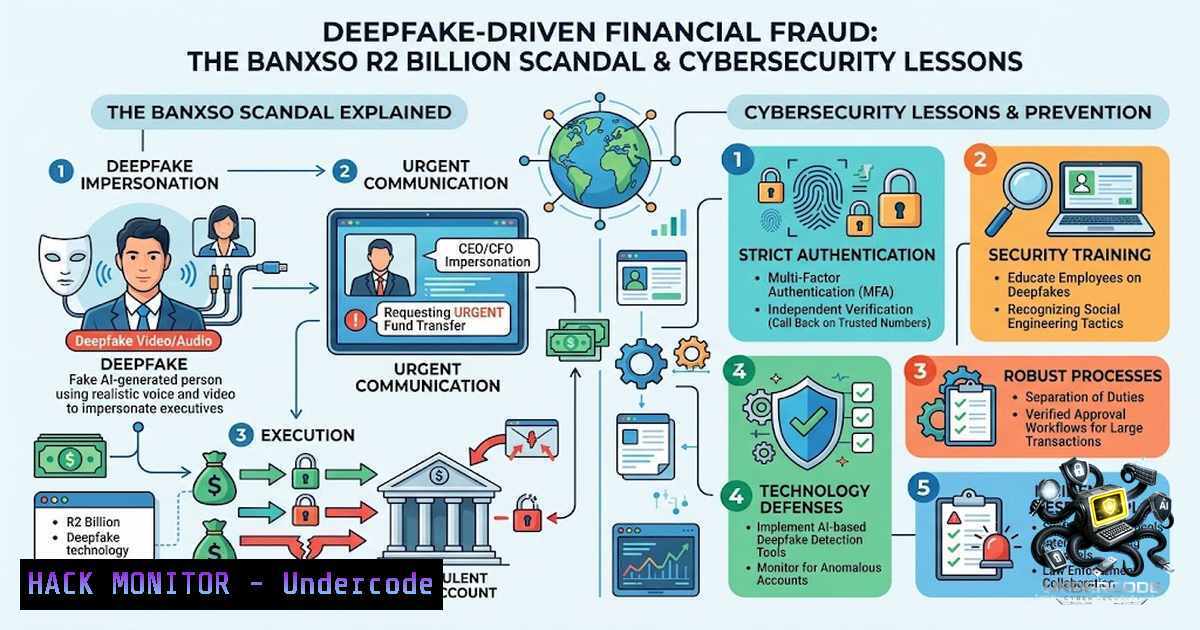
Introduction
The convergence of artificial intelligence and financial crime has reached a new milestone in South Africa, where regulators uncovered a sophisticated deepfake scheme that leveraged AI-generated advertisements featuring Elon Musk and billionaire Johann Rupert to defraud investors of approximately R1 billion ($61.5 million). The Financial Sector Conduct Authority (FSCA) imposed a record R2 billion ($123 million) penalty on trading platform Banxso, withdrew its financial services provider licence, and issued 30-year industry bans against key individuals. This case represents one of the most significant deepfake-enabled financial frauds globally, demonstrating how AI-generated synthetic media can be weaponised to manipulate investor behaviour at scale.
Learning Objectives & Secrets
- Objective 1: Deepfake Detection and Attribution – Learn to identify AI-generated synthetic media through forensic analysis of visual artefacts, audio inconsistencies, and metadata anomalies. Secret tip: analyse micro-expressions and lighting inconsistencies using tools like `ffmpeg` for frame-by-frame extraction and `OpenCV` for pixel-level scrutiny.
-
Objective 2: Financial Fraud Investigation and Transaction Tracing – Master the techniques for tracing commingled funds across accounts using blockchain analytics and traditional banking forensics. Secret tip: leverage `Python` with `pandas` for transaction pattern analysis and utilise OSINT tools to map financial flows across jurisdictions.
-
Objective 3: AI Security and Deepfake Mitigation – Implement defence-in-depth strategies against synthetic media attacks, including content authentication protocols, digital watermarking, and real-time deepfake detection APIs. Secret tip: deploy `Microsoft Video Authenticator` or `Reality Defender` APIs and implement C2PA (Coalition for Content Provenance and Authenticity) standards for content provenance.
You Should Know
- Deepfake Forensics: Detecting AI-Generated Content in Financial Advertisements
The Banxso case relied on deepfake advertisements that convincingly depicted prominent business figures endorsing a fraudulent investment scheme offering returns of up to R300,000 ($18,450) per month from a R4,700 ($289) initial investment. Detecting such synthetic media requires a multi-layered forensic approach.
Step-by-step guide for deepfake detection:
1. Extract and analyse video frames using `ffmpeg`:
ffmpeg -i suspect_video.mp4 -vf "fps=1" frames/frame_%04d.png
- Analyse facial landmarks and inconsistencies with OpenCV and dlib:
import cv2
import dlib
detector = dlib.get_frontal_face_detector()
predictor = dlib.shape_predictor("shape_predictor_68_face_landmarks.dat")
Detect inconsistencies in eye blinking and mouth movements
3. Examine metadata and compression artefacts:
exiftool suspect_video.mp4
ffprobe -v error -show_format -show_streams suspect_video.mp4
- Use deepfake detection APIs (Microsoft Video Authenticator, Reality Defender, or Sentinel):
curl -X POST "https://api.realitydefender.com/v1/detect" \
-H "Authorization: Bearer YOUR_API_KEY" \
-F "media=@suspect_video.mp4"
-
Analyse audio synchronisation – deepfakes often exhibit lip-sync discrepancies:
ffmpeg -i suspect_video.mp4 -vn -acodec pcm_s16le -ar 16000 audio.wav
Use speech-to-text alignment tools to check synchronisation
What this does: These techniques help security professionals and financial institutions verify the authenticity of promotional content before engaging with investment opportunities.
2. Financial Transaction Forensics: Tracing Commingled Funds
Investigators found that client money was allegedly commingled, moved between accounts, and used for personal and business expenses rather than being handled as represented to investors. Tracing such financial flows requires systematic forensic accounting.
Step-by-step guide for transaction tracing:
- Extract and normalise transaction data from bank statements:
import pandas as pd
df = pd.read_csv('transactions.csv')
df['date'] = pd.to_datetime(df['date'])
df_grouped = df.groupby(['account', 'counterparty']).agg({'amount': 'sum'})
2. Identify unusual patterns using anomaly detection:
from sklearn.ensemble import IsolationForest
model = IsolationForest(contamination=0.05)
df['anomaly'] = model.fit_predict(df[['amount', 'frequency']])
- Trace cryptocurrency flows (if applicable) using blockchain explorers:
Use Blockchain.com API for Bitcoin tracing
curl "https://blockchain.info/rawaddr/BITCOIN_ADDRESS"
4. Correlate across accounts to identify commingling patterns:
SELECT t1.account, t1.counterparty, SUM(t1.amount) as total_out
FROM transactions t1
JOIN transactions t2 ON t1.counterparty = t2.account
GROUP BY t1.account, t1.counterparty
HAVING SUM(t1.amount) > 100000;
- Generate forensic audit reports using open-source tools like GRR or The Sleuth Kit for digital forensics integration.
3. Cloud Security Hardening for Financial Platforms
The Banxso case highlights the importance of secure cloud infrastructure in financial services. Platforms handling client funds must implement rigorous security controls.
Step-by-step guide for cloud security hardening:
1. Implement least-privilege access using IAM policies:
{
"Version": "2012-10-17",
"Statement": [
{
"Effect": "Deny",
"Action": "",
"Resource": "",
"Condition": {
"StringNotEquals": {
"aws:PrincipalType": "AWS"
}
}
}
]
}
2. Enable comprehensive logging and monitoring:
 AWS CloudTrail for API logging
aws cloudtrail create-trail --1ame financial-platform-trail --s3-bucket-1ame audit-logs

Azure Monitor for activity logging
az monitor activity-log list --max-events 50
- Deploy Web Application Firewall (WAF) rules to prevent injection and XSS:
AWS WAF configuration aws wafv2 create-web-acl --1ame financial-waf --scope REGIONAL \ --default-action Block={} --rules file://waf-rules.json -
Implement secrets management using HashiCorp Vault or AWS Secrets Manager:
vault kv put secret/financial-api api_key=YOUR_API_KEY
-
Regular security assessments using tools like OWASP ZAP:
zap-cli quick-scan --spider -r http://financial-platform.com
4. API Security and Deepfake Injection Protection
Financial platforms increasingly rely on APIs for client onboarding and transactions. Deepfake-generated identities can be used to bypass KYC/AML controls.
Step-by-step guide for API security:
1. Implement rate limiting to prevent brute-force attacks:
from flask_limiter import Limiter
from flask_limiter.util import get_remote_address
limiter = Limiter(get_remote_address, app=app, default_limits=["100 per hour"])
2. Deploy liveness detection in KYC workflows:
 Use AWS Rekognition for liveness detection
aws rekognition detect-faces --image "{\"S3Object\":{\"Bucket\":\"kyc-images\",\"Name\":\"user_selfie.jpg\"}}"
3. Validate API requests with HMAC signatures:
import hmac
import hashlib
signature = hmac.new(b'secret_key', message, hashlib.sha256).hexdigest()
4. Monitor API anomalies using machine learning:
from pyod.models.iforest import IForest
clf = IForest(contamination=0.1)
clf.fit(api_request_features)
anomalies = clf.predict(api_request_features)
- Implement OAuth 2.0 with PKCE for secure authorisation:
Generate code verifier and challenge
openssl rand -base64 32
5. Vulnerability Exploitation and Mitigation in Financial Systems
The Banxso case demonstrates how social engineering via deepfakes exploits human trust rather than technical vulnerabilities. However, technical controls can mitigate such risks.
Step-by-step guide for mitigation:
1. Deploy content provenance standards using C2PA:
 Sign content with C2PA
c2pa sign image.jpg --cert private_key.pem --output signed_image.jpg
2. Implement real-time fraud detection using behavioural analytics:
from sklearn.ensemble import RandomForestClassifier
model = RandomForestClassifier()
model.fit(X_train, y_train)
fraud_predictions = model.predict(X_test)
3. Conduct red-team exercises simulating deepfake attacks:
 Generate test deepfakes using open-source tools
python run.py --input_dir input_faces --output_dir output_deepfakes --model first_order_model
4. Deploy SIEM solutions for centralised monitoring:
 Elastic Stack for SIEM
docker-compose -f elastic-stack.yml up -d
- Regular security awareness training for staff and clients on deepfake recognition.
6. Windows Forensics for Financial Fraud Investigation
For Windows-based financial systems, forensic acquisition and analysis are critical.
Step-by-step guide for Windows forensics:
- Acquire forensic images using FTK Imager or DD:
ftkimager.exe source_drive: destination_image.E01
2. Analyse event logs for suspicious activity:
Get-WinEvent -LogName Security | Where-Object { $<em>.Id -eq 4624 -or $</em>.Id -eq 4625 }
3. Examine browser history for deepfake advertisement clicks:
Get-ChildItem -Path "$env:USERPROFILE\AppData\Local\Google\Chrome\User Data\Default\History" | ForEach-Object { Invoke-SqliteQuery -Query "SELECT FROM urls" -Database $_.FullName }
4. Analyse network connections:
netstat -anb > network_connections.txt
5. Recover deleted files using Recuva or PhotoRec.
7. Linux Forensics and Deepfake Detection
For Linux-based infrastructure, forensic tools provide powerful capabilities.
Step-by-step guide for Linux forensics:
1. Create disk images using DD:
dd if=/dev/sda of=/mnt/forensics/disk_image.dd bs=4M status=progress
2. Analyse system logs:
journalctl --since "2024-01-01" --until "2024-12-31" > system_logs.txt
3. Examine authentication logs:
cat /var/log/auth.log | grep "Failed password"
4. Use Autopsy for comprehensive analysis:
autopsy -p 9999 /mnt/forensics/disk_image.dd
5. Analyse network traffic with tcpdump and Wireshark:
tcpdump -i eth0 -w capture.pcap
What Undercode Say:
- Key Takeaway 1: The Banxso case demonstrates that deepfake technology has evolved from a novelty into a sophisticated weapon for financial crime, capable of manipulating investor behaviour at scale. The R1 billion ($61.5 million) in misappropriated funds represents just the tip of the iceberg.
-
Key Takeaway 2: Regulatory frameworks must evolve to address AI-generated fraud. The FSCA’s record R2 billion penalty and 30-year industry bans send a strong signal, but proactive detection and prevention mechanisms are equally critical.
Analysis: The Banxso deepfake scandal exposes a critical vulnerability in the financial services industry: the trust economy that underpins investment decisions can be systematically exploited through synthetic media. When AI-generated content featuring respected business figures is deployed at scale, traditional due diligence becomes insufficient. The case also reveals how licensed financial services providers can be infiltrated by criminal syndicates. Financial institutions must now treat deepfake detection as a core security function, alongside traditional fraud prevention measures. The use of commingled funds and movement between accounts highlights the need for enhanced transaction monitoring and real-time anomaly detection. As AI generation tools become more accessible and sophisticated, the financial sector faces an existential challenge: how to maintain trust in digital communications when any piece of content can be synthetically manufactured.
Prediction:
- +1: This case will accelerate global regulatory action on AI-generated content in financial services, with other jurisdictions likely to adopt similar enforcement frameworks and potentially mandate content provenance standards.
-
+1: The development of deepfake detection technologies will receive significant investment, creating a new cybersecurity sub-sector focused on synthetic media defence.
-
-1: Deepfake-enabled fraud will proliferate as AI generation tools become more accessible and convincing, with smaller financial institutions particularly vulnerable due to limited detection capabilities.
-
-1: Consumer trust in digital financial advertisements may erode significantly, potentially slowing the adoption of legitimate fintech innovations and increasing friction in digital customer acquisition.
-
+1: The FSCA’s aggressive enforcement action establishes a precedent for regulatory intervention that may deter similar schemes, though the effectiveness will depend on cross-border cooperation given the global nature of such frauds.
-
-1: Criminal syndicates will increasingly target licensed financial services providers as vehicles for fraud, exploiting regulatory frameworks designed for legitimate operators.
-
+1: This case will drive the adoption of content authentication standards like C2PA, creating a technical foundation for verifying the provenance of digital content.
-
-1: The cost of compliance for financial institutions will increase significantly as deepfake detection and content verification become regulatory requirements, potentially creating barriers to entry for smaller players.
-
+1: Public awareness of deepfake risks will increase, potentially making investors more sceptical and cautious, which could reduce the effectiveness of similar schemes in the future.
-
-1: The Banxso case demonstrates that even after detection and enforcement, recovery of misappropriated funds remains challenging, highlighting the need for preventive rather than reactive measures.
▶️ Related Video (86% Match):
https://www.youtube.com/watch?v=-6ipneuJlpA
🎯Let’s Practice For Free:
🎓 Live Courses & Certifications:
Join Undercode Academy for Verified Certifications
🚀 Request a Custom Project:
Secure, high-velocity infrastructure and disruptive technological engineering. Contact our engineering team for high-tier development and proprietary systems:
[email protected]
💎 Smart Architecture | 🛡️ Secure by Design | ⭐ Trusted by Thousands
IT/Security Reporter URL:
Reported By: https://lnkd.in/p/eYd_jwRV – Hackers Feeds
Extra Hub: Undercode MoN
Basic Verification: Pass ✅


