
Listen to this Post
Introduction:
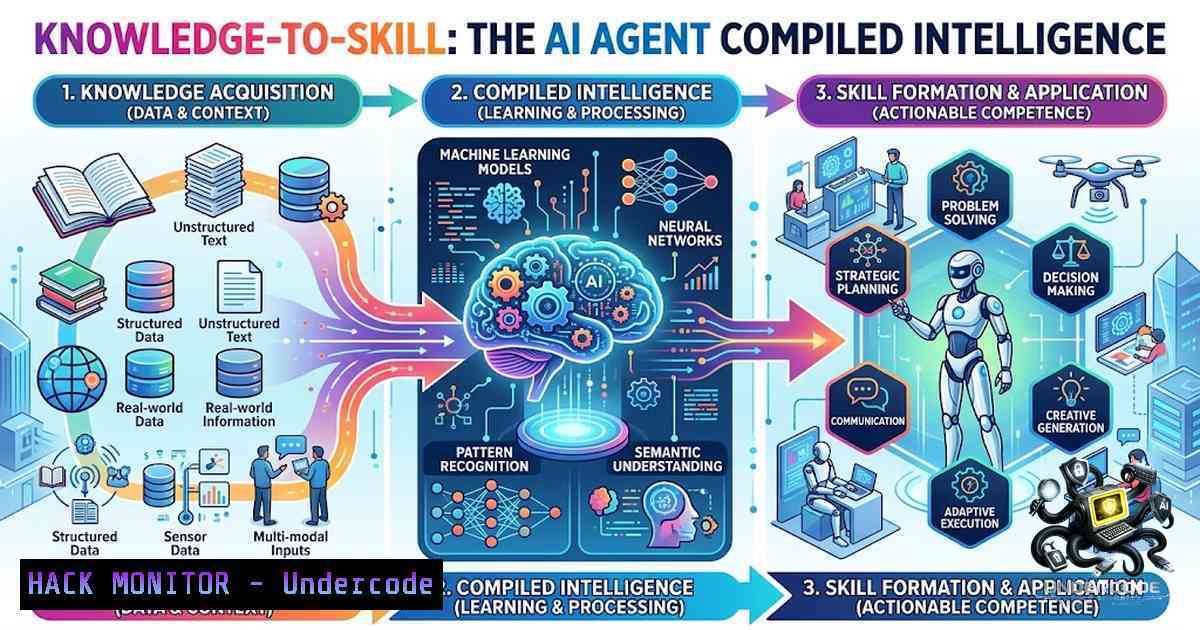
The traditional approach to leveraging vast knowledge bases—whether books, documentation, or research papers—with Artificial Intelligence involves a brute-force method: stuffing entire documents into a context window. This “context dump” is computationally expensive, often inefficient, and fails to capture the underlying structure of knowledge. A paradigm shift is occurring with projects like “book-to-skill,” which compiles information into a structured, modular format that AI Agents can dynamically query, effectively “installing” knowledge as a deployable skill rather than just referencing it as raw text.
Learning Objectives & Secrets:
- Objective 1: Master the Architecture of Skill Compilation – Learn how to transform unstructured text (books, PDFs, documentation) into a structured JSON/YAML-based Skill package containing Mental Models, Decision Rules, and Cheatsheets for efficient Agent retrieval.
- Objective 2: Optimize Token Efficiency through Structured Retrieval – Secret Tip: Implement a two-tier retrieval system where the Agent first queries a lightweight index (~4K tokens) to identify the relevant “Chapter” or “Rule,” and then loads only that specific micro-context (~1K tokens) to generate a response, achieving a 24-51x reduction in token usage.
- Objective 3: Build a Dynamic Knowledge Injection Pipeline – Secret Tip: Set up a CI/CD pipeline that “folds-in” new data (e.g., new API specs or recent research papers) into the existing Skill without rebuilding the entire index, ensuring the Agent’s knowledge remains current without exponential cost growth.
You Should Know:
1. Setting Up the Book-to-Skill Compiler
This is a Python-based tool that parses text, identifies key concepts, and generates a structured “Skill” directory.
- Step-by-step guide:
- Clone the repository: `git clone https://github.com/your-repo/book-to-skill.git`
2. Install dependencies: `pip install -r requirements.txt`. (Ensure `spacy` or `nltk` are available for NLP parsing). - Prepare your source text (e.g., `naval_manuscript.txt` or a directory of Markdown files).
- Run the compiler: `python compile.py –input path/to/source.txt –output ./skills/naval_skill/ –type book`
5. What it does: The script identifies chapters, extracts glossary terms, builds a decision matrix, and creates a `skill.json` manifest. - Verify the output: Check the `skills/naval_skill/` directory for
mental_models.json,glossary.json, andpatterns.json.
2. Configuring the Skill for Claude Code/Codex
Once compiled, the Skill must be configured so the Agent loads it on-demand.
- Step-by-step guide:
- Locate the Agent’s configuration directory (e.g., `~/.claude/` or
~/.codex/skills/). - Copy the compiled Skill folder: `cp -r ./skills/naval_skill/ ~/.claude/skills/`
3. Edit the `config.yaml` to register the skill.
4. Configuration Example:
- name: "Naval_Philosophy"
path: "~/.claude/skills/naval_skill/skill.json"
trigger_keywords: ["Naval", "philosophy", "decision-making", "venture"]
pre_load: true  Ensures the index is ready
5. Testing: Prompt the Agent: “Using the Naval philosophy skill, analyze this startup idea.” The Agent will now reference the indexed principles without loading the entire PDF.
3. API Security and Cost Management
Implementing this methodology directly impacts API costs and security posture.
- Step-by-step guide:
- Monitor Costs: Use `pricing_calculator.py` (provided in the repo) to estimate cost savings. Input your current token usage and compare.
- Security Hardening: Ensure the `skill.json` does not contain sensitive raw data. Use a hashing function to verify the integrity of the Skill before loading.
- Linux Command for Log Analysis: `grep “total_tokens” /var/log/agent_requests.log | awk ‘{sum+=$3} END {print sum/NR}’` to calculate average token usage and validate the reduction.
- Mitigation: If a Skill becomes corrupted, the Agent fails gracefully rather than hallucinating, because the retrieval function checks for the existence of the requested chapter before generating a response.
-
Extending to Documentation: Brand Voice & Engineering Skills
The “Knowledge-to-Skill” principle applies to corporate data.
- Step-by-step guide:
- Company Docs: Structure your `docs/` folder with a `manifest.md` outlining the hierarchy (e.g., `Brand Book` ->
Tone,Mission). - Compile: Run the compiler with the `–type corporate` flag to generate specific decision rules for branding.
- Integrate: For Engineering Skills (RFCs/API Specs), use the `–type engineering` flag. The compiler will extract API endpoints, parameters, and error codes into a structured JSON.
- Query Example: “What is the error code for rate limiting based on our RFC spec?” The Agent reads only the `api_spec.json` snippet rather than the whole 50-page document.
5. The “Fold-in” Process for Continuous Learning
This allows the Skill to evolve with new data without starting from scratch.
- Step-by-step guide:
1. Receive new data (e.g., `new_research.pdf`).
- Run the differential compiler: `python compile.py –input new_research.pdf –output ./skills/naval_skill/ –update –merge`
3. Linux Command: `diff old_glossary.json new_glossary.json` to review changes before pushing. - Windows Command (PowerShell): `Compare-Object (Get-Content old_glossary.json) (Get-Content new_glossary.json)`
5. Result: The Agent updates its internal representation, allowing it to answer questions referencing both the old book and the new paper without a complete rebuild.
6. Advanced Configuration: Anti-Patterns and Decision Rules
The tool specifically extracts “Anti-patterns” which are crucial for risk mitigation.
- Step-by-step guide:
- Locate the `anti_patterns.json` generated in your Skill folder.
- Example entry: `{“pattern”: “Over-reliance on fundraising”, “context”: “Naval’s criticism of growth-at-all-costs”, “mitigation”: “Focus on unit economics”}`
3. Configuration: Modify the Agent’s prompt to include: “Before providing advice, check the anti-patterns list.” - Test: Run `python test_skill.py –skill naval_skill –question “Should I raise a series A now?”` The Agent will respond with the anti-pattern warning and cite Naval’s philosophy.
What Undercode Say:
- Key Takeaway 1: The shift from “Context Dump” to “Structured Skill” is not just a technical optimization; it represents a fundamental change in how we interface with information. We are moving from “searching” for answers to “installing” reasoning frameworks directly into the Agent’s logic.
- Key Takeaway 2: The dramatic reduction in Token usage (24-51x) validates the economic viability of Agent-based workflows. This makes “RAG” (Retrieval-Augmented Generation) practical at scale, allowing complex queries to cost pennies rather than dollars, unlocking enterprise-level adoption.
Analysis: This approach solves the critical “knowledge fragmentation” problem in AI. Currently, AI sees a book as a string of text; this compiles it into a relational database of ideas. The ability to “fold-in” new data ensures the Skill acts as a living document. The biggest challenge will be the “cold start” problem—compiling the initial Skill requires significant upfront computational processing for NLP. However, this is a one-time cost that pays for itself extremely quickly in reduced latency and API fees.
Prediction:
- +1 We will see a rise in “Skill Marketplaces” where experts sell compiled versions of their knowledge (e.g., “Warren Buffett’s Investing Skill”), creating a new economy around intellectual property delivery.
- +1 Companies will shift internal documentation strategies, moving from static wikis to dynamically compiled “Company Skills” that agents use for onboarding and operational support.
- -1 The risk of “Skill Lock-in” increases; if a compiled Skill contains subtle biases from the source material, those biases are replicated persistently without the easy identification that comes from reading the raw text, potentially amplifying systemic errors.
▶️ Related Video (96% Match):
🎯Let’s Practice For Free:
🎓 Live Courses & Certifications:
Join Undercode Academy for Verified Certifications
🚀 Request a Custom Project:
Secure, high-velocity infrastructure and disruptive technological engineering. Contact our engineering team for high-tier development and proprietary systems:
[email protected]
💎 Smart Architecture | 🛡️ Secure by Design | ⭐ Trusted by Thousands
IT/Security Reporter URL:
Reported By: https://lnkd.in/p/eCKJY8zX – Hackers Feeds
Extra Hub: Undercode MoN
Basic Verification: Pass ✅


