
Listen to this Post
Introduction:
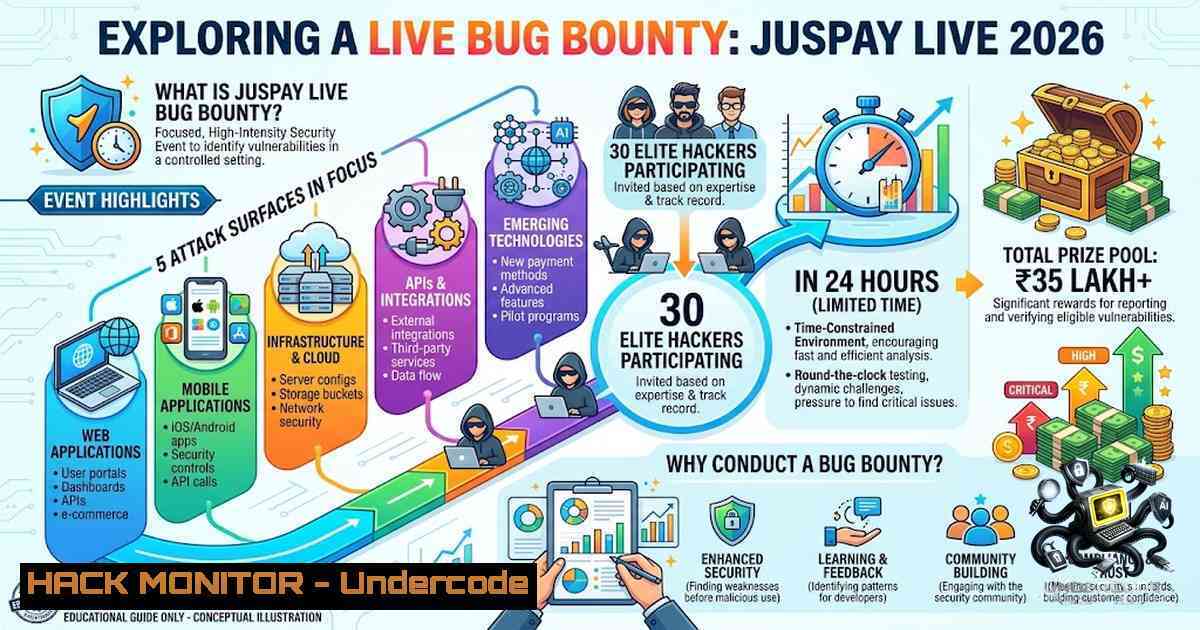
On September 12–13, 2026, Juspay is hosting a 24-hour on-site live bug bounty event at its Bengaluru headquarters, bringing together 30 curated security researchers to attack a live production-grade payment target across five critical surfaces: Web, APIs, iOS, Android, and Agentic AI.With a total bounty pool of ₹3,50,000 and real-time triage on the floor, this event represents a significant shift in how security research is conducted—moving beyond traditional CTF-style competitions and into high-stakes, real-world adversarial testing against modern fintech infrastructure.The inclusion of Agentic AI as an attack surface signals the industry’s growing recognition that AI-driven systems introduce entirely new classes of vulnerabilities that demand dedicated security research.
Learning Objectives & Secrets:
- Objective 1: Master Multi-Surface Reconnaissance — Learn to systematically discover and map attack surfaces across web applications, REST/GraphQL APIs, iOS and Android mobile apps, and AI agent interfaces. Effective bug hunting in 2026 requires testing across platforms holistically, not just focusing on a single surface.
-
Objective 2 Secret: API Endpoint Discovery Through Mobile Traffic Interception — Install the target’s mobile app on a rooted Android device or emulator, configure it to proxy through Burp Suite, and walk through every feature to uncover undocumented API endpoints.Mobile apps often expose APIs that aren’t documented in public developer portals—these are prime targets for IDOR, BOLA, and authorization bypass vulnerabilities.
-
Objective 3 Secret: Agentic AI Prompt Injection & Tool Abuse — Agentic AI systems are vulnerable to multi-turn prompt injection attacks that can cause the agent to execute unintended tool calls or leak sensitive context.Test for OWASP Top 10 for Agentic Applications (ASI) controls using frameworks like AASTF, which watches every tool call, planning iteration, and delegation to test whether your agent system resists attacks.
You Should Know:
- Web Application Attack Surface — Beyond OWASP Top 10
Modern web application security testing in 2026 requires both manual and automated methods to identify weaknesses across the application’s code, architecture, integrations, and runtime behavior.While the OWASP Web Security Testing Guide (WSTG) remains the reference architecture most AppSec programs build on, automated penetration testing has evolved from basic vulnerability scanning to the deployment of autonomous security agents that follow a four-stage cycle: Crawl, Reason, Exploit, and Report.
Step-by-Step Guide for Web Testing:
- Reconnaissance: Map subdomains, perform DNS enumeration, and use Shodan/Censys to discover exposed assets.
- Crawling & Spidering: Use Burp Suite or OWASP ZAP to crawl the application and map all accessible endpoints.
- Parameter Analysis: Identify all input parameters (GET/POST, headers, cookies) and test for injection vulnerabilities.
- Authentication & Session Testing: Test for session fixation, weak session tokens, and broken authentication mechanisms.
- Authorization Testing: Check for IDOR, privilege escalation, and horizontal/vertical access control bypasses.
- Business Logic Flaws: Manually test workflows for logic errors that automated scanners miss.
Linux Command Examples:
 Subdomain enumeration
subfinder -d target.com -o subdomains.txt
 Live host discovery
httpx -l subdomains.txt -o live_hosts.txt
 Directory brute-forcing
gobuster dir -u https://target.com -w /usr/share/wordlists/dirbuster/directory-list-2.3-medium.txt
 Parameter discovery
ffuf -u https://target.com/FUZZ -w /usr/share/wordlists/param.txt
2. API Security — The New Frontline
Over 60% of data breaches in 2025 involved API exploitation.API security testing must cover every exposed endpoint—not just the ones in your public API documentation.The OWASP API Security Top 10 provides a framework for the most critical API risks, including Broken Object Level Authorization (BOLA), Broken Authentication, and Excessive Data Exposure.
Step-by-Step Guide for API Testing:
- Endpoint Discovery: Use Burp Suite to intercept traffic from the web app and mobile app to identify all API calls.
- Schema Analysis: If OpenAPI/Swagger documentation is available, import it into Postman or Burp for structured testing.
- Authentication Testing: Verify that API keys, JWT tokens, and OAuth flows are properly validated and not reusable.
- Authorization Testing: Change user IDs in API requests to test for BOLA/BFLA vulnerabilities.
- Rate Limiting: Verify that rate limits are enforced consistently across all endpoints to prevent brute-force attacks.
- Injection Testing: Test for SQL injection, NoSQL injection, and command injection in API parameters.
- Data Exposure: Check API responses for excessive data exposure—sensitive fields that should not be returned to the client.
Windows Command Examples (using PowerShell):
 Basic API endpoint testing with Invoke-RestMethod
Invoke-RestMethod -Uri "https://api.target.com/v1/users/123" -Headers @{"Authorization"="Bearer $token"}
 Fuzzing with Burp Suite CLI (on Windows)
java -jar burpsuite.jar --project-file=api_test.burp
3. iOS Application Security — Bypassing Apple’s Protections
iOS pentesting in 2026 requires a methodical approach: extract the decrypted IPA, perform static analysis, and conduct runtime testing with Frida.App Store apps are encrypted with FairPlay DRM, so you’ll need a jailbroken device and `frida-ios-dump` to extract the decrypted binary.
Step-by-Step Guide for iOS Testing:
- Environment Setup: Jailbreak an iOS device (test on current and previous iOS versions) and install Frida.
- IPA Extraction: Use `frida-ios-dump` on the jailbroken device to extract the decrypted IPA.
- Static Analysis: Decompile the IPA using Hopper or Ghidra to review binary security controls.
- Network Interception: Configure Burp Suite as a proxy on the device (Settings → Wi-Fi → Configure Proxy).
- SSL Pinning Bypass: Use Frida scripts (e.g.,
ios-ssl-bypass.js) to bypass certificate pinning. - Runtime Analysis: Use Objection (built on Frida) for runtime exploration—it provides powerful features for iOS testing.
- Keychain & Data Storage: Test for insecure storage of sensitive data in Keychain, UserDefaults, and Plist files.
Frida Script Example (SSL Pinning Bypass):
// Save as ios-ssl-bypass.js
ObjC.schedule(ObjC.mainQueue, function() {
var NSURLRequest = ObjC.classes.NSURLRequest;
var describe = ObjC.classes.NSURLRequest['+ allowsAnyHTTPSCertificateForHost:'];
var hook = ObjC.classes.NSURLRequest['+ allowsAnyHTTPSCertificateForHost:'];
Interceptor.attach(hook.implementation, {
onLeave: function(retval) {
retval.replace(ptr(1));
}
});
});
// Run with: frida -U -f com.target.app -l ios-ssl-bypass.js
- Android Application Security — Root Detection & Component Analysis
Android security testing should emphasize exported components, intent filter security, content provider permissions, and WebView configuration.ADB is the primary tool for communicating with Android devices (physical or emulated).
Step-by-Step Guide for Android Testing:
- APK Extraction: Use `adb shell pm list packages` to list installed packages, then extract the APK.
- Static Analysis: Decompile the APK using JADX or APKTool to analyze source code and check for hardcoded secrets.
- Manifest Analysis: Review AndroidManifest.xml for exported components, permissions, and intent filters.
- Root Detection Bypass: Use Magisk Hide or Frida scripts to bypass root detection controls.
- Network Interception: Configure the device to proxy through Burp Suite and install Burp’s CA certificate.
- Runtime Analysis: Use Frida and Objection for dynamic analysis and method tracing.
- WebView Testing: Check for JavaScript interface exposure and improper WebView configuration.
ADB Commands for Android Testing:
 List all installed packages
adb shell pm list packages | grep target
 Extract APK
adb shell pm path com.target.app
adb pull /data/app/com.target.app-/base.apk target.apk
 Install APK with debugging enabled
adb install -d target.apk
 Forward ports for debugging
adb forward tcp:8080 tcp:8080
- Agentic AI Security — The New Attack Surface
Agentic AI security testing follows a systematic, scenario-based, multi-turn adversarial testing cycle: “Reconnaissance → Modeling → Layered Attack → Validation → Report → Hardening → Retest.”This differs from traditional security red teaming by emphasizing agent autonomy, context dependency, tool permissions, and memory characteristics.
Step-by-Step Guide for Agentic AI Testing:
- Reconnaissance: Map the agent’s capabilities—what tools can it call? What data can it access? What are its system prompts?
- Prompt Injection Testing: Craft multi-turn prompts designed to override system instructions and cause the agent to reveal sensitive information or execute unauthorized actions.
- Tool Abuse Testing: Test whether the agent can be tricked into calling tools with malicious parameters.
- Context Leakage: Test whether the agent inadvertently reveals sensitive information from previous turns or system context.
- Adversarial Input: Use frameworks like `agent-redteam` which systematically runs 2,304 test cases across 13 test suites to output concrete pass/fail scores.
- Multi-Agent Coordination: If the system uses multiple agents, test for cross-agent information leaks and privilege escalation.
- Compliance Validation: Use frameworks aligned with OWASP LLM Top 10 2025 and OWASP Agentic Top 10 2026.
Python Example for Agentic AI Testing (using agent-redteam):
 Install: pip install agent-redteam
from agent_redteam import RedTeam, TestSuite

Initialize red team with your agent's endpoint
redteam = RedTeam(
agent_endpoint="https://your-agent-api.com/chat",
test_suites=[
TestSuite.INJECTION,
TestSuite.TOOL_ABUSE,
TestSuite.CONTEXT_LEAKAGE
]
)

Run comprehensive tests
results = redteam.run()
print(f"Pass: {results.pass_count}, Fail: {results.fail_count}")
- Live Bug Bounty Methodology — Recon to Report
Modern bug bounty programs in 2026 assess not just vulnerability discovery but the ability to test across platforms holistically and understand platform-specific risks.
Step-by-Step Live Bug Bounty Workflow:
- Pre-Event Preparation: Research the target’s tech stack, review public bug reports, and prepare your toolkit.
- Reconnaissance (First 2-3 Hours): Map subdomains, enumerate API endpoints through web and mobile apps, and identify all attack surfaces.
- Automated Scanning: Run automated scanners (ZAP, Nuclei, Burp) in the background while conducting manual testing.
- Manual Deep-Dive: Focus on business logic flaws, authorization bypasses, and complex vulnerabilities that automated tools miss.
- Exploit Development: Create proof-of-concept exploits for validated vulnerabilities.
- Report Writing: Document findings with clear reproduction steps, impact assessment, and recommended fixes.
- Real-Time Submission: Submit reports as they’re discovered—triagers review and reward valid findings on the spot.
What Undercode Say:
- Key Takeaway 1: The inclusion of Agentic AI as an attack surface is a watershed moment for security research. Traditional web and mobile testing methodologies are insufficient for AI-driven systems—you need dedicated frameworks that test for prompt injection, tool abuse, and multi-turn adversarial scenarios. Security researchers who develop skills in AI red teaming will be in high demand as more organizations deploy agentic systems.
-
Key Takeaway 2: The 24-hour live format with real-time triage represents the evolution of bug bounty programs from asynchronous, remote submissions to high-intensity, in-person adversarial events. This model accelerates the discovery-to-fix cycle and fosters collaboration among top researchers. The curated, invitation-only approach ensures quality over quantity, with only 30 hackers selected from the applicant pool.
Analysis: Juspay’s live bug bounty event signals a broader industry trend toward immersive, high-stakes security testing. By moving beyond traditional web testing into mobile and AI surfaces, the company is acknowledging that modern fintech infrastructure is a complex, multi-layered system requiring specialized skills across multiple domains. The event’s structure—24 hours, on-site, with real-time rewards—mirrors the intensity of real-world attack scenarios and prepares both researchers and organizations for the evolving threat landscape.
For aspiring bug bounty hunters, this event highlights the critical need to develop skills across all five attack surfaces. Web and API testing remain foundational, but mobile and AI security are rapidly becoming differentiators. The curated selection process favors researchers with public, reproducible impact—meaning a strong portfolio of disclosed vulnerabilities is essential.
Prediction:
- +1 This event will set a new benchmark for corporate bug bounty programs in India and across Asia, encouraging other fintech companies to adopt similar live, multi-surface testing formats. The real-time triage and reward model will accelerate vulnerability remediation cycles and attract top-tier security talent.
-
+1 The focus on Agentic AI security will accelerate the development of standardized testing frameworks and certifications for AI red teaming. As more organizations deploy AI agents, the demand for specialized security researchers in this domain will grow exponentially.
-
-1 The 30-hacker cap and curated selection process may exclude talented researchers without established public profiles, potentially missing critical vulnerabilities that could be discovered by fresh perspectives. The event’s success will depend heavily on the quality of the selected researchers.
-
+1 The live, in-person format fosters knowledge sharing and collaboration among researchers, creating a network effect that benefits the entire security community. The meals, workstations, and 24-hour environmentcreate an immersive experience that can’t be replicated remotely.
-
-1 The ₹3,50,000 prize pool, while substantial, may not be competitive with top-tier international bug bounty programs, potentially limiting participation from elite global researchers who command higher payouts elsewhere. However, the prestige and networking opportunities may compensate for the financial aspect.
▶️ Related Video (78% Match):
https://www.youtube.com/watch?v=1AA88AioyBs
🎯Let’s Practice For Free:
🎓 Live Courses & Certifications:
Join Undercode Academy for Verified Certifications
🚀 Request a Custom Project:
Secure, high-velocity infrastructure and disruptive technological engineering. Contact our engineering team for high-tier development and proprietary systems:
[email protected]
💎 Smart Architecture | 🛡️ Secure by Design | ⭐ Trusted by Thousands
IT/Security Reporter URL:
Reported By: https://lnkd.in/p/eqWn4PtP – Hackers Feeds
Extra Hub: Undercode MoN
Basic Verification: Pass ✅


