Listen to this Post
Introduction:
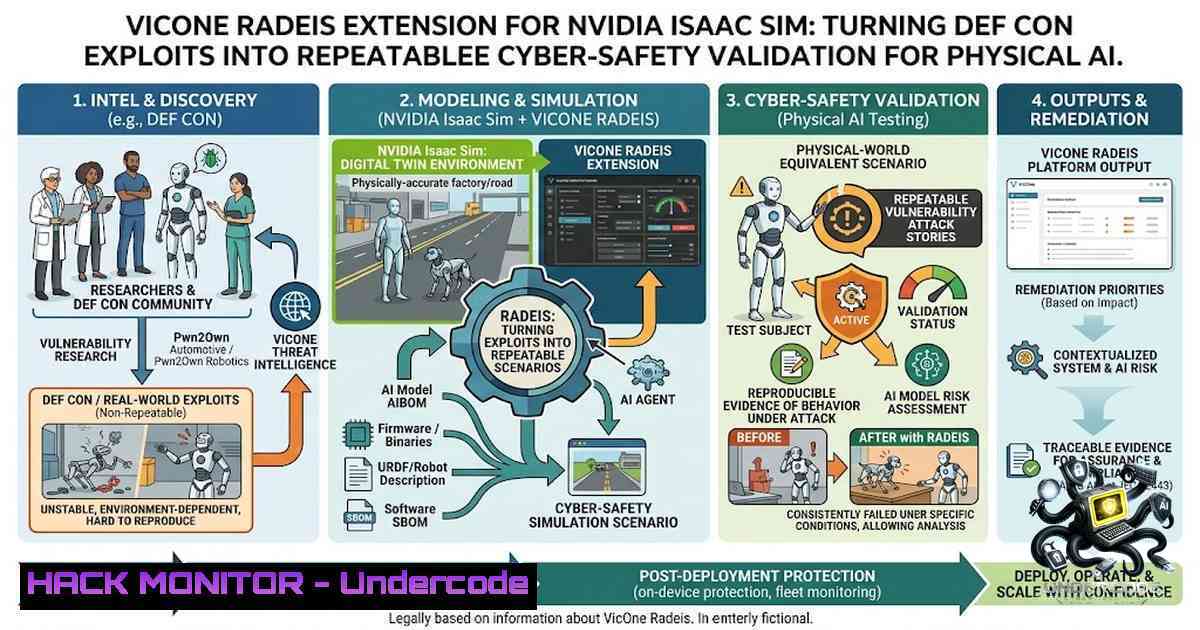
As AI-driven robots transition from controlled pilot deployments to real-world critical missions—operating alongside humans, infrastructure, and sensitive assets—the attack surface expands dramatically across perception layers, AI models, cloud APIs, and embedded firmware. The industry now faces a fundamental distinction: validating that a robot functions as designed is insufficient; it must remain reliable when the digital systems it depends on are compromised. VicOne’s newly released free Radeis Extension for NVIDIA Isaac Sim, born from DEF CON 34’s Robotic Hacking Community CTF, addresses this gap by enabling robotics teams to bring their own robot models into simulation and test whether cyberattacks—manipulated visual inputs, hijacked commands, poisoned AI policies, or exploited interfaces—actually change physical robot behavior before any hardware is exposed.
Learning Objectives:
- Understand the multi-layer attack surface of Physical AI systems, including perception, AI models, cloud/API services, robotics communications, and embedded firmware.
- Learn to deploy and configure the VicOne Radeis Extension within NVIDIA Isaac Sim to run curated cyber-safety attack scenarios against custom robot models.
- Master the methodology for validating cyber-to-physical risk—from vulnerability identification to behavioral impact observation—using simulation-based testing.
You Should Know:
- The DEF CON 34 Foundation: From CTF Exploits to Repeatable Test Scenarios
At DEF CON 34’s Robotic Hacking Community, VicOne ran a Physical AI Safety Stress Test CTF where 16 teams recorded 25 successful solves across attack paths targeting AI models, perception systems, cloud/API services, robotics communications, and embedded systems. Nearly every core challenge was solved at least once; only one advanced embedded-systems challenge involving cryptography and firmware vulnerabilities remained unsolved. Crucially, the results demonstrated that behavior-changing risks can emerge across multiple layers of the robot stack, reinforcing the need for system-level cybersecurity evaluation rather than isolated vulnerability assessments.
VicOne is now translating these findings—including both successful attack paths and unsuccessful attempts that exposed attacker assumptions—into structured, repeatable simulation scenarios. The free Radeis Extension lets developers apply these scenarios to their own robot models within NVIDIA Isaac Sim, observing whether the robot deviates from its intended task, operating boundaries, or expected response.
Step-by-Step Guide: Setting Up the VicOne Radeis Extension
- Verify System Requirements: Ensure your environment runs Ubuntu 22.04/24.04 with an NVIDIA GPU (GeForce RTX 4080 or higher recommended). Install NVIDIA Isaac Sim from the NVIDIA Omniverse launcher.
-
Download the Extension: Obtain the free VicOne Radeis Extension from the official GitHub repository: `https://github.com/VicOne-OSS-TW/labr7-radeis-InSimPhysicalAI`.
3. Install the Extension in Isaac Sim:
- Launch NVIDIA Isaac Sim.
- Navigate to `Window` → `Extensions` to open the Extension Manager.
- Click the gear icon (settings) and select
Install Extension from Path. - Browse to the downloaded extension directory and select it.
- Enable the extension by searching for “Radeis” in the Extension Manager and toggling it on.
-
Import Your Robot Model: Bring your own robot model into Isaac Sim by ingesting data from CAD, URDF (Unified Robot Description Format), or real-world captures via NVIDIA Omniverse NuRec. Assemble the simulation scene by assigning materials, enabling physics, and configuring robot and sensor models.
-
Apply Curated Attack Scenarios: Using the Radeis Extension interface, select from curated cyber-safety scenarios informed by VicOne’s DEF CON research—including manipulated visual inputs, hijacked commands, poisoned AI policies, and exploited connected interfaces.
-
Observe and Validate Behavior: Run the simulation and monitor whether the robot deviates from its intended task, operating boundaries, or expected response. Repeat tests as models, software, sensors, communications, and control paths evolve over time.
-
Understanding the Attack Surface: Where Cyber Risks Become Physical
The Radeis Extension targets four primary attack vectors that can transition digital compromise into physical robot misbehavior:
- Manipulated Input: Spoofed sensor, vision, or voice data changes what the robot perceives. For example, adversarial visual prompts can cause a Vision-Language Model (VLM) to misclassify obstacles or instructions.
-
Compromised AI Model or Software: Tampered models, firmware, or middleware alter how the robot interprets inputs and makes decisions. This includes poisoning AI policies during training or injecting malicious code into firmware binaries.
-
Compromised Command: Unauthorized or altered commands trigger the wrong movement, route, or task. A real-world example from August 2025 involved an authorization vulnerability in Pudu Robotics’ management platform that allowed authenticated attackers to view deployed units, modify settings, and create, cancel, or redirect tasks—potentially disrupting robot-assisted deliveries.
-
Exploited Connected Interfaces: Weaknesses in cloud APIs, robotics communications protocols, or backend management systems can provide entry points for attackers to inject malicious payloads or hijack control.
Linux Command Example: Analyzing Robot URDF and Firmware for Vulnerabilities
While the Radeis platform automates much of this analysis, security teams can perform preliminary assessments using Linux tools:
 Extract and analyze URDF files for insecure configurations
urdf_check my_robot.urdf

Scan firmware binaries for known vulnerabilities using Firmware Analysis Toolkit
./firmware-mod-kit/extract-firmware.sh my_robot_firmware.bin
binwalk -e my_robot_firmware.bin

Check for hardcoded credentials or API keys in the extracted filesystem
grep -r "password|api_key|secret" ./extracted_firmware/

Validate SBOM (Software Bill of Materials) integrity
cyclonedx-cli validate --input-file sbom.json
- The Radeis Platform: From Free Extension to Enterprise-Grade Validation
VicOne frames the free Radeis Extension as a practical starting point for exploring cyber-to-physical risk. For organizations requiring broader assessment, the full Radeis platform offers a comprehensive pre-deployment cyber-safety validation solution.
The full platform combines AI-agent analysis, attack-driven simulation, and continuous reassessment to validate robot behavior and keep cyber-safety evidence current as risks evolve. Key capabilities include:
- Component & System Risk Assessment: Analyzes software, firmware, dependencies, and configurations for vulnerabilities, including zero-day and unpatched risks.
-
AI Model Risk Assessment: Evaluates AI models and AIBOMs for integrity, provenance, and resilience through red-teaming exercises.
-
Physical AI Safety Validation: Runs the integrated robot software and AI models against curated attack stories to expose whether cyberattacks could trigger unsafe or unintended behavior.
-
Compliance Readiness: Builds traceable evidence aligned with the EU Cyber Resilience Act, EU AI Act, IEC 62443, and China’s GB/T 45502-2025.
Windows Command Example: Network and API Security Assessment
For robotics teams working in Windows environments, preliminary network and API security checks can be performed using:
 Test API endpoint security using Invoke-WebRequest
$headers = @{"Authorization" = "Bearer YOUR_TOKEN"}
try {
Invoke-WebRequest -Uri "https://api.robot-cloud.com/v1/status" -Headers $headers -Method GET
} catch {
Write-Host "API endpoint may be vulnerable or misconfigured: $_"
}

Scan for open ports on robot communication interfaces
Test-1etConnection -ComputerName 192.168.1.100 -Port 22
Test-1etConnection -ComputerName 192.168.1.100 -Port 80
Test-1etConnection -ComputerName 192.168.1.100 -Port 443

Check for default credentials in robot management interfaces (example - DO NOT USE IN PRODUCTION)
 Use with caution and only on authorized test environments
4. Integrating Cyber-Safety into the Robotics Development Lifecycle
VicOne’s approach aligns with emerging regulatory frameworks and industry best practices. China’s GB/T 45502-2025, effective October 1, 2025, establishes information security requirements for service robots covering the host system, operating terminal, and backend management system. The standard defines five protection levels, from basic interface and data protection (L1) to advanced, multilayer, robot-specific protections (L5).
Similarly, the collaboration between VicOne and California Robotics demonstrates how cybersecurity must be integrated across the full lifecycle—from pre-deployment risk assessment and simulation-based validation to runtime guardrails, anomaly detection, and continuous monitoring via Security Operations Centers (R-SOC).
Step-by-Step Guide: Validating Vision-Language Model (VLM) Resilience
- Load Your VLM: Within Isaac Sim, load your robot’s Vision-Language Model using the Radeis Extension’s AI model integration.
-
Select Adversarial Scenario: Choose the “Adversarial Visual Prompts” scenario, which injects manipulated visual inputs designed to cause misclassification or unsafe decision-making.
-
Run Simulation: Execute the simulation and record the robot’s perceptual outputs and subsequent actions.
-
Analyze Deviations: Compare the robot’s behavior against baseline expected responses. Document any deviations, including incorrect obstacle detection, unsafe navigation paths, or failure to execute commanded tasks.
-
Iterate and Harden: Use the findings to retrain or fine-tune the VLM, update sensor fusion algorithms, or implement input validation layers.
-
The Economics of Cyber-Safety: Why Simulation-First Testing Matters
Robotics companies invest heavily in functional testing, safety engineering, and simulation, but cyber-induced conditions can still fall outside conventional test plans. The Radeis Extension addresses this by enabling teams to test security-related edge cases before moving to physical testing or deployment.
Max Cheng, CEO of VicOne, emphasizes the strategic imperative: “Robotics companies are moving from proving individual use cases to deploying robots at scale in real-world environments. As that shift accelerates, the industry must validate not only whether robots function as designed, but whether they remain reliable when the digital systems they depend on are compromised”.
By turning DEF CON research into repeatable simulation scenarios, VicOne helps developers address these risks earlier and build more resilient Physical AI at scale.
What Undercode Say:
- Key Takeaway 1: The VicOne Radeis Extension represents a paradigm shift from reactive vulnerability patching to proactive cyber-safety validation—testing not just whether a robot works, but whether it stays safe under attack.
-
Key Takeaway 2: The free extension democratizes access to advanced security testing, but the full Radeis platform’s capabilities—including AI red-teaming, compliance traceability, and continuous reassessment—are essential for enterprise-grade deployments.
The DEF CON 34 CTF demonstrated that no single layer of the robot stack is immune to compromise. The unsolved embedded-systems challenge involving cryptography and firmware underscores that advanced persistent threats will continue to target the lowest levels of the system. As robots scale into defense, public safety, agriculture, and healthcare, the cost of a cyber-induced behavioral deviation—whether a misclassified obstacle or a hijacked command—could be catastrophic. The Radeis Extension and platform provide a much-1eeded bridge between cybersecurity research and practical engineering, enabling teams to quantify risk in terms of observable robot behavior rather than abstract vulnerability scores. However, organizations must recognize that simulation is a starting point; runtime monitoring, anomaly detection, and incident response remain critical components of a complete Physical AI security strategy.
Prediction:
- +1 The Radeis Extension will accelerate adoption of security simulation in robotics, becoming a standard component of CI/CD pipelines for Physical AI development within 12–18 months.
-
+1 Regulatory frameworks like the EU AI Act and China’s GB/T 45502-2025 will increasingly mandate simulation-based cyber-safety validation, positioning VicOne’s platform as a compliance enabler.
-
-1 As simulation tools become more accessible, attackers will also leverage them to identify and refine exploit chains against popular robot models and AI frameworks, potentially accelerating the discovery of zero-day vulnerabilities.
-
+1 The collaboration between VicOne and California Robotics signals a broader trend: cybersecurity vendors will increasingly partner with robotics OEMs to embed security from the design phase, reducing the need for costly retrofits.
-
-1 The complexity of Physical AI systems—spanning perception, decision-making, control, and cloud integration—means that no single tool can guarantee safety. Organizations must invest in layered defenses, including runtime guardrails and human-in-the-loop oversight, to mitigate residual risks.
▶️ Related Video (72% Match):
https://www.youtube.com/watch?v=-MWescGjIY8
🎯Let’s Practice For Free:
🎓 Live Courses & Certifications:
Join Undercode Academy for Verified Certifications
🚀 Request a Custom Project:
Secure, high-velocity infrastructure and disruptive technological engineering. Contact our engineering team for high-tier development and proprietary systems:
[email protected]
💎 Smart Architecture | 🛡️ Secure by Design | ⭐ Trusted by Thousands
IT/Security Reporter URL:
Reported By: Vicone Launches – Hackers Feeds
Extra Hub: Undercode MoN
Basic Verification: Pass ✅


