Listen to this Post
Introduction:
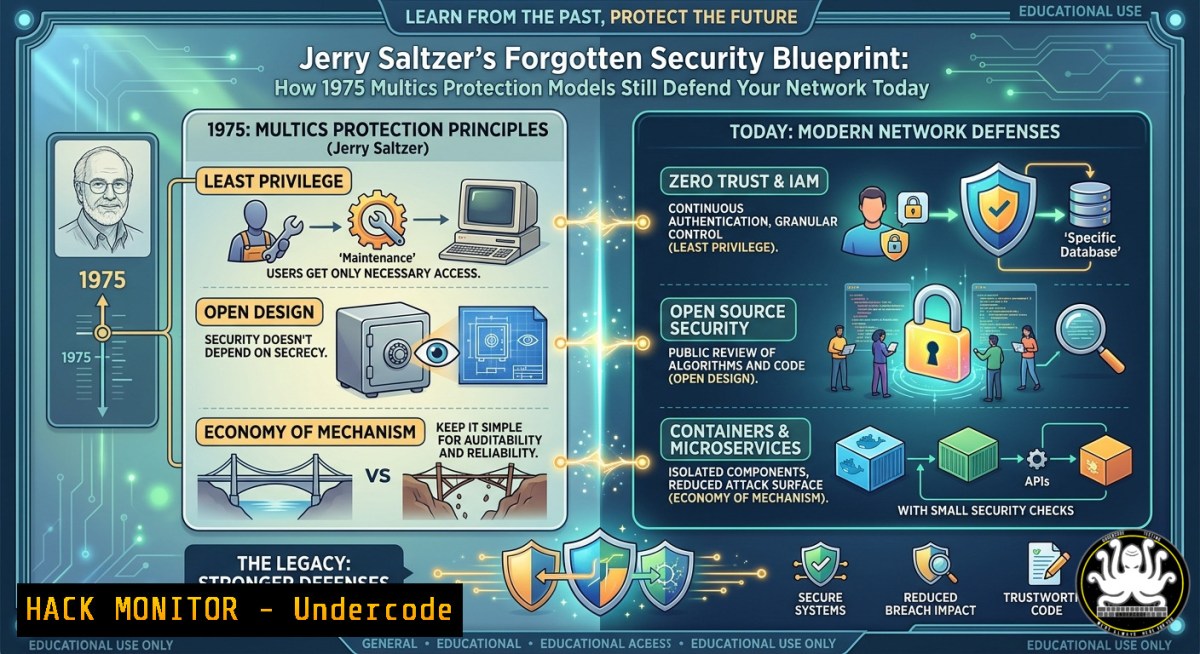
In 1975, long before cloud breaches and ransomware dominated headlines, MIT’s Jerry Saltzer and Michael Schroeder published The Protection of Information in Computer Systems—a paper that defined foundational security design principles still embedded in every modern operating system and distributed architecture. Saltzer’s work on Multics protection rings, authentication subsystems, and the end‑to‑end principle shaped how we isolate processes, verify identities, and architect resilient networks. Understanding these principles is not just history—it is a practical blueprint for hardening systems against today’s most persistent threats.
Learning Objectives:
- Apply Saltzer & Schroeder’s eight design principles (economy of mechanism, fail‑safe defaults, complete mediation, etc.) to real‑world access control and privilege management.
- Deploy and configure Kerberos authentication, the direct legacy of MIT’s Project Athena, on both Linux and Windows environments.
- Use the end‑to‑end principle to evaluate security boundaries in API gateways, zero‑trust networks, and cloud infrastructure.
- Implement process isolation and ring‑based protection using Linux capabilities and Windows integrity levels.
You Should Know:
- Multics Ring Protection: From Hardware Rings to Linux Capabilities
Multics introduced a ring‑based protection model (rings 0 to 7) where lower rings had more privileges—a direct ancestor of x86 protection rings and modern container security. Saltzer’s kernel organization ensured that process switching and inter‑ring calls were strictly mediated. Today, Linux uses a simplified two‑ring model (user vs. kernel) but augments it with capabilities (e.g., CAP_SYS_ADMIN, CAP_NET_RAW) to grant fine‑grained privileges without full root access.
Step‑by‑step guide: inspecting and managing Linux capabilities
This process helps you apply “complete mediation” (Saltzer’s principle) by auditing which processes hold dangerous capabilities.
1. List capabilities for a running process
`getpcaps
Example: `getpcaps 1234`
2. View file‑based capabilities (executables that gain privileges)
`getcap -r /usr/bin 2>/dev/null` – Recursively list capabilities on binaries.
3. Remove a dangerous capability from a binary
`sudo setcap -r /usr/bin/ping` – Removes `CAP_NET_RAW` from ping (mitigates abuse).
4. Assign minimal capability (principle of least privilege)
`sudo setcap cap_dac_read_search+ep /opt/myapp` – Grants only read‑search on files.
Windows equivalent: Use `icacls` and integrity levels (Low, Medium, High, System) to enforce Mandatory Integrity Control (MIC). Check process integrity:
`wmic process where name=”cmd.exe” get ProcessId,Name,ExecutablePath,CommandLine` then use `whoami /groups` to view integrity level.
2. The Saltzer‑Schroeder Design Principles in Action
Their 1975 paper listed eight principles that remain the gold standard for secure design. Two are most frequently violated: economy of mechanism (keep security simple) and fail‑safe defaults (deny by default). Modern misconfigurations—like permissive CORS policies or default “allow” rules in firewalls—directly contradict these.
Step‑by‑step: auditing a web API for principle violations
1. Check default‑deny on API endpoint
Send an unauthenticated request: `curl -X GET https://api.target.com/user/data`
Expected: 401 Unauthorized. If 200 OK, fail‑safe defaults are broken.
- Test for complete mediation (every access checks authority)
Authenticate, obtain JWT, then alter a parameter (e.g., `userId=1234` touserId=1235).
`curl -H “Authorization: Bearer” https://api.target.com/user/1235`
If another user’s data returns, the system fails to mediate each access.3. Apply separation of privilege – ensure two distinct factors are needed for critical actions.
Simulate: require both a valid admin token and a time‑based OTP to delete resources.4. Least privilege check – list all permissions your service account has:
`aws iam list-attached-user-policies –user-name my-service-user
(AWS)</h2>detach‑user‑policy`.
<h2 style="color: yellow;">Remove any that are unnecessary using
3. Kerberos Authentication: Project Athena’s Enduring Legacy
As Technical Director of Project Athena (1984‑1988), Saltzer oversaw the creation of Kerberos—a ticket‑based authentication system that eliminated password transmission over networks. Kerberos remains the backbone of enterprise SSO (Active Directory) and cloud identity (AWS Managed Microsoft AD). Its core components: Authentication Server (AS), Ticket Granting Server (TGS), and client‑server ticket exchange.
Step‑by‑step: set up a minimal Kerberos realm on Ubuntu 22.04
This tutorial replicates the authentication architecture Saltzer championed.
1. Install Kerberos KDC (Key Distribution Center)
`sudo apt install krb5-kdc krb5-admin-server`
2. Configure realm (e.g., `EXAMPLE.COM`). Edit `/etc/krb5kdc/kdc.conf`:
[bash]
EXAMPLE.COM = {
master_key_type = aes256-cts
supported_enctypes = aes256-cts:normal
default_principal_flags = +preauth
}
3. Create the realm database
`sudo krb5_newrealm` – set a strong master password.
4. Add a principal (user)
`sudo kadmin.local -q “addprinc alice”`
- Configure client machine – edit `/etc/krb5.conf` to point to the KDC.
[bash]
default_realm = EXAMPLE.COM
[bash]
EXAMPLE.COM = { kdc = 192.168.1.10 }
6. Obtain a ticket
`kinit alice` – then `klist` to see issued ticket.
Windows (native): Kerberos is built into Active Directory. Check ticket cache with klist. Force a ticket renewal: kinit -R.
- End‑to‑End Principle: Why TLS Terminates at the Edge, Not Inside the Cloud
The 1981 Saltzer‑Reed‑Clark paper argued that functions like reliability and security should reside at the endpoints, not in the network core. Today, many architects violate this by terminating TLS inside load balancers or service meshes, creating internal plaintext traffic that violates zero‑trust models. The principle mandates that encryption should persist end‑to‑end—from client to actual application server, not just to the reverse proxy.
Step‑by‑step: implement true end‑to‑end TLS in Kubernetes
- Disable permissive internal TLS termination – remove `ssl‑termination` on ingress controllers.
-
Deploy a service with its own certificate (e.g., using cert‑manager):
`kubectl apply -f certificate.yaml` (annotate service to inject CA). -
Configure mTLS (mutual TLS) between services using Istio or Linkerd.
Example Istio PeerAuthentication:
apiVersion: security.istio.io/v1beta1
kind: PeerAuthentication
metadata: name: default
spec:
mtls:
mode: STRICT
- Verify that traffic inside the cluster is encrypted
`kubectl exec -it— tcpdump -i eth0 -n port 80` – you should see no plaintext HTTP. -
For API security – reject any request that arrives without client‑side TLS validation.
In NGINX: `ssl_verify_client on; ssl_client_certificate /etc/ssl/ca.crt;`
- X Window System Security: The Forerunner of GUI Isolation
Under Saltzer’s direction, Project Athena helped deploy the X Window System. X11’s security model—based on `xhost` and xauth—introduced per‑display access control, a primitive form of session isolation. Modern Linux desktops have moved to Wayland, but X11 is still pervasive in legacy environments and penetration testing. Misconfigured X11 servers allow keyloggers and screen capture.
Step‑by‑step: lock down X11 against remote snooping
1. Check current access control
`xhost` – Lists which hosts can connect. If it returns `access control enabled, only authorized clients` plus a list, it’s restrictive.
2. Disable broad `xhost +` (dangerous!):
`xhost -` – Reverts to cookie‑based access only.
3. Use `xauth` to manage magic cookies
`xauth list $DISPLAY` – Shows the current cookie. Never share this file.
- Prevent remote GUI eavesdropping – enforce SSH X11 forwarding with security options:
`ssh -X -o ForwardX11Trusted=no user@remote` – This uses untrusted mode, which blocks many attacks. -
On Windows (WSL2) – restrict X server access to localhost only (e.g., VcXsrv: launch with `-ac` only for debugging, never in production).
-
From RUNOFF to Secure Text Processing: Injecting Validation into Legacy Pipelines
Saltzer contributed to RUNOFF, an early text formatter that influenced `nroff` and roff. While seemingly obsolete, text‑processing pipelines remain a vector for injection attacks (e.g., command injection in `sed` or `awk` scripts). The principle of complete mediation requires validating every input before feeding it into a formatter or interpreter.
Step‑by‑step: sanitizing text pipelines on Linux/Windows
- Identify dangerous pattern – user‑supplied string passed to
sed -e.
Example vulnerable command: `sed -e “s/$USER_INPUT/foo/g” file.txt`
- Mitigation: use `printf “%q”` to escape special characters
`safe_input=$(printf “%q” “$USER_INPUT”)`
3. Alternative: use `awk` with literal matching
`awk -v pat=”$USER_INPUT” ‘index($0, pat)’ file.txt` – `index()` does not interpret regex.
- Windows PowerShell – avoid `Invoke-Expression` with user input. Use parameterized filters:
`Get-Content file.txt | Select-String -SimpleMatch $userInput`
- Apply Saltzer’s “economy of mechanism” – replace a complex sed one‑liner with a simple, auditable Python script that escapes all input.
What Undercode Say:
- Key Takeaway 1: Jerry Saltzer’s 1975 protection model gave us “complete mediation” and “fail‑safe defaults”—principles that every modern access control (from AWS IAM to SELinux) still implements, often incorrectly. Auditing your systems against these 50‑year‑old rules reveals most cloud misconfigurations.
- Key Takeaway 2: The end‑to‑end principle is not just a networking concept—it is a security mandate. Terminating TLS at the load balancer and forwarding plaintext internally violates zero‑trust and exposes data to every internal sniffer. Re‑architecting to mTLS inside the cluster is the direct application of Saltzer’s 1981 insight.
Analysis: Saltzer’s work is often cited but rarely operationalized. For example, many security teams enforce “deny by default” at firewalls but ignore it at the API level (allowing wildcard CORS or default `OPTIONS ` responses). Similarly, Kerberos is deployed but misconfigured (weak encryption types, no pre‑authentication), exactly the kind of oversight Saltzer warned against. By extracting his original design constraints and translating them into concrete commands—capability dropping, ticket management, pipeline sanitization—practitioners can close gaps that automated scanners miss. The longevity of these principles proves that security is not about chasing novel attacks but about consistently applying fundamental constraints.
Expected Output:
After implementing the above steps, you will have:
- A hardened Linux system where no binary holds unnecessary capabilities (verified via
getcap -r /). - A functional Kerberos realm issuing time‑limited tickets, with clients able to `kinit` and access services without password re‑exposure.
- A Kubernetes cluster where all inter‑service traffic is mTLS encrypted, and any attempt to bypass TLS (e.g., port 80 internally) is blocked by network policy.
- An X11 environment resistant to remote keylogging, using cookie‑based authentication and untrusted forwarding over SSH.
- Text‑processing pipelines that resist command and regex injection through explicit escaping or token‑based matching.
Prediction:
As artificial intelligence agents gain access to operating systems and APIs, Saltzer’s principles will become critical for confining their actions. The same ring‑based protection that separated user from kernel will be applied to isolate AI models from system calls—preventing a compromised model from escalating privileges. Moreover, the end‑to‑end argument will force a rethink of “AI security copilots” that sit in the network path; instead, endpoints will run local guardrails that cannot be bypassed by a tampered network. Finally, Kerberos’s ticket model may see a revival in federated identity for AI agents, where each agent receives a short‑lived, auditable ticket bound to a specific task—bringing Saltzer’s 1970s vision into the age of autonomous systems.
▶️ Related Video (78% Match):
🎯Let’s Practice For Free:
IT/Security Reporter URL:
Reported By: Sdalbera Born – Hackers Feeds
Extra Hub: Undercode MoN
Basic Verification: Pass ✅


