Listen to this Post
Introduction:
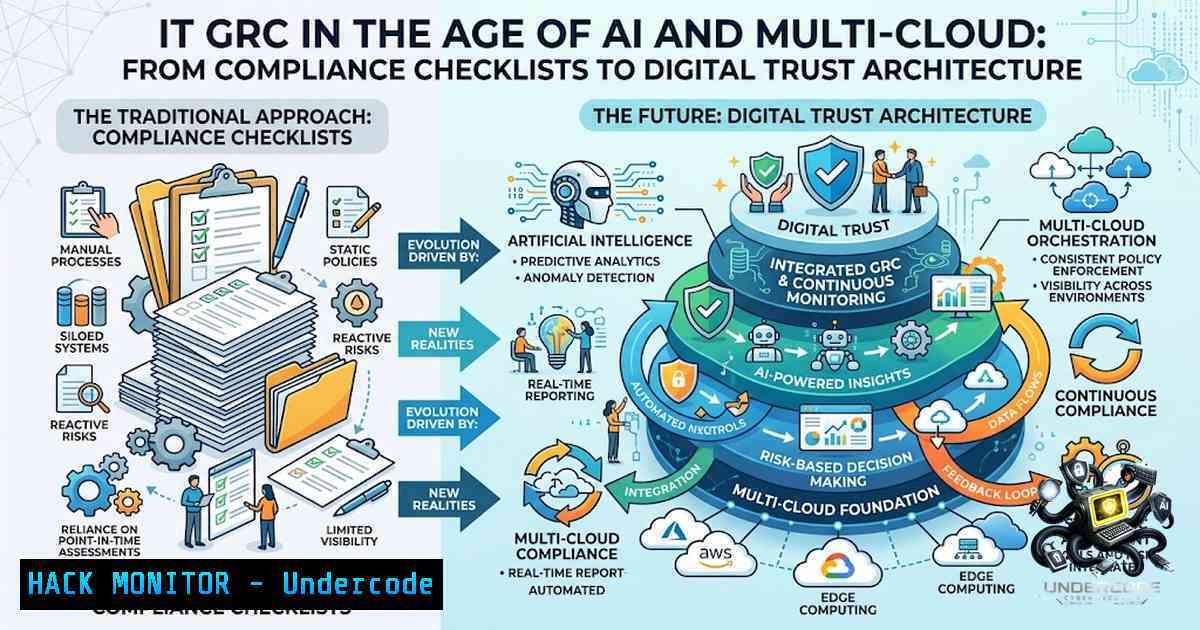
In today’s hyper-connected digital ecosystem, IT Governance, Risk, and Compliance (GRC) has transcended its traditional role as a back-office function of policies, audits, and checklists. It has become the foundational architecture for building and sustaining digital trust—the currency that determines whether customers, partners, and regulators will engage with an organization. As organizations aggressively adopt AI, cloud platforms, and interconnected digital ecosystems, GRC must evolve into a strategic enabler that connects business objectives with technology risk and compliance outcomes. This article provides a technical deep-dive into modern IT GRC, offering actionable frameworks, command-line tools, and configuration guides to operationalize governance, risk management, and compliance across hybrid and multi-cloud environments.
Learning Objectives:
- Objective 1: Understand the interconnected pillars of modern IT GRC—Governance, Risk Management, and Compliance—and how they converge to enable better decision-making and operational resilience.
- Objective 2: Master the practical implementation of GRC controls across Linux, Windows, and cloud environments using native tools and open-source frameworks.
- Objective 3: Learn how to integrate AI governance (ISO/IEC 42001), third-party risk management (TPRM), and continuous compliance monitoring into a unified GRC program.
You Should Know:
- Operationalizing the Three Pillars: Governance, Risk, and Compliance
Modern IT GRC rests on three interconnected pillars that must function as a cohesive system rather than isolated workstreams.
- Governance aligns technology decisions with business objectives, establishes accountability, and ensures AI readiness. It defines decision rights, policies, and the strategic direction for technology investments.
- Risk Management involves identifying, assessing, and mitigating cyber, data, AI, third-party, cloud, and operational risks. This requires continuous monitoring and dynamic risk scoring.
- Compliance is the continuous process of mapping regulatory requirements (GDPR, HIPAA, PCI DSS, etc.) to technical controls, gathering evidence, testing controls, and remediating gaps.
The real value emerges when these three pillars work together, resulting in better decision-making, lower risk exposure, faster audit readiness, stronger third-party oversight, greater operational resilience, and, ultimately, stronger digital trust.
Step‑by‑Step Guide: Implementing a Unified GRC Control Framework
This guide walks you through establishing a foundational GRC program using a combination of policy definition, technical controls, and automated monitoring.
Step 1: Define Your Governance Framework
Select and adopt a primary governance framework. COBIT 2019 is widely used for aligning IT governance with business strategy. Document your organization’s IT strategy, decision rights, and accountability structures. Create a RACI (Responsible, Accountable, Consulted, Informed) matrix for all key technology decisions.
Step 2: Establish a Risk Register
Create a centralized risk register that catalogs all identified risks, their likelihood, impact, and mitigation status. Use the FAIR (Factor Analysis of Information Risk) model to quantify risk in financial terms.
Step 3: Map Compliance Requirements to Controls
Identify all applicable regulatory and industry standards (e.g., ISO 27001, NIST CSF, PCI DSS). Map each requirement to specific technical and administrative controls. Tools like CISO Assistant can automate this mapping across 90+ frameworks.
Step 4: Implement Technical Controls
Deploy the following technical controls across your infrastructure:
Linux (Ubuntu/RHEL):
 Harden SSH configuration
sudo sed -i 's/PermitRootLogin prohibit-password/PermitRootLogin no/' /etc/ssh/sshd_config
sudo sed -i 's/PasswordAuthentication yes/PasswordAuthentication no/' /etc/ssh/sshd_config
sudo systemctl restart sshd

Implement file integrity monitoring with AIDE
sudo apt-get install aide  Debian/Ubuntu
sudo yum install aide  RHEL/CentOS
sudo aideinit
sudo aide --check

Configure auditd for security event logging
sudo auditctl -w /etc/passwd -p wa -k identity
sudo auditctl -w /etc/sudoers -p wa -k sudoers
sudo auditctl -e 1
Windows (PowerShell as Administrator):
 Enforce strong password policies
Set-ADDefaultDomainPasswordPolicy -Identity "yourdomain.com" -MinPasswordLength 12 -ComplexityEnabled $true -LockoutThreshold 5

Enable Windows Defender real-time protection
Set-MpPreference -DisableRealtimeMonitoring $false

Configure advanced audit policy
auditpol /set /subcategory:"Logon" /success:enable /failure:enable
auditpol /set /subcategory:"Object Access" /success:enable /failure:enable

Enforce BitLocker encryption
Manage-bde -on C: -RecoveryPassword -SkipHardwareTest
Step 5: Automate Evidence Collection
Deploy a GRC automation platform (e.g., Vanta, Drata, or open-source Probo) to continuously collect evidence from your tech stack. Configure integrations with AWS, Azure, GCP, identity providers, and SIEM tools to automate control testing and evidence gathering.
Step 6: Establish Continuous Monitoring
Implement a continuous monitoring program using:
- CSPM (Cloud Security Posture Management) tools to monitor cloud configurations against CIS benchmarks
- SIEM solutions for real-time threat detection
- Vulnerability scanners (e.g., OpenVAS, Nessus) for regular infrastructure scanning
- AI Governance: Implementing ISO/IEC 42001 for Responsible AI
As AI systems proliferate, organizations must govern them with the same rigor as traditional IT systems. ISO/IEC 42001:2023 is the first international standard specifically designed to establish, implement, maintain, and continuously improve an AI Management System (AIMS).
Step‑by‑Step Guide: Building an AI Governance Program
Step 1: Establish AI Governance Structure
Define roles and responsibilities for AI oversight. Assign an AI Governance Lead responsible for policy development, risk assessment, and compliance monitoring. Document AI objectives with measurement plans.
Step 2: Conduct AI Risk and Impact Assessments
Perform AI risk assessments (Clause 6.1.2) and AI system impact assessments (Clause 6.1.4) for all AI systems. Assess risks related to:
– Data quality and bias
– Model explainability and transparency
– Human oversight and accountability
– Security and privacy
Step 3: Implement AI Controls (Annex A)
ISO 42001 includes 38 controls across various domains. Key controls include:
– A.7 Transparency: Disclose AI capabilities and limitations to users and affected individuals
– A.8 Use of AI Systems: Establish acceptable use policies, verify intended use, implement human oversight, and maintain decision records
Step 4: Continuous AI Monitoring
Implement MLOps practices that include:
- Model performance monitoring
- Drift detection (data and concept drift)
- Bias and fairness monitoring
- Automated alerting for model degradation
Example: Monitoring AI Model Drift with Python
import pandas as pd
from scipy.stats import ks_2samp

Load reference and current datasets
reference_data = pd.read_csv('reference_data.csv')
current_data = pd.read_csv('current_data.csv')

Perform Kolmogorov-Smirnov test for feature drift
for col in reference_data.columns:
ks_stat, p_value = ks_2samp(reference_data[bash], current_data[bash])
if p_value < 0.05:
print(f"Significant drift detected in feature: {col}")
- Third-Party Risk Management (TPRM): Securing the Extended Enterprise
Organizations increasingly rely on third-party vendors, making TPRM a critical GRC component. Regulators expect continuous oversight, including live monitoring, due diligence, concentration risk management, and tested exit plans.
Step‑by‑Step Guide: Implementing a TPRM Program
Step 1: Vendor Inventory and Tiering
Create a comprehensive inventory of all third-party vendors. Tier vendors based on:
– Data sensitivity and access level
– Criticality to business operations
– Regulatory impact
Step 2: Risk-Based Due Diligence
Conduct risk-based due diligence for all vendors. For high-risk vendors, perform:
– Cybersecurity audits
– Evidence of compliance with relevant frameworks (ISO 27001, SOC 2, etc.)
– Financial stability assessment
Step 3: Continuous Monitoring
Implement continuous monitoring of vendor security posture:
- Regular security scorecard reviews
- Automated vulnerability scanning of vendor-facing systems
- Monitoring of vendor security incidents and breaches
Step 4: Contractual Safeguards
Ensure all vendor contracts include:
- Data protection and privacy clauses
- Right-to-audit provisions
- Incident notification and response requirements
- Exit and data return/ destruction terms
4. Cloud Security GRC: Hardening Multi-Cloud Environments
With organizations operating across AWS, Azure, and GCP, cloud security GRC requires a unified approach. Across these platforms, there are approximately 40,000 different permissions that can be granted, making least-privilege access a critical control.
Step‑by‑Step Guide: Implementing Cloud GRC Controls
Step 1: Establish Cloud Governance
Deploy AWS Control Tower, Azure Policy, or Google Cloud Organization Policy to enforce governance at scale. Define:
– Service control policies (SCPs) restricting allowed services and regions
– Tagging policies for resource classification and cost tracking
– Encryption requirements for data at rest and in transit
Step 2: Implement Cloud Security Posture Management (CSPM)
Deploy CSPM tools to continuously monitor cloud configurations against benchmarks:
– CIS AWS Benchmarks (v1.4, v1.5, v4.0)
– CIS Azure Benchmarks
– CIS GCP Benchmarks
Example: AWS CLI Command to Check S3 Bucket Public Access
 List all S3 buckets
aws s3 ls

Check bucket public access block configuration
aws s3api get-public-access-block --bucket your-bucket-1ame

Enable block public access for all buckets (enforce at organization level)
aws organizations create-policy --1ame "BlockS3PublicAccess" \
--content '{"Version":"2012-10-17","Statement":[{"Effect":"Deny","Action":"s3:PutBucketPublicAccessBlock","Resource":""}]}' \
--type "SERVICE_CONTROL_POLICY"
Example: Azure CLI Command to Enforce Encryption
 Enable Azure Defender for all subscriptions
az security auto-provisioning-setting create --1ame "default" --auto-provision "On"

Enforce encryption for storage accounts
az storage account create --1ame mystorageaccount --resource-group myresourcegroup \
--encryption-services blob --https-only true

Check Azure Policy compliance
az policy state list --resource-group myresourcegroup --query "[?complianceState=='NonCompliant']"
Step 3: Implement Identity and Access Management (IAM)
Enforce least-privilege access using:
- AWS IAM with fine-grained policies
- Azure AD with Conditional Access policies
- GCP IAM with predefined and custom roles
Example: AWS IAM Policy for Least Privilege
{
"Version": "2012-10-17",
"Statement": [
{
"Effect": "Allow",
"Action": [
"s3:GetObject",
"s3:PutObject"
],
"Resource": "arn:aws:s3:::my-application-bucket/",
"Condition": {
"StringEquals": {
"aws:SourceIp": "192.168.1.0/24"
}
}
}
]
}
Step 4: Continuous Compliance Monitoring
Integrate your GRC platform with cloud providers to automate evidence collection and continuous compliance monitoring.
5. GRC Automation: Tools and Open-Source Solutions
Automation is essential for scaling GRC programs. Several open-source and commercial tools can streamline governance, risk, and compliance workflows.
Open-Source GRC Tools:
- CISO Assistant: A comprehensive GRC platform supporting 90+ frameworks with auto-mapping capabilities (NIST CSF, ISO 27001, SOC 2, PCI DSS, etc.)
- Probo: A self-hostable GRC platform covering risk identification, control tracking, vendor risk, data privacy, access reviews, and audit programs
- AuditSym: An offline-first GRC platform with integrated AI for NIST CSF 2.0, ISO 27001, CIS Controls v8, and COBIT audits, featuring a remediation hub
Deployment Guide: Setting Up CISO Assistant
 Clone the repository
git clone https://github.com/datsproject/ciso.git
cd ciso

Deploy using Docker Compose
docker-compose up -d

Access the web interface at http://localhost:8080
 Default credentials: admin / admin (change immediately)

Configure framework mappings
 Navigate to Admin > Frameworks > Import Framework
 Upload NIST CSF 2.0, ISO 27001, or other framework definitions
What Undercode Say:
- Key Takeaway 1: IT GRC is not about creating more controls—it is about creating the right controls, continuously measuring them, and connecting them to business outcomes. The shift from checkbox compliance to strategic digital trust is the defining trend of modern GRC.
- Key Takeaway 2: The convergence of AI, cloud, and third-party ecosystems demands a unified GRC approach. Organizations must treat governance, risk, and compliance as an integrated system rather than siloed functions. ISO 42001 provides the framework for AI governance, while cloud-1ative tools and automation platforms enable scalability across multi-cloud environments.
Analysis:
The post emphasizes that GRC has evolved from a reactive, compliance-focused function to a strategic enabler of digital trust. This evolution is driven by three key factors: (1) the rapid adoption of AI, which introduces new governance challenges around bias, transparency, and accountability; (2) the complexity of multi-cloud environments, which require unified security and compliance controls; and (3) increasing regulatory scrutiny, which demands continuous monitoring and evidence automation. Organizations that treat GRC as a strategic capability—rather than a cost center—will be better positioned to innovate responsibly and build lasting trust with stakeholders. The integration of frameworks like COBIT, ISO 27001, and ISO 42001, combined with automation and AI-powered GRC tools, represents the future of enterprise risk management.
Prediction:
- +1 GRC will become a board-level strategic function, with CIOs and CISOs increasingly reporting directly to the board on GRC metrics and digital trust scores.
- +1 AI-powered GRC platforms will automate 70-80% of compliance evidence collection and control testing by 2028, dramatically reducing audit fatigue and enabling real-time risk visibility.
- -1 Organizations that fail to integrate AI governance (ISO 42001) into their GRC programs will face significant regulatory penalties, reputational damage, and loss of customer trust as AI regulations (e.g., EU AI Act) take effect.
- +1 The convergence of GRC with DevSecOps and MLOps will create new roles—GRC Engineers and AI Governance Specialists—bridging the gap between security, compliance, and development teams.
- -1 The complexity of managing GRC across an average of 50+ third-party vendors and multiple cloud providers will overwhelm organizations without automated GRC platforms, leading to increased breach risk and compliance failures.
- +1 Standardization of GRC frameworks (NIST CSF 2.0, ISO 27001:2022, ISO 42001) will enable better interoperability and data exchange between GRC tools, reducing integration costs and improving risk intelligence sharing.
▶️ Related Video (76% Match):
🎯Let’s Practice For Free:
🎓 Live Courses & Certifications:
Join Undercode Academy for Verified Certifications
🚀 Request a Custom Project:
Secure, high-velocity infrastructure and disruptive technological engineering. Contact our engineering team for high-tier development and proprietary systems:
[email protected]
💎 Smart Architecture | 🛡️ Secure by Design | ⭐ Trusted by Thousands
IT/Security Reporter URL:
Reported By: Kulbhushan Upadhyay – Hackers Feeds
Extra Hub: Undercode MoN
Basic Verification: Pass ✅


