Listen to this Post
Introduction
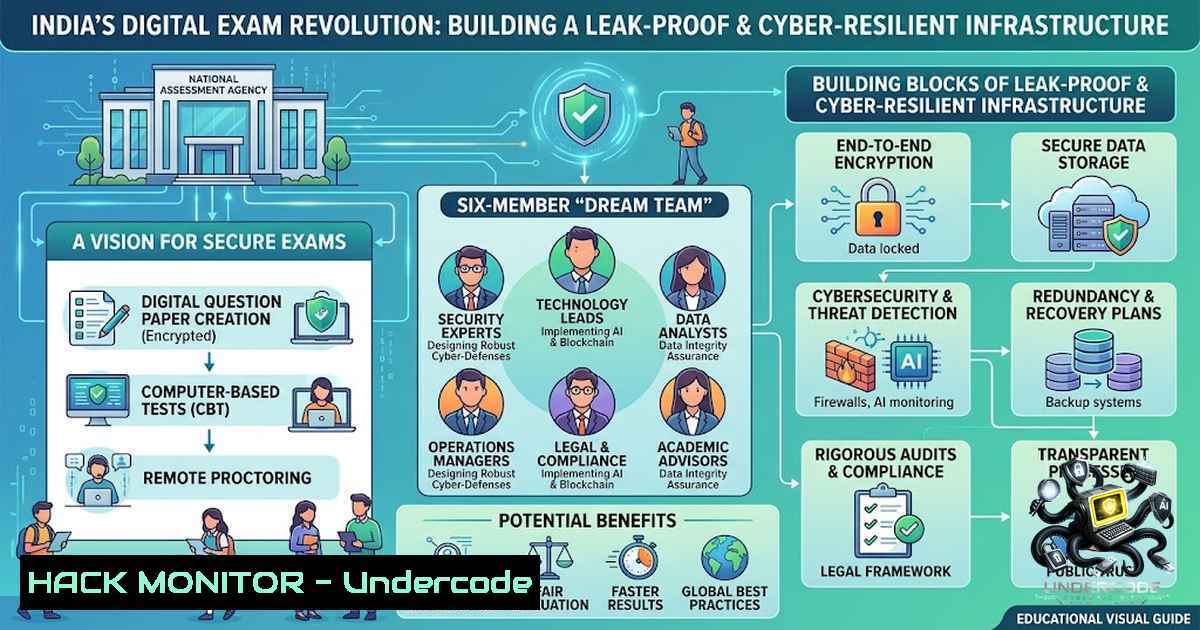
India’s examination system stands at a critical inflection point. Following the NEET-UG 2026 paper leak controversy—which triggered nationwide student protests and the resignation of the Union Education Minister—the government has assembled a six-member high-powered task force led by Infosys co-founder and Aadhaar architect Nandan Nilekani. The panel’s mandate: reimagine mass examinations through a Digital Public Infrastructure (DPI)-scale framework that merges space-grade reliability, AI-driven security, and intelligence-led anti-fraud mechanisms. But can any system—digital or otherwise—truly eliminate leaks when 2.2 million candidates sit for a single test like NEET? This article dissects the technical architecture, cybersecurity challenges, and operational realities of building a leak-proof national examination ecosystem.
Learning Objectives
- Understand the core components of an AI-powered digital examination system, including encrypted question banks, randomized question generation, and AI proctoring
- Identify the cybersecurity threat vectors specific to high-stakes computer-based testing at national scale
- Learn practical commands and configurations for securing examination infrastructure across Linux, Windows, and cloud environments
- Evaluate the feasibility of DPI-level scalability for examinations serving over 20 lakh candidates simultaneously
You Should Know
- The Technical Architecture of a Leak-Proof Digital Examination System
The task force’s proposed framework draws inspiration from three distinct domains: Nilekani’s DPI expertise (Aadhaar, UPI), Somanath’s zero-error space systems (ISRO), and Kamakoti’s cybersecurity acumen (IIT Madras). The result is a multi-layered architecture designed to eliminate single points of failure.
Encrypted Digital Question Banks with Randomized Generation
The first line of defense is removing human paper setters entirely. Following the model of the US Educational Testing Service (ETS), the system would maintain a centralized, encrypted question bank where items are stored in cryptographically protected databases. During examination delivery, a randomization algorithm generates unique question sequences for each candidate, making screen-sharing or local server hacks ineffective.
Practical Implementation – Database Encryption (PostgreSQL with AES-256):
-- Enable pgcrypto extension for AES encryption
CREATE EXTENSION IF NOT EXISTS pgcrypto;

-- Encrypt question bank table
CREATE TABLE encrypted_question_bank (
id SERIAL PRIMARY KEY,
question_text BYTEA NOT NULL, -- Encrypted with AES-256
options BYTEA NOT NULL,
correct_answer BYTEA NOT NULL,
topic_hash BYTEA,
difficulty_score INTEGER,
created_at TIMESTAMP DEFAULT NOW()
);

-- Insert encrypted question
INSERT INTO encrypted_question_bank (question_text, options, correct_answer)
VALUES (
pgp_sym_encrypt('What is the product of 12 and 15?', 'master_key_2026'),
pgp_sym_encrypt('["180","170","190","160"]', 'master_key_2026'),
pgp_sym_encrypt('A', 'master_key_2026')
);

-- Decrypt for delivery (server-side only)
SELECT
pgp_sym_decrypt(question_text, 'master_key_2026') AS question,
pgp_sym_decrypt(options, 'master_key_2026') AS options
FROM encrypted_question_bank
WHERE id = 12345;
Time-Locked Delivery and Geo-Fencing
Question papers must be accessible only at predefined times and physical locations. This requires NTP-synchronized cryptographic locks and GPS-based access controls.
Linux NTP Hardening for Exam Servers:
 Install and configure NTP with hardened parameters
sudo apt-get install ntp secsipid

Restrict NTP to authorized exam centre subnets
echo "restrict 10.0.0.0 mask 255.0.0.0 nomodify notrap" >> /etc/ntp.conf
echo "restrict 192.168.0.0 mask 255.255.0.0 nomodify notrap" >> /etc/ntp.conf

Enable NTP authentication to prevent time spoofing
echo "enable auth" >> /etc/ntp.conf
echo "keys /etc/ntp.keys" >> /etc/ntp.conf

Generate symmetric keys for NTP authentication
sudo ntp-keygen -M -1 -T 10

Restart NTP service
sudo systemctl restart ntp
sudo systemctl enable ntp
Windows PowerShell – Geo-Fencing with IP Restriction:
 Restrict exam application access to authorized centre IP ranges
New-1etFirewallRule -DisplayName "ExamCentreAccess" `
-Direction Inbound `
-Protocol TCP `
-LocalPort 443,8443 `
-RemoteAddress "10.0.0.0/8","192.168.0.0/16" `
-Action Allow

 Block all other IPs
New-1etFirewallRule -DisplayName "BlockOtherAccess" `
-Direction Inbound `
-Protocol TCP `
-LocalPort 443,8443 `
-Action Block
- AI Proctoring and Biometric Authentication: Promise vs. Vulnerability
AI proctoring models analyze candidates’ gaze, head movement, browser activity, and keyboard patterns to flag suspicious behavior. The NTA has already piloted Aadhaar-based facial authentication at select NEET centres in Delhi, with plans for nationwide rollout from 2026. However, these systems introduce new attack surfaces.
Threat Vectors in AI Proctoring:
- Adversarial Attacks: Attackers can inject adversarial content into user messages or external data streams to confuse AI models
- Training-Time Poisoning: Malicious actors could manipulate training data to create blind spots in proctoring algorithms
- Inference-Time Exploitation: Attackers can exploit inference infrastructure to bypass detection
- Agentic AI Cheating: Advanced AI agents can now plan, adapt, and execute multi-step attacks—bypassing browser lockdowns, identity checks, and proctoring systems without human intervention
Mitigation – AI Red-Teaming Framework:
 Automated adversarial testing for proctoring models
import torch
import torch.nn as nn
from captum.attr import FGSM

def test_adversarial_robustness(model, test_data, epsilon=0.01):
"""
Evaluate proctoring model against FGSM adversarial attacks
"""
fgsm = FGSM(model)
attack_success = 0
total = len(test_data)

for images, labels in test_data:
 Generate adversarial examples
adv_images = fgsm.perturb(images, labels, epsilon=epsilon)

Test model robustness
with torch.no_grad():
original_pred = model(images)
adv_pred = model(adv_images)

if torch.argmax(original_pred) != torch.argmax(adv_pred):
attack_success += 1

return f"Adversarial vulnerability: {attack_success/total100:.2f}%"

Log results to security audit system
print(f"[bash] {test_adversarial_robustness(proctoring_model, test_loader)}")
- Securing the Infrastructure: From Exam Centres to Cloud Backends
The scale of NEET—2.2 million candidates in a single sitting—demands infrastructure comparable to a national DPI. The task force must address power outages, connectivity failures, and hardware malfunctions at ground zero.
Zero-Error Process Design (ISRO Model)
Former ISRO Chairman S Somanath brings expertise in building near-perfect, zero-error processes. His recommendations include redundant safety layers and multi-verification checkpoints at every stage—from question paper preparation to result declaration.
Implementation – Multi-Layer Verification Script (Linux):
!/bin/bash
 Zero-error verification script for exam centre readiness

LOG_FILE="/var/log/exam_centre_audit.log"
TIMESTAMP=$(date '+%Y-%m-%d %H:%M:%S')

Layer 1: Hardware verification
echo "[$TIMESTAMP] LAYER 1: Hardware Verification" >> $LOG_FILE
for workstation in $(cat /etc/exam_centres/workstations.list); do
ping -c 1 -W 2 $workstation > /dev/null 2>&1
if [ $? -1e 0 ]; then
echo "CRITICAL: Workstation $workstation unreachable" >> $LOG_FILE
exit 1
fi
done

Layer 2: Network isolation check
echo "[$TIMESTAMP] LAYER 2: Network Isolation" >> $LOG_FILE
iptables -L -1 -v | grep "DROP" | grep "10.0.0.0" > /dev/null
if [ $? -1e 0 ]; then
echo "CRITICAL: Network isolation rules not applied" >> $LOG_FILE
exit 1
fi

Layer 3: Database connectivity with encryption
echo "[$TIMESTAMP] LAYER 3: Encrypted Database Connection" >> $LOG_FILE
psql "host=exam-db.central.gov.in dbname=exam_db user=exam_user sslmode=require" -c "SELECT 1" > /dev/null 2>&1
if [ $? -1e 0 ]; then
echo "CRITICAL: Database connection failed" >> $LOG_FILE
exit 1
fi

Layer 4: Time synchronization check
echo "[$TIMESTAMP] LAYER 4: Time Sync Check" >> $LOG_FILE
ntpdate -q ntp.central.gov.in | grep "offset" | awk '{print $6}'
if [ $(echo "$offset > 0.1" | bc) -eq 1 ]; then
echo "CRITICAL: Time offset exceeds 100ms" >> $LOG_FILE
exit 1
fi

echo "[$TIMESTAMP] All layers verified - System ready" >> $LOG_FILE
exit 0
Cloud Infrastructure Hardening (AWS/Azure/GCP)
Given the scale, a hybrid cloud approach is inevitable. Here’s a Terraform snippet for securing exam infrastructure:
 Security Group for Exam Application Servers
resource "aws_security_group" "exam_app_sg" {
name = "exam-app-security-group"
description = "Security group for exam application servers"

Allow HTTPS only from authorised exam centre IPs
ingress {
from_port = 443
to_port = 443
protocol = "tcp"
cidr_blocks = ["10.0.0.0/8", "192.168.0.0/16"]
}

Allow SSH only from jump host
ingress {
from_port = 22
to_port = 22
protocol = "tcp"
cidr_blocks = ["203.0.113.0/24"]
}

Block all other traffic
egress {
from_port = 0
to_port = 0
protocol = "-1"
cidr_blocks = ["0.0.0.0/0"]
}
}

Enable VPC Flow Logs for audit trail
resource "aws_flow_log" "exam_vpc_flow_log" {
iam_role_arn = aws_iam_role.flow_log_role.arn
log_destination = aws_cloudwatch_log_group.exam_flow_log.arn
traffic_type = "ALL"
vpc_id = aws_vpc.exam_vpc.id
}
- Insider Threats and Exam Mafia Networks: The Intelligence Dimension
Former Intelligence Bureau chief Tapan Deka brings a unique capability: designing preemptive anti-theft and anti-sabotage mechanisms to ringfence the system against exam-fraud syndicates and insider threats. This involves real-time cyber monitoring, intelligence-led surveillance, and rigorous security audits of examination centres.
Real-Time Threat Monitoring with SIEM Integration:
 Python script for real-time anomaly detection in exam logs
import pandas as pd
from sklearn.ensemble import IsolationForest
import json

def detect_exam_anomalies(log_file_path):
"""
Detect suspicious patterns in exam centre logs using Isolation Forest
"""
 Load logs
logs = pd.read_json(log_file_path, lines=True)

Feature engineering
features = logs[['login_attempts', 'question_access_time',
'ip_changes', 'browser_fingerprint_changes']]

Train Isolation Forest
model = IsolationForest(contamination=0.01, random_state=42)
predictions = model.fit_predict(features)

Flag anomalies
anomalies = logs[predictions == -1]

if len(anomalies) > 0:
alert = {
"severity": "HIGH",
"timestamp": pd.Timestamp.now().isoformat(),
"anomalies": anomalies.to_dict('records'),
"recommendation": "Immediate security audit required"
}
 Send to SIEM
send_to_siem(json.dumps(alert))
return alert
return {"status": "CLEAR"}

Scheduled execution every 5 minutes
if <strong>name</strong> == "<strong>main</strong>":
detect_exam_anomalies("/var/log/exam_centres/centre_audit.log")
Digital Audit Trail and Traceability
Every action creates a cryptographic audit trail, adding traceability and accountability at every stage. This is non-1egotiable for restoring public trust.
Blockchain-Based Audit Trail (Hyperledger Fabric snippet):
// Smart contract for exam audit trail
async function recordExamEvent(ctx, examId, eventType, centreId, timestamp) {
// Verify identity of caller
const clientIdentity = ctx.clientIdentity;
if (!clientIdentity.assertAttributeValue('role', 'exam_administrator')) {
throw new Error('Unauthorized');
}

// Create immutable record
const eventRecord = {
examId: examId,
eventType: eventType,
centreId: centreId,
timestamp: timestamp,
txId: ctx.stub.getTxID(),
creator: clientIdentity.getID()
};

// Store on ledger (immutable)
await ctx.stub.putState(
<code>EXAM_EVENT_${examId}_${timestamp}</code>,
Buffer.from(JSON.stringify(eventRecord))
);

return eventRecord;
}
- The Cost-Benefit Calculus: Infrastructure, Connectivity, and Cyber Risk
While exams like CAT, JEE, and GATE successfully transitioned to CBT, NEET’s scale (2.2 million candidates) makes it a complex, costly, and risky affair. Even developed nations hesitated—the US did not adopt CBT for SATs until 2024, and when they did, they suffered cyber hacks.
Key Infrastructure Requirements for 2.2 Million Candidates:
- Workstations: ~50,000 exam centres × 50 workstations = 2.5 million machines
- Bandwidth: Minimum 10 Mbps per centre = 500 Gbps aggregate
- Power Backup: UPS + diesel generators for every centre
- Redundancy: N+1 configuration across all critical components
Cyber Threat Mitigation Commands:
Linux – DDoS Protection with iptables:
 Rate limiting to prevent DDoS
iptables -A INPUT -p tcp --dport 443 -m state --state NEW -m recent --set
iptables -A INPUT -p tcp --dport 443 -m state --state NEW -m recent --update \
--seconds 60 --hitcount 100 -j DROP

Block common attack patterns
iptables -A INPUT -p tcp --dport 443 -m string --string "POST /exam/submit" \
--algo bm -m limit --limit 10/minute -j ACCEPT
iptables -A INPUT -p tcp --dport 443 -m string --string "POST /exam/submit" \
--algo bm -j DROP
Windows – Advanced Audit Policy for Insider Threat Detection:
 Enable advanced audit policies
auditpol /set /subcategory:"Logon" /success:enable /failure:enable
auditpol /set /subcategory:"File System" /success:enable /failure:enable
auditpol /set /subcategory:"Registry" /success:enable /failure:enable
auditpol /set /subcategory:"Detailed Tracking" /success:enable /failure:enable

Forward logs to central SIEM
wevtutil set-log "Security" /enabled:true /retention:false /maxsize:1073741824
wevtutil set-log "Application" /enabled:true /retention:false /maxsize:1073741824
What Undercode Say
- The “Dream Team” is structurally sound but operationally untested: Nilekani’s DPI experience, Somanath’s zero-error processes, Kamakoti’s cybersecurity expertise, and Deka’s intelligence background create a formidable combination. However, the transition from pen-and-paper to CBT for 2.2 million candidates is unprecedented globally—no country has attempted this at scale.
-
AI is not a silver bullet; it introduces new attack surfaces: AI proctoring, facial authentication, and randomized question generation are powerful tools, but they also create vulnerabilities—adversarial attacks, training data poisoning, and agentic AI cheating. The task force must build red-teaming capabilities and continuous adversarial testing into the system from day one.
-
The infrastructure challenge is the real bottleneck: Cyberattacks are a concern, but power outages, connectivity failures, and hardware malfunctions at ground zero are equally threatening. ISRO-style redundancy and zero-error processes must extend to every exam centre, not just the central systems.
-
Insider threats require intelligence-led, not just technology-led, solutions: Deka’s inclusion is critical because the most sophisticated technical safeguards can be undermined by compromised insiders or organised fraud syndicates. Real-time cyber monitoring, intelligence gathering, and rigorous security audits are essential complements to AI and encryption.
-
Public trust hinges on transparency, not just technology: The digital audit trail and traceability mechanisms are as important as the encryption itself. Without transparent processes and independent oversight, even the most secure system will fail to restore confidence.
Prediction
-1 The transition to a fully digital, AI-proctored examination system for 2.2 million candidates will face significant delays and cost overruns. The infrastructure requirements—power, connectivity, hardware—are orders of magnitude beyond current capabilities, and cyberattacks during the initial rollout are almost certain.
-1 Agentic AI cheating tools will evolve faster than proctoring countermeasures, creating an ongoing arms race that could undermine the system’s credibility in its first few years.
+1 If successfully implemented, India’s digital examination infrastructure could become a global benchmark for secure, large-scale assessments—exportable to other nations facing similar challenges, much like Aadhaar and UPI became global reference models.
+1 The integration of ISRO-style zero-error processes with DPI-scale infrastructure could create a new category of “mission-critical” digital public infrastructure that extends beyond examinations to other high-stakes government services.
+1 The task force’s multidisciplinary composition—spanning technology, security, space, logistics, and education policy—offers a template for solving other complex national challenges that require both technical excellence and systemic integrity.
▶️ Related Video (76% Match):
🎯Let’s Practice For Free:
🎓 Live Courses & Certifications:
Join Undercode Academy for Verified Certifications
🚀 Request a Custom Project:
Secure, high-velocity infrastructure and disruptive technological engineering. Contact our engineering team for high-tier development and proprietary systems:
[email protected]
💎 Smart Architecture | 🛡️ Secure by Design | ⭐ Trusted by Thousands
IT/Security Reporter URL:
Reported By: Bhargavmb Amidst – Hackers Feeds
Extra Hub: Undercode MoN
Basic Verification: Pass ✅


